Volatility Expectations Recede after US-China Trade Truce
S&P 500, Treasury Bond, Gold, and Bitcoin Market Volatility Key Talking Points
- The 90-day US-China tariff truce has reduced expected volatility across major markets
- What could cause stock, bond, commodity, and crypto market volatility to increase or decrease from here?
- Now that volatility has broadly declined, the outlook for volatility is more balanced, with the potential for further trade “deals”, geopolitical hotspots, and the health of the global economy as the key flashpoints to watch
In 1987, the US Army War College introduced the acronym VUCA (Volatility, Uncertainty, Complexity and Ambiguity) as a lens to view challenges and opportunities in an increasingly unclear world. While the term’s application to broader geopolitical strategies is beyond the scope of this article, the indelible link between concepts like uncertainty and ambiguity on volatility is something that any experienced market participant must internalize.
The 90-day ‘tariff truce’ between the US and China has brought a welcome sense of clarity to markets, easing recession fears and leading to a noticeable drop in expected volatility. Even if 10-30% tariffs may still cause major adjustments in global trade and supply chains, the relative clarity and gradualism of the current situation will allow corporations, countries, and investors to adjust to a “new normal” environment in the future.
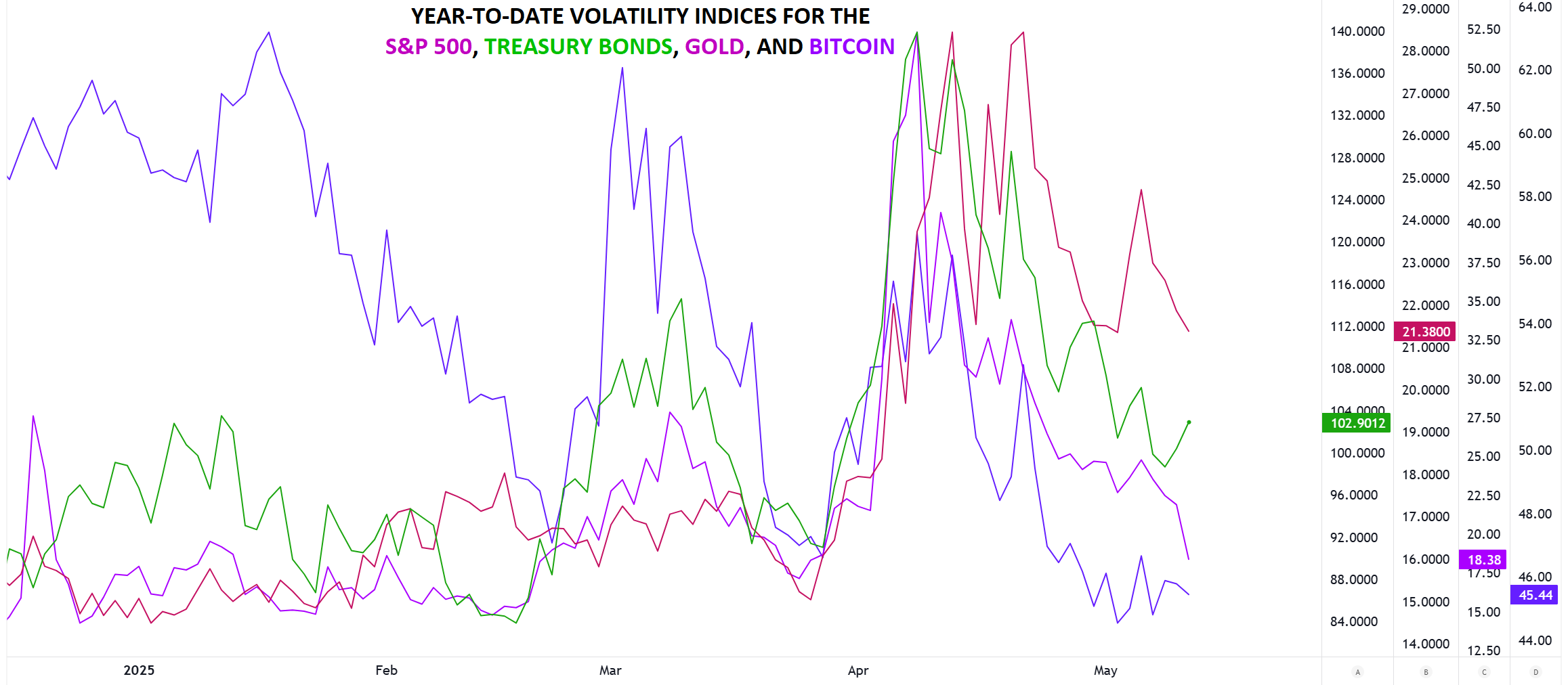
Below, we highlight how anticipated volatility in major markets has evolved so far this year, highlighting relative changes in expected market moves in the stock, bond, currency, and cryptoasset markets:
Source: StoneX, TradingView
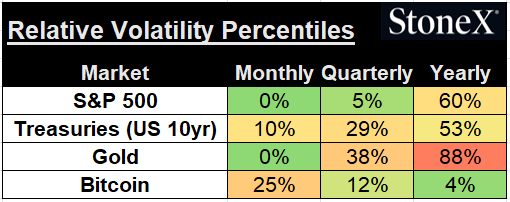
As the table below shows, anticipated volatility in major markets has declined to near the lowest levels we’ve seen in the past month, and all measures of expected volatility have declined below their respective averages of the past quarter after last weekend’s announcement:
Source: StoneX, TradingView
Detailed volatility outlooks for major markets follow:
S&P 500 Volatility Outlook (VIX)
Starting with the stock market, the VIX, Wall Street’s “Fear Gauge” of implied volatility in the S&P 500 sits below 20, down more than two-thirds from the peak near 60 seen in early April. At this level, the VIX suggests that options traders expect daily moves of roughly 1.2% in the S&P 500 and weekly moves of about 2.6%. Compared to the average VIX reading of 19.5 since inception in 1990, stock market volatility is near average.
A stronger-than-expected Q1 earnings season has dampened volatility and fears of a global recession, though the international trade situation remains highly unpredictable, hinting that the risks may be tilted to the upside for stock market volatility in the coming weeks.
Treasury Bond Market Volatility Outlook (MOVE)
Like the stock market, implied volatility in the Treasury bond market has declined sharply in recent weeks as well. With the Fed seemingly on hold for the foreseeable future and the “left tail” of a trade-driven global recession reduced, a period of relatively low volatility looks likely heading into the proverbial summer doldrums.
Gold Market Volatility Outlook (GVZ)
Interestingly given this week’s pullback in the yellow metal, expected moves in the gold market have receded from last month’s historically elevated level.
With fractures emerging in long-maintained geopolitical and trading relationships, volatility in the commodity markets may be nearing a near-term nadir. Gold in particular is enjoying a secular bullish trend – which tends to bring generally lower volatility – amidst a falling US dollar and questions about the US’s position in the global economy.
Crypto Market Volatility Outlook (DVOL)
As in the far more mature stock, bond, and commodity markets, the outlook for Bitcoin volatility remains generally low. Looking back over the last year, the expected volatility for Bitcoin is in just the 4th percentile.
Broadly speaking, volatility in the Bitcoin has generally declined since the blockchain’s “Genesis Block” in 2009. Ultimately, growing acceptance of Bitcoin as an emerging asset class and a maturing set of increasingly institutional investors should continue to push Bitcoin’s volatility lower over time, regardless of US trade policy. A renewed global trade war might accelerate Bitcoin adoption as investors seek alternatives outside traditional finance, potentially leading to even lower volatility.
Last week, we noted that “[e]ven if tariffs remain historically high, traders would benefit from increased clarity, contrasting the unpredictable environment of recent months.” Now that that scenario has played out, the outlook for volatility is more balanced, with the potential for further trade “deals”, the situations in geopolitical hotspots, and the health of the global economy as the key flashpoints to watch moving forward.
Follow the Global Macro Calendar
What are the major events and indicators on tap for the global economy that could charge volatility in markets and reshape deeper fundamental themes? Sign up for the updated Global Macro Calendar updated each week with a two week look ahead of the top events!
Sign Up
-- Written by Matt Weller, Global Head of Research, StoneX Self-Directed