Will Trump Revive Reciprocal Tariffs and Disrupt Seasonal Market Calm?
Seasonal expectations and a light economic docket will seriously curb market expectations over the coming week, but beware thematic threats such as the revival of reciprocal tariffs.
Talking Points:
Historical averages suggest the S&P 500 is looking at a continued slide in liquidity but a further persistence in risk appetite – past performance not indicative of future results
Benchmarks of risk like the S&P 500 are pushing record highs, showing a distinct disregard to systemic threats
Top consideration over the coming week is what President Trump decides to do with Liberation Day tariffs due to come back into effect
Systemic Versus Structural Conditions
High profile event risk can generate dramatic volatility, overtaking or abiding technical levels can tip the scales of sentiment and pure risk appetite can build its own head of steam. However, underlying all of these external drivers and catalysts are the foundational market conditions that we rely on to facilitate market movement. So, while I will be watching the headlines around President Trump’s decision on what to do with trade partners as the 90-day reprieve on the reciprocal tariffs expires, the S&P 500’s course from fresh record highs and top shelf economic event risk; it is the depth of the markets that will be my first consideration in evaluating what potential there is when the catalysts show up.
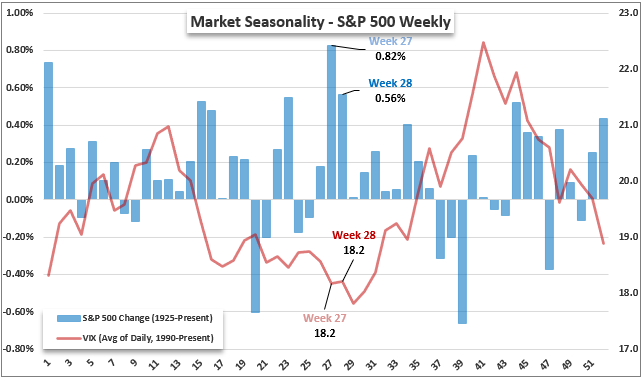
On the seasonal side of this equation, the expectations are strong. While we will have passed the long, holiday Independence holiday in the United States – which one could say seems to be observed by the world given how infrequently volatility shows up during this period – history suggests the 28th week carries with it significant norms of its own. Referring to the S&P 500 as the speculative benchmark, appropriate with that record high, this period has averaged a substantial continuation of the preceding week’s average gain as well as a progression of low volume and further suppression of volatility (VIX).
Chart of S&P 500 Average Weekly Performance and VIX Volatility (From 1925/1990-Present)
Source: John Kicklighter, Standard & Poor’s
Participation Raises Some Eyebrows
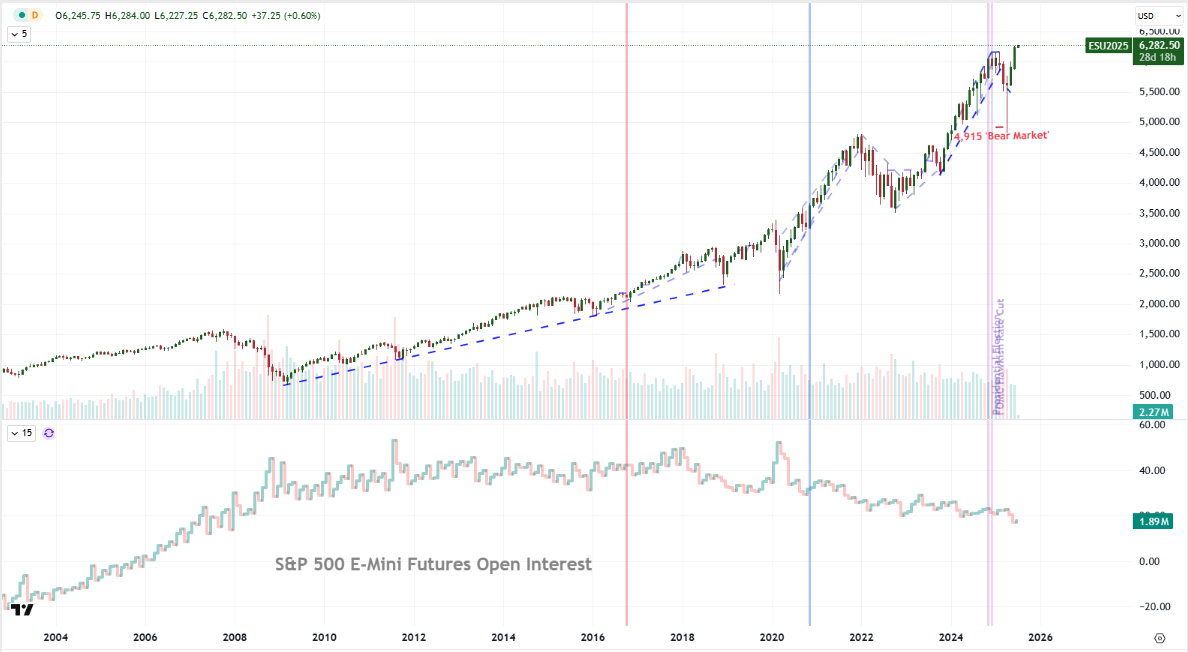
What makes our current situation even more interesting beyond the historical statistical norms are the more structural circumstances present in the markets. The drive to record highs by the benchmark US indices (at last the S&P 500 and Nasdaq 100) is remarkable in the context to the impressive thematic disruptions to the headlines these past few months. Perhaps the most remarkable, anti-cyclical reading though is the steady slide in open interest behind S&P 500 emini futures – one of the most heavily traded speculative products in the world. ‘Participation’ in the market has dropped to its lowest level since December 2007 – before the swell around the Global Financial Crisis. While these kind of conditions can eventually push us to extremes of complacency and set stage for comprehensive and persistent capital reallocation (aka a bear trend); in the interim, it can exacerbate an environment of complacency.
Chart of S&P 500 Emini Futures with Open Interest (Monthly)
Source: John Kicklighter, TradingView, CME
A Light Docket for Traditional Economic Data
Top scheduled event risk over the coming week is noticeably lighter than what we have averaged these past few months. Even compared to this past week where holiday liquidity was a prominent feature of the landscape, we still had the likes of Friday’s nonfarm payrolls to look forward to for volatility – whether or not the liquidity backdrop would represent a reliable foundation for more productive movements.
On the one hand, the week ahead carries strong assumptions around activity as it is one week off the nadir for calendar year volatility with a strong risk-on orientation, but there is no guarantee that we will abide by the historical averages. Further, the lack of commitment to a particular systemic theme amplifies the lack of high-profile data when looking for any level of urgency in the otherwise passive milieu.
Yet, as destined for inactivity as the market may seem moving forward, it is important for participations to consider the scenarios that could upend the norms. Assuming a sudden shift in liquidity is a particularly unmoored and outlier consideration; but monitoring themes for reemergence at least narrows down the field of observation. Event risk as a potential catalyst is even more focused a consideration; and there are particular listings that stand out for capacity should they meet an unexpectedly dramatic outcome.
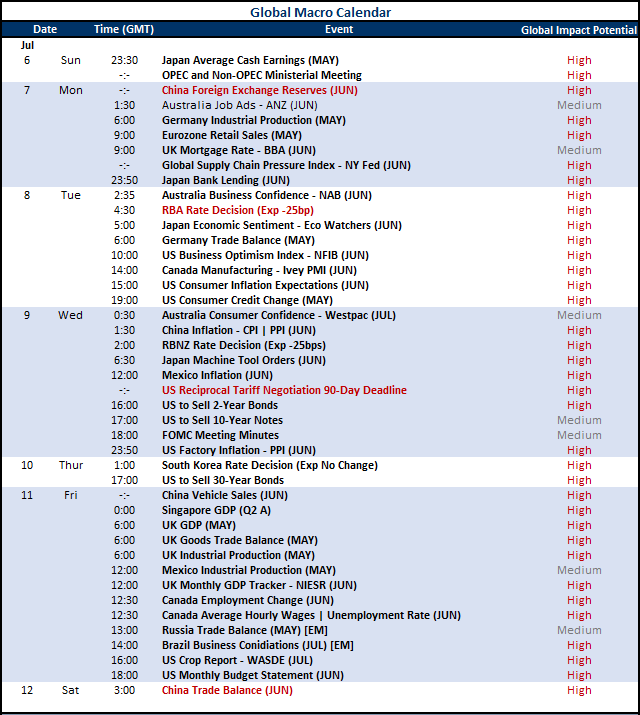
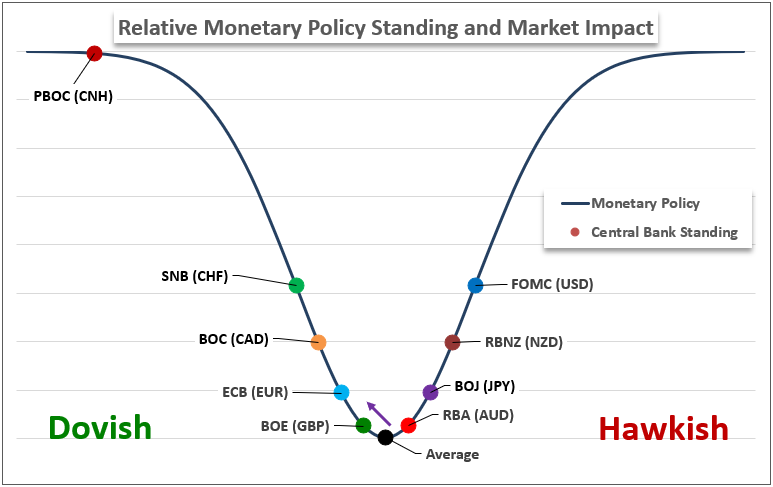
Setting aside macro-relevant updates like Chinese foreign exchange reserves and the New York Fed’s Global Supply Chain Pressure index, the major central bank rate decisions on tap this week carry a more concentrated potency as far as event risk that can translate into tangible market movement. The Reserve Bank of Australia (RBA) is the largest central bank due to deliberate policy this week, and the group is expected to cut its benchmark rate for only the third time this cycle to 3.60 percent (another -25 basis points). That isn’t a big or extended cut policy, but it is notable for a typical ‘carry currency’ in its contrast to the Federal Reserve’s 4.25 percent hold. The same loss of yield capacity extends to the Reserve Bank of New Zealand (RBNZ) which is seen cutting itself -25bp to 3.00 percent the following day.
Relative Monetary Policy Standing
Source: John Kicklighter
President Trump to Decide the Next Move in the Trade War
For top billing in macro terms over the coming week, the greatest threat isn’t a data point in a series. Instead, it is a self-imposed due date by US President Donald Trump. Back in early April, Trump announced a wide range of ‘reciprocal tariffs’ against trade partners intended to counteract perceived systemic trade inequities in a bid to force negotiations in an effort the White House dubbed Liberation Day. Following an abrupt market correction that seemed to signal a global fear over the economic fallout that would result from this action, the administration soon announced a 90 day delay to allow for governments to negotiate with the United States. That timeline would theoretically run through Wednesday July 9th.
And, while President Trump and his team have made some a few outlier remarks about confidence regarding discussion with certain trade partners since; only one tangible deal has been agreed to thus far (Vietnam). What will the President do with the threat of market backlash readily at hand? There is no evidence of a broad deal at hand and he is not known for capitulation. A broad extension would add to uncertainty and add to skepticism and undermine expectations (fear) of conviction, but it would allow markets some degree of relief. Acceptance of terms with some counterparts and reapplication of full tariffs with others would probably result in the most volatile outcome with specific regionalized fall out.
White House Original Liberation Day Reciprocal Tariff Rates
Source: White House
Raising the Issue of Global Economic Activity Before Bigger Releases
Finally, through the end of the week, there is a run of event risk covering regional and thematic considerations such as Canadian employment, US monthly budget numbers and Chinese trade figures (a Saturday release); but there is a general GDP – or broader growth – consideration to be found between Asian and European hours. This is a more important consideration for the recognition of the Chinese quarterly growth update the following week (as an earnest start of the 2Q GDP run), but deference should be given to the advanced 2Q GDP update for Singapore as the first major economy to report Friday morning. While less comprehensive, the UK government’s May GDP reading will represent a more weighty influence int eh global spectrum later in the same session. If there is a trend that starts to emerge of either resilience or deterioration, beware the color it adds to the systemic backdrop for sentiment.
Follow the Global Macro Calendar
What are the major events and indicators on tap for the global economy that could charge volatility in markets and reshape deeper fundamental themes? Sign up for the updated Global Macro Calendar updated each week with a two week look ahead of the top events!
The subsidiaries of StoneX Group Inc. provide financial products and services, including, but not limited to, physical commodities, securities, clearing, global payments, risk management, asset management, foreign exchange, and exchange-traded and over-the-counter derivatives. These financial products and services are offered in accordance with the applicable laws in the jurisdictions in which they are provided and are subject to specific terms, conditions, and restrictions contained in the terms of business applicable to each such offering. Not all products and services are available in all countries. The products and services offered by the StoneX Group of companies involve risk of loss and may not be suitable for all investors. Full Disclaimer. This content is not intended for residents of any particular country, and the information herein is not advice nor a recommendation to trade nor does it constitute an offer or solicitation to buy or sell any financial product or service, by any person or entity in any jurisdiction or country where such distribution or use would be contrary to local law or regulation. Please refer to the Regulatory Disclosure section for entity-specific disclosures. No part of this material may be copied, photocopied or duplicated in any form by any means or redistributed without the prior written consent of StoneX Group Inc. The information herein is provided for informational purposes only. This information is provided on an ‘as-is’ basis and may contain statements and opinions of the StoneX Group of companies as well as excerpts and/or information from public sources and third parties and no warranty, whether express or implied, is given as to its completeness or accuracy. Each company within the StoneX Group of companies (on its own behalf and on behalf of its directors, employees and agents) disclaims any and all liability as well as any third-party claim that may arise from the accuracy and/or completeness of the information detailed herein, as well as the use of or reliance on this information by the recipient, any member of its group or any third party.
Our market expertise, advanced platforms, global reach, culture of full transparency and commitment to our clients’ success all set us apart in the financial marketplace.
Reach
With access to 40+ derivatives exchanges, 180+ foreign exchange markets, nearly every global securities marketplace and numerous bilateral liquidity venues, StoneX’s digital network and deep relationships can take clients anywhere they want to go.
Transparency
As a publicly traded company meeting the highest standards of regulatory compliance in the markets we serve, our financials and track record are matters of public record. StoneX’s commitment to “doing the right thing over the easy thing” sets us apart in the industry and helps us build respect, client trust and new partnerships.
Expertise
From our proprietary Market Intelligence platform to “boots-on-the-ground” expertise from award-winning traders and professionals, we connect our clients directly to actionable insights they can use to make more informed decisions and achieve their goals in the global markets.