StoneX Strategy: The 2% Inflation Target and Powell’s Jackson Hole Problem
From the desk of our senior advisor, Jon Hilsenrath.
Summary: In Jackson Hole, Jerome Powell will likely signal his inclination to accommodate market expectations for a quarter percentage point interest rate cut in September, but limits to how far he can go. Markets have become conditioned during the past quarter century to a dovish Fed and investors remain prone to believing the Fed will go further than it can. Powell will also reaffirm the central bank's commitment to a 2% inflation target in Jackson Hole. As long as the Fed is serious about that commitment, it is constrained. Powell thus faces hard choices. Expect him to take small steps in the mountains of Wyoming.
The 2% Inflation Target and Powell’s Jackson Hole Problem: We have noted in earlier commentary that the Federal Reserve tends to backload decisions for late in the year. Its forecasting cycle – which emphasizes year-end data points – encourages action between September and year-end, often previewed at the Fed’s Jackson Hole meetings in August. Now here we are.
Powell finds himself in an awkward position as he prepares for his final Jackson Hole speech as Fed chairman. Most of his comments Friday will focus on revisions to the central bank’s statement of longer-run goals and monetary policy strategy. The statement’s cornerstone is a commitment to 2% inflation. Powell will reaffirm the commitment and preview changes that signal a slightly more hawkish approach to inflation than the Fed adopted in the secular stagnation era; less emphasis on fighting undershoots of jobs and inflation that were common in the 2000 to 2020 era. Yet, even as inflation trudges above the 2% target that the Fed is about to reaffirm, Powell finds himself laying rhetorical groundwork for the central bank to cut its benchmark interest rate by a quarter percentage point in September.
That is somewhat incoherent: Inflation is too high. A lower policy rate doesn’t reduce it.
The justification for a cut is the employment side of the Fed’s dual mandate; hiring looks materially weaker today than when the central bank decided to remain on hold last month. Powell deeply wants to achieve a soft landing with low inflation and a growing economy as he prepares to leave office next year. The dual mandate – maximum employment and stable prices gives him a legal obligation to try. His tool is to boost demand with a lower interest rate. The market is thus convinced the Fed will cut the fed funds rate by a quarter percentage point in September to just above 4%. Powell appears likely to indicate he’ll deliver on that expectation.
However, because inflation is above target and rising, the Fed chairman needs to prevent investors from getting carried away with how far they think the Fed will go in a campaign to boost employment. He can’t lean toward a half percentage point rate cut in September or a succession of rate cuts in October and December. As much as it frustrates many people, he needs to stay in a mindset of data dependence and meeting-by-meeting decision-making.
A disastrous jobs report could make the Fed more dovish, a disastrous inflation report can turn it hawkish. Such is life when the economy faces stagflation challenges, as now. Powell will thus likely continue to play his cards close to the vest as he proceeds even as he leans toward a September move.
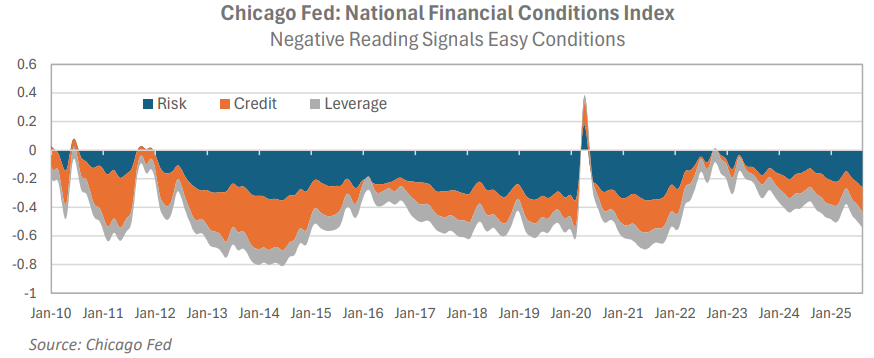
The Fed is prone to making a mistake. One central justification for cutting interest rates – aside from a weakening labor market – is the idea that monetary policy is restrictive: The Fed estimates a neutral interest rate is 3%, while the actual policy rate is 4.3%. Yet financial markets and inflation don’t indicate policy is restrictive at these levels. Inflation’s descent has stopped, stocks prices are rising, spreads on riskier debt are tight, money is pouring into private credit, crypto assets are booming, bank lending is up. In short: Financial markets and the behavior of inflation suggest the neutral rate is higher than Fed officials recognize or acknowledge. It risks over-accommodating.
The Chicago Fed’s National Financial Conditions Index suggests financial conditions are about as accommodative now as they were for much of the 2000-2020 period:
In this moment, Powell’s prevailing nightmare is a negative print in a monthly payroll employment report. He would look behind the curve and become the object of blame for stoking recession. Such blame would be unfair, given the effects of forces out of his control – including tariffs and a national immigration crackdown – which are surely affecting demand and hiring. In Jackson Hole he will likely signal a willingness to accommodate, but limits to how far he can go. Markets, having become conditioned during the past quarter century to a dovish Fed and are prone to believing the Fed will go further than it can. As long as it is serious about the 2% inflation target, it is constrained. Powell faces hard choices. Expect him to take small steps in the mountains.
Expert: John Hilsenrath, Senior Advisor
Jon Hilsenrath is Senior Advisor to StoneX Group Inc. He is an independent contractor. Any statements made by Jon are based on his personal views and should not be construed as a recommendation of StoneX Group Inc.
The subsidiaries of StoneX Group Inc. provide financial products and services, including, but not limited to, physical commodities, securities, clearing, global payments, risk management, asset management, foreign exchange, and exchange-traded and over-the-counter derivatives. These financial products and services are offered in accordance with the applicable laws in the jurisdictions in which they are provided and are subject to specific terms, conditions, and restrictions contained in the terms of business applicable to each such offering. Not all products and services are available in all countries. The products and services offered by the StoneX Group of companies involve risk of loss and may not be suitable for all investors. Full Disclaimer. This content is not intended for residents of any particular country, and the information herein is not advice nor a recommendation to trade nor does it constitute an offer or solicitation to buy or sell any financial product or service, by any person or entity in any jurisdiction or country where such distribution or use would be contrary to local law or regulation. Please refer to the Regulatory Disclosure section for entity-specific disclosures. No part of this material may be copied, photocopied or duplicated in any form by any means or redistributed without the prior written consent of StoneX Group Inc. The information herein is provided for informational purposes only. This information is provided on an ‘as-is’ basis and may contain statements and opinions of the StoneX Group of companies as well as excerpts and/or information from public sources and third parties and no warranty, whether express or implied, is given as to its completeness or accuracy. Each company within the StoneX Group of companies (on its own behalf and on behalf of its directors, employees and agents) disclaims any and all liability as well as any third-party claim that may arise from the accuracy and/or completeness of the information detailed herein, as well as the use of or reliance on this information by the recipient, any member of its group or any third party.
© 2026 StoneX Group Inc. all rights reserved.