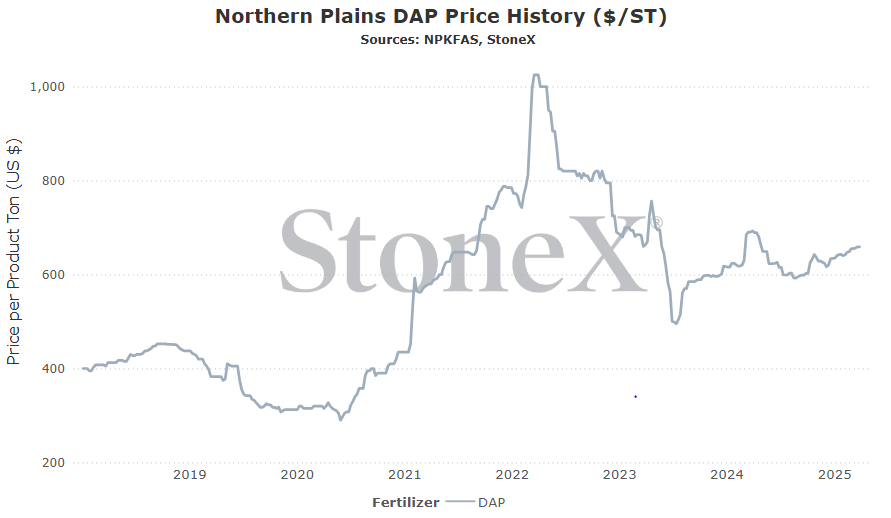
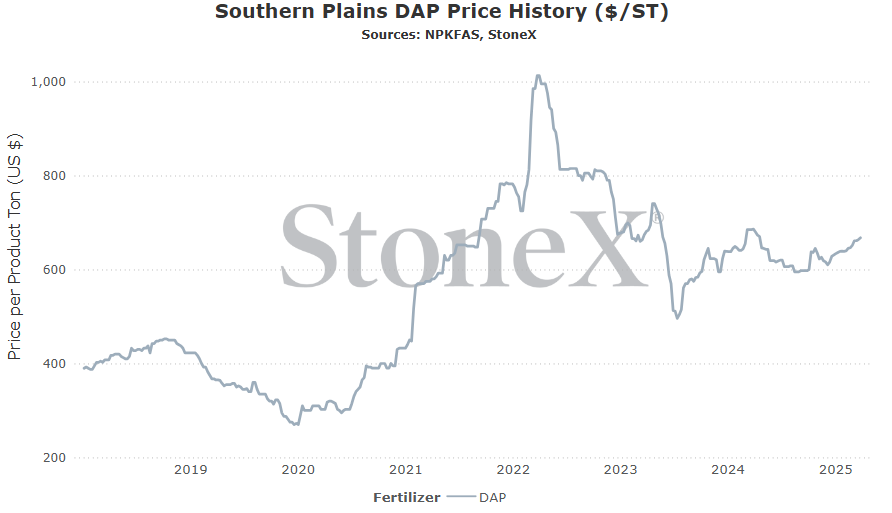
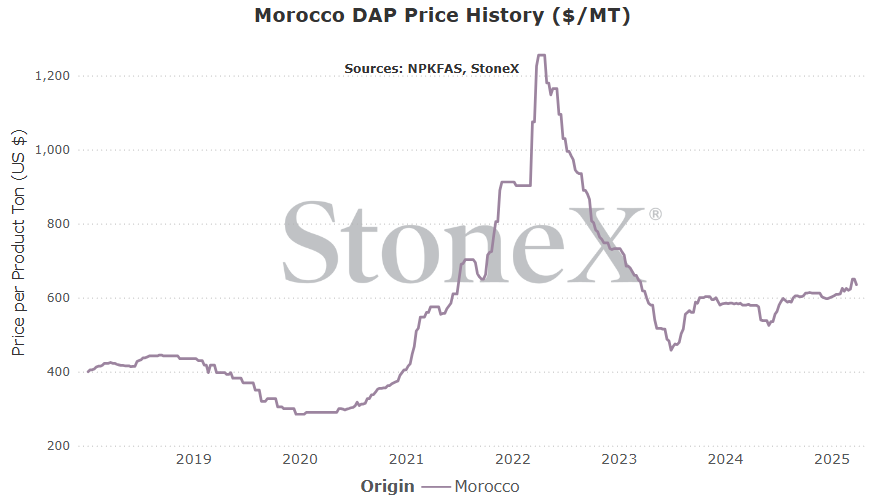
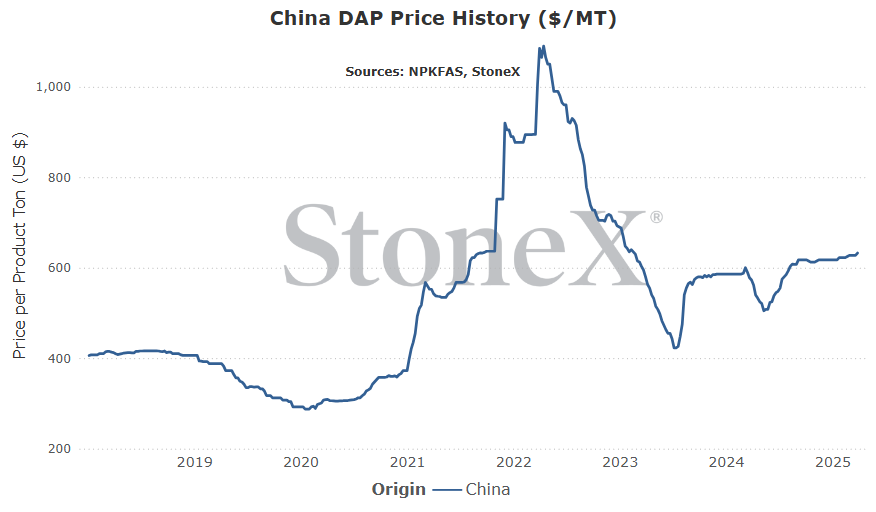
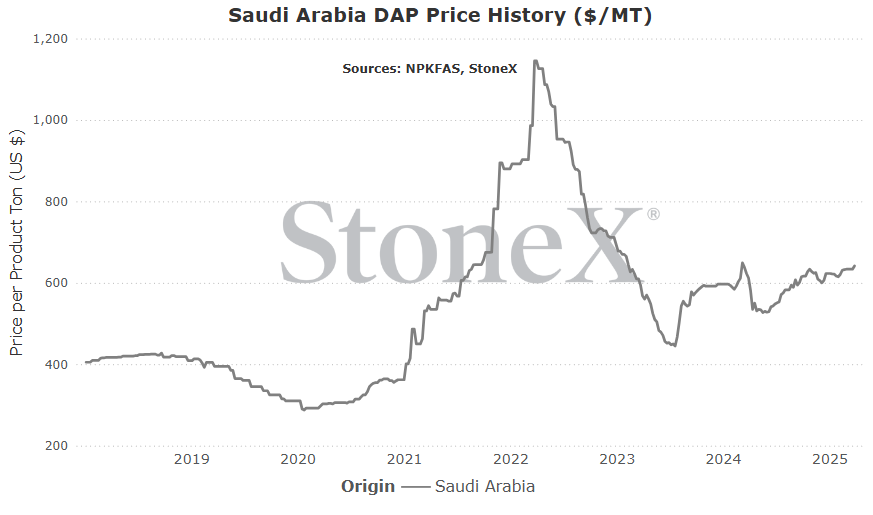
I will say this now and will say it going forward to eternity: these are the flat price graphs for each individual location. Your price where you are is going to be different. There are logistics. There is the cost of storage/interest/insurance/etc. These graphs should not be taken as "it shows the price at $700, why isn't my price $700". These graphs should be used to give an appreciation for price movements.
All values are in metric tons and USD currency.
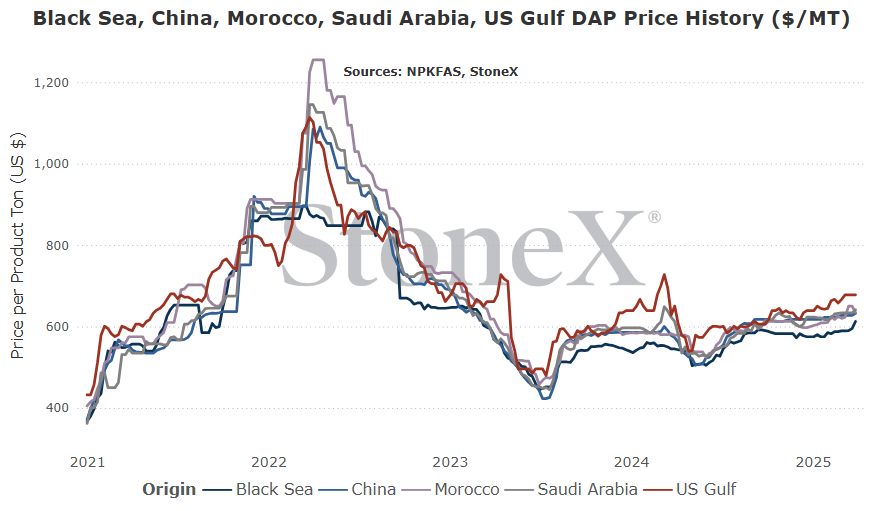
Global
I think the global phosphate world has an issue and that issue is China.
Now, any rumors/stories/etc. linked to China always need to be taken with a bit of skepticism. It is VERY hard to find accurate info when it comes to future strategies. However, given how the last couple years have gone, the chance that China may further slow exports is certainly possible.
The recent storyline rumor has been that the Chinese government is going to further restrict exports of urea and phosphate. Recent strategies have checked both the boxes they set out to hit on: lower domestic prices and higher domestic inventories. So putting more restrictions in place would only make that better for their people.
If this strategy rumor becomes reality, the world will have a bigger issue on its hands in the form of higher prices.
Fortunately, we continue to hear that Saudi Arabian production is looking to increase...but that will take some time. It isn't as though they can wave a wand and their production increase millions of tons.
I do believe we will see values a bit softer as we move into Northern Hemisphere months. However, I think that price decline will mostly be muted by fears of Chinese exports slowing further. If China scales back, it will be very hard to see a substantial resetting of values.
Basically, the price floor keeps rising...
North America
This is going to be a good spring season for phosphate demand. There is a lot of pushback from groups claiming that demand destruction will happen with the high prices. While I agree that will be the case, I'm afraid it will not be enough.
Even with phosphate prices high and grain values low, we have not see the demand destruction we expected to see. At the end of the day, farmers have had to stomach the price or run the risk of reducing yield potential. Now, we have started 2025 with corn acre forecasts rising quickly. Every additional acre is more phosphate demand.
It gets worse for our Canadian neighbors who need to be concerned with tariffs. If the Canadian government imposes wide stretching tariffs on U.S. goods, that will include phosphate and Canada is heavily reliant on the U.S. for those flows.
However, this is the April edition which means that by the time you read this, spring preplant is mostly done with eyes setting on planting. Buyers will not be thrilled at the idea of buying for fall this far in advance.
Ultimately, we should see prices starting to fall into the April/May period...but I think the price floor stays higher this year given global issues. There is hope that Mosaic production rates will increase which would help N.A. supplies, but ultimately it will not be enough to offset China. Unless things change dramatically, downside price potential will be limited...
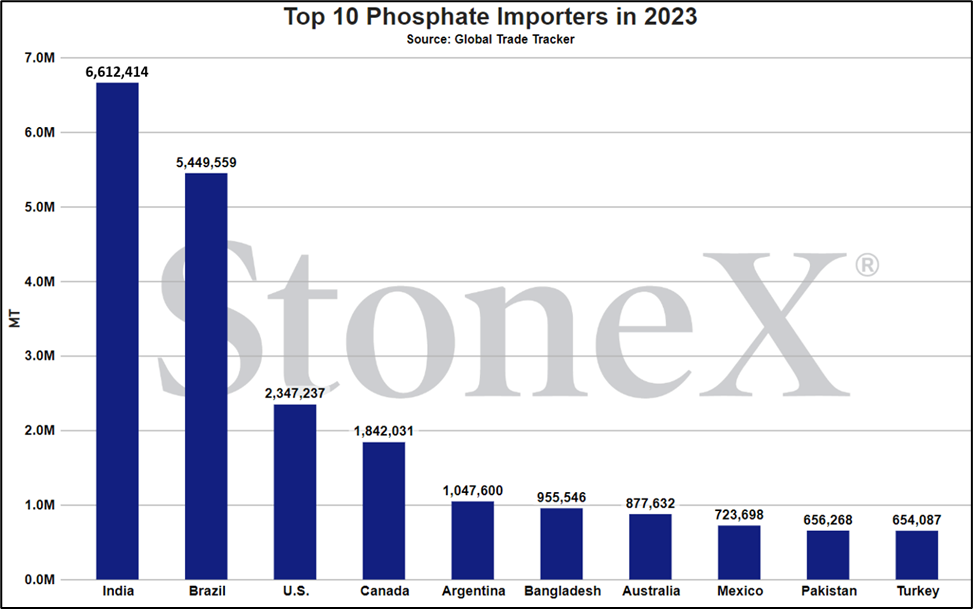
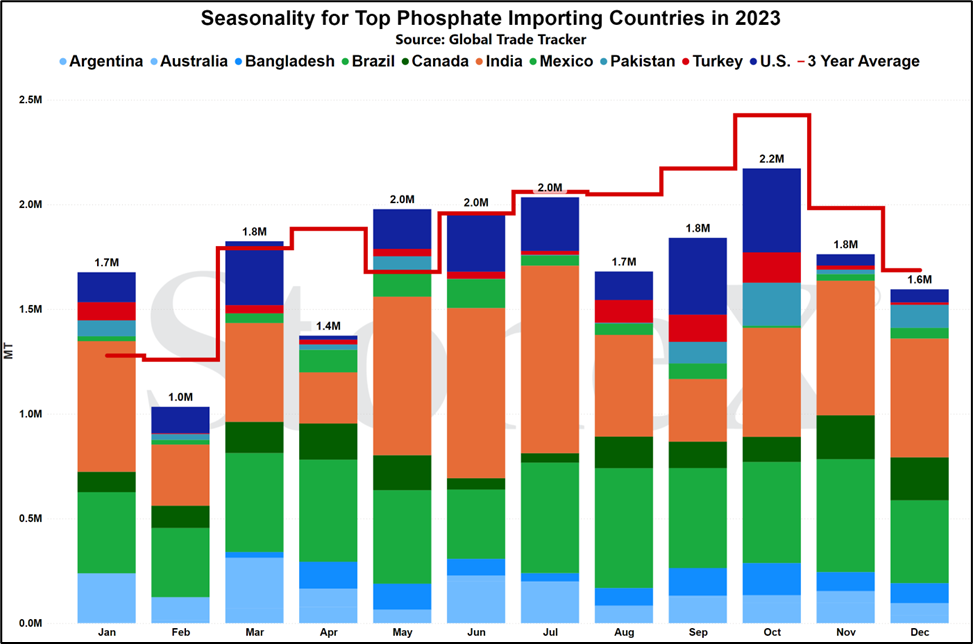
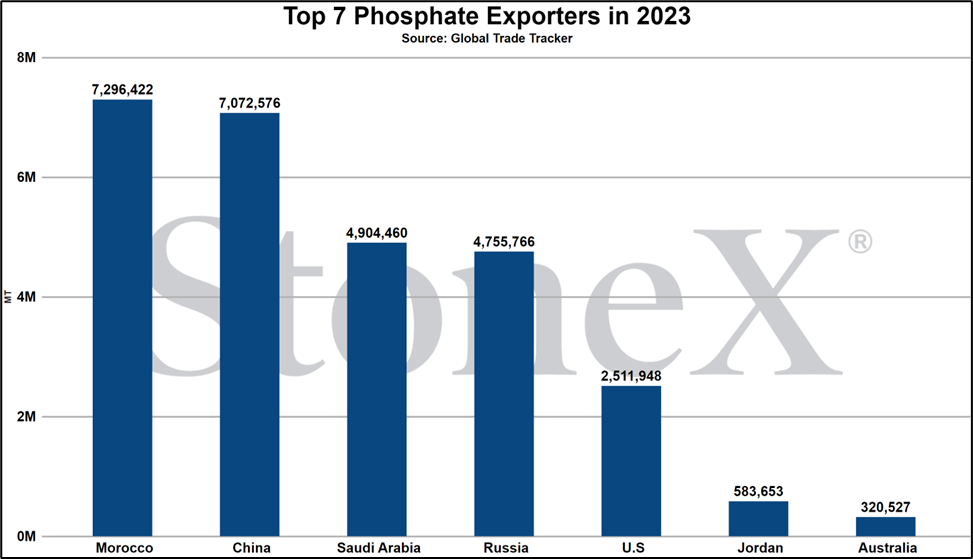
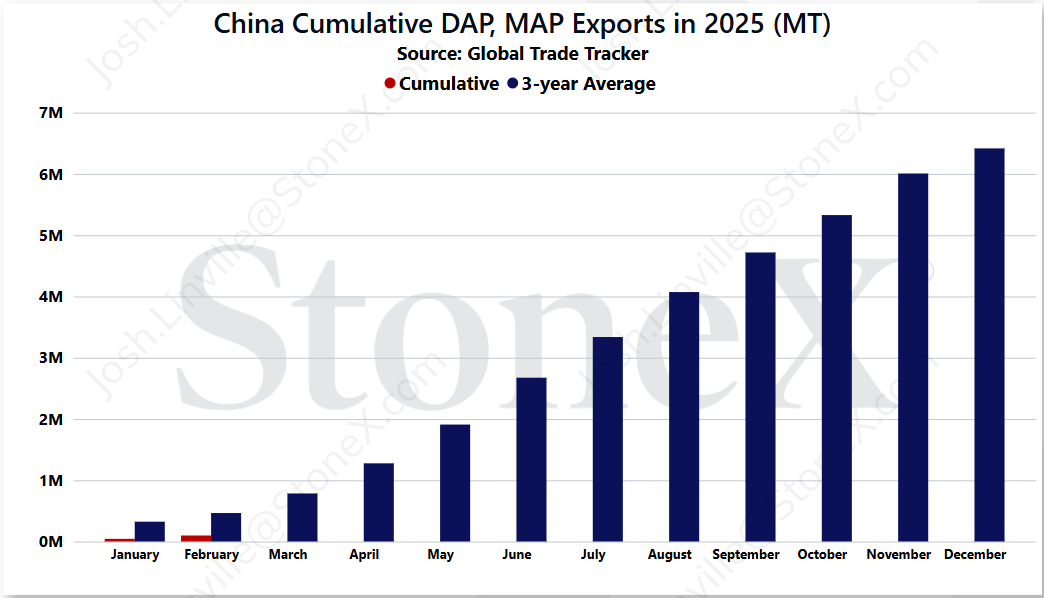
China Jan/Feb export data reflects very low exports, concerns rise globally
One of the big stories in fertilizer the last couple years, and a large part of why phosphate prices are so high globally, has been tied to lower Chinese flows.
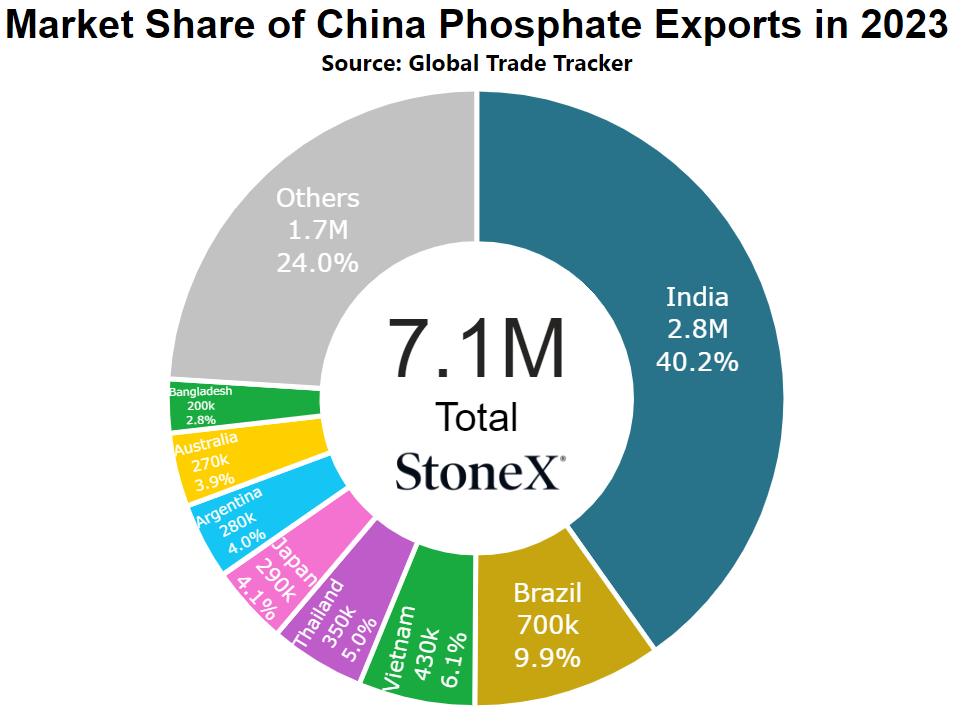
China has historically been the world's largest exporter with flows typically hitting 10M tons. That all changed after 2021. Since that time, their exports for DAP/MAP have been:
- 2022 - 5.6M
- 2023 - 7.1M
- 2024 - 6.6M
That is nearly 11M tons of DAP and MAP that have been removed from the global market over a 3-year span. How did it come to this?
When it comes to China, it is easy. It is government dictation. In late 2021, global fertilizers (phosphate included) saw prices skyrocket and fears build of product shortages. The Chinese government saw what had been happening and decided to take action. Rather than continue to supply the world, the government started to restrict exports with two goals (similar to urea):
- Ensure adequate domestic supplies
- Lower domestic values vs the world
They were successful on both fronts which was a loss for the world.
Anyone who had been hoping for these restrictions to be loosened in 2025 have been sorely disappointed.
January and February combined for only 98,000 tons exported. Even vs a fresh 3-year average export total which only reflects around 6.5M tons, this is significantly behind.
To make matters worse, there continue to be conversations in the fertilizer world that China may never resume their export place. While more of these conversations have centered around urea which is considered more an energy product, phosphate has been included in rumors/fears that these export restrictions are here to stay. The largest block of people in China are attached to agriculture. Keeping phosphate price low and well supplied helps to keep their biggest population happy.
Now, never count China out. As soon as we think we have them figured out, they do something completely different. We could see Chinese exports surge any day and it would not surprise me one bit...but that is not our current expectation. The current expectation is that lower than normal exports will become the norm. The fear factor is that significantly lower exports on phosphate will be the 2025 story.
What does this mean for farmers?
Long story short: higher prices around the globe.
It does not matter where you farm (unless you are Chinese). This situation is causing your prices to be higher. I have yet to find another market that doesn't have higher prices when the largest exporter starts reducing their flows this significantly.
I realize this is hard to take because phosphate is already very high priced vs every matrix we use. Unfortunately, things can always get worse...
N.A. phosphate demand jumps last minute on higher corn acres
Farmers across North America have been struggling as they look thru 2025. Low grain prices and high input prices have combined for a situation where many are just hoping to break even. During these times, it makes sense that folks would look at their input plan and see if there is any place that reductions can be made to cut costs.
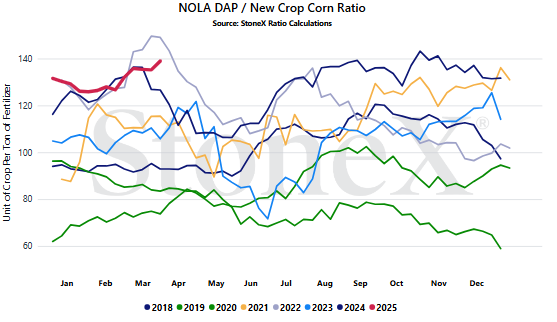
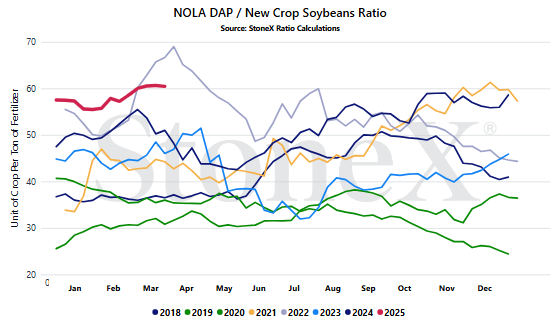
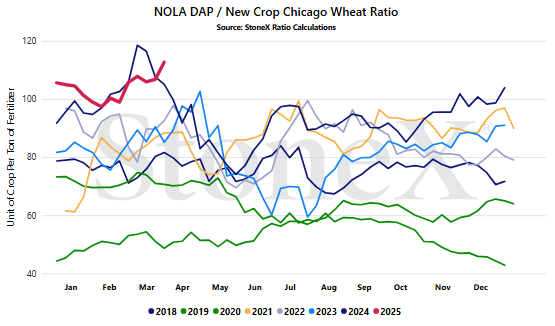
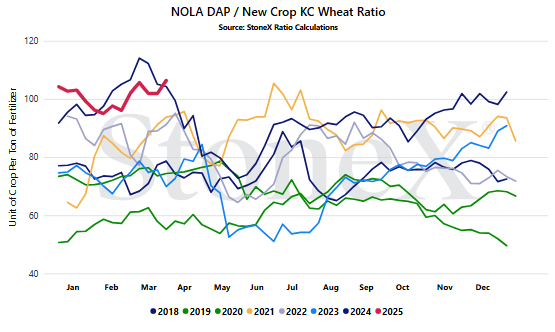
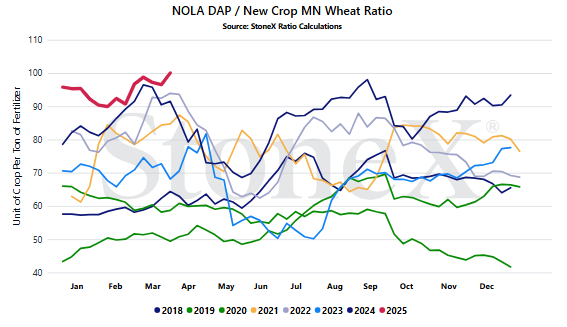
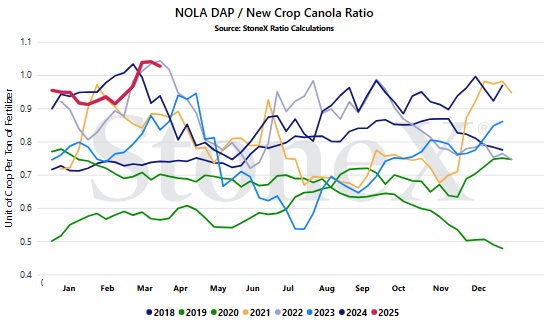
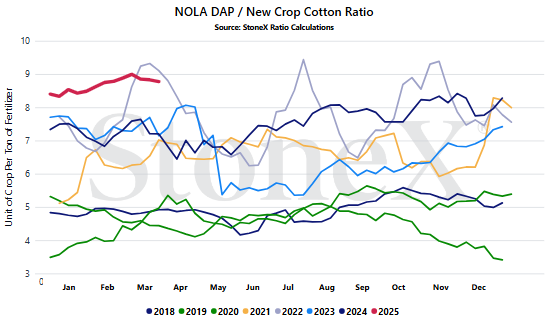
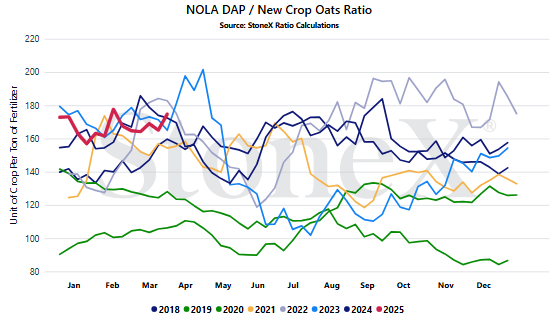
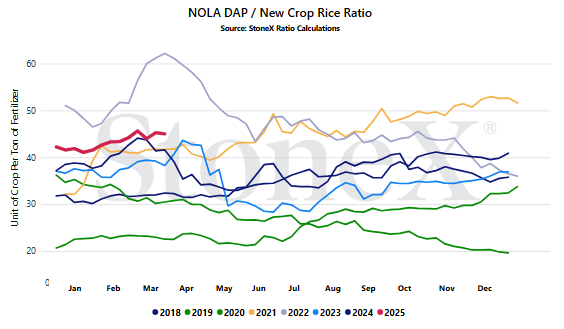
Phosphate appears to be at the front of many lines. Not only is it high priced vs historical values, it is extremely high priced vs grain values as you can see below. Only the highest ratio values of the 2022 bull run created a worse scenario. That means that today, farmers are spending far more bushels of corn to pay for the same ton of phosphate. With values so out of balance, it makes sense that farmers would do a double take to reconsider their approach.
So part of the conversation thru the winter has revolved around demand expectations. With a chunk of preplant application done, we have been hearing news that there have been some cuts here and there. Obviously, those that raised large crops or had been slacking on rates the last couple years are unable to do so without impacting their yield potential but those that have kept up are willing to cut back.
That should mean lower demand equating to lower prices...
Unfortunately for buyers, corn acres rallying higher has helped to offset any demand destruction. StoneX started 2025 with our corn acreage forecast at 92M. By the end of January, it was 93.5M. Before this week's USDA revision, we had moved to 94.2M and were surprised with the new official number of 95.3M.
I know some will argue/question/etc. the USDA's number as too high. Regardless, most of the market is on board with 94M+ which still represents a significant jump in phosphate demand. More than enough, from our perspective, to offset any application reductions.
While it is too early to know, it feels safe to assume that North America will end spring '25 nearly empty on phosphate inventories. While there is a long time until the fall run, there will be a lot of work to do to refill the system and that type of setup usually benefits the manufacturers/suppliers.
What does this mean for farmers?
Long story short: it should keep phosphate price ideas elevated for a while longer.
With big spring demand, likely we go into the summer relatively empty across N.A. That gives manufacturers/suppliers plenty of space to work on filling before the fall run. Their knowing that the system is empty gives them confidence to hold price ideas high. If the market says no, then they can focus on filling their own space, buying them time to drag their feet on lowering prices.
Canadian farmers anxiously watch for revenge tariffs that could include phosphate
Much of this year has seen N.A. media being dominated by coverage of the U.S. / Canada tariff war. Very quickly, potash became a big talking point due to the U.S.'s reliance on Canadian tonnages. This was seen as a product that Canada would be able to leverage the U.S.
However, what many missed were opposite flows. For Canadian farmers, their fears should be tied to revenge U.S. tariff's that include phosphate.
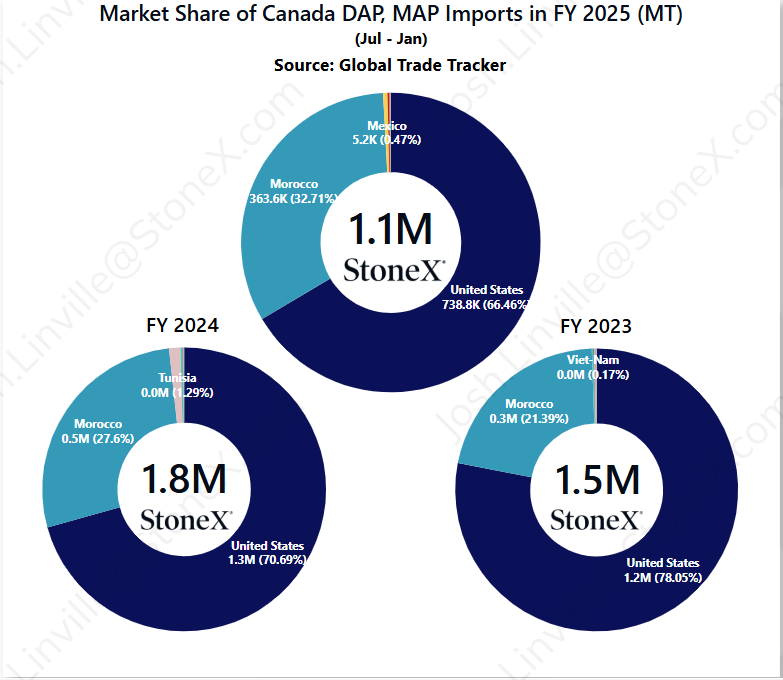
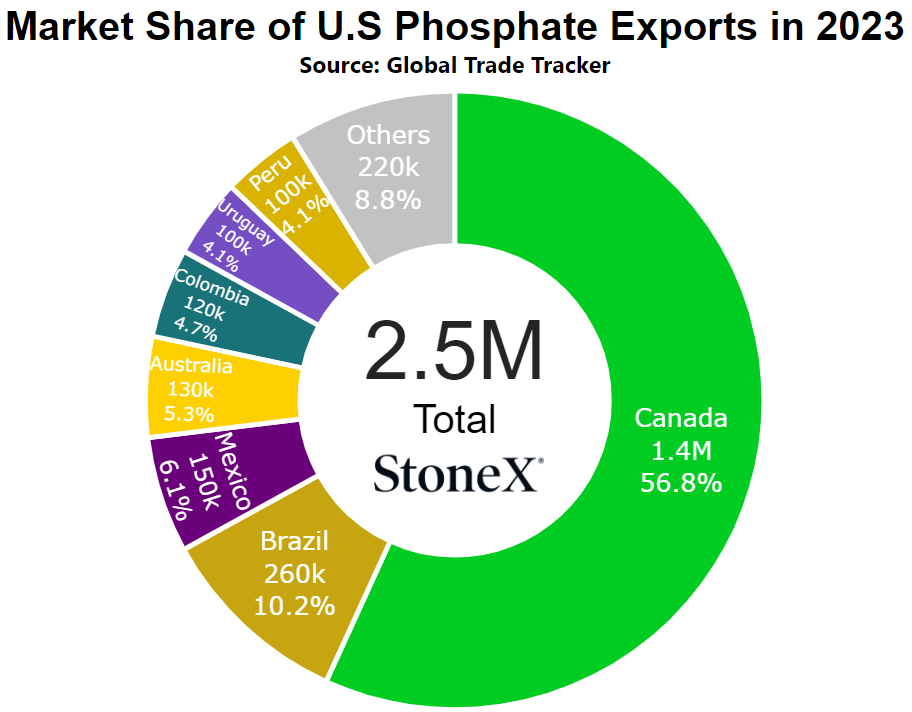
Historically, Canada has been heavily reliant on the U.S. for its phosphate needs. Prior to the U.S. placing tariffs on Russia and Morocco (Chinese tariffs have been in place since the 1st Trump administration), almost 90% of Canada's phosphate imports came from the U.S. After these tariffs were put into place and NOLA values moved to a premium vs the world, the U.S. share dropped to 65 - 80% of total phosphate imports with Morocco sending more product direct to eastern Canada.
U.S. farmers have been struggling with what a 10 - 25% tariff on potash would be. However, potash prices are relatively low vs other inputs, meaning a 10 - 25% tariff rate wouldn't be massive. Sure, every dollar counts, but if there is an input to have these on, potash is near the top of the list.
However, Canadian farmers were be devastated by similar tariff percentages. NOLA DAP has been trading recently in the $615 range. That equates to a $60 - $150+ tariff. This is on top of a product that is already highly priced vs historical values and highly priced vs grain values.
I would guess if the tariff threats go thru, the Canadian response will be more muted in comparison. I would not be surprised at all to see phosphate be taken off the list, but that is not a certainty.
Unfortunately, until both sides come to agreement, farmers on both sides of the border need to watch.
What does this mean for farmers?
Long story short: if wide ranging revenge tariffs are put into place, it will devastate Canadian farmer phosphate values.
The Canadian fertilizer supply market will go into overdrive trying to find alternatives to get around the tariff. You will likely see more tons arrive west/east coasts and pushed inland. There will be a push to bring more product direct to Canadian locations to bypass tariffs.
However, it remains uncertain if Canada could completely go around the U.S. Even if it could, it will require higher priced logistics to do so.
Unfortunately, if this happens, there is no good way around.
Mosaic, N.A. largest phosphate producer, points to higher production outlook
While the major N.A. phosphate story over the last several years has been focused on U.S. tariffs against Russia/China/Morocco, another story has been lurking that is just as important.
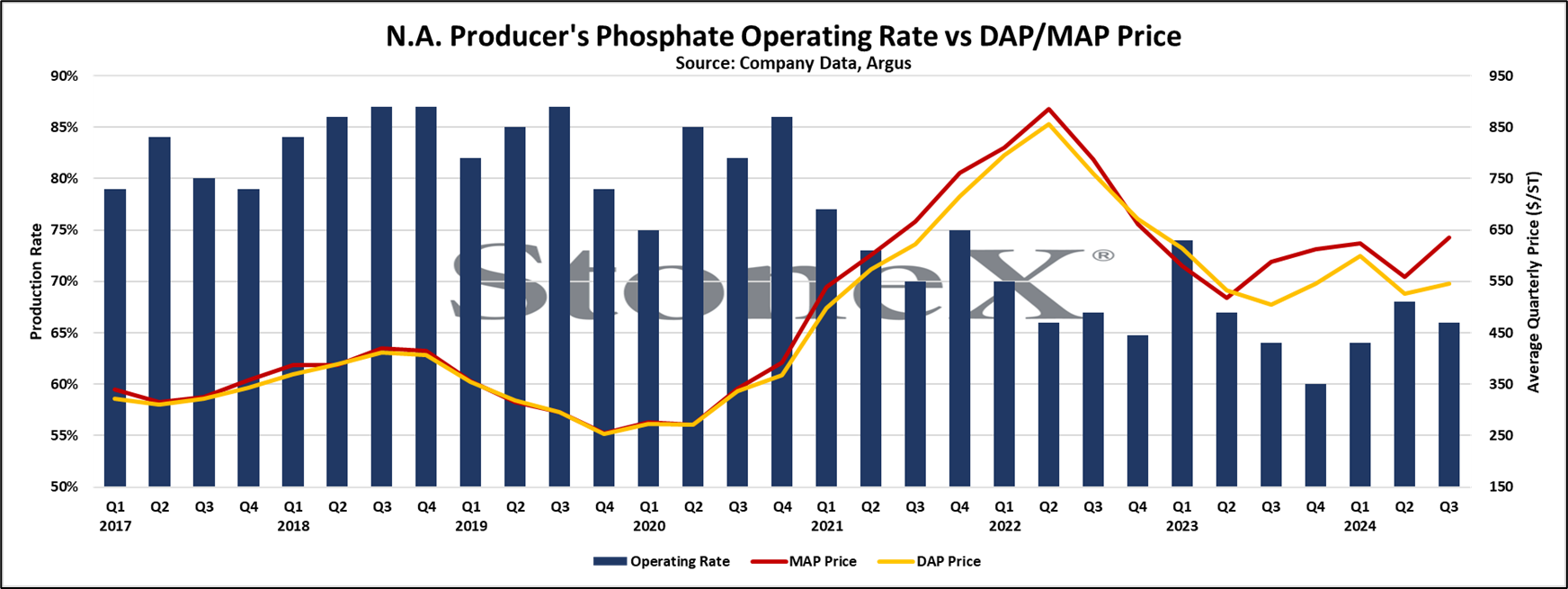
Prior to 2021, U.S. phosphate operating rates ran very well. So well that anytime the quarterly rate dropped below 80%, it was cause for concern and typically took a god like event to cause it. However, starting in 2021, operating rates have struggled to hit 75% and have only hit it/come close twice (Q4 '21 / Q1 '23). The graph below shows the operating rate by quarter, but has not been updated to Q4 '24. We now know that total...a fresh historic low of 58%.
Many people will point to this as a manual push by manufacturers to keep supplies tight and prices high. While I understand the POV and the anger associated with it, I do not share that. NOLA phosphate levels, except for some break out periods during peak demand, has largely been in line with global phosphate values. That means that NOLA phosphate has been ebbing and flowing with global prices that have done the same. Much of the N.A. high phosphate story is due to the lack of Chinese exports and heavy demand elsewhere around the world.
There has been signs of hope. During the most recent quarterly earnings call, massive N.A. phosphate producer Mosaic made mention of their hopes that operating rates will return to normal. They have been putting big efforts into restoring production, which makes sense looking at current market values. Why would a company reduce production purposefully in a period that has them making more money per ton than most other periods in history? Mosaic should be pressing to produce every ton possible, but equipment and facilities fail.
If these statements had been made a dinners/meetings/etc., I wouldn't be as excited. These types of comments can be made off the cuff. However, making these statements on something as important as an earnings call means they believe it. They are making these statements to their stock owners. The same stock owners that drive their retirement packages! Not wise to make promises you cannot keep in that scenario!
While having phosphate production return to normal will not solve every issue, it will certainly help free up more tons for the market. At this point, we will take any win we can get.
What does this mean for farmers?
Long story short: it isn't going to be the silver bullet that causes phosphate prices to halve, but it will help with tight supply situations.
N.A. phosphate market pricing is going to continue to be driven by the world, as it has always been. However, increasing production will mean more tons available across various forms. Instead of NOLA being a premium to the world, we should see it move more in line. It doesn't solve every issue...but it helps.
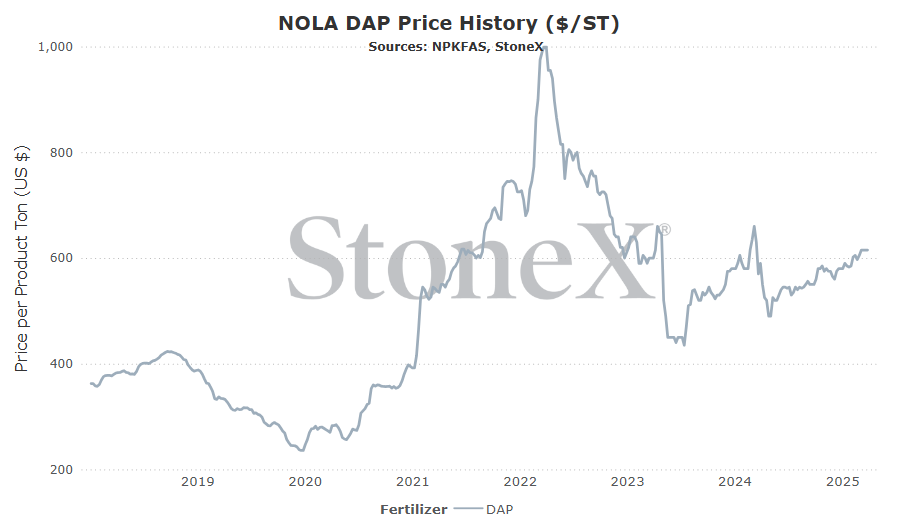
NOLA/New Orleans, Louisiana DAP price comparison
Number 5 global exporter in 2022
Price comparisons
Vs 30 days ago - 2% or approximately $10 higher
Vs 90 days ago - 6% or approximately $35 higher
Vs 6 months ago - 12% or approximately $65 higher
Vs 1 year ago - 4% or approximately $25 higher
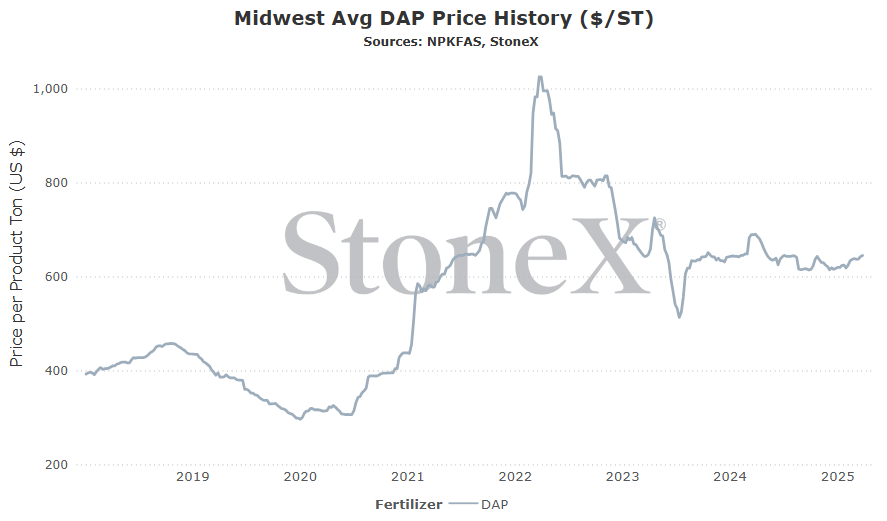
U.S. Midwest Average (using multiple points across Midwest) price comparison
Vs 30 days ago - 1% or approximately $7 higher
Vs 90 days ago - 4% or approximately $25 higher
Vs 6 months ago - 5% or approximately $31 higher
Vs 1 year ago - unchanged vs last year
U.S. Northern Plains Average price comparison
Vs 30 days ago - 1% or approximately $4 higher
Vs 90 days ago - 4% or approximately $24 higher
Vs 6 months ago - 9% or approximately $56 higher
Vs 1 year ago - -5% or approximately $34 lower
U.S. Southern Plains Average price comparison
Vs 30 days ago - 2% or approximately $16 higher
Vs 90 days ago - 5% or approximately $34 higher
Vs 6 months ago - 12% or approximately $70 higher
Vs 1 year ago - -3% or approximately $19 lower
Morocco DAP price comparison
Number 1 global exporter in 2022
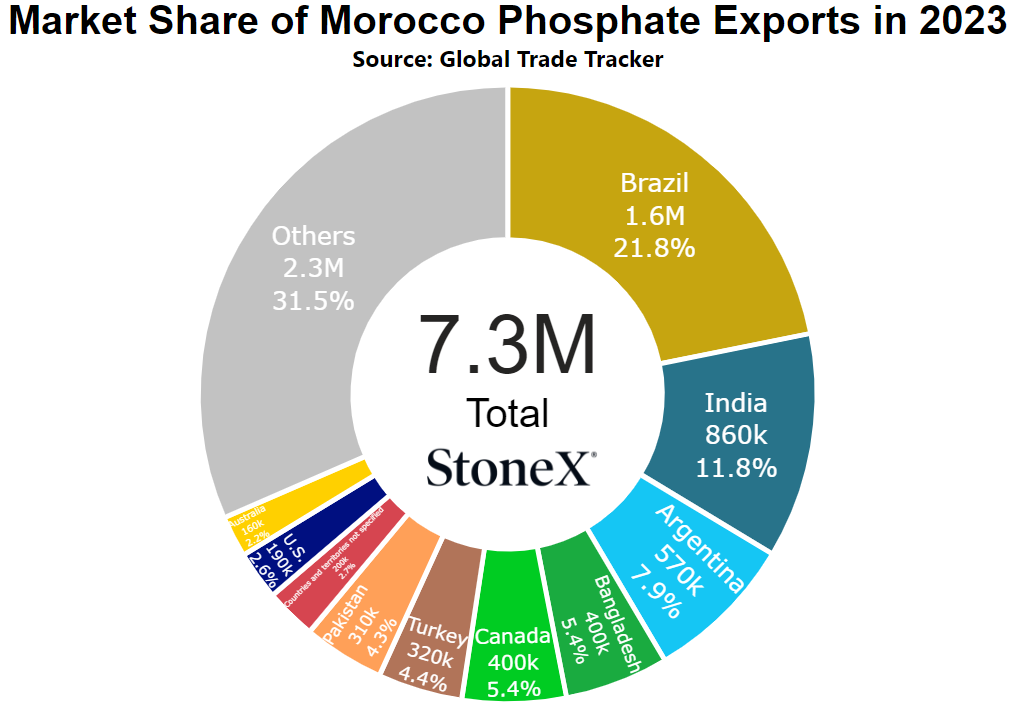
Price comparisons:
Vs 30 days ago - 2% or approximately $15 higher
Vs 90 days ago - 5% or approximately $33 higher
Vs 6 months ago - 5% or approximately $30 higher
Vs 1 year ago - 10% or approximately $56 higher
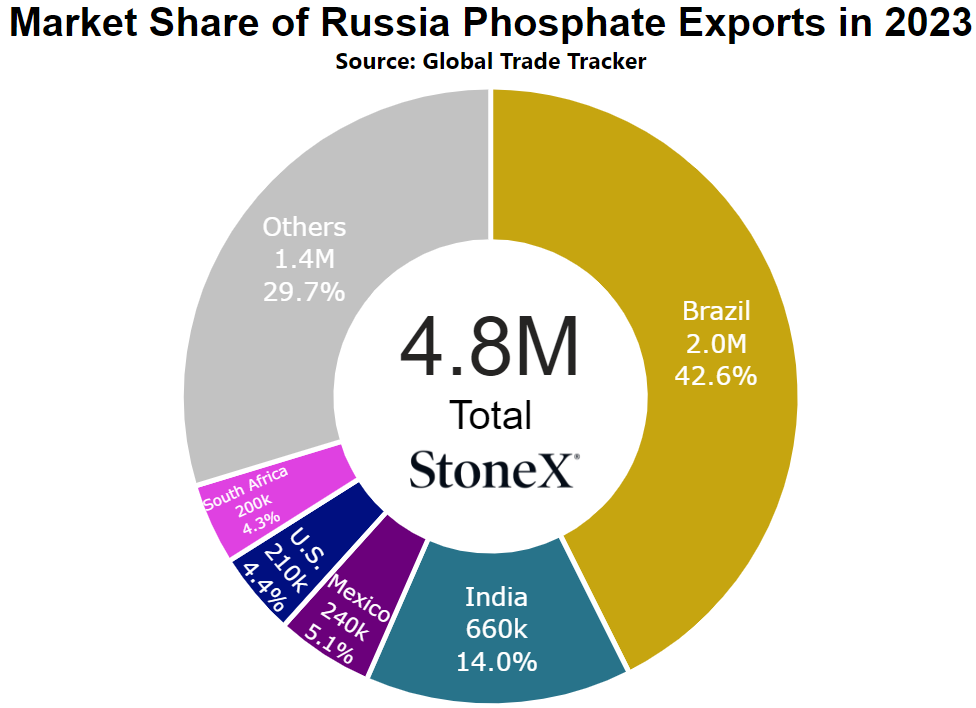
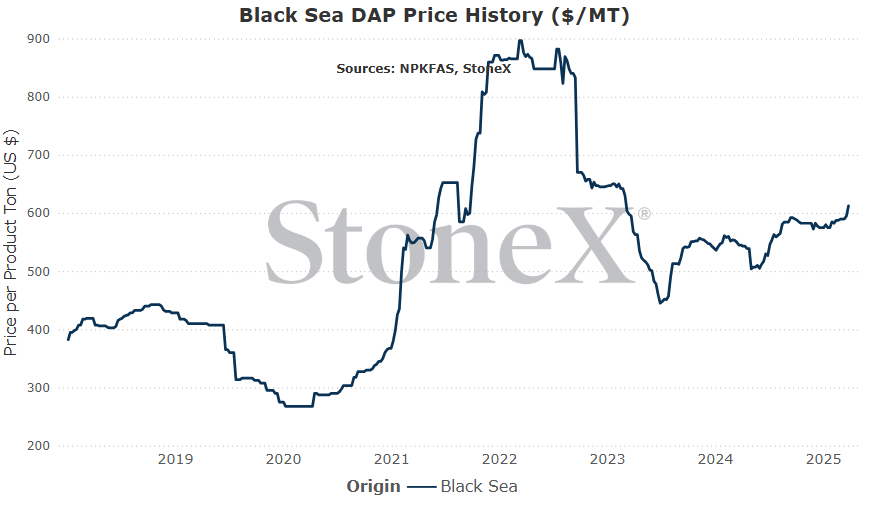
Black Sea DAP price comparison
Number 3 exporter of DAP/MAP in 2022
Price comparisons:
Vs 30 days ago - 4% or approximately $23 higher
Vs 90 days ago - 7% or approximately $38 higher
Vs 6 months ago - 4% or approximately $23 higher
Vs 1 year ago - 12% or approximately $68 higher
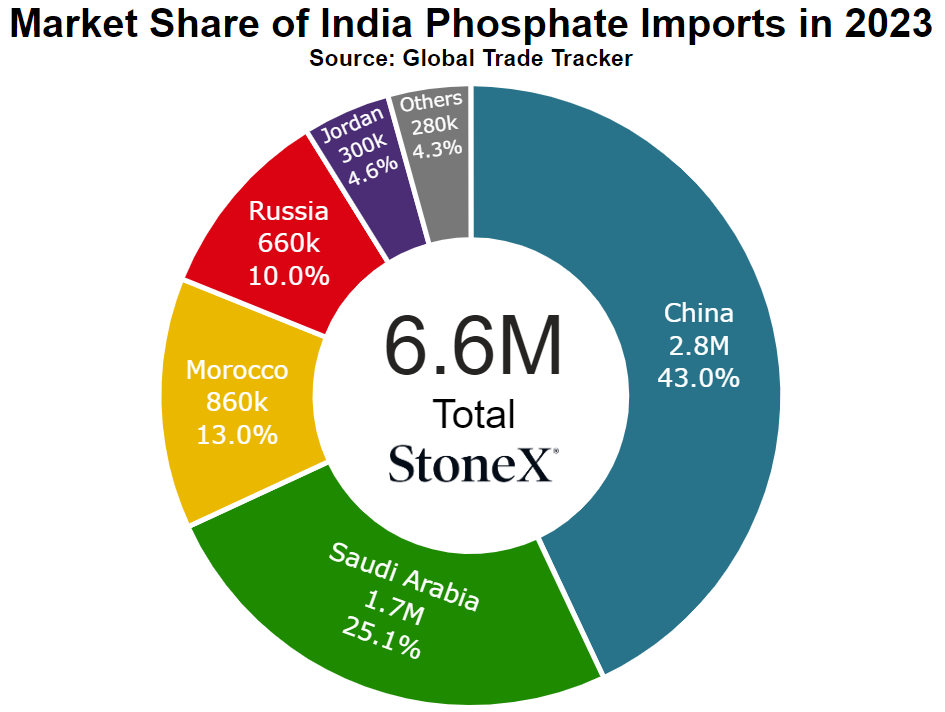
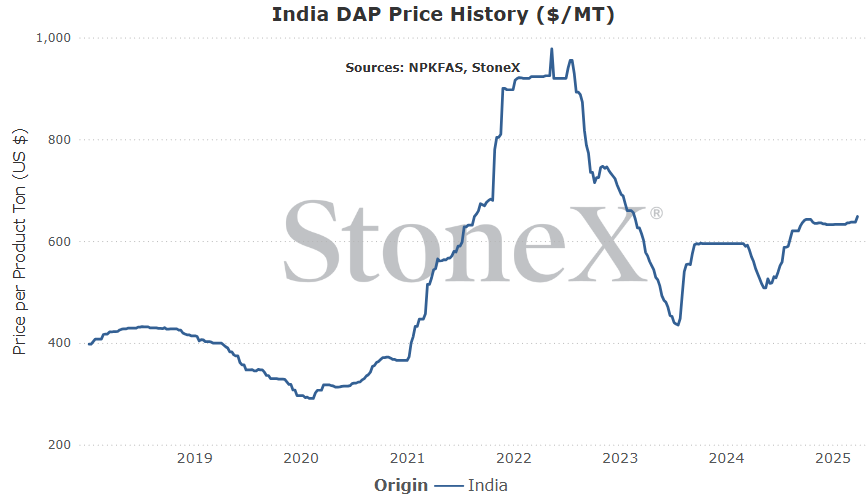
India DAP price comparison
Number 1 global importer in 2022
Price comparisons:
Vs 30 days ago - 2% or approximately $13 higher
Vs 90 days ago - 3% or approximately $16 higher
Vs 6 months ago - 1% or approximately $8 higher
Vs 1 year ago - 14% or approximately $80 higher
China DAP price comparison
Number 2 global exporter in 2022
Price comparisons:
Vs 30 days ago - 1% or approximately $5 higher
Vs 90 days ago - 2% or approximately $15 higher
Vs 6 months ago - 2% or approximately $15 higher
Vs 1 year ago - 10% or approximately $60 higher
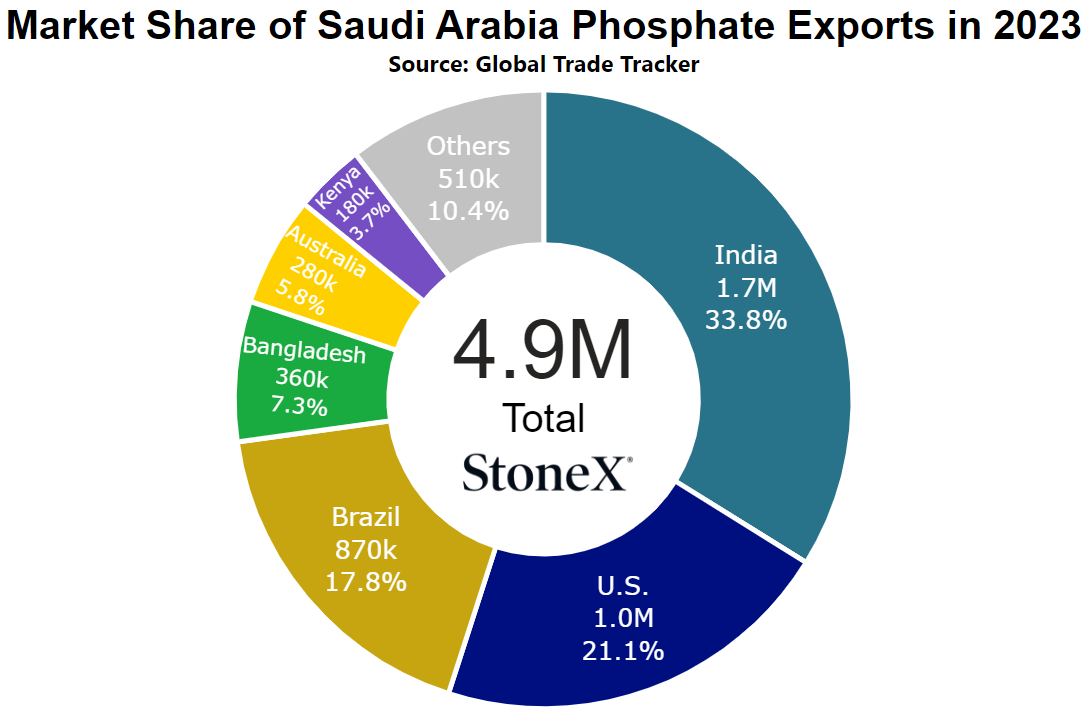
Saudi Arabia DAP price comparison
Number 4 global exporter in 2022
Price comparisons:
Vs 30 days ago - 1% or approximately $8 higher
Vs 90 days ago - 3% or approximately $19 higher
Vs 6 months ago - 4% or approximately $27 higher
Vs 1 year ago - 5% or approximately $30 higher
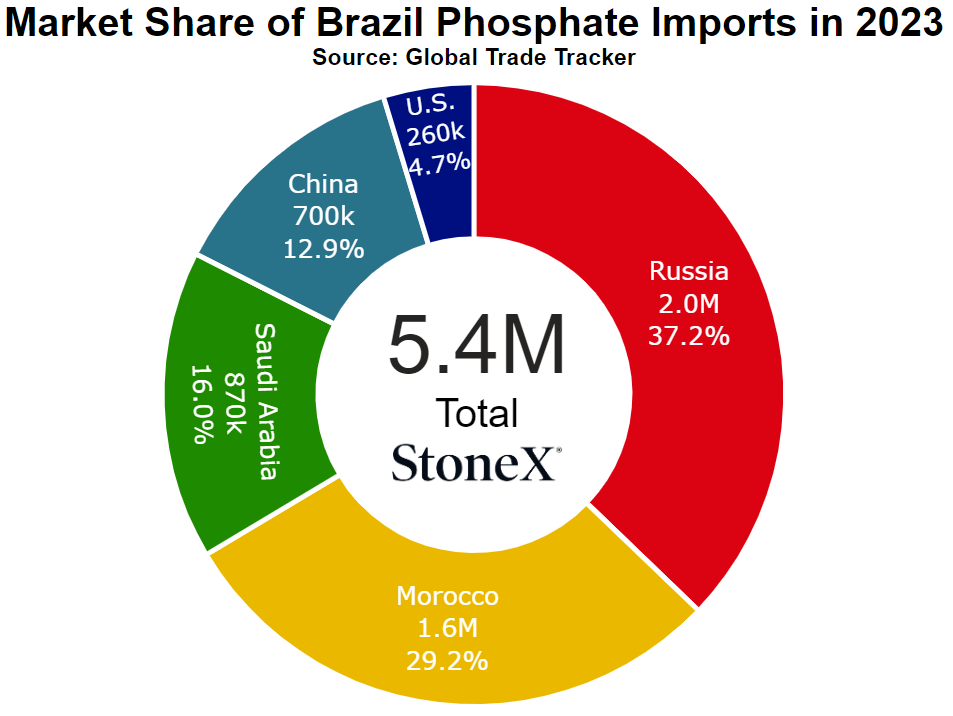
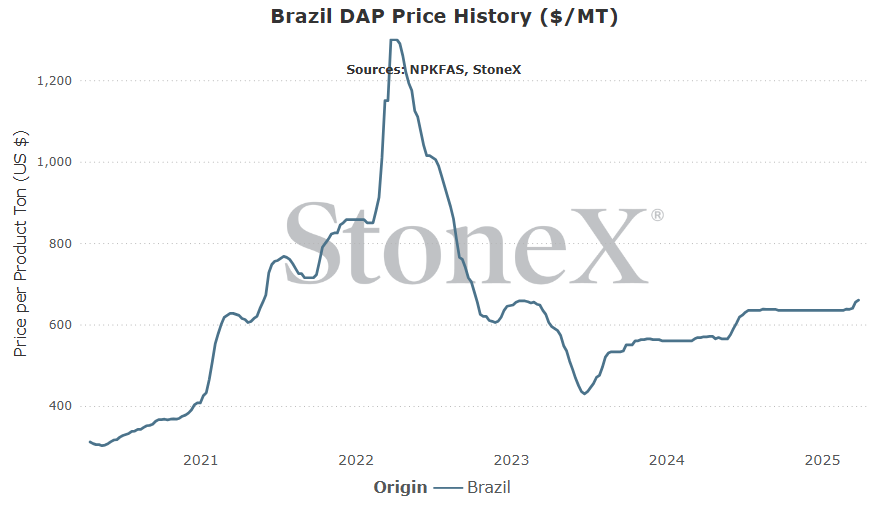
Brazil DAP price comparison
Number 2 global importer in 2022
Price comparisons
Vs 30 days ago - 3% or approximately $22 higher
Vs 90 days ago - 4% or approximately $25 higher
Vs 6 months ago - 4% or approximately $25 higher
Vs 1 year ago - 16% or approximately $90 higher
- Chinese exports get even lower... – a large part of why global phosphate prices are as high as they are is due to Chinese exports failing to meet normal flows. In recent history, China would export 10M tons. In 2024, they only exported 6.6M tons. There are now signs that further cuts are going to be made. If that happens, the global S&D gets even tighter and prices will reflect that.
- N.A. production operating rates continue to suffer – since early 2021, North American phosphate production has suffered. Normally, operating rates would stay north of 80%. There was a quarter where it dipped to 75% and that was cause for concern. Since early 2021, it has not reached 75% and hit a new low in Q4 '24 of 58%. There is hope that normal production will resume, but that is not guaranteed. If the market believes operating rates will get better but then the market gets disappointed, prices will push higher.
- Spring demand wipes out supplies – this is looking like a real possibility. While many people are angry with phosphates high price, it doesn't seem to be deterring application rates. In fact, demand is believed larger because corn acres continue higher than most earlier expectation. Every additional corn acre is a bump in phosphate demand with little to no time to make supply changes.
- Chinese government reduces export restrictions – the current global phosphate fear is that the Chinese government will restrict exports even further than they already are. However, never count them out. Just as soon as you think you have them figured out, they will do a 180. If we suddenly saw the Chinese government allow full free market exports, global values would likely fall quickly.
- Any remaining long positions start fearing carryover to summer – this doesn't seem likely right now. North American demand appears really solid. Inventories should be almost empty...if not completely empty. However, spring preplant season is nearly done. That means the bulk of phosphate demand is nearly complete. If anyone has any tons remaining, they can start to justify lowering their price to get rid of them before it is too late. Again, doesn't look likely but something we still need to watch.
- Demand stays far, far away due to high prices – this is more a summer situation than a nearby thing. As the market starts to look to summer, buyers are going to be very reluctant. Phosphate prices are very high vs historical values. Phosphate prices are very high vs grain values. Monthly interest on phosphate is a very real cost. There just isn't any way to look at phosphate and get excited about buying it. If buyers stay away long enough, it can cause prices to dip a bit.
We believe that only looking at the flat price of either grains or fertilizer can be misleading:
-
Only selling grain can hurt you if fertilizer prices rise substantially
-
Only buying fertilizer can hurt you if grain prices fall
We look at the ratio "value" to get a better indication of where we are or how many bushels of X does it take to pay for 1 ton of fertilizer.
Would you rather:
-
Spend 150 bushels to pay for 1 ton of DAP
-
Spend 80 bushels to pay for 1 ton of DAP
When we compare the current ratio value against recent years, we start to see if we are high or low.
YOUR VALUES MAY LOOK DIFFERENT
This graph looks at the NOLA DAP price vs the flat grain price. There are no logistics on either product. Your location will look different due to fertilizer logistical costs, grain basis, etc.
- China's export programs - this is easily the most important thing I'm watching. It is a short term event. It is a long term event. There isn't a farmer in the world that this doesn't affect. If the world sees the Chinese government restricting exports even further in 2025, that will place a very firm price floor in the market. China was the world's largest exporter of phosphate so the more restrictions they put into place, the higher global price ideas go. Their January/February export data certainly didn't fill me with confidence...
- Saudi Arabia's approach to increasing production, global manufacturer reactions - to help offset the China story is the rumor/reports that Saudi Arabia's Ma'aden company is going ahead with the 3rd phase of production which would add 3M tons per year of capacity. The good news is those 3M tons is almost exactly what China did not export in 2024. The bad news is it will take a while for it to be come operational. More important in my mind is how other producing nations react. Mainly Morocco. Best case scenario is they see Saudi Arabia boost production and feel they need to do the same to "keep up". That is where we would start to see some real price help.
- Phosphate buyers approach to high prices this later spring/summer - the long story short here is that buyers are going to be reluctant. Phosphate prices are very high vs historical values. Phosphate prices are excessively high vs grain values. It costs a lot of money every month just in interest to "carry" it. Buyers are going to be reluctant...but will it matter. Everything is pointing to a very good spring which means an empty system. Also a lot of signs that global supplies will be lower with China's approach. Unless something changes, even if buyers drag their feet, it may not have the impact most hope for...
StoneX Ratio Calculation
The ratio calculation is derived from Bloomberg historical grains values as well as fertilizer values from StoneX, NPKFAS, and Argus.
The calculation is simply dividing the fertilizer price by each grain price.
All data was sourced from StoneX unless otherwise noted.