Australian business and consumer sentiment deteriorated in August and September, with NAB business conditions turning negative for the first time in six years and Westpac consumer confidence falling sharply as concerns over interest rates and employment increased.
See more of Matt's analysis:
Australian Sentiment Weakens as Rate Concerns Build
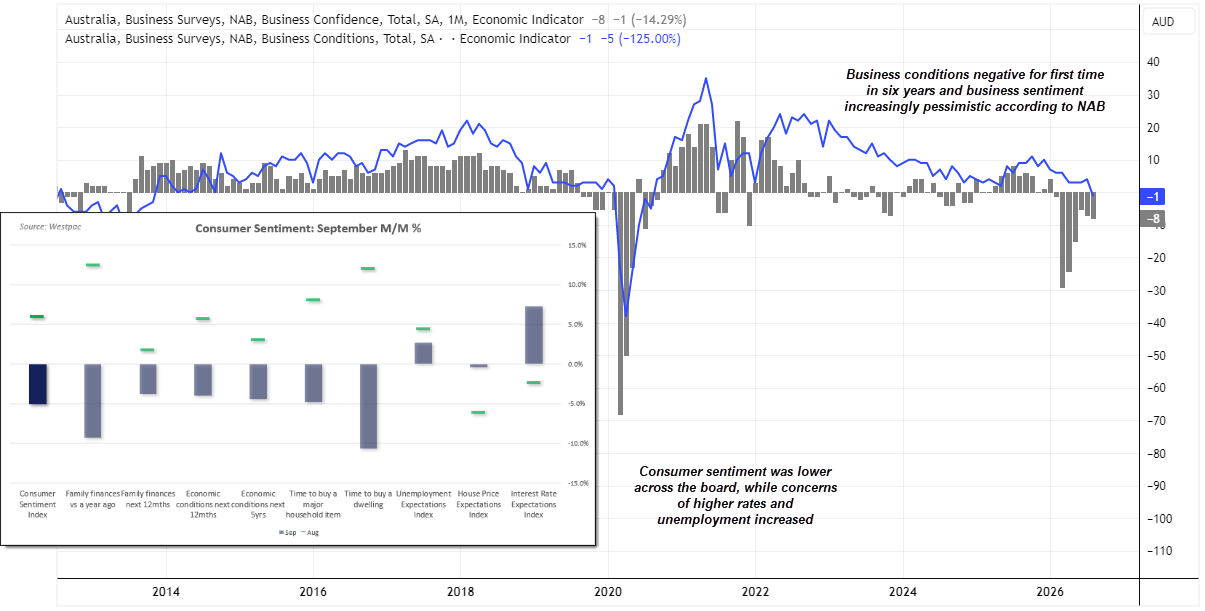
Business conditions were negative for the first time in six years, according to NAB. The metric takes into account trading conditions, profitability and employment, and its -1 print means negative responses marginally outweighed positive ones. Profitability was the largest contributor to the decline, falling 10 points over the month to -9.
Business confidence also fell to -8, which is 13 points below its long-term average of 5. As a forward-looking metric, the deterioration adds another layer for the RBA to consider, particularly if weaker confidence begins to weigh more heavily on hiring, investment and domestic demand.
Source, NAB, Westpac, LSEG
Australian Consumer Sentiment Shifts Further Into Pessimism
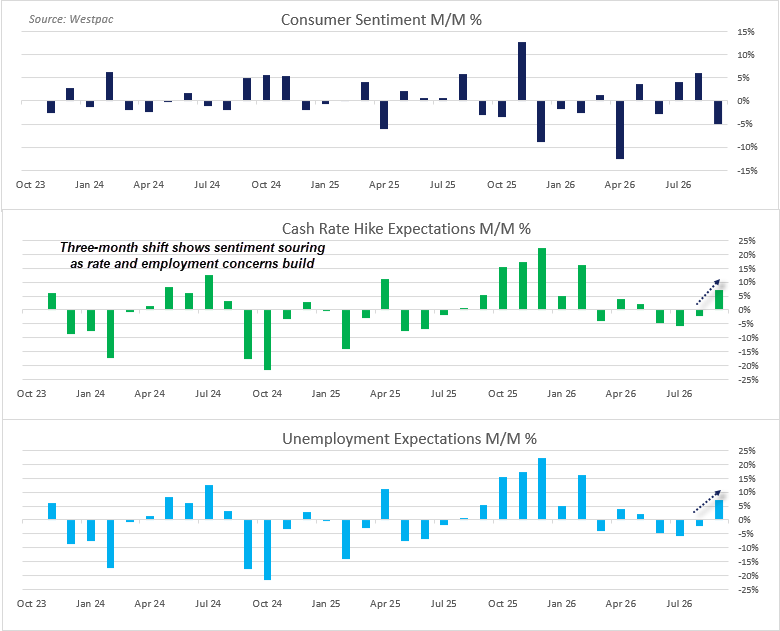
Australian consumer sentiment fell 5.2% in September to 84.4, according to Westpac, reversing much of the improvement seen over the previous two months. Consumers seemed particularly gloomy, with all main sub-indices declining, while interest-rate expectations and concerns over employment increased. That suggests households are becoming more cautious just as the prospect of another RBA hike adds further pressure to the outlook for spending.
Looking at the time series better highlights the shift in consumer sentiment. While the raw numbers are not extreme, the past three months show a clear move from rising optimism towards increased pessimism, whether through weaker overall sentiment or growing concerns over rates and jobs. And if this negativity among consumers lingers for too long, it will likely begin to show up in growth figures through scaled-back spending.
I doubt today’s figures are enough to dispel the threat of an RBA hike, but they may be enough to give the RBA some cause for concern. For now, markets continue to favour November as the preferred time to hike, potentially because the central bank will have the quarterly CPI figures at hand.
Source, NAB, Westpac, LSEG