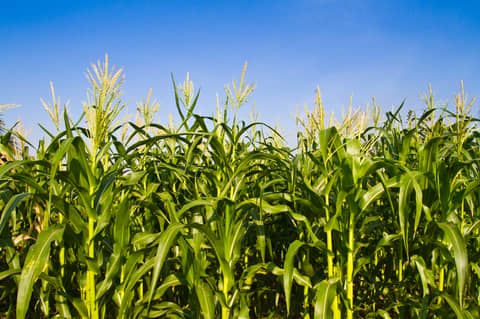
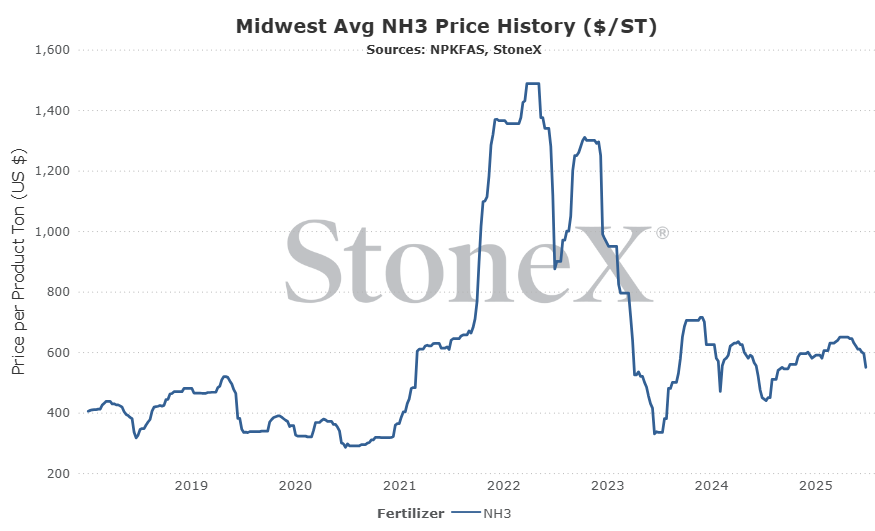
The first graph is the AVERAGE of the entire Midwest U.S. region. That means your local value WILL be different than what the graph reflects. Please do not take this into your retailer and say "why isn't my price the same as here". That is comparing apples to oranges. You might be on the cheaper or more expensive side of this graph. This doesn't take into account logistics/storage/interest/insurance/shrink/etc.
This graph looks at the price from a short ton and USD currency POV.
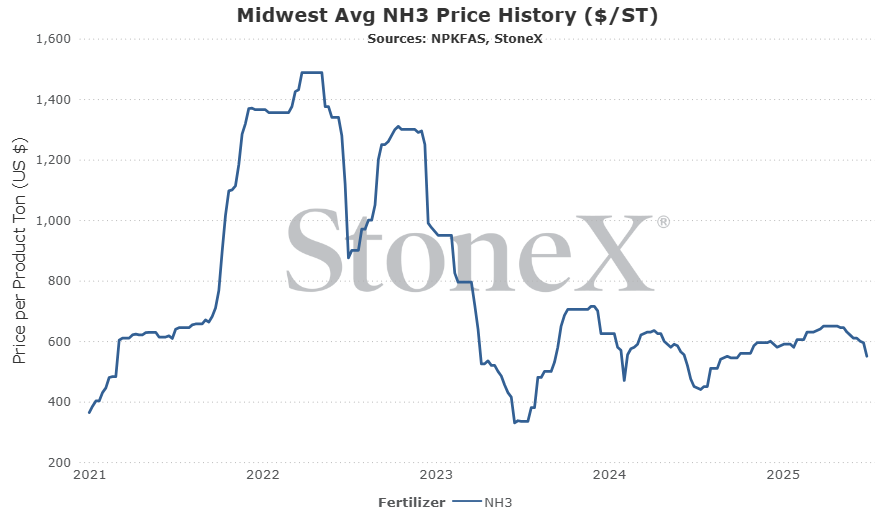
This second graph looks at the price set for Tampa NH3. This value does not have a high correlation to Midwest values. It is a talking point used when prices are rallying...yet somehow gets skipped on the way down. This price is more an indication of the global price. This price is set by two parties (purchaser - phosphate producer in Florida / seller - international producer providing NH3 to FL phosphate production).
This graph CAN be used as an indication of global market price direction/trends. This graph SHOULD NOT be used to determine a Midwest value. Tonnage is listed in short ton and currency in USD.
I thought about how to tackle this for a while. At first, I thought I could go through all the ways that I think global NH3 values could go higher. That was going to be a pretty long laundry list.
So I decided to take the other approach and cover the only way I think it drops near term.
And that hinges on peace between Russia and Ukraine.
Yeah, I know how low of a probability that is.
If peace did happen, then I think we could see Russian exports pick up very quickly. From the sounds of it, there have been multiple ship issues in the Ust-Luga port. While details are sketchy as to the why, one can think there is a chance those "explosion issues" go away if they are not at war. Then there is the Taman factility. It sounds like it is ready to go, but with Ukraine getting very good at striking targets on Russian ground, the government appears unwilling to start the plant. Why start a facility that can house tens of thousands of tons of NH3 with Ukraine hitting fertilizer plants? The population and environmental impacts would be massive. However, if peace is found, perhaps exports can pick up quickly.
Unfortunately, it seems like the far fetched hope that Russia and Ukraine find peace is about the only thing that could make prices drop. Otherwise, the laundry list of production issues aroud the world continues which keeps supplies tight in the face of solid demand.
North America
If it takes something as monumental as Russia and Ukraine finding peace to possibly send global values lower, it would probably take something even larger and less unlikely to drop N.A. values at this point.
First, NH3 looks really good vs urea and UAN. Notice I didn't say good on its own. It is high priced. However, compared to the alternatives, it is solid.
Second, it sounds/feels like a really good sales book was put on by the manufacturers. That means they can wait out buyers for the next round of business.
Third, demand looks solid with big corn acres expected in 2026. It isn't like corn is a great profit next year. Rather, it stinks less than the other options (assuming banks allow it...).
Fourth, after what happened this spring with UAN, I think we could see a lot of those folks turning back to NH3 rather than risk liquid.
I could probably keep going, but I think you get the gist.
In the end, it is going to be incredibly difficult for NH3 values to fall before the end of 2025. If it happens in 2025, it is more than likely due to very poor weather for much of November and December and by the time it really impacts prices, it is Christmas.
Is it impossible for prices to fall? No, just highly unlikely.
Full disclosure, after spending a lot of time thinking through it, I finally told friends and family to really consider locking up their fall needs. If wrong, I'm going to have hell to pay from a lot of different places near and far!!!
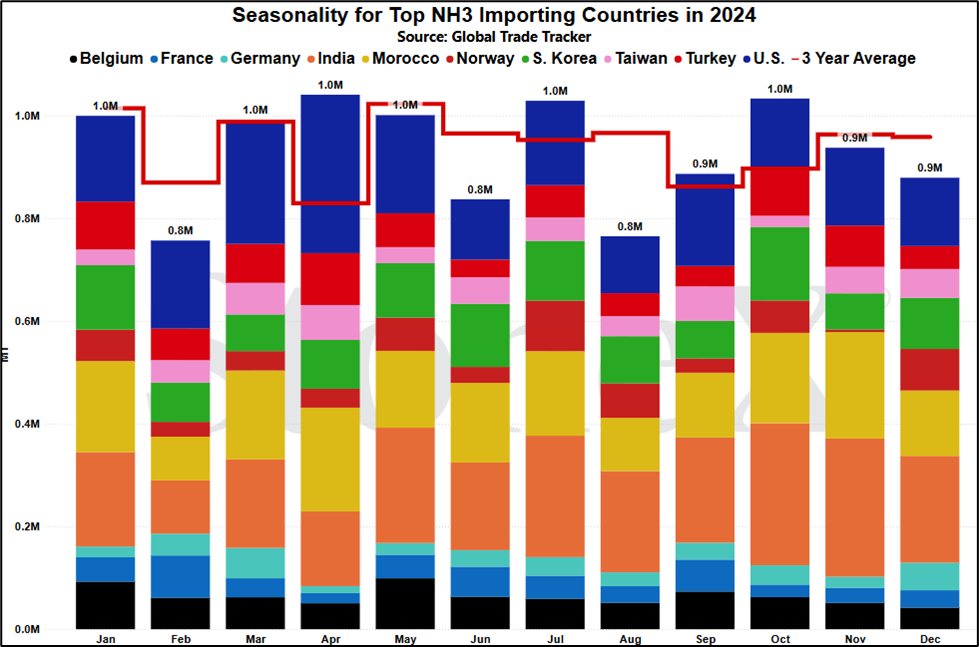
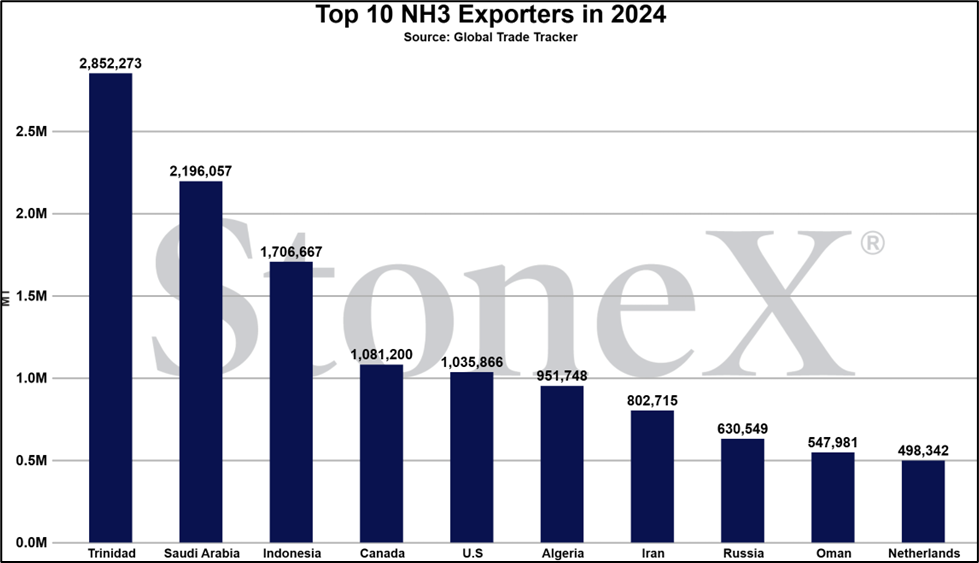
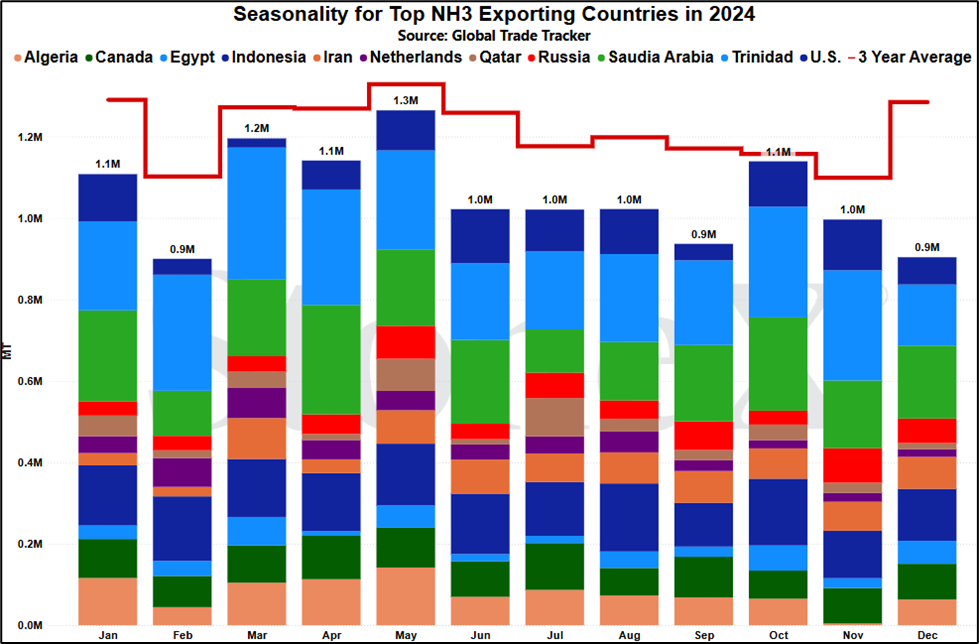
August Tampa NH3 price rallies $70, proving global supply tightness
For the last couple months, we have been discussing how tightly supplied global NH3 markets have been across multiple areas:
- Europe - production continues at about 75% of normal due to high gas costs.
- Egypt - production has been on again/off again due to gas supply disruptions
- Iran - production has been on again/off again due to gas supply disruptions
- Trinidad - yep, production on again/off again due to gas supply disruptions
- Russia - exports remain extremely low due to lack of export options, ongoing war
These are just the "highlights" and do not take into account things like production plants going down for scheduled maintenance that further impacts supplies.
There have been all of these issues and more that have chewed into available supplies. At the same time, global demand hasn't gone anywhere. That has created an imbalance which has allowed price ideas to climb.
Tampa proved this story with the August price being agreed upon/set at $487. This was a $70 price increase from the July value which on its own had been a $25 increase from June.
From my seat, the biggest change event to watch for would be a sudden peace between Russia and Ukraine. While it looks unlikely today, there is a lot of pressure being placed on Putin/Russia. President Trump is ratcheting up pressure with extremely heavy handed tariffs against Russia and any country that does business with them. While Putin shows little interest in giving up the fight and is likely willing to let his people suffer for his endgame goal, all wars eventually come to a close. If peace were to be found, we could quickly see Russia start taking big steps toward returning to the top exporting spot for the world.
Again, unlikely but it is a path we can watch for that could help prices improve.
Why does this matter to farmers?
When global NH3 values fall, it can largely be ignored by suppliers/manufacturers. However, when global prices rise, everyone loves to point to the global situation as a reason why domestic values need to rise.
Lower priced global markets eventually create enough pressure that domestic markets have to respond, but it takes time. It is MUCH easier for bullish swings to influence prices.
It isn't fair. It doesn't feel right. But it is reality.
U.S. tariffs could impact NH3 imports (Trinidad)
The U.S. economic war on the world continues to take center stage. This remains true for the fertilizer markets.
For NH3, it is a bit less impactful. The majority of NH3 used both agronimcally and industrially in North America is produced in North America...but not all.
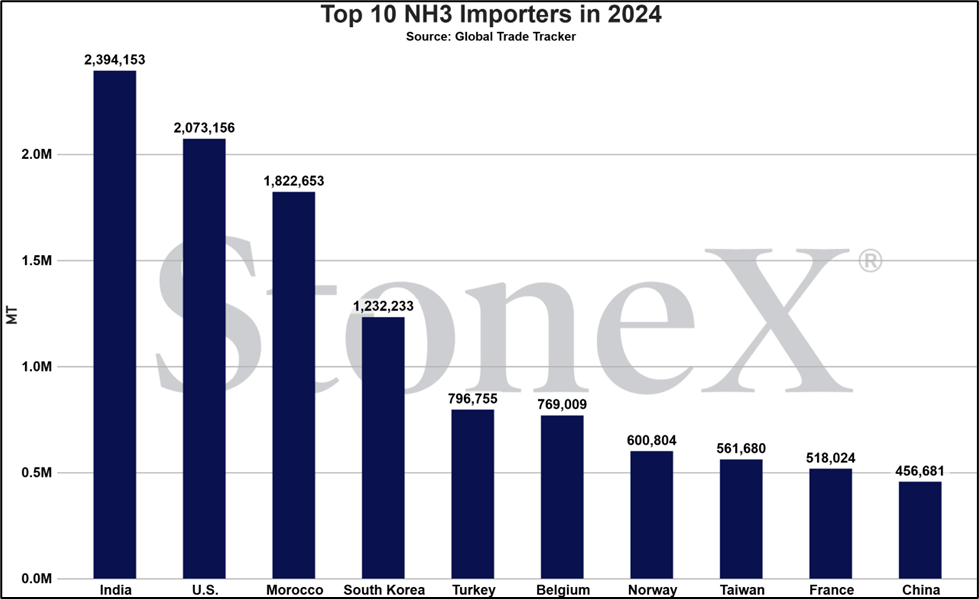
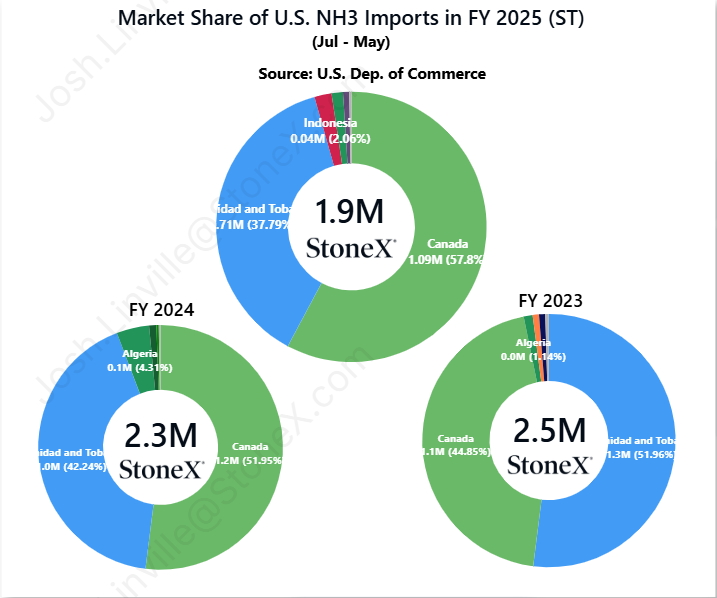
As the pie charts below show, there is still a couple million tons that are imported into the U.S. each year. The biggest "outside" (i.e. not Canada) importer is Trinidad...who currently has a 10% tariff in place.
Trinidad has been having a lot of their own nitrogen production issues due to poor natural gas flows. While the future appears bright with new, undeveloped water being approved for development, that process will take a while. Until then, their production rates are likely to continue to suffer. That means less tons to sell to the world.
With less tons to sell, they can be a bit more picky on where they sell those tons. They likely want to maintain relations with U.S. buyers, but if another country pops up willing to pay more, they may err that way. That is how the 10% tariff the U.S. currently has on Trinidad could sway product flows. If Trinidad has plenty of sales opportunities, they can effectively "force" U.S. buyers/importers to pay a 10% premium to offset the tariff price.
If importers are paying a 10% premium for product, do you think they will eat that price or pass it down the line...
Right now, it does not appear to be having substantial changes on flows. We have little reason to worry about supplies this fall, but this is a story that needs tracked.
What does this mean for farmers?
You and I both know which direction crap flows.
If Trinidad product is tight and they have plenty of sales options, they can force U.S. importers to pay the tariff difference. If U.S. importers have to pay a 10% premium, it is very likely that cost will get pushed through the supply chain to the end user.
Farmers. Farmers are the end user. That is the direction crap flows.
North American fall application showing early signs of being big run
From my seat, this fall could be a major NH3 run.
- Overall N demand should be big - it is far too early to be placing firm acreage number for 2026, but we must. We are officially in fertilizer year 2026. In order to have a solid idea of demand, we have to have a solid idea of grain splits for next year. While no grain looks "good" today, corn remains the best option and has us expecting 93M acres for next year. That requires a significant amount of N applied to raise the crop. This boosts NH3 demand.
- Spring UAN supply situation could push more demand to NH3 - this spring saw the worst nightmare scenario for fertilizer come true. UAN supplies did not exist. It was not a matter of pricing. It was a matter of it not being available. Let me be clear, I am NOT saying it becomes a regular event. However, the fact that it happened could have a lot of spring UAN application farmers flocking back to NH3.
- NH3 prices currently attractive vs other N sources - there is nothing cheap or attractive about current NH3 values. I am merely saying this from the comparison perspective. When looking at NH3 vs urea/UAN, NH3 is the best and cheapest source of N. With financials as tight as they are this year (and presumably next year), farmers will flock to cheap more often than not.
- Crop is maturing on time, harvest should be on time - all signs are pointing to the crop progressing nicely and on-time. Assuming mother nature plays nice, this crop could be out of the way well ahead of fall application time. That reduces the chance of a late application start because the previous crop is in the way.
Now, this is not my saying that this guarantees prices higher or guarantees supply shortages this fall. I am merely pointing out that NH3 suppliers are in a very strong position right now. It is understood that a solid sales book was put on for the summer and fall ship programs. Urea and UAN continue to show strength. Demand outlook remains solid.
Those are all factors that boosts the chances that prices rise...
What does this mean for farmers?
It means there is a solid chance that prices start to rise for NH3.
All of these factors are seen by the manufacturer and suppliers of NH3. Poor grain values are likely keeping a lid on higher values...for now.
U.S. Midwest Wholesale price average
Vs 30 days ago - 0% or approximately $0
Vs 90 days ago - -15% or approximately $95 lower
Vs 6 months ago - -9% or approximately $55 lower
Vs 1 year ago - 22% or approximately $100 higher
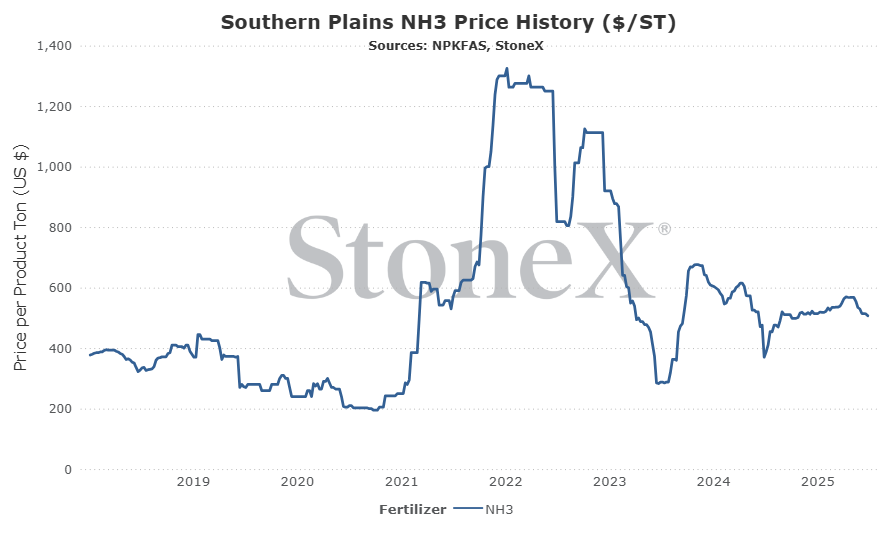
U.S. Southern Plains price average
Vs 30 days ago - -1% or approximately $5 lower
Vs 90 days ago - -12% or approximately $66 lower
Vs 6 months ago - -4% or approximately $20 lower
Vs 1 year ago - 12% or approximately $55 higher
- Russian exports remain low, creating larger supply void - while the top of this newsletters global export list may not show it, Russia is typically the world's largest exporting nation. However, their export logistics utilized a pipeline that ran through Ukraine and loaded ships from a port in the Odessa region. Needless to say, that has not been operational for a while. While work continues to rebuild export capacities within Russian territories, it takes time. The longer Russian exports are removed, the bigger the supply loss.
- Production issues continue around the world - it has not been a great production year for NH3 and global production already appears to be falling behind global demand growth meaning less ability to handle production losses. Europe/Iran/Egypt/Trinidad, this is a short list of countries that have struggled with production outside of Russia. If this pattern continues through the rest of this year, it likely only serves to boost price ideas.
- N.A. demand continues to be seen as growing - urea prices continue to rise. UAN is not expected to reset very much. Nitrogen demand should be large once again. Farmers/retailers may sway more to NH3 applications to back away from UAN after what happend this last spring. The more all of these factors occur, the bigger fall demand gets. The bigger fall demand gets, the more bold manufacturers/suppliers get on price ideas.
- Russia/Ukraine peace returns Russian exports - this is a long shot, but it isn't zero either. If Russia and Ukraine find peace, nitrogen markets could quickly start to lower price ideas. For NH3, it would allow Russia to start exporting more through Ust-Luga and finally start utilizing their Taman facility. Gas values in Europe may fall, allowing their offline nitrogen production to restart. These could be major changes for global NH3 supplies and demand and could allow prices to finally start to correct.
- High input values cause farmers to switch from corn, whether they want to or not - today, this does not look likely. As bad as the situation appears, corn still looks like the best planting bet for 2026 (yes, I know, lot of time until then). However, that assumes all farmers get to make that decision. Some that are heavily reliant on loans to grow their crop could see bankers making decisions for them. Yes, corn may be the best bet but it also may be the highest cost crop to raise. Something like soybeans takes much less input costs. If outside parties start having a say, corn acres could be lower and with it, nitrogen demand.
- A good run of global production rates - Iran and Egypt continue to appear to have the easiest route to normalized production rates. Yes, they have seen struggles 1st half of this year, but they can right their ship easier than most rest of the world. Trinidad comes in next. If natural gas supplies can stabilize, nitrogen manufacturing is ready to go. Europe is far fetched but with global overall nitrogen market so high priced, we could be surprised with at least some production resuming. If at least some of these can happen and stay stable, it could calm nerves.
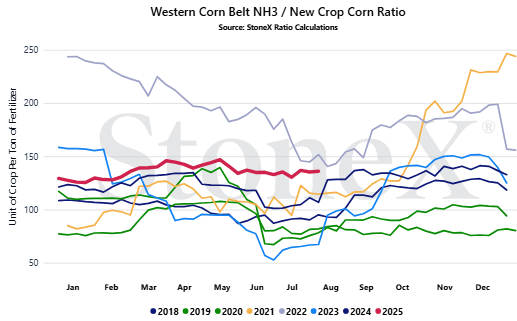
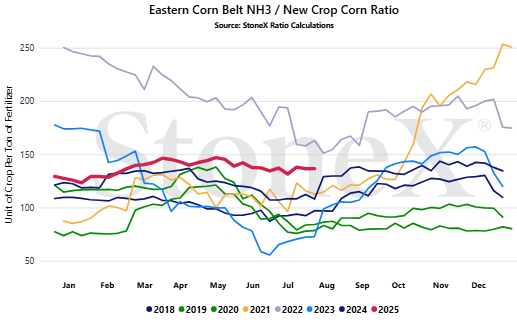
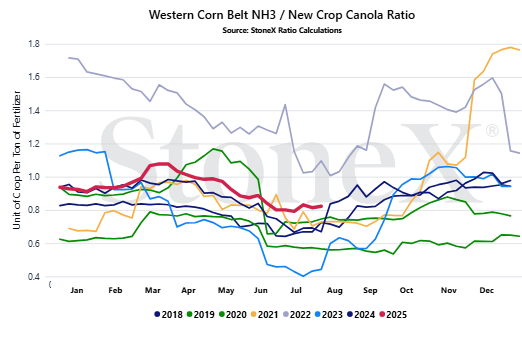
Where are the current NH3/grain ratio values today
We believe that only looking at the flat price of either grains or fertilizer can be misleading:
-
Only selling grain can hurt you if fertilizer prices rise substantially
-
Only buying fertilizer can hurt you if grain prices fall
We look at the ratio "value" to get a better indication of where we are or how many bushels of X does it take to pay for 1 ton of fertilizer.
Would you rather:
-
Spend 150 bushels to pay for 1 ton of potash
-
Spend 100 bushels to pay for 1 ton of NH3
When we compare the current ratio value against recent years, we start to see if we are high or low.
YOUR VALUES MAY LOOK DIFFERENT
This graph looks at the NOLA NH3 price vs the flat grain price. There are no logistics on either product. Your location will look different due to fertilizer logistical costs, grain basis, etc.
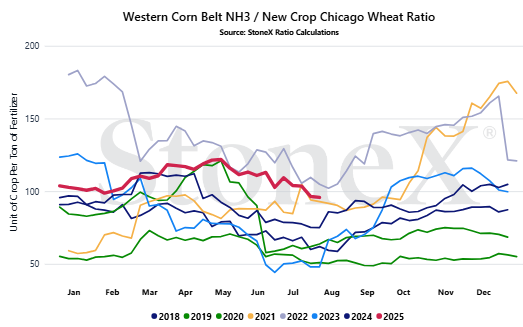
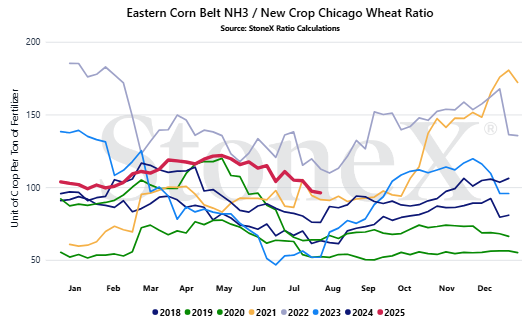
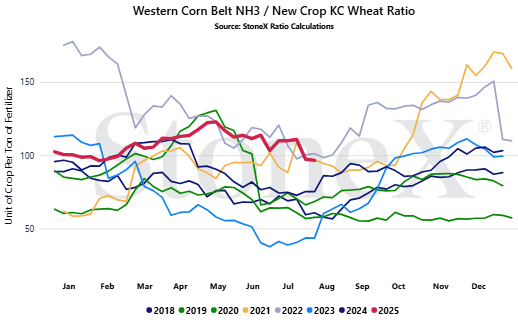
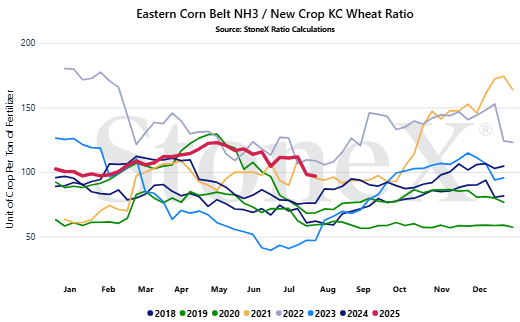
- Global tight supply outlook - Russian exports remain very low as they continue to invade Ukraine. European production remains at 75% of normal as long as Russian gas flows remain stopped. Iran and Egypt have had their production on and off more than usual. Trinidad gas flows continues to impact its production rates. There is a lot wrong with global NH3 supplies. Could it improve? Certainly and we are watching for it. Note that I saw watching, not expecting...
- N.A. NH3 price vs nitrogen alternatives - let me start by saying there is absolutely nothing cheap about NH3. However, when we start looking at its price vs things like urea and UAN, it is pretty attractive. If urea and UAN continue to push prices higher, it is just a matter of time before NH3 values are pulled higher with them.
- Grain (specifically soybean) progress - it has been a better than average growing season this year. While plenty of people will argue the crop isn't as good as some believe, it is hard to find another spring/summer with better conditions. The crop is making a lot of growing progress and so far it looks like harvest will be on-time. If that continues, harvest could be done ahead of November which gives NH3 applicators full access to fields. The longer the application period, the better the chance of a big fall run.
- How good could the fall NH3 run be? - I think this fall has the makings of a near record application. Again, things can and will change, but hear me out. Overall nitrogen demand is still expected to be large with another big corn crop expected in 2026. NH3 values currently look solid vs urea and UAN and could have farmers switching to save money. The spring UAN supply debacle could have more farmers considering a fall NH3 run to keep from repeating the story. Harvest could be early/on-time. That is a lot of factors that point to a big fall run. Ultimately, mother nature will have the last say and crappy farmer economics may have more folks delaying until spring. Still, the tilt of the current view is to a big fall.
StoneX Ratio Calculation
The ratio calculation is derived from Bloomberg historical grains values as well as fertilizer values from StoneX, NPKFAS, and Argus.
The calculation is simply dividing the fertilizer price by each grain price.
All data was sourced from StoneX unless otherwise noted.