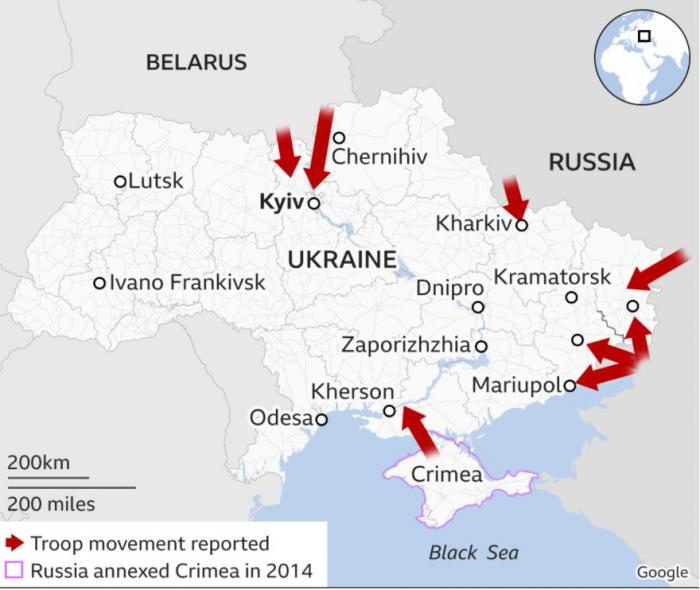
MAP OF RUSSIAN TROOPS AROUND UKRAINE
Timeline of Geopolitical Developments this week:
21st February:
President Putin signs a decree recognising the independence of Ukrainian ‘breakaway’ cities, Donetsk and Luhansk and orders a deployment of troops as ‘peacekeepers’
22nd February:
First ‘tranche’ of sanctions from the United Kingdom, the United States, the European Union, Canada, Australia, Japan, and Germany. (Please see our report here)
23rd February:
Ukraine’s parliament impose a state of emergency within the country and urges its citizens that live in Russia to leave immediately.
24th February:
President Putin authorises “special military operations” in eastern Ukraine, while ordering Ukrainian forces to lay down their arms. Ukraine since then has undergone attacks by land, sea and air against both military forces and around major cities (including the country’s capital Kyiv). This is the largest military attack by one European state on another since World War Two.
A second tranche of sanctions have bene placed on Russia (please see below)
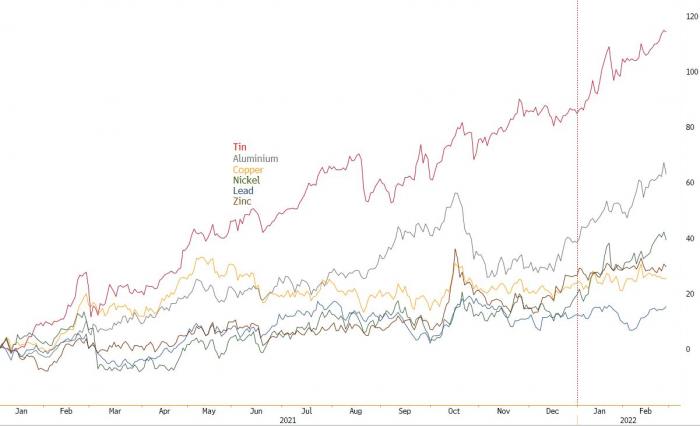
LME 3M BASE METAL PRICE PERFORMANCE
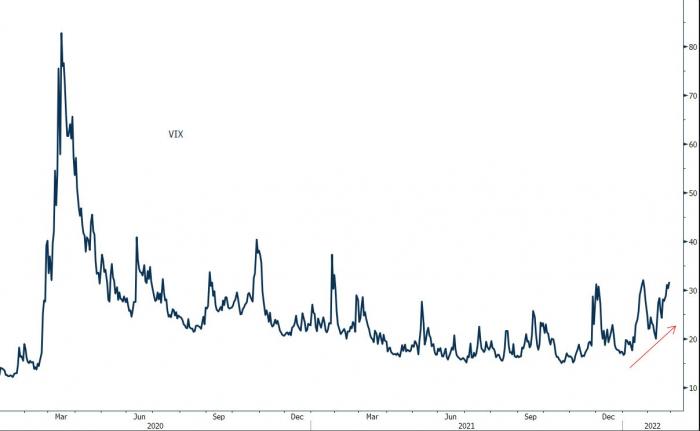
VIX
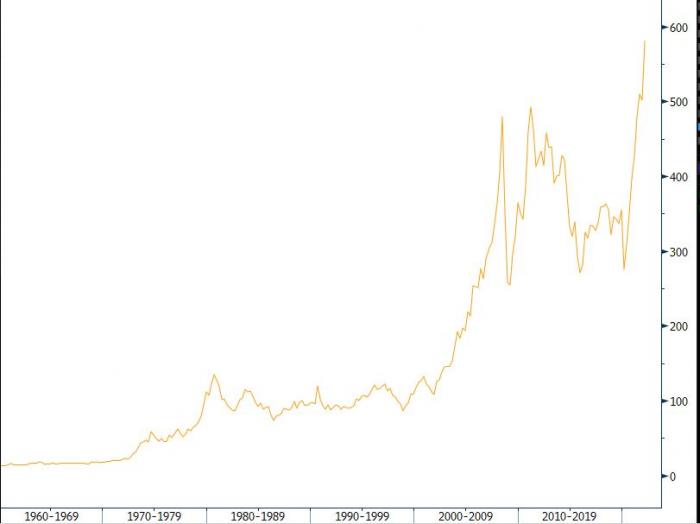
BLOOMBERG COMMOIDTY INDEX
Second ‘tranche’ of Sanctions Placed on Russia
The United Kingdom
• All major Russian banks will have their assets frozen and will be excluded from the UK financial system. This will stop them from accessing sterling and clearing payments through the UK. This includes a full and immediate freeze of VTB bank
• Legislation will stop major Russian companies and the state from raising finance or borrowing money on UK markets
• Asset freezes will be put on 100 new individuals or entities
• The Aeroflot airline will be banned from landing in the UK
• There will be a suspension of dual use export licences to cover things which can be used for military purposes
• Within days the UK will stop exports of hi-tech items and oil refinery equipment
• There will be a limit on deposits Russians can make to UK bank accounts
Source: BBC.co.uk
In addition to this, Mr. Johnson announced that there is potential to cut Russia out from SWIFT (The Society for Worldwide Interbank Financial Telecommunications) payments, while similar financial sanctions will be extended to Belarus for its role in the assault on Ukraine.
United States
President Biden announced on 24th February a second set of more extreme sanctions, with an aim to negatively impact Russia’s economy in the longer-term, while minimising the impact on the U.S. and its allies. Please see below for sanctions announced:
• Severing the connection to the U.S. financial system for Russia’s largest financial institution, Sberbank, including 25 subsidiaries, by imposing correspondent and payable-through account sanctions. This action will restrict Sberbank’s access to transactions made in the dollar. Sberbank is the largest bank in Russia, holds nearly one-third of the overall Russian banking sector’s assets, is heavily connected to the global financial system, and is systemically critical to the Russian financial system.
• Full blocking sanctions on Russia’s second largest financial institution, VTB Bank (VTB), including 20 subsidiaries. This action will freeze any of VTB’s assets touching the U.S financial system and prohibit U.S. persons from dealing with them. VTB holds nearly one-fifth of the overall Russian banking sector’s assets, is heavily exposed to the U.S. and western financial systems, and is systemically critical to the Russian financial system.
• Full blocking sanctions on three other major Russian financial institutions: Bank Otkritie, Sovcombank OJSC, and Novikombank- and 34 subsidiaries. These sanctions freeze any of these institutions’ assets touching the U.S financial system and prohibit U.S. persons from dealing with them. These financial institutions play a significant a role in the Russian economy.
• New debt and equity restrictions on thirteen of the most critical major Russian enterprises and entities. This includes restrictions on all transactions in, provision of financing for, and other dealings in new debt of greater than 14 days maturity and new equity issued by thirteen Russian state-owned enterprises and entities: Sberbank, AlfaBank, Credit Bank of Moscow, Gazprombank, Russian Agricultural Bank, Gazprom, Gazprom Neft, Transneft, Rostelecom, RusHydro, Alrosa, Sovcomflot, and Russian Railways. These entities, including companies critical to the Russian economy with estimated assets of nearly $1.4 trillion, will not be able to raise money through the U.S. market — a key source of capital and revenue generation, which limits the Kremlin’s ability to raise money for its activity.
• Additional full blocking sanctions on Russian elites and their family members: Sergei Ivanov (and his son, Sergei), Nikolai Patrushev (and his son Andrey), Igor Sechin (and his son Ivan), Andrey Puchkov, Yuriy Solviev (and two real estate companies he owns), Galina Ulyutina, and Alexander Vedyakhin. This action includes individuals who have enriched themselves at the expense of the Russian state and have elevated their family members into some of the highest position of powers in the country. It also includes financial figures who sit atop Russia’s largest financial institutions and are responsible for providing the resources necessary to support Putin’s invasion of Ukraine. This action follows up on yesterday’s action targeting Russian elites and their family members and cuts them off from the U.S. financial system, freezes any assets they hold in the United States and blocks their travel to the United States.
• Costs on Belarus for supporting a further invasion of Ukraine by sanctioning 24 Belarusian individuals and entities, including targeting Belarus’ military and financial capabilities by sanctioning two significant Belarusian state-owned banks, nine defence firms, and seven regime-connected official and elites. We call on Belarus to withdraw its support for Russian aggression in Ukraine.
• Sweeping restrictions on Russia’s military to strike a blow to Putin’s military and strategic ambitions. This includes measures against military end users, including the Russian Ministry of Defence. Exports of nearly all U.S. items and items produced in foreign countries using certain U.S.-origin software, technology, or equipment will be restricted to targeted military end users. These comprehensive restrictions apply to the Russian Ministry of Defence, including the Armed Forces of Russia, wherever located.
• Russia-wide restrictions to choke off Russia’s import of technological goods critical to a diversified economy and Putin’s ability to project power. This includes Russia-wide denial of exports of sensitive technology, primarily targeting the Russian defence, aviation, and maritime sectors to cut off Russia’s access to cutting-edge technology. In addition to sweeping restrictions on the Russian-defence sector, the United States government will impose Russia-wide restrictions on sensitive U.S. technologies produced in foreign countries using U.S.-origin software, technology, or equipment. This includes Russia-wide restrictions on semiconductors, telecommunication, encryption security, lasers, sensors, navigation, avionics, and maritime technologies. These severe and sustained controls will cut off Russia’s access to cutting edge technology.
• Historical multilateral cooperation that serves as a force multiplier in restricting more than $50 billion in key inputs to Russia- impacting far more than that in Russia’s production. As a result of this multilateral coordination, we will provide an exemption for other countries that adopt equally stringent measures. Countries that adopt substantially similar export restrictions are exempted from new U.S. licensing requirements for items produced in their countries. The European Union, Australia, Japan, Canada, New Zealand, and the United Kingdom, have already communicated their plans for parallel actions. This unprecedented coordination significantly expands the scope of restrictions on Russia. Further engagement with Allies and partners will continue to maximize the impact on Russia’s military capabilities.
Source: Whitehouse.gov
Please note, the EU will finalise details today on further Russian sanctions.
Our View
• As it stands, the base metal suite has already been impacted by the indirect consequences occurring from heighted geopolitical tensions and the first round of sanctions (including the halting of the Nord Stream 2 gas pipeline), which in the near-term, will keep energy prices across Europe elevated, with aluminium and zinc most at risk. (Please see our report here)
• The second tranche of sanctions yesterday avoided targeting base metal-specific industries, however, we are cautious here, as further sanctions are likely. Indeed, we allude to the announcement from the United Kingdom’s Prime Minister Boris Johnson, in which he stated that Russia could be cut out of the international payment method SWIFT. (To read about the impact this could have, please see our report here).
• Our expectations of future U.S. sanctions targeting the aluminium industry remain low, given meetings held between White House Officials and U.S. aluminium industry representatives over recent weeks. Please note, Russia is responsible for ~10% of total U.S. aluminium imports a year.
• As the situation develops, we will continue to monitor the impact on commodity-trade finance and the impact towards physical trading of Russian held materials.
BRENT CRUDE OIL & EUROPEAN NAUTRAL GAS PRICES
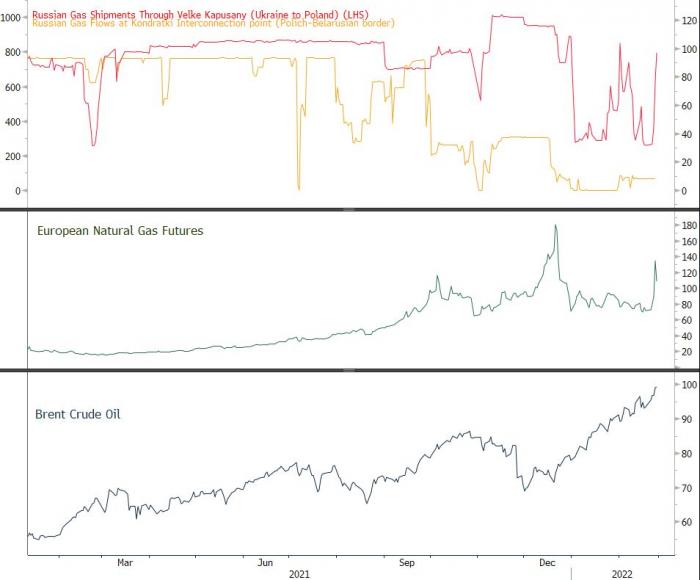
• The outlook for near-term natural gas flows from Russia to Europe is becoming more uncertain, however, we do not expect that Europe will be cut off for a sustained period, as this would not only result in Russia failing to meet its contractual obligations, but would hurt Russia’s longer-term plans for future contracts in the region. However, having said this, natural gas exports out of Russia only make up 25% of that of crude oil (based on Government revenue), while China’s growing intention to supply natural gas to China (given the recent progress on the ‘power of Siberia’ gas pipeline), is evident. Overall, if Russia does withhold supply to Europe as an act of military intervention, it would only negatively impact Russia’s credibility to create future contracts with other countries, and therefore, we see the risk as moderate-to-low. (Please note however, this excludes the knee-jerk market reaction of higher natural gas prices in the near-term due to uncertainty and heighted volatility).
• The outlook for crude oil will be determined in the coming week, with the expected conclusion of Iranian nuclear talks, in addition to 2nd March marking the date for both the next OPEC+ meeting and latest release of U.S. Government crude holdings.
U.S. DOLLAR VERSUS EURO