Given the fast-changing nature of developments between Russia and Ukraine and indeed the introduction of updated sanctions on Russia, below we provide a snapshot update on the base metal market and look at the underlying fundamentals for copper, nickel, and aluminium.
THE UNITED STATES – Executive Orders
• The importation into the United States of Russian crude oil and certain petroleum products, liquefied natural gas, and coal. Last year, the U.S. imported nearly 700,000 barrels per day of crude oil and refined petroleum products from Russia and this step will deprive Russia of billions of dollars in revenues from U.S. drivers and consumers annually.
• New U.S. investment in Russia’s energy sector, which will ensure that American companies and American investors are not underwriting Vladimir Putin’s efforts to expand energy production inside Russia.
• Americans will also be prohibited from financing or enabling foreign companies that are making investment to produce energy in Russia.
Source: Whitehouse.gov (here)
THE UNITED KINGDOM
• “In another economic blow to the Putin regime following their illegal invasion of Ukraine, the UK will move away from dependence on Russian oil throughout this year, building on our severe package of international economic sanctions” – Prime Minister, Boris Johnson
THE EUROPEAN UNION
• The EU will officially release new sanctions on Russia later this week during the COREPER II summit to be held in Versailles. As it stands, it is understood that sanctions will focus on Russian officials and oligarchs, the export of maritime navigational technology to Russia and three Belarusian banks.
Source: BBC
THE EUROPEAN COMMISSION
• “By the end of this year, we can replace 100 bcm of gas imports from Russia. That is two-thirds of what we import from them. This will end our over-dependency and give us much needed room to manoeuvre. Two thirds by the end of this year” – Executive Vice-President Timmermans
• Meanwhile, a plan called “REPowerEU” was also announced, which has the goal of making Europe independent from Russian gas “well before” 2030. The first track to do this is to “diversify supply and bring in more renewable gases”, with the second track to “accelerate our clean energy transition” - Executive Vice-President Timmermans
Source: ec.europa.eu (here)
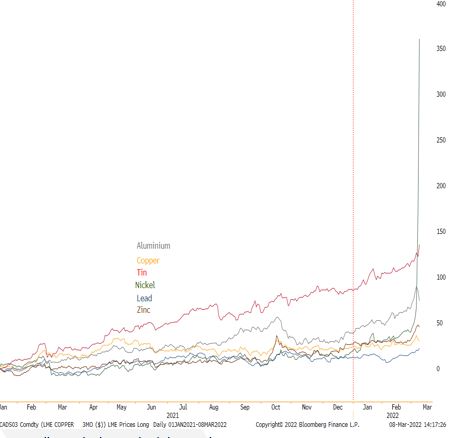
LME 3M BASE METAL PRICE PERFORMANCE
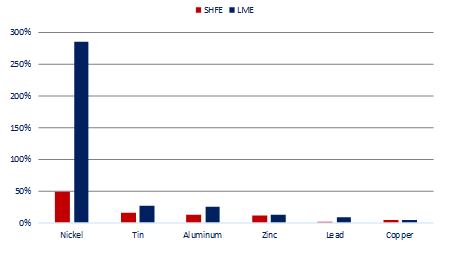
LME VERSUS SHFE YTD PRICE PERFORMANCE
THE IMPACT OF SANCTIONS ON THE BASE METAL MARKETS – IN SUMMARY
As it stands, no Russian owned base metal producer has been directly targeted with sanctions; however, the indirect impact of sanctions can be summarised below:
U.S. & U.K Place Sanctions on Imports of Russian Oil & Gas
(In addition to the halting of Nord Stream II Gas Pipeline – in which the operator Nord Stream 2 AG filed for bankruptcy on 2nd March)
• Supports high energy prices in the United States, United Kingdom, and Europe across the medium-term
• Permanent re-routing of trade flows
• Base metal smelters to face near-term pain as adjustments are made (and countries seek to fill the ‘gap’ in supply)
• Aluminium and zinc are most at risk given high energy intensive production routes, expect deficits this year to widen from previous forecasts, stocks remain a fraction of deficits
• Reliance on higher Chinese output in the near-term
• LME prices & premia in the west to remain elevated and on an upward trajectory
Commodity-Finance for Russian Banks Cuts
• The prevention of Russian banks from using SWIFT will not stop transactions from taking place; however, it could increase the time it takes (i.e., using alternative methods like emails to communicate or indeed other similar communication and payment methods like Chinese Cross-Border Interbank Payment System (CIPS) or Russian System for Transfer of Financial Messages (SPFS)).
• The prevention of the Russian Central Bank (and others) from making transactions in U.S. dollars or in sterling will limit finance and liquidity available (and in our view is more detrimental to the Russian economy than the sanction on SWIFT)
• Meanwhile, reputation risk associated to current and future sanctions will likely disrupt commodity-trade with Russia on a global basis (please note the list of banks that have thus far restricted finance for purchases of Russian commodities: ICBC, Bank of China Ltd, ING Group NV, Rabobank, Société Generale SA, Credit Agricole SA & Credit Suisse Group AG)
Ukrainian Specific Disruptions
• Ukrainian iron ore producer Ferrexpo announced force majeure on 25th February
• 40% Ukrainian steel production suspended for a week
• 1.7Mt/y Mykolaiv alumina refinery plant owned by RUSAL has “severely curtailed” production (accounts for 1.2% of global alumina capacity)
Freight Disruptions (No booking to and from Russia)
• No booking to and from Russia – this includes MSC (the world’s largest shipping company), CMA CGM (the world's second largest shipping company), A.P. Moller-Maersk A/S (responsible for ~17% of global container fleets) and One Network Express Pte (Asia’s second largest container shipping line)
• Markets awaiting EU ban on shipping from Russia (following European Parliament passing a similar rule on 1st March)
• Higher freight rates as a result will have a knock-on impact on the availability of inventories held in Asia
In Summary
- Base metal prices are set on an upwards trajectory as pressure is placed on future supply outside China
- LME metal backwardations could rise if metal from Russia is replaced by warehouse inventories
- Heightened volatility (please see our report ‘The LME Closes Trading on All Nickel Contracts- Snapshot Update’ – here)
What to Watch
- Concerns regarding the physical movement of commodities (please note, if sanctions are placed on Russian Railways this could impact flows to China)
- Risk of reduced Russian market liquidity could indirectly impact Russian commodity producers
- Risk of further sanctions on Russia from global powers (will Russia retaliate?)
- Demand destruction on higher prices is needed to help rebalance the market
COPPER, ALUMINIUM & NICKEL MARKET FUNDAMENTALS
COPPER
Quantifying Russian Copper Exports
• Russian mine production makes up 4% of the global copper market (~800,000t), making Russia the 8th largest producer in the world
• Russia produces 4% of global refined copper (~1Mt)
• Russia is the third largest global exporter of refined copper & copper wire rod
• Russia exports 70% of copper cathode produced, with 50-60% going to China and a third going to Europe
What Impacts Have Current Sanctions Played on Copper
• No direct sanctions on metal producers yet, risks remain moderate
• Indirect Impact:
- Uncertainty and self-sanctioning on importing Russia commodities
- No direct refinery reduction from Ukrainian wire rod producer (>10,000t)
Will China See Higher Flows of Copper?
In the near-term there remains hesitancy in the markets, but China’s import share could rise as a result.
Have Freight Issues Impacted Copper Shipments Out of Russia?
No reduced trade flows yet. Please note copper concentrates can travel from Russia to China by land, but copper cathode imports are more complicated and tend to go via cargo shipments from Russia to Rotterdam. If we see increased railway use, the transport costs to move copper out of Russia will rise.
What Would Happen if Russia stopped exporting aluminium to European Markets?
Longer-term impact to be considered as 1-1.5Mt of copper projects are set to come online over the next decade.
Market Balance
Copper is set to record a fifth year of deficits in 2022 at ~100,000t
ALUMINIUM
Quantifying Russian Aluminium Exports
• Russia is the world’s third largest producer of primary aluminium (following China and India)
• Russia is the largest exporter of aluminium & semis (outside China), of which 41% feeds Europe, 24% goes to Asia, 8% to America (and 27% domestic demand)
What Impacts Have Current Sanctions Played on Aluminium
Sanctions Impact
• No direct sanctions on metal producers yet, risks remain moderate
• Indirect Impact:
- Higher energy prices (750,000t idled capacity won’t come online until Q3 at the earliest)
- Alumina supply from Ukrainian operation to Rusal (1.7Mt/y) unable to fulfil shipment operations. Likely to see Russia look for alternatives, possibility from China.
- Uncertainty and self-sanctioning on importing Russian commodities
Will China See Higher Flows of Copper?
In the near-term there remains hesitancy in the markets, but China’s import share could rise as a result
Have Freight Issues Impacted Aluminium Shipments Out of Russia?
No reduced trade flows yet
What Would Happen if Russia stopped exporting aluminium to European Markets?
Expect the deficit to widen further than current expectations, which would push the price to a new historic high. Given a lack of alternative supply of aluminium and its VAP, European and Western counties would suffer in specialist industries such as the automotive sector.
Market Balance
Aluminium is set to record its second year of deficits in 2022 at over 2Mt.
NICKEL
Quantifying Russian Nickel Exports
• Russia accounts for 5% of global refined nickel (if we account for Nornickel’s plant in Finland as well then 6.5%)
• Russia accounts for 15% of Class I nickel globally
What Impacts Have Current Sanctions Played on Nickel
No direct sanctions on metal producers yet, risks remain moderate
• Indirect Impact:
- 16,000t ferronickel supply from Ukraine could be impacted
- Primarily Class I nickel market that is impacted; with demand for briquettes in LME stocks already high, expect premia to remain elevated
Will China See Higher Flows of Nickel?
In the near-term there remains hesitancy in the markets, while demand in China has been weak this year for both EV and stainless steel. No rush from Chinese buyers to soak up tonnage.
Have Freight Issues Impacted Nickel Shipments Out of Russia?
No reduced trade flows yet but please note, Nornickel has its own shipping line, so only impact if we see more sanctions in Europe (like those the UK placed on its waters)
What Would Happen if Russia stopped exporting nickel to European Markets?
EV market in Europe will be hit the hardest, while the stainless-steel market will fare better (given that it uses nickel scrap and ferronickel largely over Class I nickel). The market surplus this year will tighten, while the Class I nickel market will face deficits, and this will have a direct impact on the price.
Market Balance
Nickel is set to record a balanced market in 2022, after a deficit last year.