Hopes of a Turn Around in Chinese Demand are Dashed by the Release of Trade Data
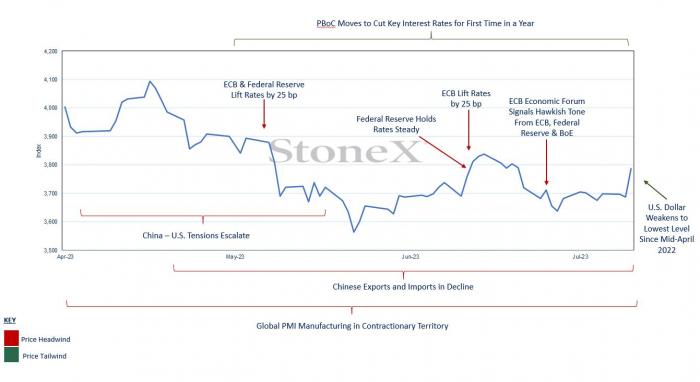
In recent weeks, activity undertaken by China’s PBoC and Government to stimulate growth in the country (by cutting key interest rates and promising more targeted monetary and fiscal policy), have been unable to offset the continued release of downbeat economic readings. This is particularly true this week, with trade data overnight highlighting the ongoing weakness in domestic and external demand forecasts. In this commentary, we will highlight the key outcomes of China’s June economic numbers and the impact on the base metal market.
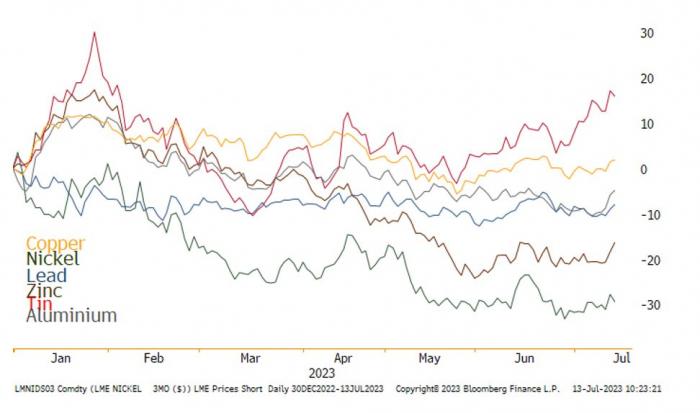
Base Metal 3M LME Price Performance
What Have June Chinese Economic Readings Shown Us So Far?
1. Trade Activity Continues to Fall Deeper into the Red
2. Deflation - a Possibility?
3. Manufacturing Remains in Contractionary Territory
4. PBoC and Government Move to Increase Stimulus Efforts
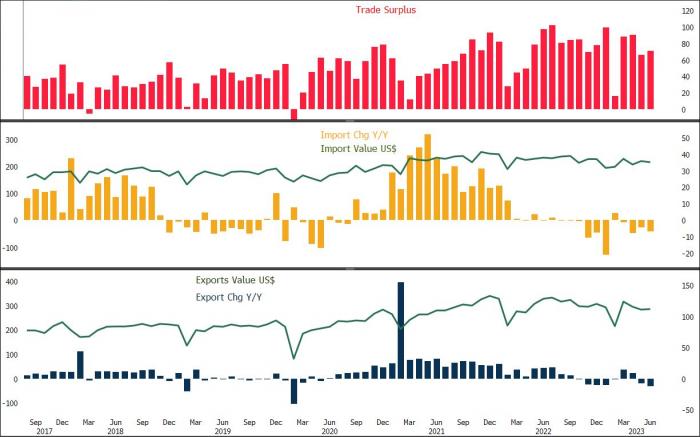
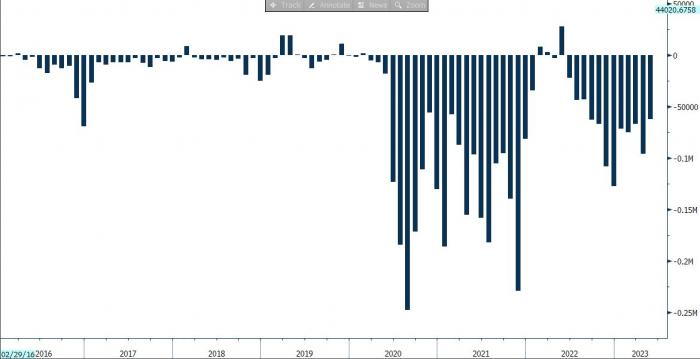
• June exports out of China fell at their quickest pace since February 2020 (at -12.4% Y/Y), exceeding market forecasts. This marks the fourth month of consecutive declines out of the country. If we look at export levels to key trading partners, the impact from higher-interest rates for longer in the west is limiting consumer appetite, while demand from southeast Asian nations is not faring much better, with outright contractions recorded across Europe, the U.S. and Asia ex-China since May. In addition, exports from Russia (which have been a key driver of support this year) have decelerated since hitting a peak in April, likely a sign of things to come.
• Meanwhile, June imports similarly fell more than expected, declining by 6.8% Y/Y from 4.5% in May, reflecting a third month of weakening activity.
Chinese Exports by Country – Russian Demand Starts to Falter
Copper
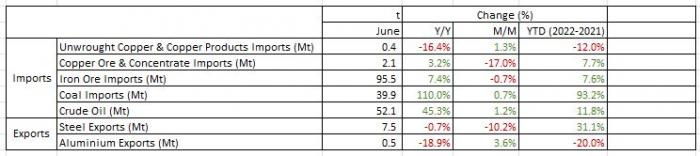
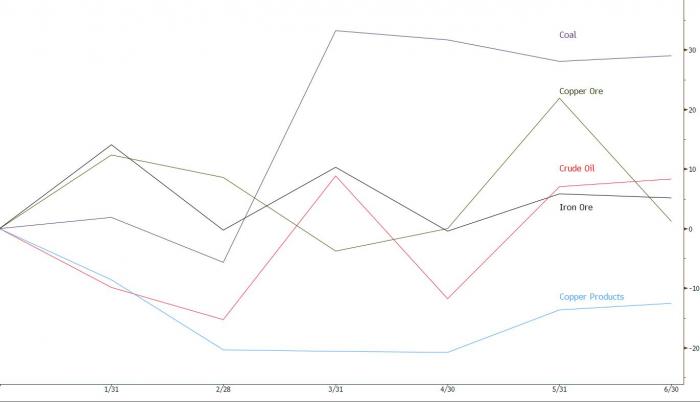
Despite an increase in M/M imports for unwrought copper and copper products in June, on a YTD basis, imports remain deep in the red, with this recent improvement in activity likely down to material flows being re-established between CMOC Group in the DRC and China. Meanwhile, the pullback in copper ore imports by a significant 17% in June highlights the reality of weak demand in the country, as SHFE inventories increase upon record domestic production.
Energy Products
China has favoured imports of energy products in 2023, as the country aims to avoid power shortages faced in previous years. Please note, in the Two Session annual meeting in March, coal was outlined as the fuel of choice this year.
Steel
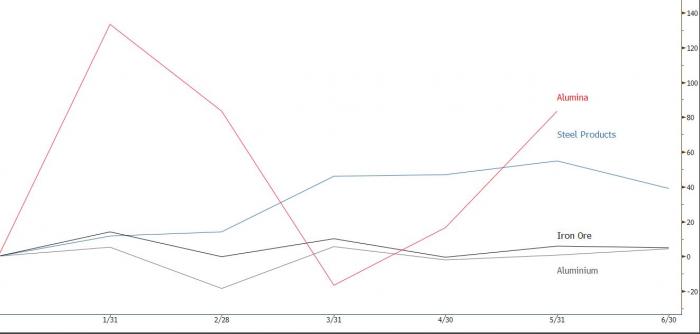
While exports in June pulled back by 10.2% M/M, this move is not in fact as significant as the outright figure reflects, given that May export levels for steel rose to their highest level since 2016, and YTD Y/Y exports remain up by 31.1%. However, given falling water levels within Europe’s Rhine River (which is the major transport route for commodities and fuel in the region), and modest infrastructure demand within China, steel demand is set to remain luke warm in the near-term.
Aluminium
China has been a net importer of aluminium since 2020, reversing its global position as a supplier of the metal in previous years. However, looking at gross exports, demand has been on a downwards trajectory since June 2022, as global manufacturing activity has been unable return to peak posted in 2021.
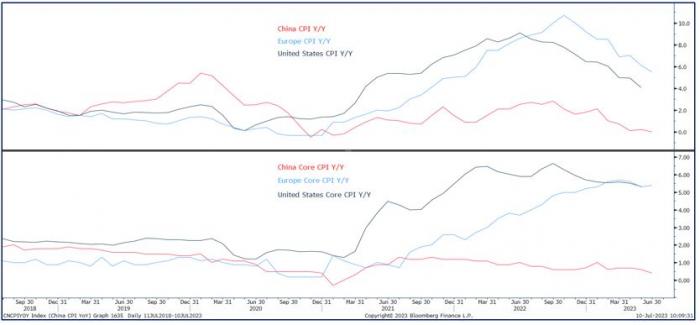
Deflation - a Possibility?
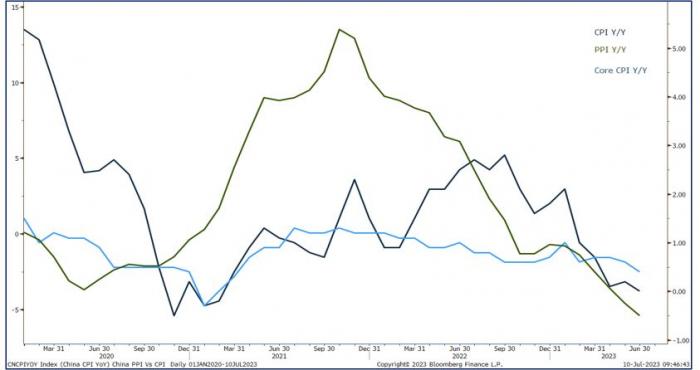
• China June’s CPI reading came in flat compared to a year earlier, while the reading for factory-gate prices declined at its quickest pace since December 2015, raising the risk that further sluggish demand ahead could result in deflation in the country.
• On a M/M basis, the CPI has fallen for a fifth consecutive month, while the PPI reading fell for a third month.
• Please note on a M/M basis, six out of the eight categories in the CPI basket highlighted deflation, including travel prices, mining industries and durable goods.
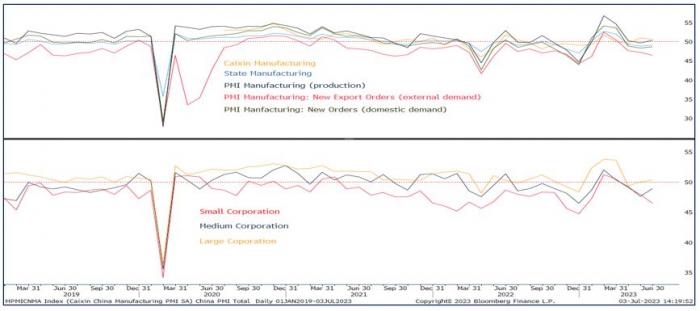
State Produced Figures
• Manufacturing PMI for June came in as expected, lifting to 49.0 (from 48.8), but remained in contractionary territory
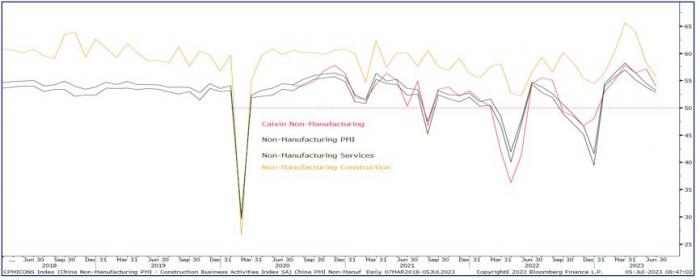
• Non-manufacturing PMI declined below expectations to 53.2 from 54.5 in May
Caixin Produced Figures
• Caixin manufacturing PMI fell to 50.5 from 50.9, although remained in expansionary territory and came in higher than forecasts of 50.0
• Services declined to 53.9, falling well below market expectations of 56.2 from 57.1 in May
July data remain weak overall from what we had anticipated for China at the start of the year, with both domestic and foreign orders remaining in contractionary territory, while construction activity decelerates for a third month.
The outcome of the Q2 Monetary Policy meeting highlighted that more targeted stimulus will take place this year:
"We will launch more practical and effective measures in expanding the potential of domestic demand, activating market vitality, promoting coordinated development, accelerating green transition, and promoting high-level opening to the outside world”- Premier Li Qiang.
While a move to cut key interest rates for the first time in 12 months, reflects that the country will use all possible tools to boost growth, while avoiding fuelling asset bubbles.
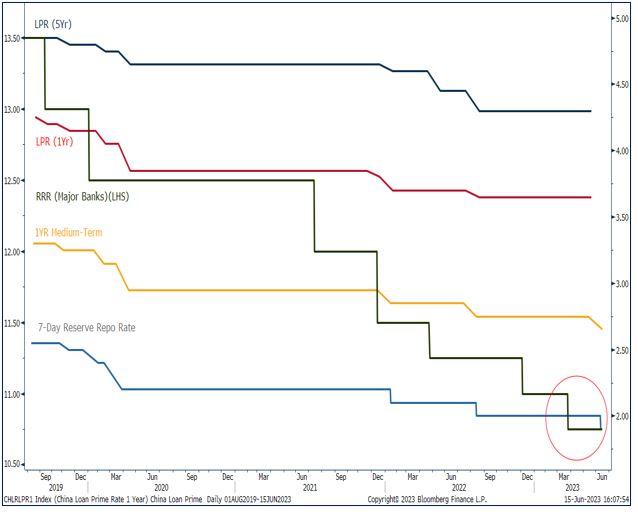
• The 1Y LPR (a proxy for corporate short-term loans), was cut by 10 bps in June to 3.6%, after previously being cut in August 2022.
• The 5Y LPR (a proxy for mortgage loans), was cut by 10 bps in June to 4.2%, marking the first cut since August 2022.
• The 1Y medium-term lending facility was reduced by 10bps in June (please note the previous cut was in July 2022).
• Corporate U.S. dollar deposits for the nine largest banks were cut to 5.1% in July from 5.7% a few weeks ago (and 6% a month ago). This comes as a move to help stabilise the yuan.
• 1Y-household deposits were cut to 2.8% in July from 4.5% previously (to boost household spending).
We forecast that the weak PMI reading at the start of July would be a sign of things to come for the rest of the month, which at present, holds true. Despite positive headlines surrounding actions taken by the PBoC and Government to boost stimulus and accelerate growth this year, ongoing issues within the property market, muted domestic consumer confidence and weakening external demand have capped optimism and failed to result in a robust recovery.
We forecast that as we enter the wetter, warmer summer months within China, construction demand will struggle to improve from current levels in the near-term, while seasonal weakness in manufacturing will further act as a headwind. Having said this however, it is worth watching domestic stock levels, which have been recording outflows over the last several months as barometers of a demand turnaround.
To follow weekly developments taken by China, please follow this link to our ‘Weekly Macro Economic Base Metal Slides’ here.