Brazilian Robusta Coffee Exports May Gain Momentum with New U.S. Tariffs
On April 2, 2025, U.S. President Donald Trump announced the imposition of tariffs on imports originating from various countries. According to the most recent information, these measures do not include exceptions, including for the coffee sector. However, the director of the National Coffee Association of the United States stated, in an official note, that a request has been submitted to the Department of Commerce for coffee to be exempted from the new tariffs. Thus, there is still uncertainty regarding the actual application of these measures to imported coffee.
Given the current scenario, it is possible to assess the potential impacts of these tariffs on coffee-exporting countries. According to the USDA, the United States imported approximately 7.3 million bags of green coffee from Brazil, its main supplier, in 2024. In this case, a 10% tariff was applied. Data from the Brazilian Coffee Exporters Council (Cecafé) show that only 693,000 bags of robusta coffee were exported to the U.S. in 2024. From Colombia, the second-largest U.S. coffee trading partner, nearly 4.2 million bags were imported that year, also subject to the 10% tariff.
The same tariff rate was applied to imports from Honduras, Guatemala, Peru, Costa Rica, Ethiopia, Uganda, and El Salvador. In contrast, countries such as Vietnam, Nicaragua, and Indonesia were subject to significantly higher tariffs. Vietnam, for example, will face a 46% tariff on its coffee exports to the U.S. According to the USDA, the U.S. imported 1.5 million bags from Vietnam in 2024, mostly composed of robusta coffee, as this variety dominates Vietnamese production. Indonesia, another major robusta producer, exported 637,000 bags and will be subject to a 32% tariff. Nicaragua, in turn, will face an 18% tariff.
Main Origins of U.S. Coffee Imports in 2024 and the Announced Tariffs
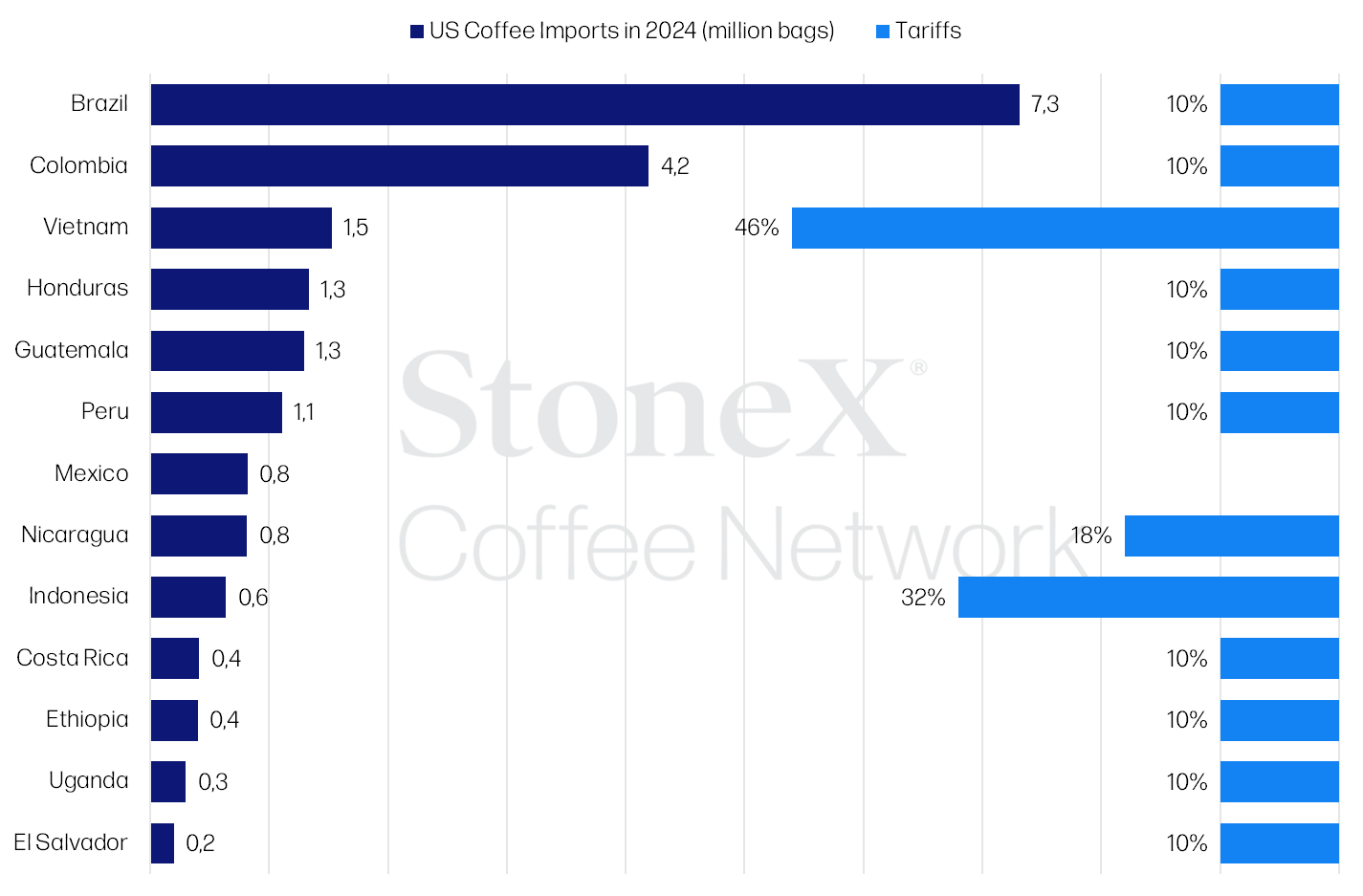
Sources: USDA and U.S. Government. Design: StoneX.
This new scenario may create opportunities for increased Brazilian robusta coffee exports to the U.S., especially in light of the trade restrictions faced by key competitors such as Vietnam and Indonesia. Although Brazil already holds a prominent position as a supplier of arabica coffee, the volume of robusta exported remains relatively low, which represents a significant opportunity for growth.
The United States is currently the world’s largest coffee consumer. Estimates from the U.S. Department of Agriculture (USDA) project consumption at 23.9 million bags for the 2024/25 season. In 2024, total imports reached approximately 21.2 million bags, highlighting the country’s strong reliance on foreign supply to meet domestic demand.
Another relevant point concerns the impact of the tariffs on consumer prices. The coffee market has already shown significant price increases since 2024, culminating in historic highs recorded in February 2025. This price surge has directly impacted consumers. In Brazil, for instance, the annual inflation rate for roasted and ground coffee exceeded 66% over the past year. A similar situation occurred in the United States, where the price of roasted and ground coffee reached $7.25 per pound, the highest level since the beginning of the historical series in 1980. The annual inflation rate for this product in the U.S. reached 18.9% as of January 2025.
Therefore, if the tariffs announced are effectively implemented, coffee prices are likely to continue rising, further pressuring inflation on this product in the United States. In addition to affecting trade flows and the competitiveness of certain exporting countries, these measures could have significant consequences for U.S. consumers and for global coffee trade dynamics.