July grain options expired on Friday.
Tomorrow quarterly stocks and WASDE.
The U.S. and Mexico are stepping up their response to New World screwworm, a dangerous livestock parasite that can infest open wounds and kill animals if untreated. The two countries opened a new sterile fly production facility in Chiapas, Mexico, near the Guatemala border, as part of a broader effort to stop the pest from moving farther north. The strategy is to release large numbers of sterile male flies into affected areas so wild populations cannot reproduce, which is the same basic method used decades ago to eradicate screwworm from the U.S. This is important for cattle and livestock markets because screwworm has already disrupted cross-border animal health controls and raised concerns about cattle movement, beef supply, and higher production costs if the outbreak spreads. The new facility is a positive step, but the market will still watch closely for new detections near the U.S. border and any further restrictions on live cattle trade. Reuters reported the Chiapas facility is expected to produce up to 100 million sterile flies per week, while USDA has confirmed a U.S. case in Texas during the current outbreak and says sterile fly releases and surveillance are part of the containment effort.
President Trump’s tariff threat is another sign that trade tensions are moving beyond traditional goods and into the digital economy. On Friday, Trump said several European countries are considering digital services taxes aimed at large American technology companies, and he warned that any country moving forward with such a tax could face tariffs of up to 100% on exports to the U.S. The issue matters because Europe views the taxes as a way to collect revenue from major tech firms operating in their markets, while the U.S. sees them as discriminatory measures targeting American companies. For markets, this is not an immediate agriculture-specific headline, but it raises the risk of a broader U.S.-Europe trade dispute, which could pressure global risk sentiment, support the dollar, and create another potential headwind for commodities if retaliation escalates.
The situation in the Strait of Hormuz remains fragile but has not yet turned into a confirmed closure or sustained supply disruption. The U.S. struck Iranian coastal radar, missile, drone, communications, air-defense and minelaying-related sites after Iran attacked commercial shipping, including a vessel tied to Qatari oil flows. Iran responded by launching missiles and drones toward U.S. military positions in Kuwait and Bahrain, though U.S. officials said those attacks either failed, missed, or were intercepted. Both sides are accusing the other of violating the ceasefire/MoU, and Iran has publicly rejected direct U.S.–IRGC communication on Hormuz. Still, reports indicate
S&P’s decision to affirm the U.S. at AA+ with a stable outlook is a reassuring credit headline, but it is not a clean bill of health. The agency cited the resilience of the U.S. economy, solid revenue collection, and strong institutions as reasons to keep the rating stable, while still flagging fiscal pressure from large deficits, political polarization, and debt growth. For markets, the takeaway is that this avoids a negative ratings shock and should be modestly supportive for Treasuries and risk sentiment, but it does not remove the longer-term concern that U.S. fiscal policy remains stretched. In the near term, this helps steady confidence, while the bigger macro focus remains inflation, Fed policy, tariffs, and Treasury supply.
China’s latest industrial profit figures point to a still‑resilient but increasingly uneven recovery in the manufacturing sector. May profits rose 21.1% year‑on‑year, a moderation from April’s 24.7% pace, suggesting that the strongest phase of the recent upswing may be behind us even as growth remains firmly in double‑digit territory. At the same time, cumulative profits for January–May climbed 18.8% from a year earlier, edging up from 18.2% in the prior period and underscoring that the overall profit base is still expanding rather than rolling over. The key takeaway is that China’s factory side remains an important support for global activity, but the profit strength is concentrated in export‑oriented and technology‑linked industries, leaving the broader recovery sensitive to any cooling in external demand and to ongoing domestic demand headwinds.
France’s deadly heat wave is becoming both a public-health and market concern, with officials reporting roughly 1,000 excess deaths during the past week as temperatures reached exceptional levels across the country. The immediate human impact is concentrated among older and more vulnerable populations, but the broader issue for markets is that extreme European heat can disrupt transportation, power demand, river logistics, labor productivity, and crop conditions. For agriculture, sustained heat in France and Western Europe raises concern for corn and other summer crops if stress continues during key development stages, while also adding pressure to livestock, energy use, and infrastructure. The key takeaway is that this is no longer just a weather headline — it is a real economic and supply-chain risk if the heat persists or spreads farther across Europe.
China is sending a tougher message to Europe, with a CCTV-affiliated account saying Beijing can withstand a further deterioration, or even a freeze, in economic and trade ties with the EU. The comment reflects rising tension as Europe pushes back on Chinese industrial policy, electric vehicles, technology, procurement, and strategic supply chains, while China signals it will not be pressured into concessions. For markets, this is not an immediate agriculture-specific headline, but it adds to the broader theme of global trade fragmentation and raises the risk of more retaliation between two major economies. If China-EU tensions continue to build, it could weigh on global risk sentiment, pressure industrial demand expectations, and create another layer of uncertainty for commodities and currencies.
China’s central bank is adding short-term liquidity to keep funding markets stable, but it is doing so in a targeted way rather than announcing a broad stimulus package. The PBoC injected 157.5 billion yuan through its regular seven-day reverse repo operation and kept that rate unchanged at 1.40%, while also adding 300 billion yuan through overnight reverse repos at a reported 1.25%, below expectations. The lower overnight rate suggests Beijing wants to ease short-term funding pressure, especially around month-end, without making a larger policy-cut signal. For markets, this is modestly supportive because it shows China is still working to stabilize financial conditions, but the move is more about keeping liquidity calm than launching a major growth stimulus.
Fed commentary remains tilted hawkish, with Minneapolis Fed President Kashkari saying he is still concerned about inflation, especially in services, and that recent price pressure is broader than just oil or Middle East disruptions. Kashkari said he has one rate hike penciled in for 2026, expects rates to stay on hold in 2027, and warned the Fed may need to raise rates again if inflation remains broad-based. He also noted the Fed is moving away from forward guidance, meaning markets may get less clear direction from the Fed statement and will have to react more directly to incoming data. Richmond Fed President Barkin also said inflation is still too high, although he sees some signs that price pressures could ease. For markets, the message is that the Fed is not ready to declare victory on inflation, which keeps upward pressure on rates and the dollar and can act as a headwind for commodities and broader risk appetite.
Private credit funds are increasingly moving into Buy Now, Pay Later consumer debt, with investors agreeing to buy loans before they are even made in search of higher returns. The concern is that this creates an incentive for BNPL firms to keep producing more consumer loans at a time when borrowers are already showing more repayment stress, drawing comparisons to the pre-2008 subprime lending model. Supporters argue lenders still retain some risk, but the bigger issue is that two opaque parts of finance—private credit and BNPL—are overlapping just as private credit faces investor withdrawals and consumer credit quality is weakening. The broader takeaway is that this is another sign of late-cycle credit risk building under the surface.
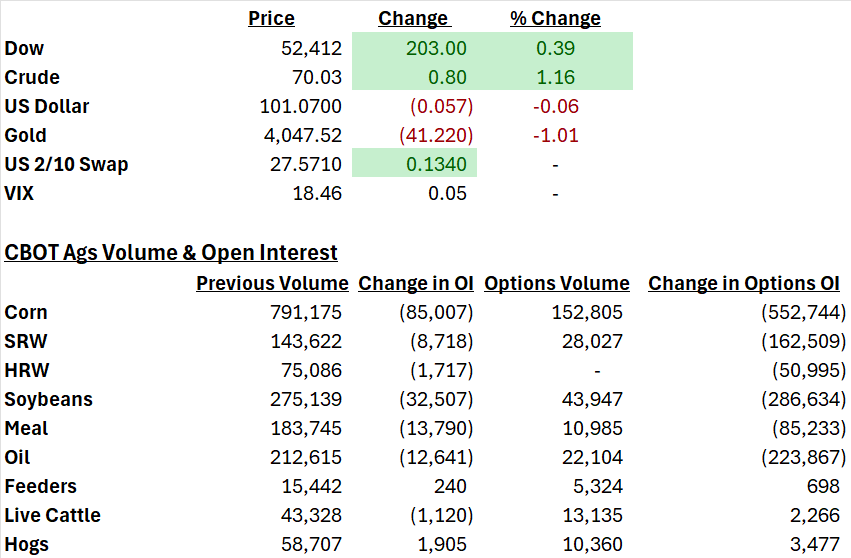
Overnight option activity
Corn
S 750 q 420 c 11 ¾ to 11 5/8
B 1000 u 430 c 12 5/8 to 12 3/4
S 100 h 490/470 ps 14 1/8
S 300 u 410 p 12 7/8 to 12 1/2
B 250 z 450 c 9 5/8
S 100 z 480/460 ps 14 7/8
B 300 z 500 c vs s 400 p 3/8 db vs 437 1/4
S 200 z 440 straddles 48
B 300 k 480 c vs s 430 p 8 ½ db
S 500 sd q 440 c 12 to 11 1/4
B 300 n 485 c vs s 435 p 9 ¾ db
S 200 u 450 c 7 1/8 to 6 7/8
B 300 z 460 c vs s 410 p 5 7/8 to 6
B 500 h 475 c vs s h 425 p 6 7/8 to 7
Beans
S 500 q 1140 c 14 3/8
S 1000 u 1130 p 29
B 800 x 1150 p 43 to 45 3/4
B 300 v 1180 c 26 ½ to 28
B 375 v 1190/1200 cs 2 5/8
Soymeal
B 300 z 315/340 c 5.15
B 250 u 370 c .70
Wheat
B 250 q 560 p 4 ¾ to 4 7/8
S 200 u 580/560 ps 9
Open interest changes
Corn
Aug 475/530 cs buy and short aug 440 straddle sales were new. Aug 495/550 call spread buy and sept 460/450 put spread sales were rolling longs. Sept 465 call buy was closing.
Beans
Short aug 1170 call buy and nov 1180 call buys were new.
Soymeal
Aug 310 call sale, aug 300 put buy and aug 295 put buys were new.
Lean hogs
Aug 88 put buy was new
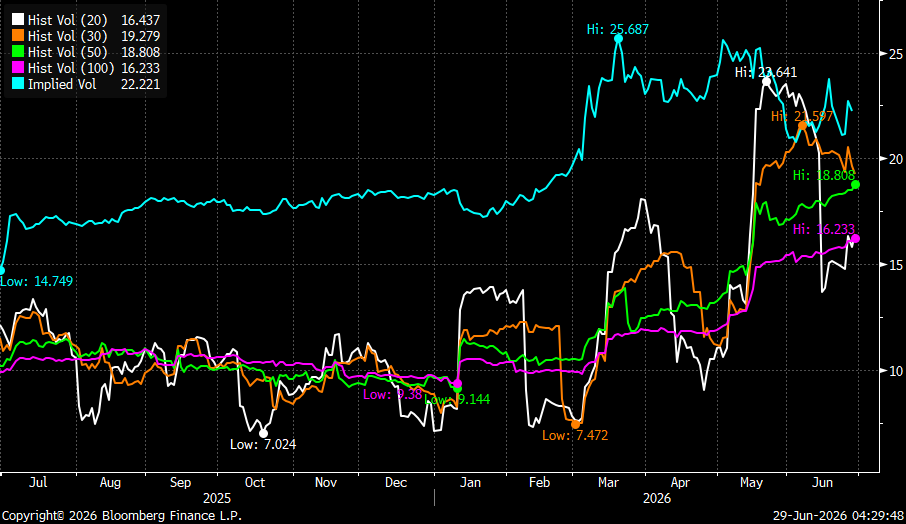
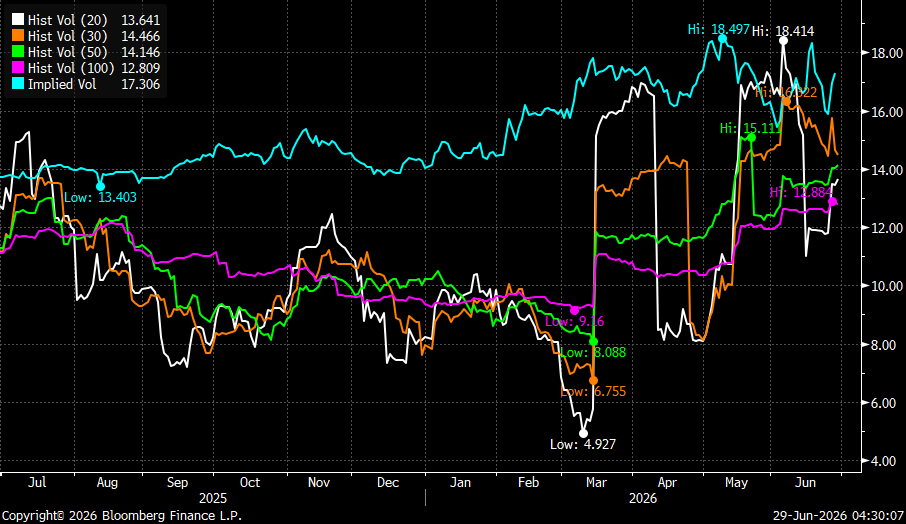
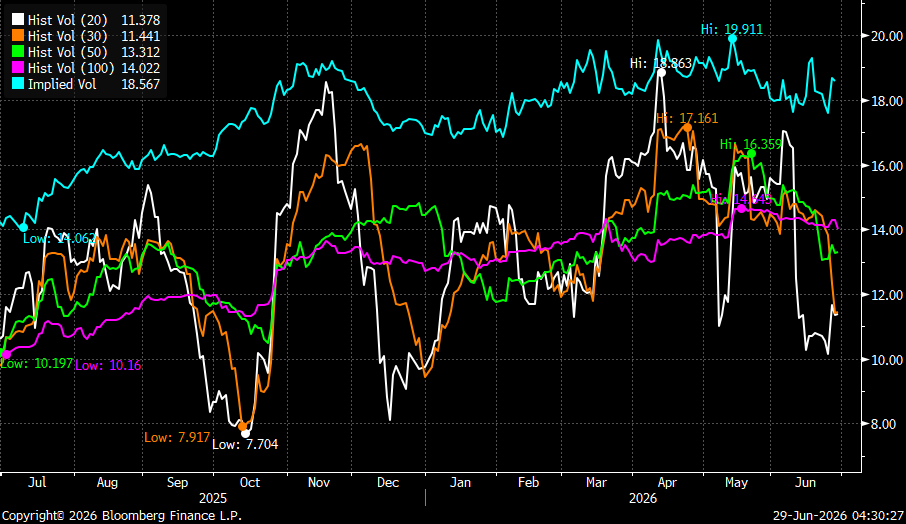
Cvol
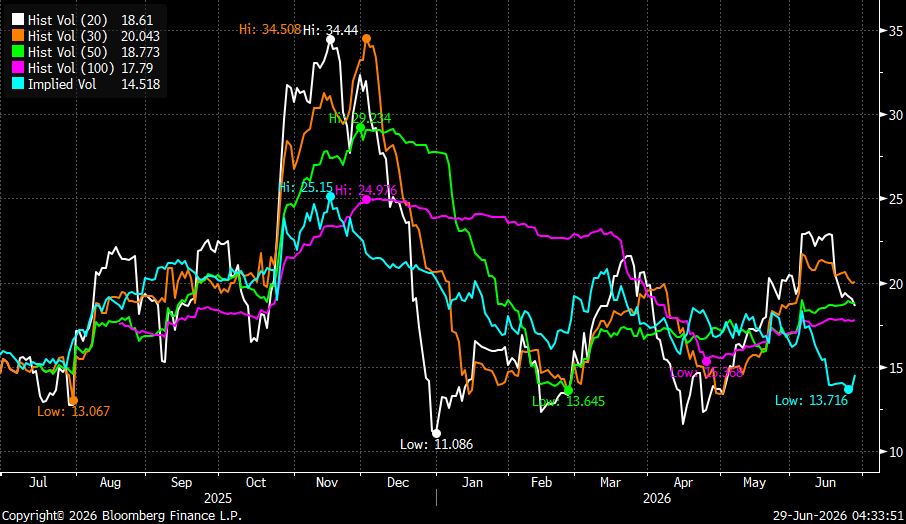
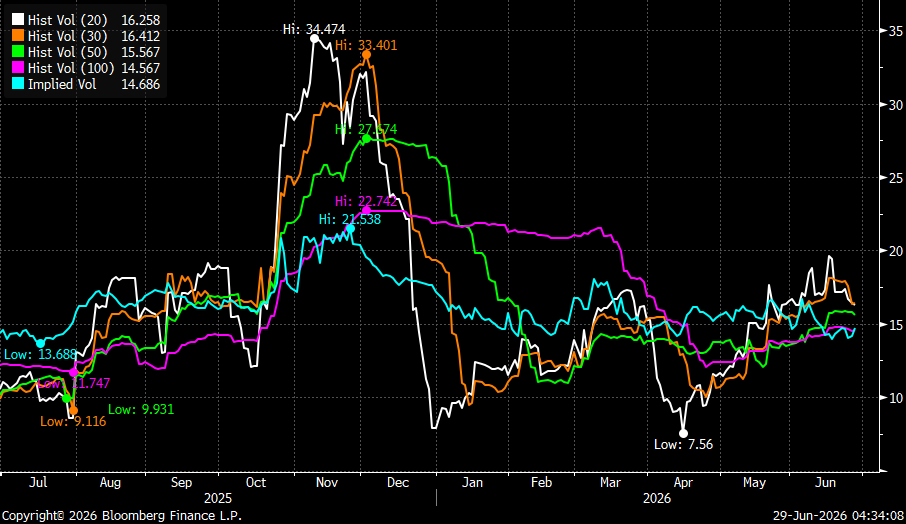
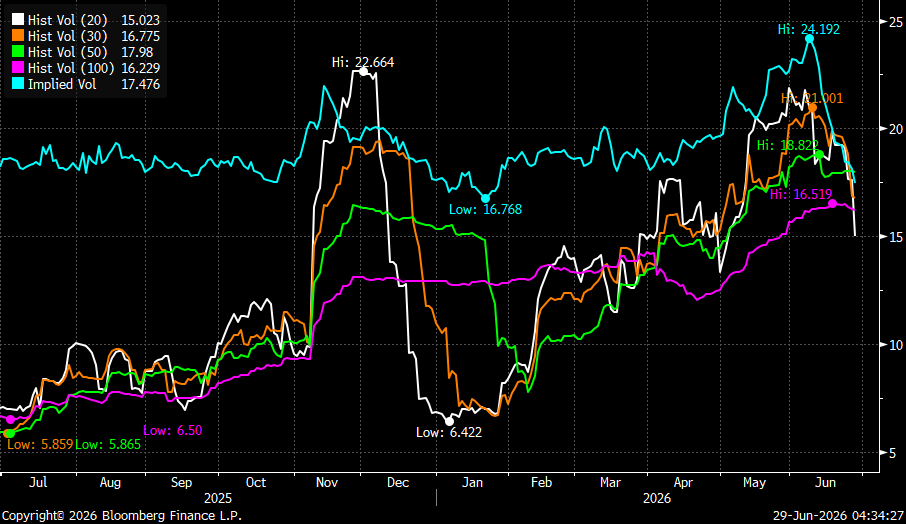
Ags 22.33% down .57%
Corn 31.46% down 2.34%
Beans 18.79% up .32%
Soymeal 21.67% down 1.06%
Bean oil 25.90% down .19%
Wheat 27.47% down 1.50%
Feeder cattle 15.24% up .66%
Live cattle 21.19% down .36%
Class 3 milk 19.51% up .31%
Corn
Beans
Soymeal
Bean oil
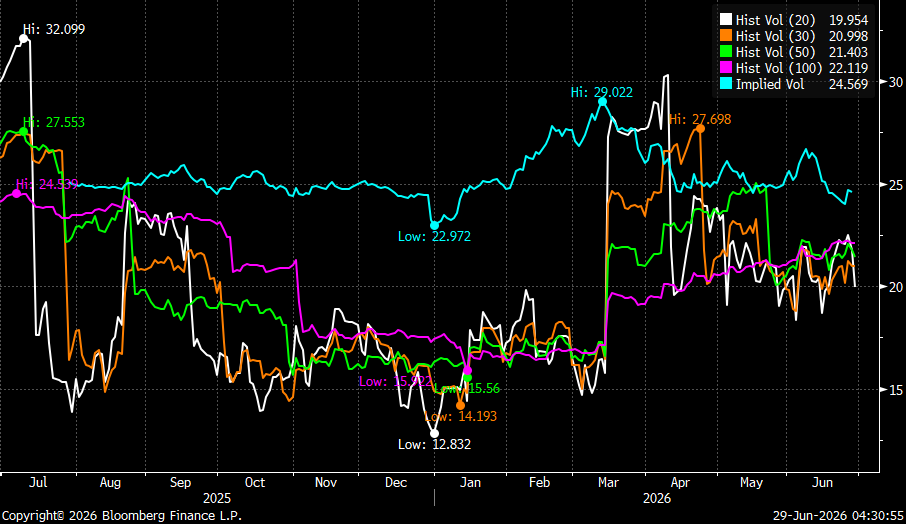
Wheat
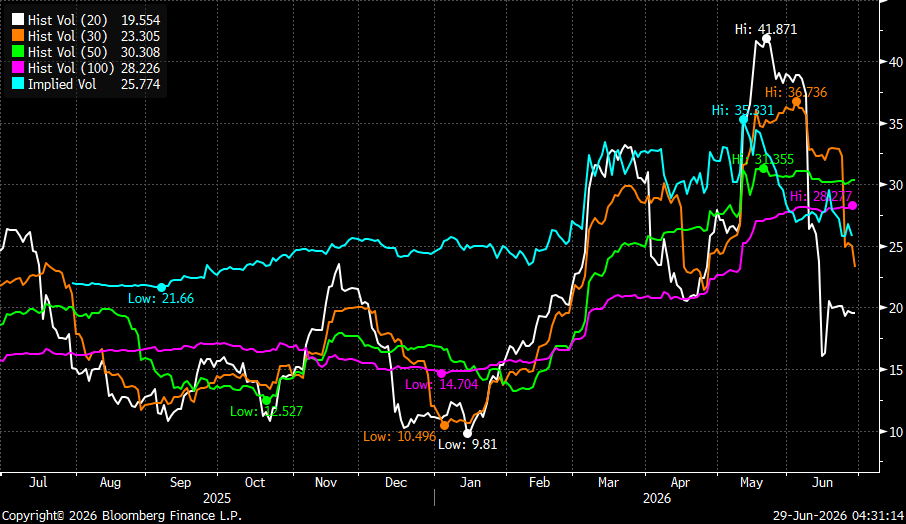
Kc wheat
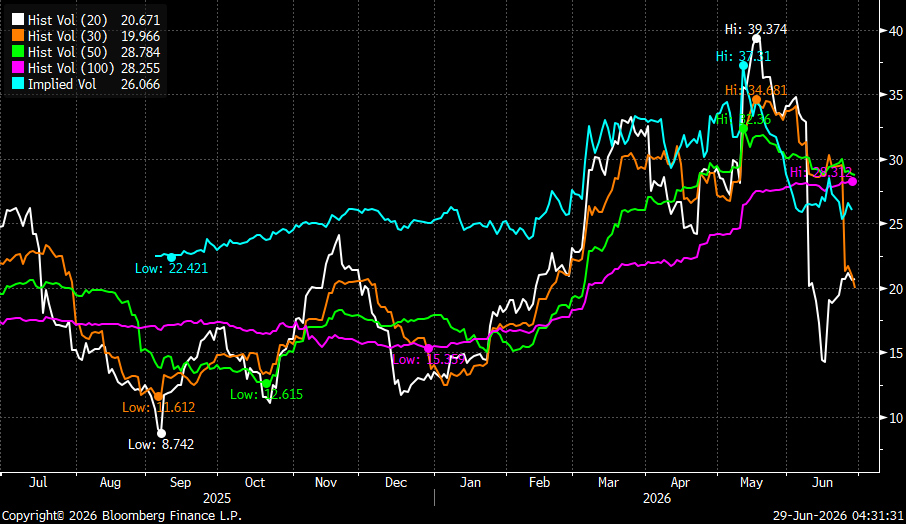
Miax wheat
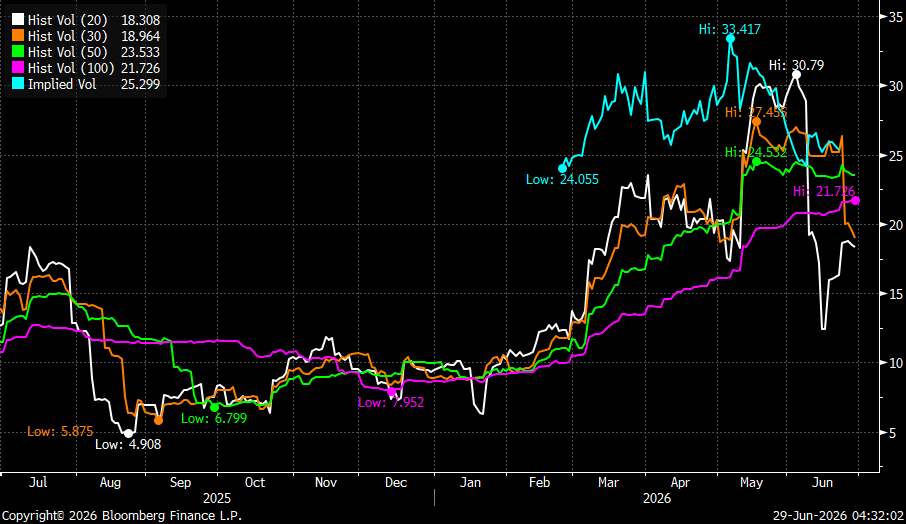
Oats
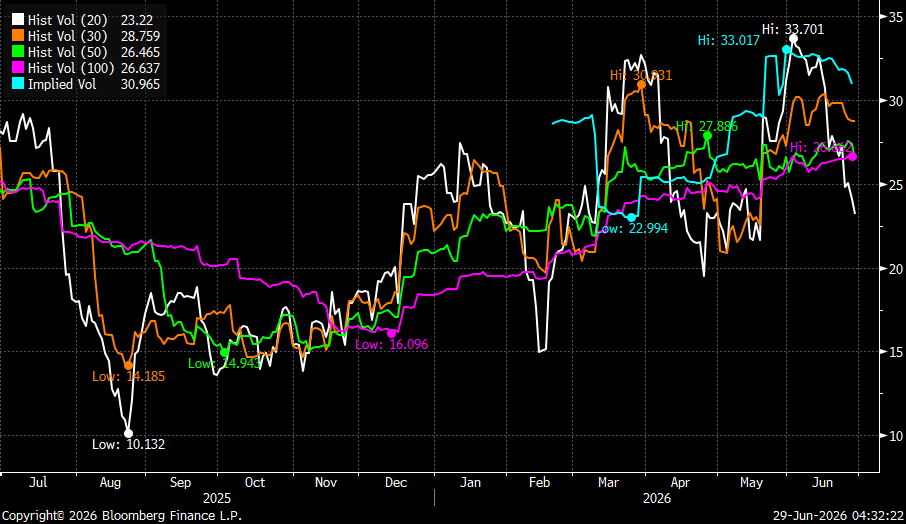
Rough rice
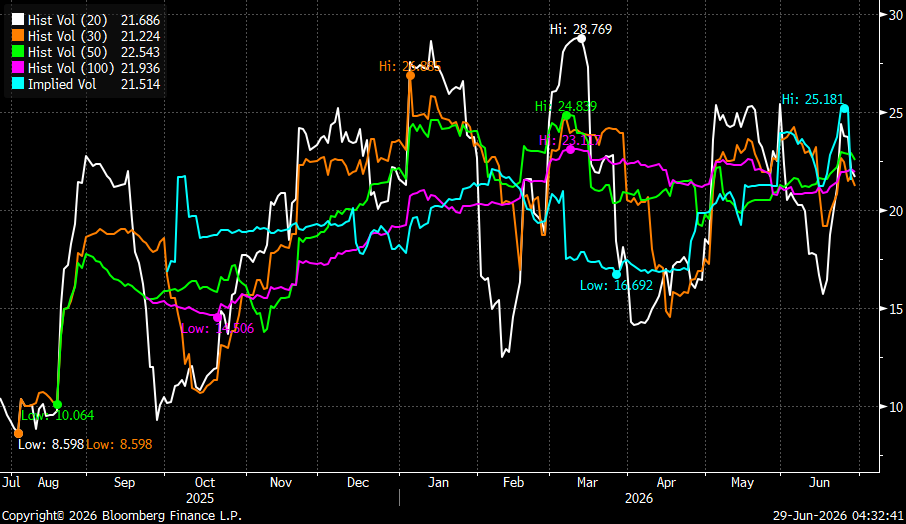
Cotton
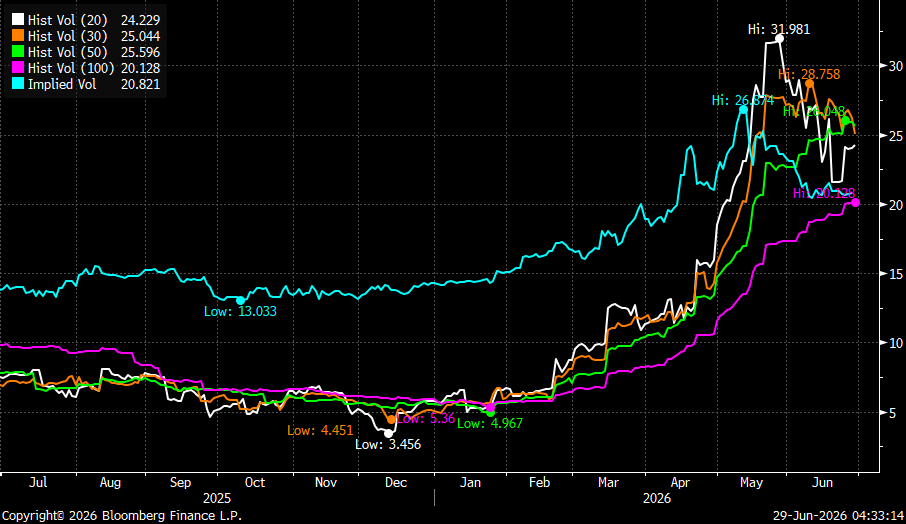
Canola
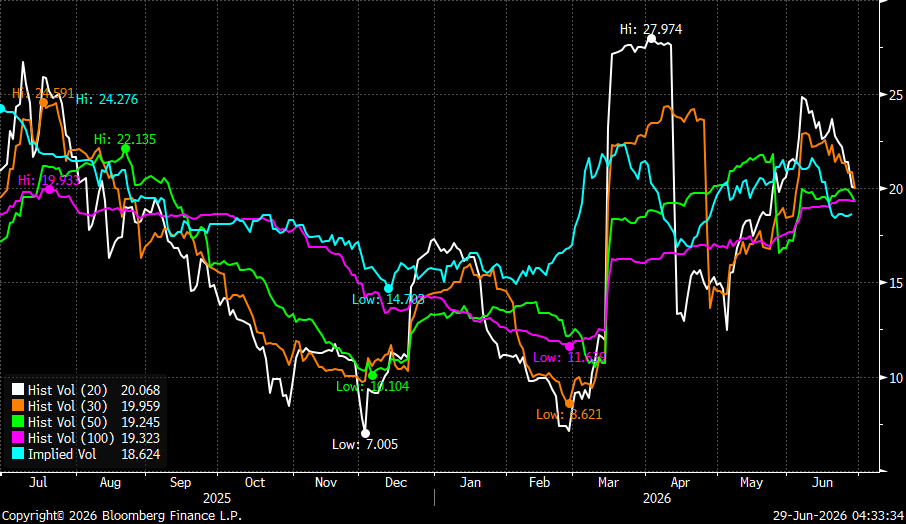
Feeder cattle
Live cattle
Lean hogs
This material should be construed as the solicitation of an account, order, and/or services and represents the opinions and viewpoints of the individual authors or presenters. It does not constitute an individualized recommendation or take into account the particular trading objectives, financial situations, or needs of individual customers.
The views are current only through the date stated and are subject to change at any time based upon market or other conditions, and StoneX Group Inc. (“SGI”) disclaims any responsibility to update such views. Actual results, performance, or achievements may differ materially from those expressed or implied. Information is based on data gathered from what we believe are reliable sources. Past performance does not guarantee future results.
The StoneX Group Inc. group of companies provides financial services worldwide through its subsidiaries, including physical commodities, securities, exchange-traded and over-the-counter derivatives, risk management, global payments and foreign exchange products in accordance with applicable law in the jurisdictions where services are provided.
References to certain OTC products or swaps are made on behalf of StoneX Markets, LLC (SXM), a member of the National Futures Association (NFA) and provisionally registered with the U.S. Commodity Futures Trading Commission (CFTC) as a swap dealer. SXM’s products are designed only for individuals or firms who qualify under CFTC rules as an ‘Eligible Contract Participant’ and who have been accepted as customers of SXM.
StoneX Financial Inc. (SFI) is a member of FINRA/NFA/SIPC and registered with the MSRB. SFI is registered with the U.S. Securities and Exchange Commission (SEC) as a Broker-Dealer and with the CFTC as a Futures Commission Merchant and Commodity Trading Advisor. StoneX Financial (Canada) Inc. (SFCI) is registered in Canada and is a member of CIRO and CIPF. References to certain securities trading are made on behalf of the BD Division of SFI and are intended only for an audience of institutional clients as defined by FINRA Rule 4512(c). References to certain exchange-traded futures and options are made on behalf of the FCM Division of SFI. Wealth Management is offered through SA Stone Wealth Management Inc., member FINRA/SIPC, and SA Stone Investment Advisors Inc., an SEC-registered investment advisor, both wholly owned subsidiaries of SGI.
R.J. O’Brien & Associates, LLC (RJO) is registered with the CFTC as a Futures Commission Merchant and is a member of NFA.
StoneX Financial Ltd (SFL) is registered in England and Wales, company no. 5616586. SFL is authorized and regulated by the Financial Conduct Authority (FCA) (registration number FRN:446717) to provide services to professional and eligible customers including: arrangement, execution and, where required, clearing derivative transactions in exchange traded futures and options. SFL is also authorized to engage in the arrangement and execution of transactions in certain OTC products, certain securities trading, precious metals trading and payment services to eligible customers. SFL is authorized and regulated by the FCA under the Payment Services Regulations 2017 for the provision of payment services. SFL is a category 1 ring-dealing member of the London Metal Exchange. In addition SFL also engages in other physically delivered commodities business and other general business activities which are unregulated and not required to be authorized by the FCA.
This communication is issued in the European Economic Area by StoneX Financial Europe GmbH (SFEG). StoneX is the trade name used by STONEX GROUP INC. and all its associated entities and subsidiaries. StoneX Financial Europe GmbH (“SFEG”) is a securities trading firm registered in Germany under Company No. HRB 80844.
StoneX Financial Pte Ltd (Co. Reg. No 201130598R) (“SFP”) is regulated by the Monetary Authority of Singapore and is a Capital Markets Service Licence holder (for dealing in capital market products), an Exempt Financial Adviser (for advising on investment products and issuing or promulgating analyses/ reports on investment products) and a Major Payment Institution (for domestic and cross-border money transfer services).
SFP may distribute analysis/report produced by its respective foreign affiliates within the StoneX Group of companies pursuant to an arrangement under Regulation 32C of the Financial Advisers Regulations Recipients should contact SFP at (65) 6309 1000 for any matters arising from, or in connection with, this webinar.
StoneX APAC Pte. Ltd. (“SAP”) (Co. Reg. No 200616676W) is regulated as a Dealer (PS20190001002) under the Precious Stones and Precious Metals (Prevention of Money Laundering and Terrorism Financing) Act 2019 for purposes of anti-money laundering and countering the financing of terrorism.
StoneX Financial (HK) Limited (CE No.: BCQ152) (“SHK”) is regulated by the Hong Kong Securities and Futures Commission for Dealing in Securities and Dealing in Futures Contracts.
StoneX Financial Pty Ltd (ACN 141 774 727) holds an Australian Financial Service License (AFSL: 345646) for Dealing in Securities, Exchange-Traded Derivatives Contracts, OTC Derivatives Contracts and Foreign Exchange Contracts, and is regulated by the Australian Securities and Investments Commission.
StoneX Securities Co., Ltd. (“SSJ”) (Co. Reg. No 010401047199) is regulated by the Japanese Financial Services Agency as a Type-I Financial Instruments Business Operator (Kanto Local Finance Bureau (FIBO)No.291’), is a member of the Financial Futures Association of Japan for dealing and broking FX and FX Option transactions, and is a member of the Japan Securities Dealers Association for dealing and broking stock indices and option transactions.
Trading swaps and over-the-counter derivatives, exchange-traded derivatives and options and securities involves substantial risk and is not suitable for all investors. Past performance of any futures or option is not indicative of future success. Indicators are not a trading system and are not published as a specific trade recommendation. The information herein is not a recommendation to trade nor investment research or an offer to buy or sell any derivative or security. It does not take into account your particular investment objectives, financial situation or needs and does not create a binding obligation on any of the StoneX group of companies to enter into any transaction with you. You are advised to perform an independent investigation of any transaction to determine whether any transaction is suitable for you. No part of this material may be copied, photocopied or duplicated in any form by any means or redistributed without the prior written consent of StoneX Group Inc.
The report/analysis herein is not directed to, or intended for distribution to or use by, any person or entity who is a citizen or resident of or located in any locality, state, country or other jurisdiction where such distribution, publication, availability or use would be contrary to law or regulation.
© 2026 StoneX Group Inc. All Rights Reserved.




