The USMCA review is moving from a procedural deadline into a real trade risk, though not an immediate breakup of the agreement. The U.S. is expected not to extend the pact on July 1, which would start a 10-year countdown toward possible expiration in 2036 unless the U.S., Mexico and Canada negotiate changes. The key issue is not whether North American trade stops, but whether the three countries can rewrite the agreement around autos, steel, aluminum, Chinese transshipment, rules of origin and domestic-content requirements. For agriculture, the near-term impact is uncertainty rather than a direct policy change, but the risk is that broader trade tensions with Canada and Mexico spill into farm products if negotiations deteriorate. Mexico and Canada are two of the largest buyers of U.S. agricultural goods, so any prolonged fight over USMCA would be a bearish demand risk for corn, meat, dairy and other cross-border flows, while a negotiated update would help restore confidence.
Treasury Secretary Bessent’s comments add a policy-risk angle to the energy market, with the administration clearly trying to pressure gasoline retailers to pass lower crude costs through to consumers more quickly. Bessent said the government is “watching” retailers and encouraged them to be “good actors,” following President Trump’s push for lower pump prices as crude has eased. For markets, this is less about immediate supply and more about political pressure on fuel margins: lower gasoline prices would help consumers and could ease inflation concerns, but tougher rhetoric toward oil companies and retailers may create headline risk for refiners, integrated oil names, and retail fuel operators. The broader commodity read is that Washington wants cheaper energy to flow through the economy, which would be a mild macro positive if it lowers transportation costs and inflation expectations.
Mercosur’s move to launch economic partnership talks with Japan is another sign that South America is trying to broaden its trade reach beyond China, the EU, and the U.S. The proposed agreement would look to expand market access for both agricultural and non-agricultural goods while also encouraging investment and supply-chain cooperation between the two sides. For agriculture, this matters because Japan is a high-value import market, and better access for Mercosur could eventually increase competition against U.S. beef, corn, soy, poultry, sugar, ethanol, and processed food exports. The talks are still early, so there is no immediate market impact, but the direction is important: Brazil and the broader Mercosur bloc continue to push aggressively for new trade outlets, which could strengthen South America’s long-term export position.
China’s move to impose provisional anti-dumping measures on Canadian pea starch is another sign that agriculture remains a pressure point in China-Canada trade. The measure takes effect July 1, 2026, with importers required to post a 73.5% security deposit after China’s Commerce Ministry preliminarily found Canadian pea starch was being dumped and causing material injury to China’s domestic industry. For markets, this is more important as a trade signal than a major global grain demand story: pea starch is niche, but the action keeps risk alive across Canadian pulses and specialty ag exports, and it reinforces that China is willing to use ag trade cases as leverage. The direct impact on U.S. corn and soybeans is limited, but it is mildly supportive to alternative starch sources and keeps broader China-Canada ag trade tensions on the radar, especially after prior disputes involving canola and pulses.
Fed voter Beth Hammack kept the door open to a more hawkish policy path, saying the labor market is near full employment, growth remains solid, and inflation is still too high. While she emphasized that she will keep an open mind at upcoming meetings, her comments that additional rate hikes may need to be considered are a reminder that the Fed is not ready to declare victory, especially with core services inflation still elevated and price pressures appearing broad-based. Treasury Secretary Bessent’s comment that June payrolls could be very strong adds to that theme. For markets, the takeaway is that strong employment and sticky inflation keep the Fed cautious, support higher-for-longer rate risk, and may limit the near-term upside for commodities unless demand strength or weather risk becomes the dominant driver.
U.S. data was mixed but generally points to an economy that is still holding up. The Dallas Fed Services Index moved back into positive territory at 2.9 from -7.7, while the revenue index improved to 9.8, suggesting service-sector activity firmed in June. Chicago PMI cooled to 56.7 from 62.7, but it still remained comfortably above the 50 expansion line and within the expected range. JOLTs job openings slipped slightly to 7.594 million from 7.618 million, but came in above the high end of expectations, showing labor demand remains resilient. For markets, the takeaway is that growth is not breaking, services remain supported, and the labor market is still firm enough to keep the Fed cautious on cutting rates too quickly.
The latest reserve and settlement headlines point to a slow but steady push away from automatic reliance on the U.S. dollar. A new OMFIF survey cited by Reuters found that, for the first time, more central banks plan to reduce dollar allocations than increase them over the next decade, with political and geopolitical risk cited as part of the concern. At the same time, Japan and India are reportedly considering a direct yen-rupee settlement framework for bilateral trade, which would lower transaction costs and reduce the need to route payments through the dollar. For markets, this is not an immediate threat to the dollar’s reserve-currency role, but it does reinforce a longer-term diversification theme: more countries are looking for ways to trade, settle, and hold reserves in alternatives such as gold, the euro, yuan, yen, and local currencies. For commodities, a weaker or less dominant dollar over time would generally be supportive to hard assets, but the near-term impact is more psychological than fundamental.
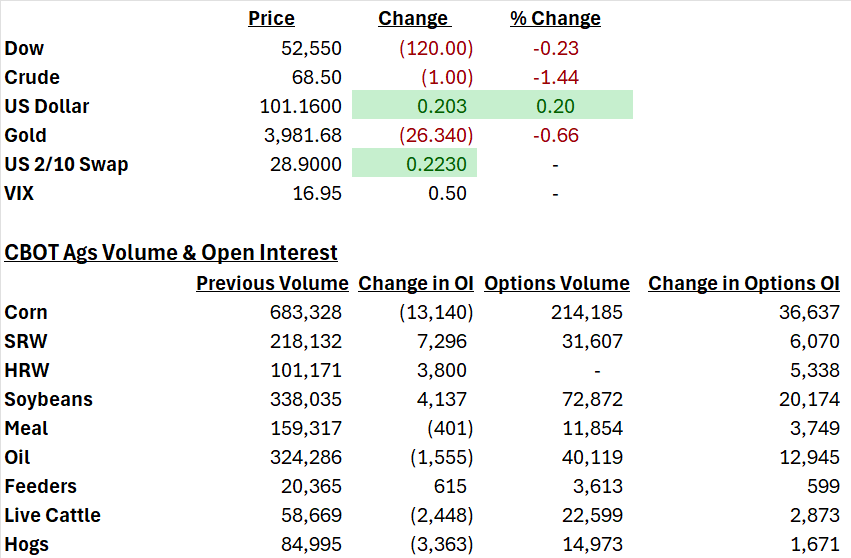
Overnight option activity
Corn
B 300 u 440/480 cs 5
B 500 q 410/425 cs 7
S 700 q 410 p 6 ½ vs 419 1/2
B 500 z 480/540 cs vs s u 500/540 cs 5 7/8 db
S 300 sd q 500 c 1 1/8 to 1
Beans
B 550 sd q 1130 p vs s sd q 1160/1190 cs 2 ¼ to 2 5/8 db
B 100 f 1140/1160 cs 9
S 600 q 1100 p 6 ¾ vs 1127
B 500 q 1150/1190 cs 6 1/4
S 100 v 1180c 22 5/8
Bean oil
B 300 z 70/75 cs .995
Kc wheat
B 150 u 650/700 cs 10 5/8
Open interest changes
Corn
Sept 440 call buy, aug 475 call buy, dec 550/850 call spread buy and aug 410/420 call spread buys were new. Dec 550 call sale and sept 460 call buys were closing. Short sept 425 put buy vs sale of short aug 430 put and sept 425/450 1x2 call spread buys were rolling longs.
Beans
Nov 1130/1050 put spread buy, sept 1120 put sale and nov 1100 put sales were new. Nov 1250 call sale and sept 1300 call buys were closing.
Bean oil
Sept 8050 call buy was closing. Aug 60 put buy was new.
Wheat
Sept 620/650 cs buy was rolling a long
Kc wheat
Sept 650/700 call spread buy was new.
Lean hogs
Oct 90 call buy was new.
Live cattle
Oct 218 put buy and oct 222 put sales were closing.
Cvol
Ags 21.05% down 1.96%
Corn 28.15% down 5.46%
Beans 17.01% down 1.71%
Soymeal 19.60%down 1.60%
Bean oil 26.03% up .38%
Wheat 26.98% down .45%
Feeder cattle 15.85% up .14%
Live cattle 15.83% down .17%
Lean hogs 21.34% down .47%
Class 3 milk 20.36% down .12%
Corn
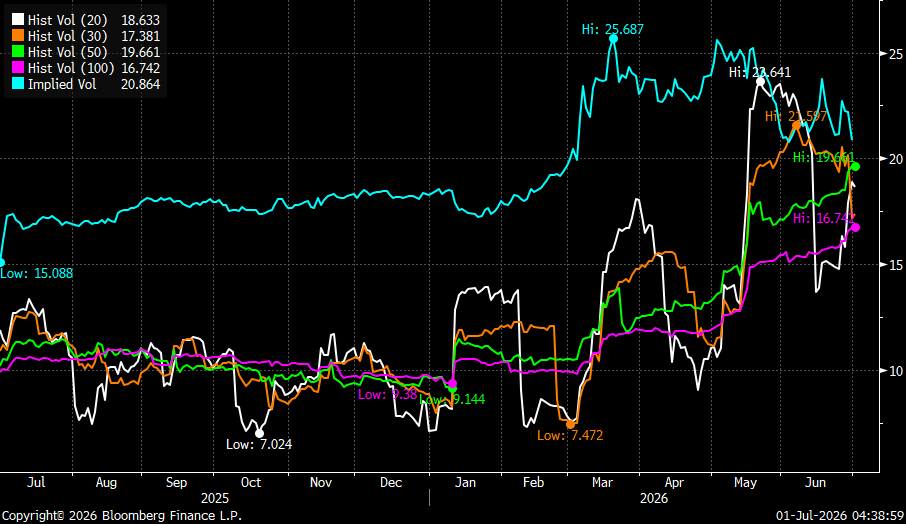
Beans
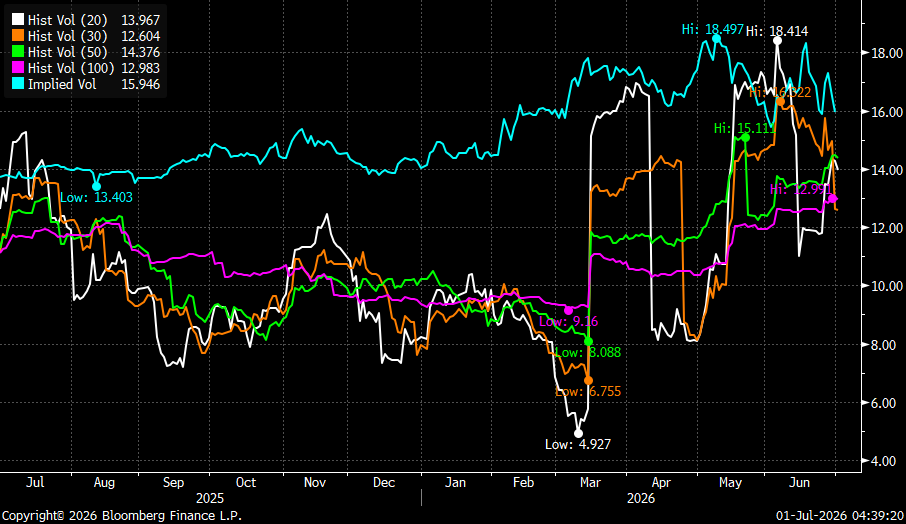
Soymeal
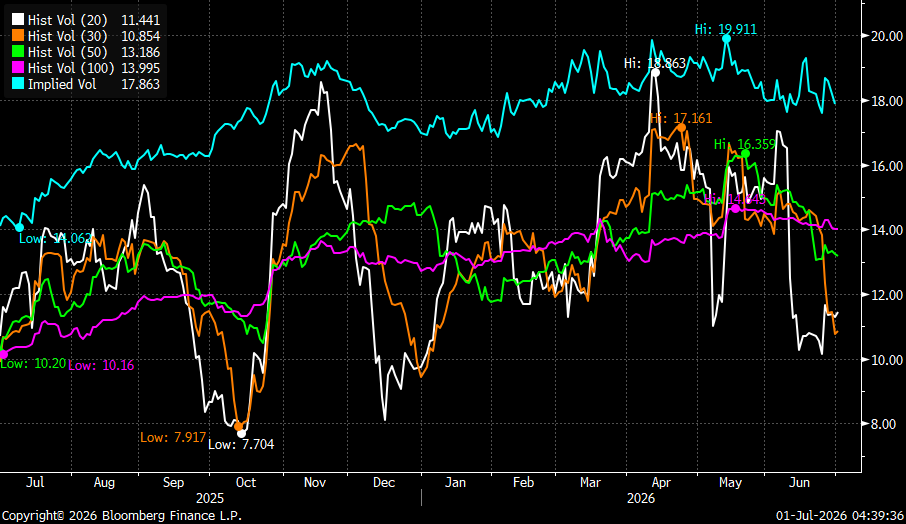
Bean oil
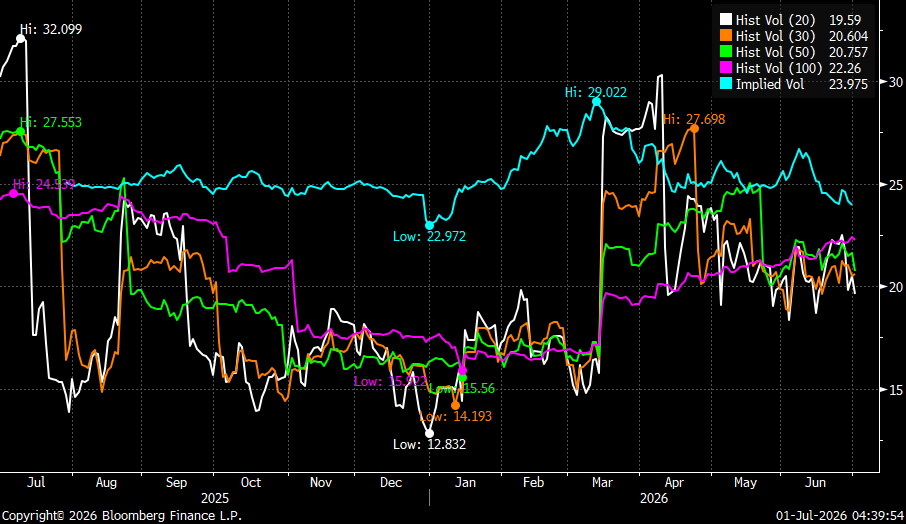
Wheat
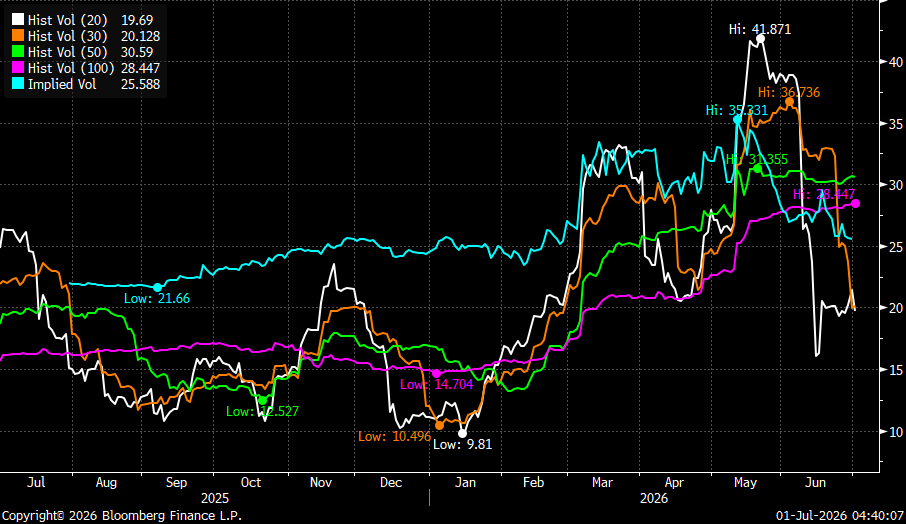
Kc wheat
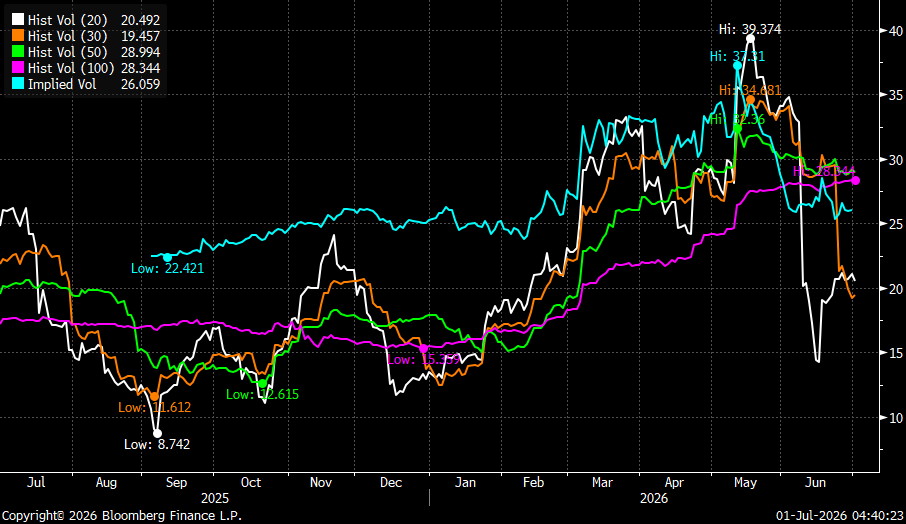
Miax wheat
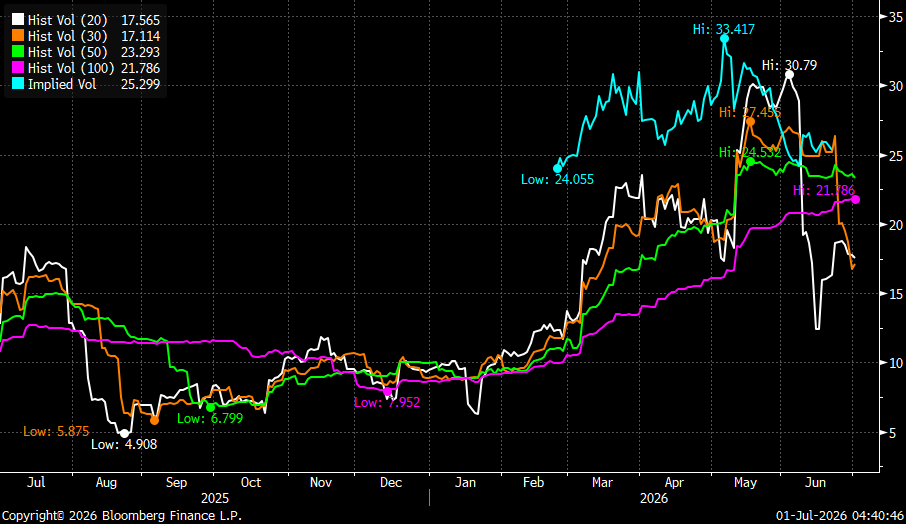
Oats
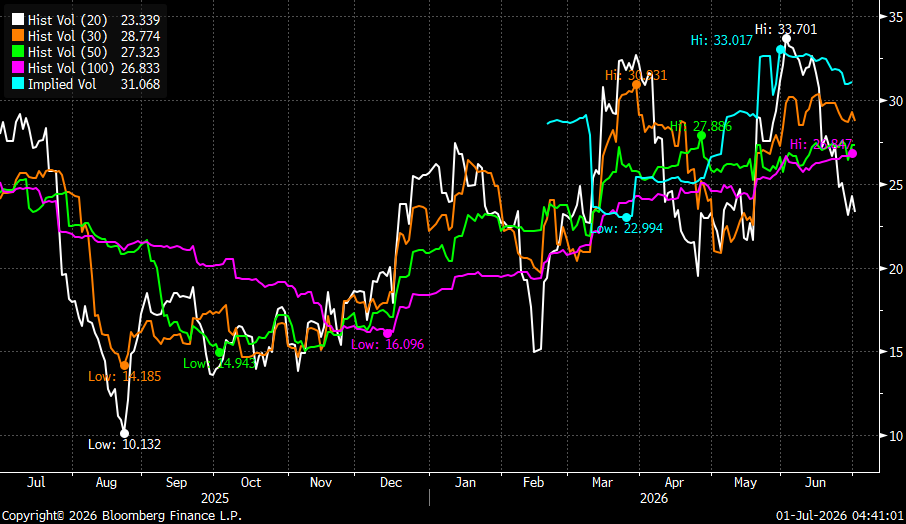
Rough rice
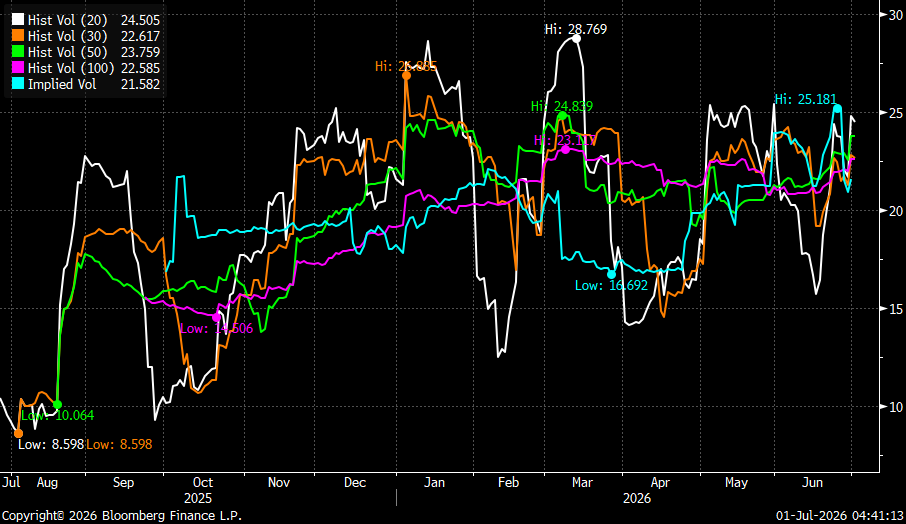
Cotton
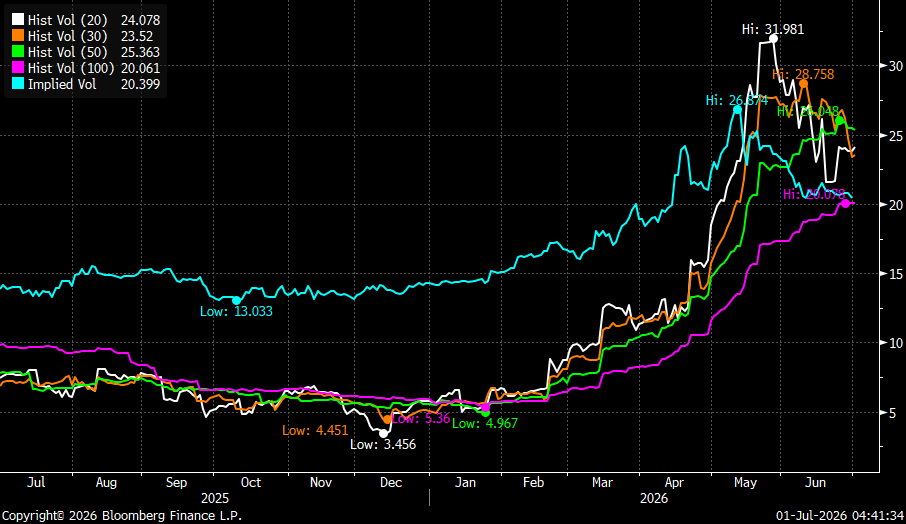
Canola
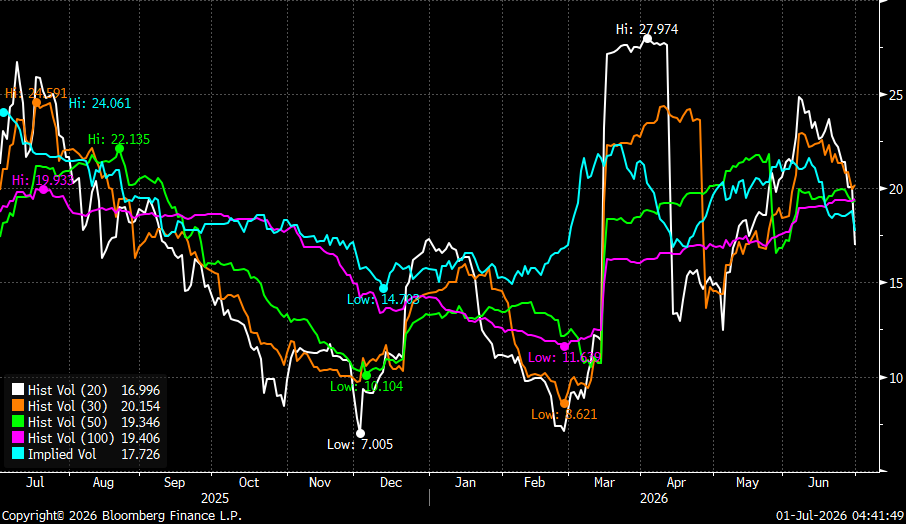
Feeder cattle
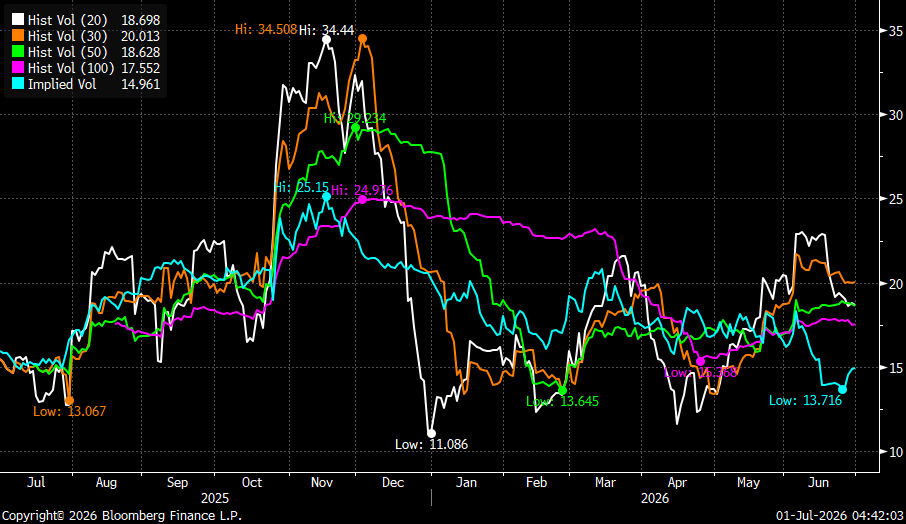
Live cattle
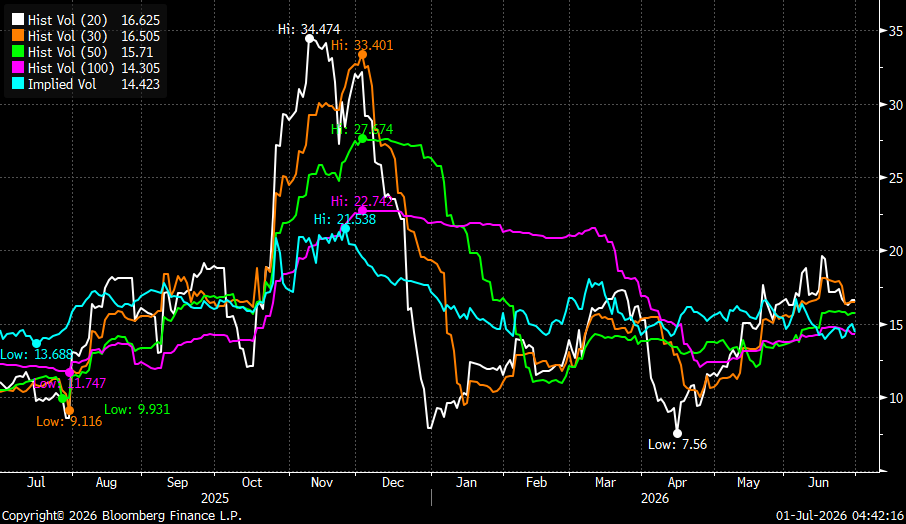
Lean hogs
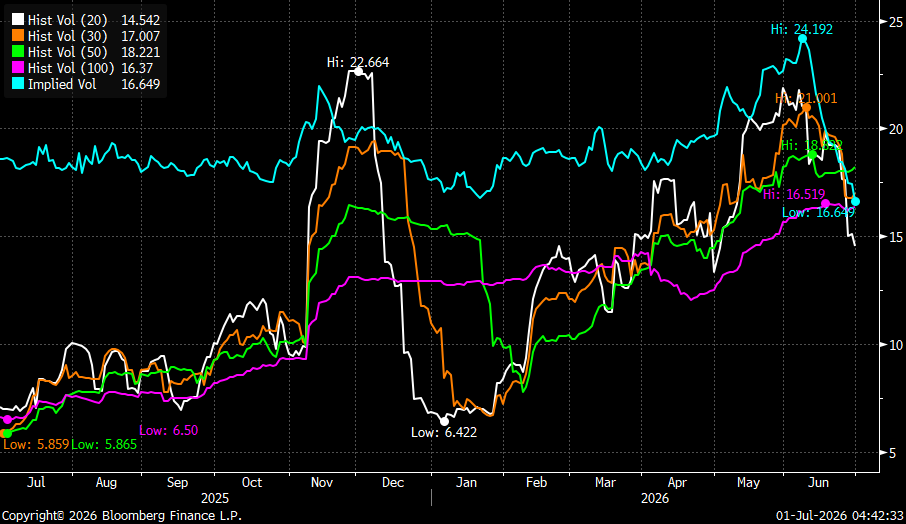
This material should be construed as the solicitation of an account, order, and/or services and represents the opinions and viewpoints of the individual authors or presenters. It does not constitute an individualized recommendation or take into account the particular trading objectives, financial situations, or needs of individual customers.
The views are current only through the date stated and are subject to change at any time based upon market or other conditions, and StoneX Group Inc. (“SGI”) disclaims any responsibility to update such views. Actual results, performance, or achievements may differ materially from those expressed or implied. Information is based on data gathered from what we believe are reliable sources. Past performance does not guarantee future results.
The StoneX Group Inc. group of companies provides financial services worldwide through its subsidiaries, including physical commodities, securities, exchange-traded and over-the-counter derivatives, risk management, global payments and foreign exchange products in accordance with applicable law in the jurisdictions where services are provided.
References to certain OTC products or swaps are made on behalf of StoneX Markets, LLC (SXM), a member of the National Futures Association (NFA) and provisionally registered with the U.S. Commodity Futures Trading Commission (CFTC) as a swap dealer. SXM’s products are designed only for individuals or firms who qualify under CFTC rules as an ‘Eligible Contract Participant’ and who have been accepted as customers of SXM.
StoneX Financial Inc. (SFI) is a member of FINRA/NFA/SIPC and registered with the MSRB. SFI is registered with the U.S. Securities and Exchange Commission (SEC) as a Broker-Dealer and with the CFTC as a Futures Commission Merchant and Commodity Trading Advisor. StoneX Financial (Canada) Inc. (SFCI) is registered in Canada and is a member of CIRO and CIPF. References to certain securities trading are made on behalf of the BD Division of SFI and are intended only for an audience of institutional clients as defined by FINRA Rule 4512(c). References to certain exchange-traded futures and options are made on behalf of the FCM Division of SFI. Wealth Management is offered through SA Stone Wealth Management Inc., member FINRA/SIPC, and SA Stone Investment Advisors Inc., an SEC-registered investment advisor, both wholly owned subsidiaries of SGI.
R.J. O’Brien & Associates, LLC (RJO) is registered with the CFTC as a Futures Commission Merchant and is a member of NFA.
StoneX Financial Ltd (SFL) is registered in England and Wales, company no. 5616586. SFL is authorized and regulated by the Financial Conduct Authority (FCA) (registration number FRN:446717) to provide services to professional and eligible customers including: arrangement, execution and, where required, clearing derivative transactions in exchange traded futures and options. SFL is also authorized to engage in the arrangement and execution of transactions in certain OTC products, certain securities trading, precious metals trading and payment services to eligible customers. SFL is authorized and regulated by the FCA under the Payment Services Regulations 2017 for the provision of payment services. SFL is a category 1 ring-dealing member of the London Metal Exchange. In addition SFL also engages in other physically delivered commodities business and other general business activities which are unregulated and not required to be authorized by the FCA.
This communication is issued in the European Economic Area by StoneX Financial Europe GmbH (SFEG). StoneX is the trade name used by STONEX GROUP INC. and all its associated entities and subsidiaries. StoneX Financial Europe GmbH (“SFEG”) is a securities trading firm registered in Germany under Company No. HRB 80844.
StoneX Financial Pte Ltd (Co. Reg. No 201130598R) (“SFP”) is regulated by the Monetary Authority of Singapore and is a Capital Markets Service Licence holder (for dealing in capital market products), an Exempt Financial Adviser (for advising on investment products and issuing or promulgating analyses/ reports on investment products) and a Major Payment Institution (for domestic and cross-border money transfer services).
SFP may distribute analysis/report produced by its respective foreign affiliates within the StoneX Group of companies pursuant to an arrangement under Regulation 32C of the Financial Advisers Regulations Recipients should contact SFP at (65) 6309 1000 for any matters arising from, or in connection with, this webinar.
StoneX APAC Pte. Ltd. (“SAP”) (Co. Reg. No 200616676W) is regulated as a Dealer (PS20190001002) under the Precious Stones and Precious Metals (Prevention of Money Laundering and Terrorism Financing) Act 2019 for purposes of anti-money laundering and countering the financing of terrorism.
StoneX Financial (HK) Limited (CE No.: BCQ152) (“SHK”) is regulated by the Hong Kong Securities and Futures Commission for Dealing in Securities and Dealing in Futures Contracts.
StoneX Financial Pty Ltd (ACN 141 774 727) holds an Australian Financial Service License (AFSL: 345646) for Dealing in Securities, Exchange-Traded Derivatives Contracts, OTC Derivatives Contracts and Foreign Exchange Contracts, and is regulated by the Australian Securities and Investments Commission.
StoneX Securities Co., Ltd. (“SSJ”) (Co. Reg. No 010401047199) is regulated by the Japanese Financial Services Agency as a Type-I Financial Instruments Business Operator (Kanto Local Finance Bureau (FIBO)No.291’), is a member of the Financial Futures Association of Japan for dealing and broking FX and FX Option transactions, and is a member of the Japan Securities Dealers Association for dealing and broking stock indices and option transactions.
Trading swaps and over-the-counter derivatives, exchange-traded derivatives and options and securities involves substantial risk and is not suitable for all investors. Past performance of any futures or option is not indicative of future success. Indicators are not a trading system and are not published as a specific trade recommendation. The information herein is not a recommendation to trade nor investment research or an offer to buy or sell any derivative or security. It does not take into account your particular investment objectives, financial situation or needs and does not create a binding obligation on any of the StoneX group of companies to enter into any transaction with you. You are advised to perform an independent investigation of any transaction to determine whether any transaction is suitable for you. No part of this material may be copied, photocopied or duplicated in any form by any means or redistributed without the prior written consent of StoneX Group Inc.
The report/analysis herein is not directed to, or intended for distribution to or use by, any person or entity who is a citizen or resident of or located in any locality, state, country or other jurisdiction where such distribution, publication, availability or use would be contrary to law or regulation.
© 2026 StoneX Group Inc. All Rights Reserved.



