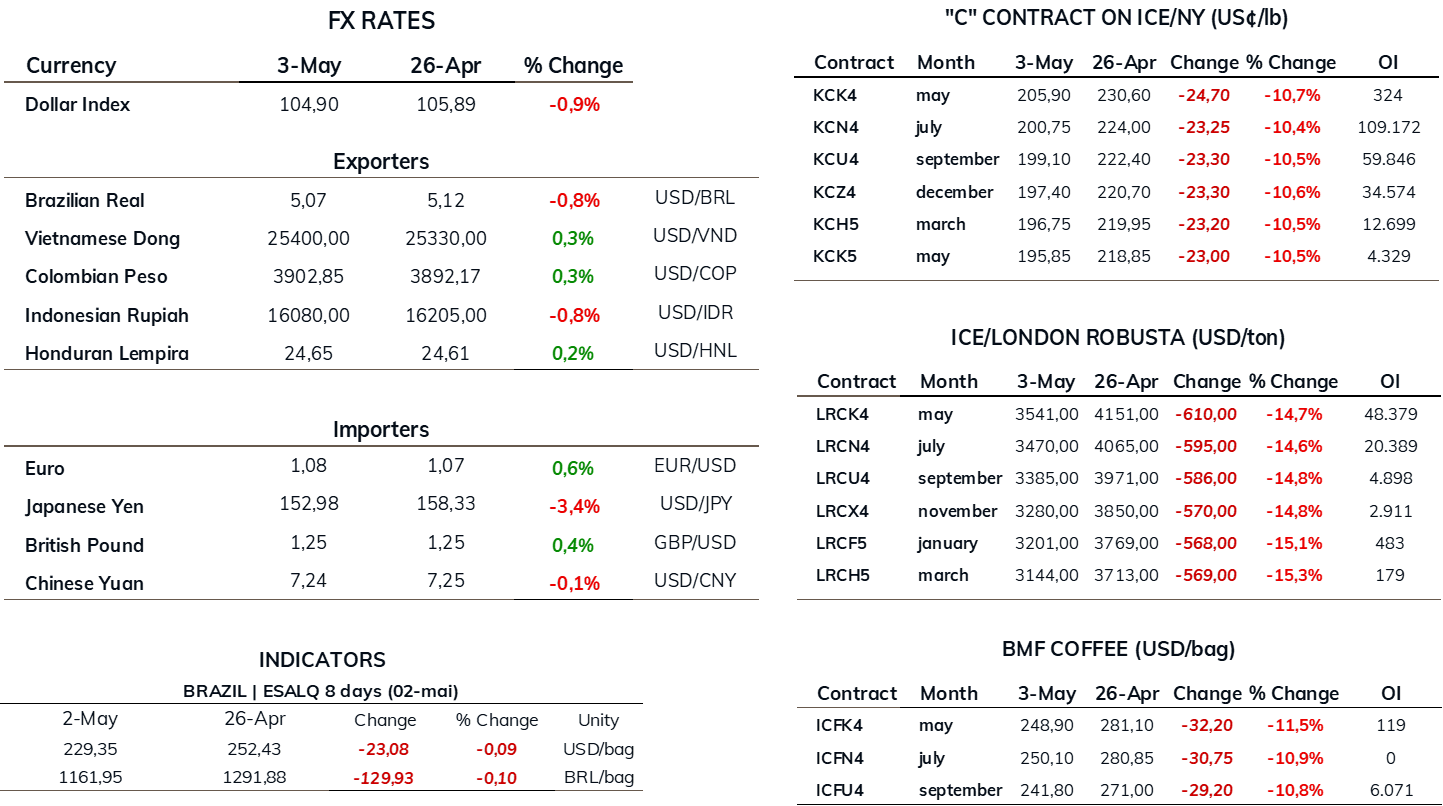
• Arabica coffee fell 10.4% on the week in New York, closing at US₵ 200.75/lb
• On the London exchange, Robusta coffee prices fell 14.7% to USD 3541/t
• Dollar down 0.8% to USDBRL 5.07 for the week
• Cepea indicator for Arabica coffee down 9% at BRL 1,141.86/bag
• Cepea indicator for Robusta coffee down 16% to BRL 970.33/bag
• Models point to return of rains in Vietnam
• Reduced supply of Robusta, and Brazilian winter are bullish factors
• New crop coming in and concerns about consumption are bearish factors
• Starbucks and Néstle reported a drop in sales in the first quarter
• Preliminary data from Secex points to a 66% increase in exports in April
After reaching record highs in London and historically high levels in New York, coffee futures prices ended last week with heavy losses. The week's movement was mainly dictated by the speculative liquidation of futures contracts, both for coffee and for other commodities in the softs group, such as cocoa, which saw a 23% drop in prices. According to the StoneX Commodity Index, $2 billion (-7.3%) flowed out of the soft commodities complex last week.
The most intense fall occurred in Thursday's session (02), led by the Robusta coffee market, which showed losses of USD 298/t (-7.5%), which put pressure on prices in New York, which saw losses of 990 points (-4.6%). Coffee market operators described the session as a “total collapse”, while the Reuters news agency published a story entitled “Bloodbath in commodity markets softens as funds exit cocoa and coffee futures”.
In New York, the most active contract ended the week with a drop of 2325 points (-10.4%), closing Friday (03) quoted at US₵ 200.75/lb. In London, the drop was even more intense at USD 610/t (-14.7%), closing the week quoted at USD 3541/t. In the period, the Dollar Index fell 0.9% to 104.9 points and the USDBRL pair fell 0.8% to 5.07.
Weekly intraday (most active contract) - April 29 to May 3
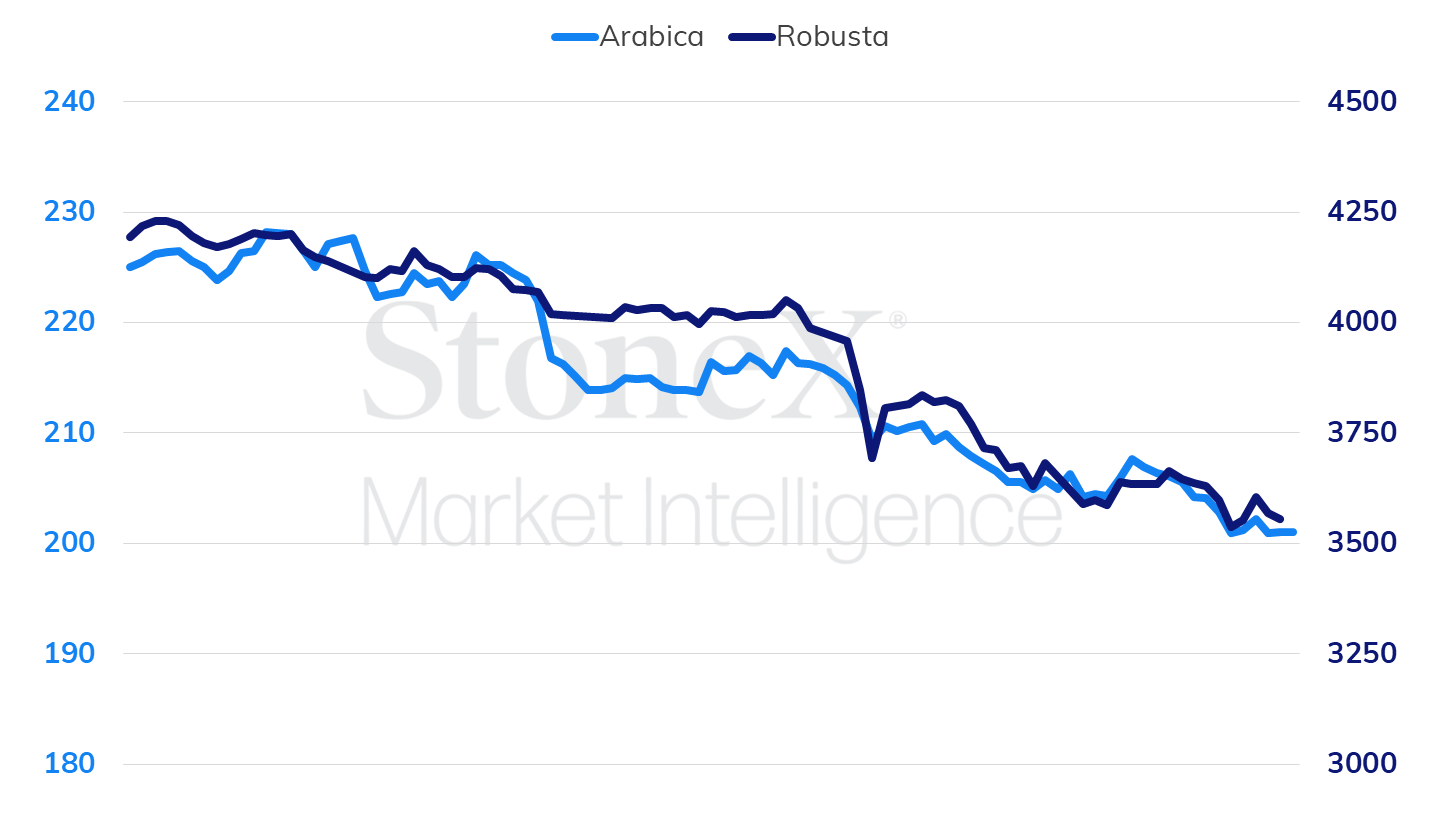
On the Brazilian domestic market, the trend was the same as on the international markets, but with a more intense downturn for Robusta due to the dollar's fall in the period. The Cepea indicator for Arabica coffee fell by 9% to BRL 1141.86/bag. The indicator for Robusta coffee fell by 16%, closing the week below BRL 1,000 per bag, quoted at BRL 970.33/bag.
In addition to technical and speculative issues, the prospect of improved weather conditions in Vietnam helped to ease agents' concerns and put pressure on prices. According to StoneX data, a large part of Vietnam's coffee belt has received rainfall accumulations of up to 200 mm in the last 14 days. In addition, the forecast for the next two weeks indicates that the country should receive accumulated volumes of between 90 mm and 200 mm, which marks the return of the rainy season in the country and should contribute to the development of its 2024/25 crop. As discussed in other editions, the transition from El Niño to a neutral condition would favor the return of rainfall in the country.
Accumulated rainfall in Vietnam over the last 14 days and forecast for the next two weeks (mm)
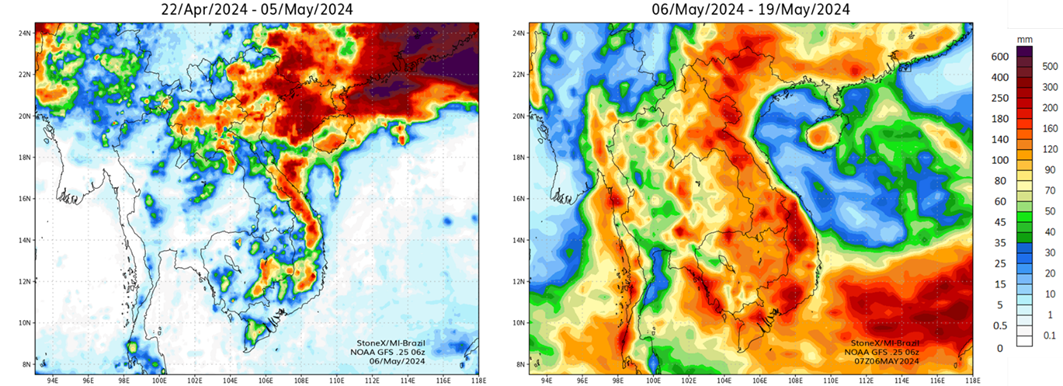
Source: StoneX, with data from NOAA/NCEP/EMC (GFS: Global Forecast System), 2024
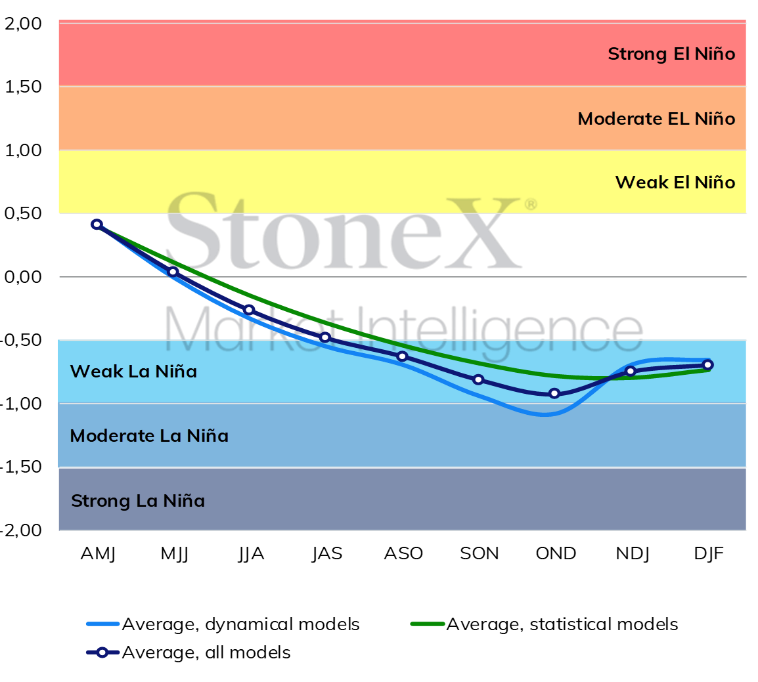
From the point of view of fundamentals, these are the bullish and bearish factors that could impact prices in the coming months. The scenario of limited supplies of Robusta coffee in Asia and the inter-crop period in Vietnam, whose harvest is not expected to start until mid-November, continue to be bullish factors. Strong demand for Robusta is also a positive factor for coffee prices. Another factor that could act in a bullish manner is the onset of the Brazilian winter and the possibility of cold waves, which would lead to greater price volatility, bearing in mind the 2021 frost. Finally, there is the possibility of a La Niña in the second half of the year which, if strong, could have a negative impact on flowering in Brazil.
On the other hand, if La Niña is of weak intensity, this would have a bearish bias, as the phenomenon would not be able to cause severe damage to Brazilian coffee production. The start of the harvest in Brazil and Indonesia would have a bearish bias for prices, as it would increase coffee supply on the physical market. In addition, the prospect of a wider supply and demand (S&D) balance in 2024/25, especially for Arabica coffee, tends to act negatively on prices. The USDA has already started releasing the country attaché reports and will publish the final one in mid-June, which is expected to point to a more comfortable balance and act in a bearish manner. Another issue is consumption. Despite the significant volumes exported in the first months of 2024, the financial results of some companies pointed to a drop in sales in the first quarter of the year.
Projected change in Pacific Ocean surface temperature (in ºC)
Source: IRI/CPC, NOAA. *Average of statistical models.
In a recent announcement, Néstle reported a 5.9% drop in revenue amid lower coffee sales, mainly in North America, which fell by 2.5% in the first quarter of the year. According to the company, weakened demand and supply chain problems are the reasons behind the declines. In line with this trend, the results of the Starbucks coffee shop chain pointed to a 2% drop in consolidated net revenue during the first quarter of the year (second fiscal quarter, according to the company's report). The company's global sales fell by 4%, with a drop of 3% in the United States and 6% in international markets, with sales in China falling by 11%. The company attributed the drop to a “complex operating environment”.
The week will also see the release of export data for April by Cecafé. The report is expected to point to another month of strong exports amid a global scenario of reduced supply of Robusta coffee in particular. Preliminary data from the Secretariat of Foreign Trade (Secex) indicated that Brazil exported 3.8 million bags up to the fourth week of April, which represents an increase of 66% compared to April 2023. In addition, in the coming weeks, market participants will be keeping an eye on the weather data in Vietnam and the start of the harvest in Brazil.
INDICATORS