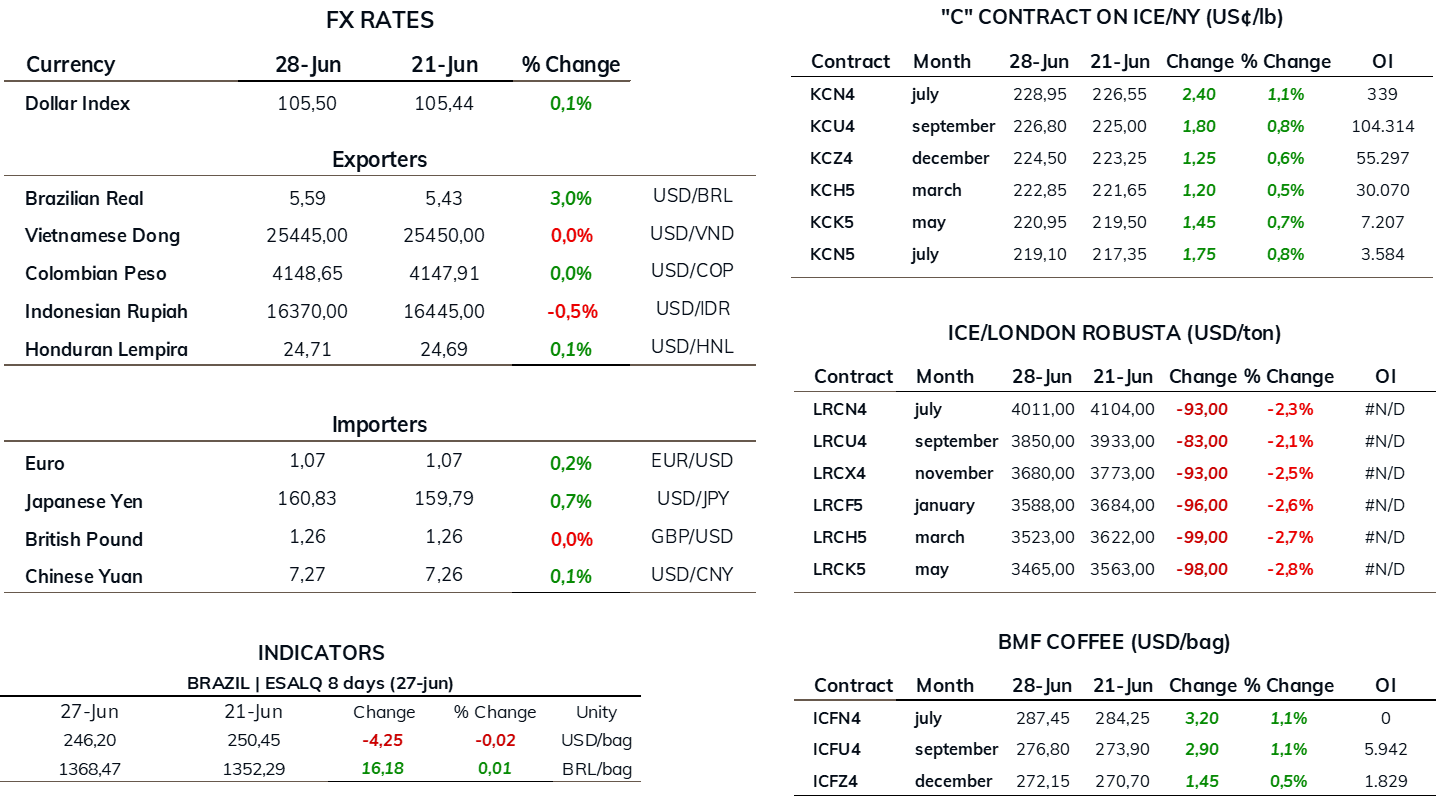
• Arabica coffee up 0.8% on the week in New York, quoted at US₵ 226.80/lb
• On the London exchange, Robusta coffee prices fell 2.5% to USD 4011/t
• Dollar up 2.9% to USDBRL 5.59 on the week
• Cepea indicator for Arabica up 1.4% to BRL 1,370,81/bag
• Cepea indicator for Robusta up 1.3% to BRL 1,222.46/bag
• Reduced supply in Asia continues to be a bullish factor
• Uncertainty about the real size of the Brazilian crop may act as a bullish factor
• Possible optimism about the Brazilian flowering may put pressure on prices
• Release of Brazilian export data will be the agents' focus
• Consumption trends are still uncertain
Last week, coffee futures prices ended the period with mixed results, but with Robusta retreating amid deliveries against the July contract on the London exchange. So far, more than 4,100 delivery notices have been issued for Robusta coffee for the July expiry. As far as the fundamentals are concerned, the scenario remains practically unchanged, with the supply of Robusta coffee in Asia acting as a bullish factor and participants focusing on weather conditions.
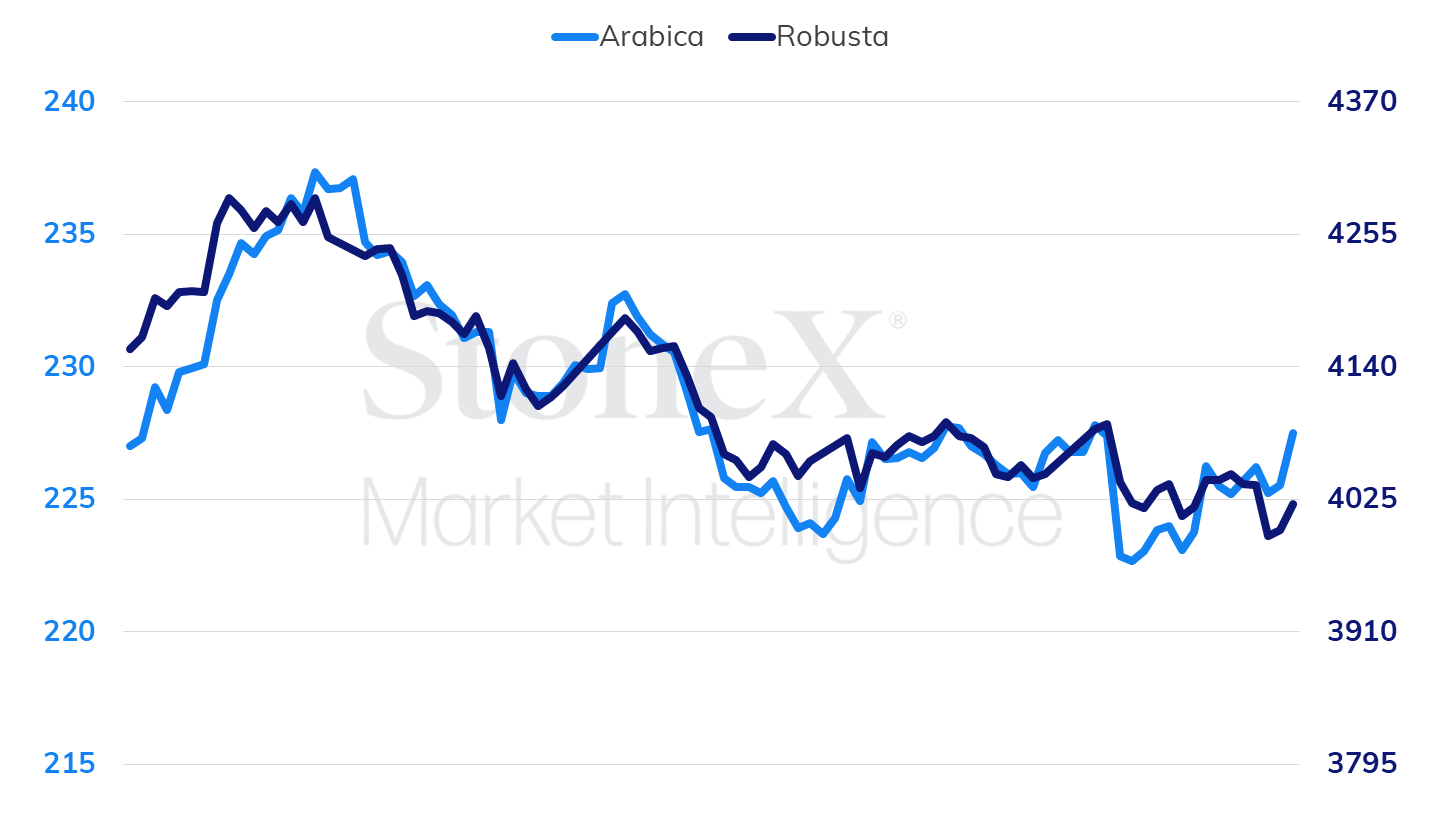
In New York, the most active contract, for September, ended the week up just 0.8%, closing Friday (28) at US₵ 226.80/lb. For the London terminal, the Robusta contract expiring in September fell by 2.3% over the week, to USD 4011/t. On the other hand, considering the monthly change, Arabica prices rose by 2.5% in June, while Robusta prices gained only 0.6% in the month.
Weekly intraday (most active contract) - June 24 to June 28
On the Brazilian domestic market, coffee prices ended the week higher. The Cepea indicator for Arabica coffee rose by 1.4% in the week and accumulated an increase of 6.6% in the month, closing last week at BRL 1370.81/bag. The indicator for Robusta also rose, up 1.3% in the week and 6.4% in the month to BRL 1222.46. The sharp rise in prices on the domestic market is linked to the strong dollar, which rose 2.9% last week and accumulated a monthly gain of 6.7%, closing the last session quoted at USDBRL 5.59.
From the point of view of fundamentals, which continue to remain largely unchanged, there are both bullish and bearish factors that could have an impact on coffee prices in the coming months. With the release of the USDA's final report, which pointed to a surplus of 5.6 million bags for the 2024/25 season, agents' attention has turned to the early stages of development in Brazil and the weather. However, there are some aspects that can impact prices in different ways.
Among the bullish factors, we can highlight the continued impact of the reduced supply of Robusta coffee in Asia, a scenario that is expected to continue for at least a few months. While part of the Indonesian coffee harvest starts in June, the crop in Vietnam, the world's largest producer of the variety, is not expected to start until mid-November. Official data has pointed to a string of falls in coffee exports from Asian countries, with Vietnamese exports down 47% and Indonesian exports down 35% year-on-year in May.
Another major factor is the uncertainty surrounding the actual size of the Brazilian coffee crop. There are several reports and indications that Brazil's conilon crop will be smaller than expected. In addition, some Arabica coffee regions have also shown lower-than-expected results for the season. StoneX is carrying out a study on crop yields in Brazil and will release its results between the end of July and the beginning of August.
On the other hand, despite some divergences, the USDA's outlook for a larger surplus in 2024/25 has a bearish bias for prices. Another factor that could act negatively is the expectation of suitable weather during the coffee bloom. The US agency NOAA has reduced the likelihood of La Niña occurring in the second half of the year and pointed out in its latest report that the phenomenon would be of low intensity and for a relatively short period. The expectation is that in this context, there will be no delays in the onset of the rains, which would contribute to a good flowering period. A scenario of wide-open blooms could lead to optimism about the 2025/26 crop and have a negative effect on prices.
Projection of changes in the surface temperature of the Pacific Ocean (in ºC)
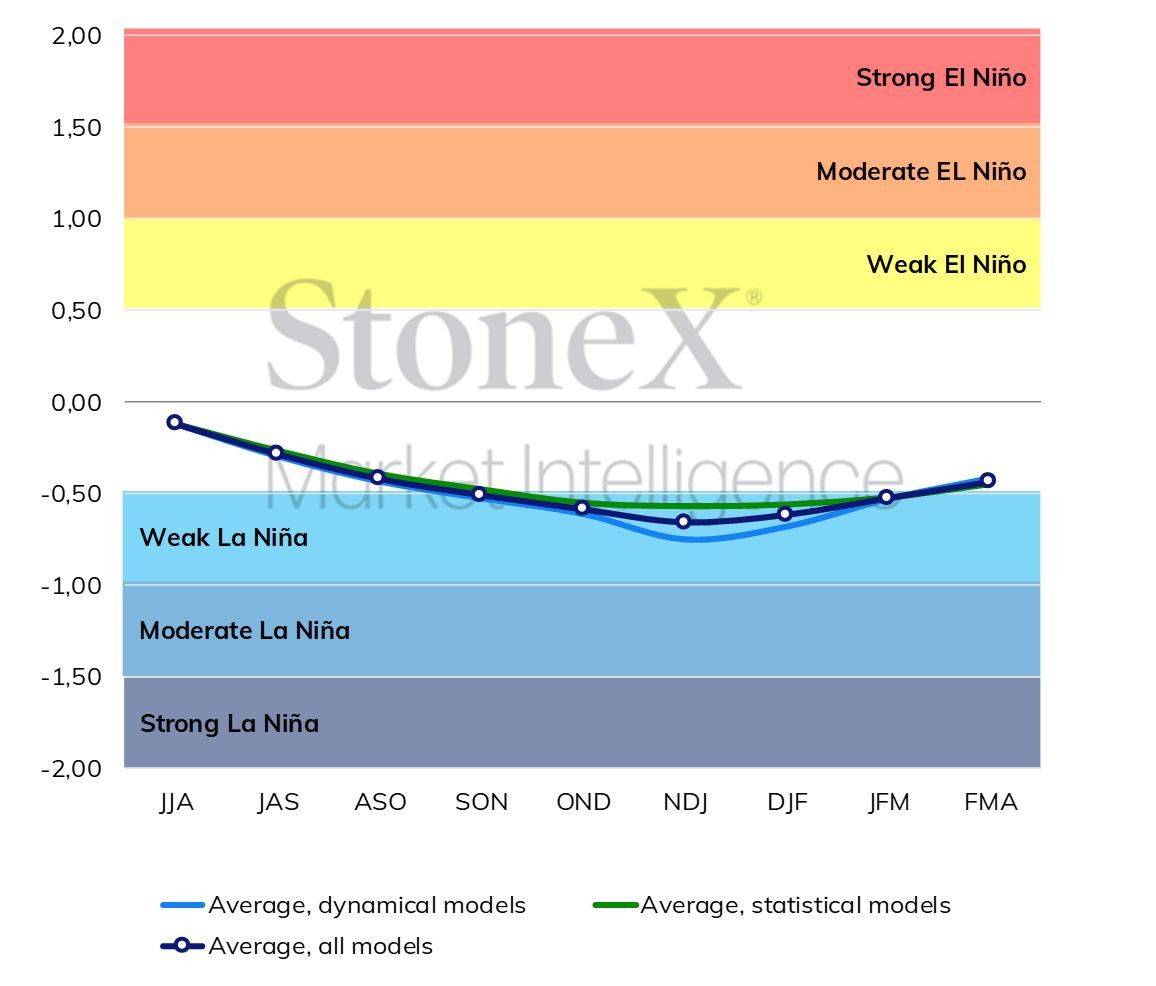
Source: IRI/CPC, NOAA. *Average of statistical models.
In addition to these factors, another negative point is the uncertainty about coffee consumption in the main consuming centers. In recent years, consumption in the US and Europe has been impacted by strong inflation in coffee prices. At the beginning of the year, there were expectations of a substantial recovery in consumption as price inflation receded. However, this was not the case and the financial results of some companies in the sector pointed to negative performance in the first quarter of the year.
Furthermore, for the coming weeks, although there are no concrete prospects, the possibility of a cold snap could act in a bullish manner and contribute to greater volatility in coffee prices. Agents will also be focusing on the release of Brazilian coffee exports in June by Cecafé. The council's preliminary figures point to a drop of over 20% in shipments. However, preliminary figures from the Foreign Trade Secretariat point to an 11% increase in exports up to the third week of the month, with a volume of 2.57 million bags.
INDICATORS