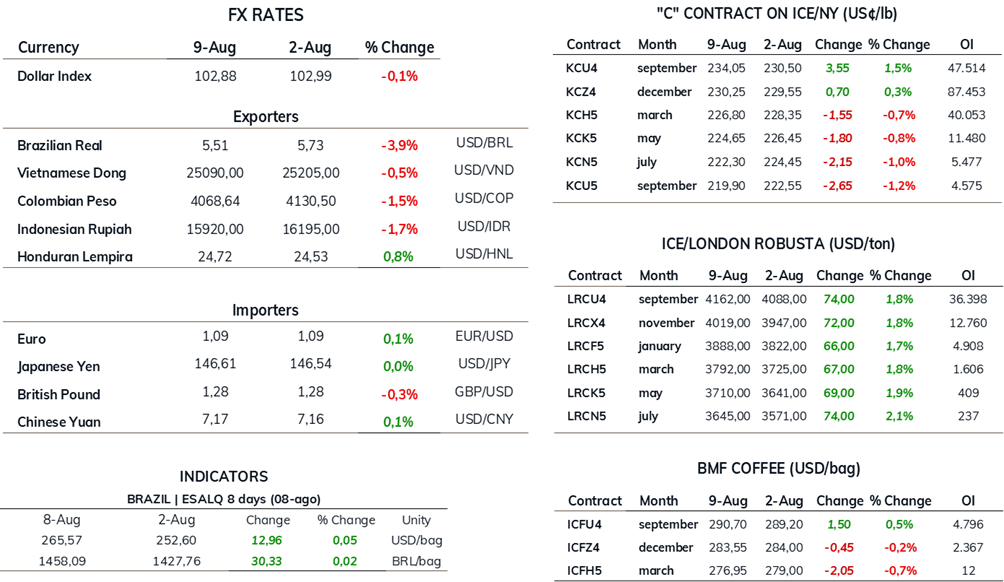
• Arabica coffee fell by 0.3% for the week in New York, quoted at US₵ 230.25/lb.
• On the London exchange, Robusta coffee prices advanced 1.8% to USD 4162/t.
• The Cepea indicator for Arabica coffee recorded a 1.7% drop, quoted at R$ 1,402.89/bag.
• The Cepea indicator for Robusta coffee advanced 2.1% to R$ 1,287.13/bag.
• Fluctuations in weather forecasts brought high volatility during the week.
• Preliminary data on Brazilian exports indicate a strong increase in coffee shipments in July.
• Intensification of the cold front increases fears of new frosts and damage to Brazilian production.
• Localized frosts were recorded in the Cerrado and Mogiana. Damage was limited.
• Low temperatures in the early hours of Tuesday (13) post greater risks for southern Minas region.
Last week, coffee futures were marked by high volatility due to the forecast of two approaching cold fronts in Brazil. Following the bearish trend of the previous week, the first session of the week on Monday (5) saw a sharp decline in coffee prices. However, on Monday, forecast models began to indicate the arrival of two cold fronts that would lower temperatures in Brazil.
Although the models did not yet indicate the possibility of frost in the producing regions, coffee prices reacted very intensely on Tuesday and Wednesday, when Arabica coffee prices advanced by 865 (+3.8%) and 905 (+3.9%) points, respectively. After closing Wednesday's session (7) at US₵ 242.00/lb, the highest level since mid-July, prices fell again on Thursday and even more sharply on Friday (9th).
In the weekly balance, the most active Arabica coffee contract advanced by only 0.3%, closing Friday (9) at US₵ 230.25/lb. In London, despite showing high volatility like New York, Robusta coffee futures prices ended the week higher, closing Friday (9) at USD 4162/ton (+1.8%). In the Brazilian domestic market, Arabica coffee prices fell by 1.7% over the week, according to the Cepea indicator to R$ 1,402.89/bag. Meanwhile, the Robusta coffee indicator followed the trend of the London exchange, advancing by 2.1% during the period to R$ 1,287.13/bag.
Weekly intraday (most active contract) – August 05 to 8
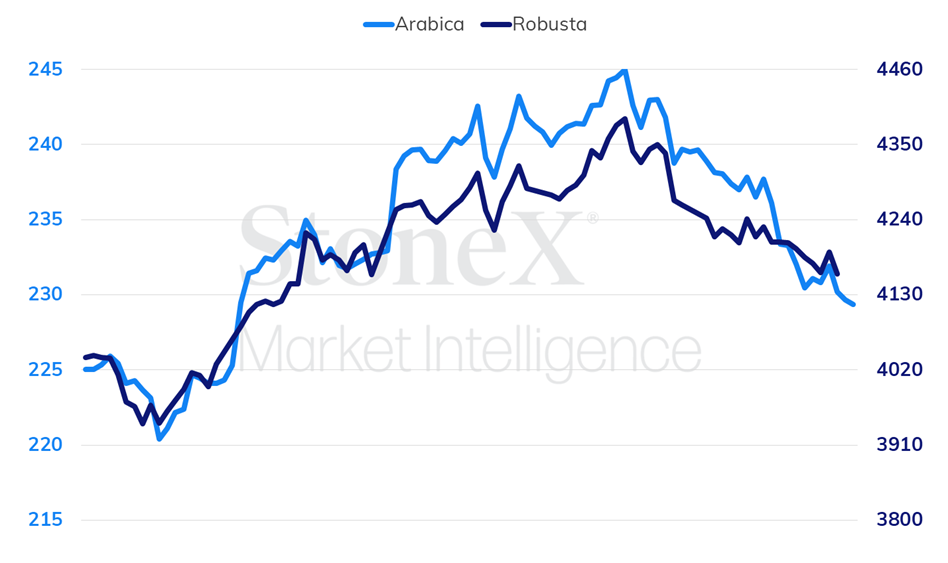
The main factor behind the sharp declines on Thursday and Friday was the easing of concerns among market participants regarding the weather, given that the models were pointing to a drop in temperatures but not posing risks to the main coffee-producing regions. Another point that acted negatively on prices is the expectation that Cecafé will report a large export volume in July in the report to be released on Monday (12). Preliminary data from the Foreign Trade Secretariat (Secex) indicated a 44% increase to 3.37 million bags. The significant increase in Brazilian coffee exports supports the sentiment of greater supply in the world's largest coffee producer and exporter.
Intensification of cold front raises fear of new frost and damage to Brazilian production
Despite last week's retreat, the changes observed in temperature forecast models over the weekend, with temperature drops and reports of localized frosts, significantly raised concerns about a possible broader frost at the start of this week. As a result, prices opened sharply higher this Monday (12), with the December/24 contract closing the session at US₵ 238.55/lb, a daily increase of 3.6%. In this scenario, we delve into the two main questions raised by market participants since yesterday: Were the climate impacts over the past weekend significant? And what are the risks of new impacts from the cold front in the coming days?
Since Friday, August 9, 2024, an event in Brazil has caused a significant temperature drop after several months characterized by drought and above-normal temperatures. Generally, in August, frosts are rare, but the emergence of cold fronts followed by a very strong polar mass is surprising the coffee industry. On Saturday, August 10, the first cold front brought moisture to the Southeast of Brazil, with some light rains recorded in a localized manner in southern Minas Gerais and Matas de Minas. On Sunday, August 11, records from INMET stations in coffee-growing areas showed that temperatures dropped by more than five degrees compared to August 10 in many coffee-growing areas. The temperature drop significantly affected coffee in Paraná and São Paulo.
On the other hand, the most unexpected reductions were recorded by INMET in Maria da Fé (South of Minas), where the minimum temperature fell from 13°C on August 10 to -0.5°C on August 11, and in Patrocínio (Cerrado), which dropped from 12.5°C on August 10 to 1.6°C on August 11. This situation caused localized frosts, especially in the higher-altitude areas of the Cerrado Mineiro and Alta Mogiana in São Paulo, where only a thin layer of ice formed on the upper leaves. The StoneX field team visited several producing municipalities in the Mogiana and South of Minas areas between Sunday and Monday, where no major damage was observed in the crops.
According to the numerical forecast of the ETA 0.8 km model, from the night of August 12 to the early morning of August 13, the cold front will intensify in southern Brazil, and sub-zero temperatures will be present in this region from 9 p.m. that night (BRT). At 3 a.m. on Tuesday (13), the cold front will reach southern São Paulo, and the temperature drop in coffee-growing regions will be around 4 to 6°C. At 6 a.m., the drop will be significant at the border between São Paulo and Minas Gerais, with local spots potentially reaching between 2 and 4°C.
Forecast of minimum temperatures in the Southeast and South of Brazil on August 13 (°C)

Source: INPE.
According to a study by the Agronomic Institute of Paraná (IAPAR), low temperatures (-1 to 2 °C) are lethal to coffee leaves, and the greater the temperature drop and the duration of low temperatures, the more severe and extensive the damage. Remember that most coffee plants have formed floral buds, which are delicate structures, and low temperatures or light frosts can cause buds to necrosis (cell death). Severe frosts can completely kill the buds, leading to total production loss in some areas. There is also the possibility of damaging the branches, impacting the plant's vigor.
Initially, after the coldest night this Tuesday (13), when there is a higher risk of impacts in some areas, temperatures tend to gradually rise again. If there are no records of frosts in wide areas this morning, concerns tend to decrease.
However, it is worth noting that the low temperatures in recent days have contributed to increasing the stress that plants are currently facing. Additionally, rainfall forecasts remain scarce until the end of the month, which should continue as a point of attention and supporting prices.
Farmer Selling Update
The coffee market remains challenging. Currently, we are facing a scenario of a tight balance between supply and demand, production issues of various origins, and increasingly frequent weather adversities for the crop. Additionally, the macroeconomic scenario has had a greater impact on commodities in recent weeks, with risk aversion sentiment and more intense exchange rate fluctuations further increasing the volatility and complexity of the Brazilian market.
In Brazil, producers have been actively participating in the market, but there is a more cautious stance among Arabica producers, especially regarding future sales. On the other hand, Robusta producers have reported good productions and favorable prices over the last three years, giving them a more advantageous trading condition.
Below is a survey conducted by StoneX, with the average percentage of sales by producers in some of the main producing regions of the country:
Percentage of sales by producer by crop

Source: StoneX. Design: StoneX.
Indicators