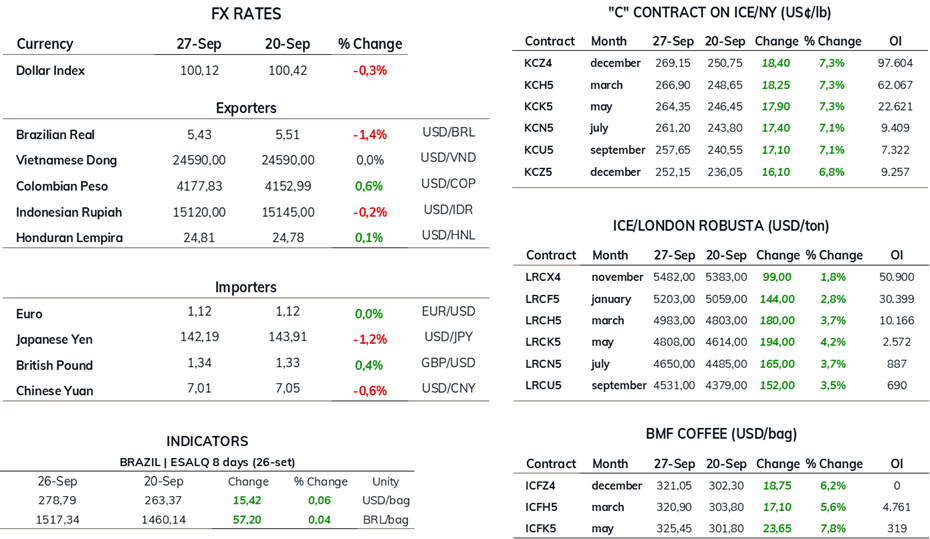
• New York coffee contract advances 7.3%, quoted at US¢ 269.15/lb
• Robusta futures prices rise 1.8% to USD 5482/ton on the London exchange
• The dollar falls 1.4% against the Brazilian currency
• In Brazil, Robusta coffee prices remain above Arabica
• Weather in Brazil remains on the radar. Higher volumes are crucial
• High prices in the Brazilian market are starting to reflect on store shelves
• Brazilian Robusta coffee remains significantly more competitive than Asian Robusta
• Harvesting in Vietnam in November may provide relief to physical market prices
• The National Federation of Coffee Growers of Colombia expects to harvest 13 million bags in 2024
• Import data in major consumer regions remains mixed
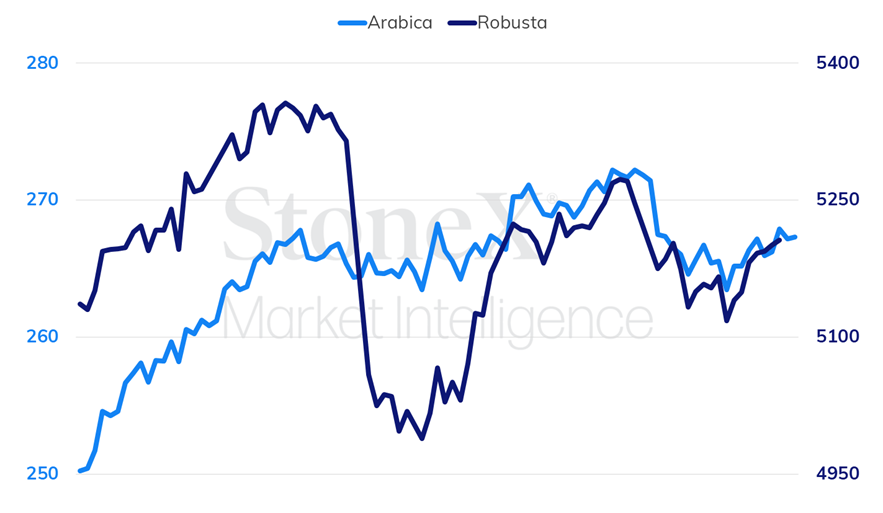
The last few days have seen another week of coffee appreciation on its main exchanges, with weather in Brazil remaining in the spotlight and keeping the market concerned, as consistent rainfall volumes have not yet been recorded in the coffee belt. Arabica coffee prices on the New York exchange closed around US¢ 270/lb, representing a 7.3% weekly increase. Meanwhile, Robusta coffee on the London exchange rose by 1.8%, ending at USD 5,482/t. On Thursday (26), the market reached a new milestone, with prices hitting historical highs. In New York, the most active contract reached an intraday high of US¢ 275.05/lb, renewing the highest levels in 13 years. In London, Robusta coffee hit USD 5,575/t, the highest level ever recorded.
In Brazil, the Cepea indicator points out that Robusta coffee remains the most expensive, with the differential between Arabica and Robusta staying positive, which is rare in the Brazilian market. The Arabica coffee indicator ended the week quoted at R$ 1,496.57/bag, a 2.5% increase. Meanwhile, the Robusta coffee indicator closed Friday at R$ 1,504.58/bag, with a weekly gain of 2.4%.
Weekly Intraday (most active contract) – September
The weather in Brazil continues to be the main source of short-term volatility, and it is crucial to follow the forecast updates. Rain is expected to normalize only from mid-October onwards. Recently, some coffee-growing regions in Minas Gerais recorded rainfall, although concentrated and for a short period. This helped to slightly ease the high-temperature scenario, but more rain is still essential for the proper development of the plants and for the setting and continued growth of the beans.
The high prices of recent months have impacted consumers in Brazil. Until April this year, according to the IBGE, the 12-month accumulated inflation for roasted and ground coffee was at -1.6%. Since then, we have observed significant monthly increases, with the most recent data, from August, showing an accumulated inflation of 16.6%. If these increases continue, they could harm consumption, as occurred in 2022, when the accumulated inflation exceeded 60%. In the eurozone, prices have remained stable, while in the United States, there has been a slight increase in recent months, but still within controlled levels, not indicating significant risks to consumption.
12-month accumulated inflation for roasted and ground coffee for consumers
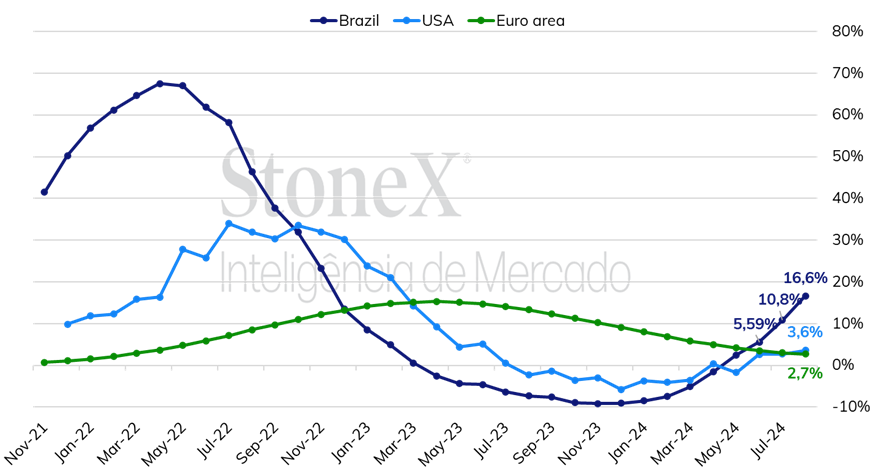
Source: IBGE, BLS, and Eurostat. Design: StoneX.
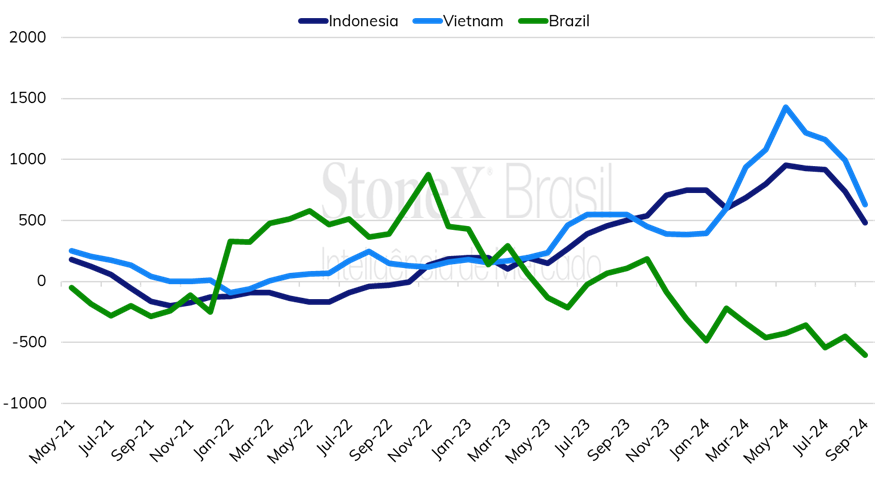
Despite the high prices, Brazilian Robusta coffee continues to be the most competitive compared to other origins. In the Asian market, spot prices are even higher due to reduced supply and the inter-crop in Vietnam, the largest Robusta producer. However, the price differentials for Robusta in Vietnam and Indonesia fell in September, with prices not following the increase observed in the London exchange, suggesting that buyers managed to replenish part of their inventories. The situation may improve from November onwards, with the start of the harvest in Vietnam, depending on good yields being observed.
Average price differentials of Robusta coffee at origins (USD/t)
Source: StoneX, Cecafé, and Refinitiv. Design: StoneX.
In terms of production, Colombia also had updates, with the National Federation of Coffee Growers predicting that 2024 production will reach 13 million bags, a 15% increase compared to last year, when the country produced 11.3 million bags. The main harvest has already started and is expected to gain momentum in October, contributing to a higher supply in the American market in the fourth quarter, when Colombian coffee imports tend to increase. For 2025, there is some concern as, despite the return of rains, the country experienced two consecutive months of drought, and, like in Brazil, more rain is needed to ensure the full development of the crop.
On the demand side, data from the main importers are mixed. In July, US coffee imports recorded the second consecutive monthly decline compared to the previous year. In June, imports were 5.4% lower than in the same month of 2023, while in July, they totaled 1.659 million bags, a 13.8% decrease from July 2023, when they stood at 1.925 million. Year-to-date through July, the US imported 12.8 million bags, about 1% below the same period last year. Meanwhile, European Union imports increased by 4.7% until July compared to the previous year, reaching 28.3 million bags, a more positive indicator for consumption in the region.
This week, in addition to the weather, Brazil's Ministry of Commerce will release the September export data next Friday. Although the coffee numbers are preliminary, as Cecafé's data will be published only the following week, these data will provide a thermometer of how the export flow of the current crop is performing.
INDICATORS