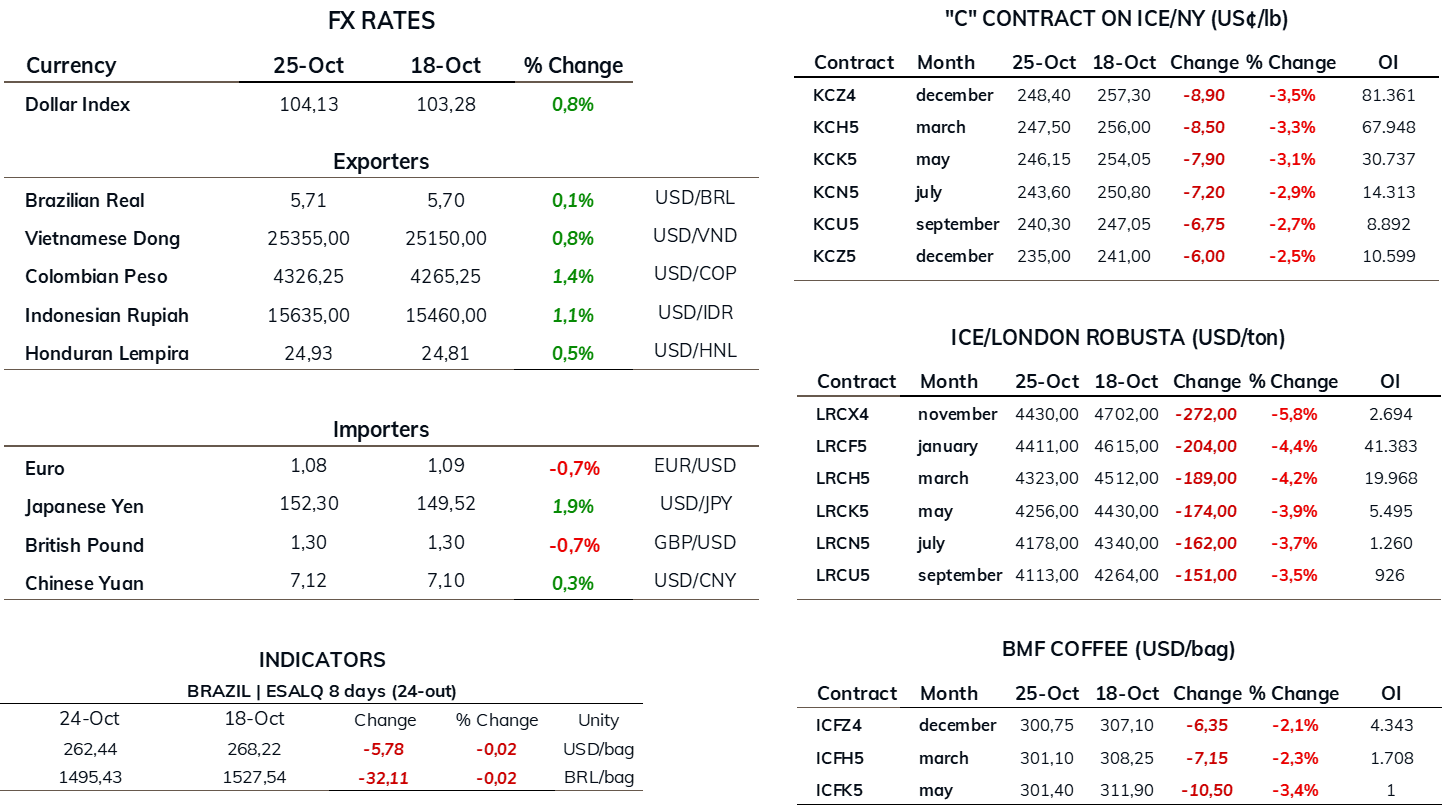
Arabica coffee fell 3.5% on the New York exchange, priced at US¢ 248.40/lb
Robusta coffee prices dropped 4.4%, to USD 4,411/ton, on the London exchange
The dollar rose 0.1% during the week, reaching USDBRL 5.70
In the domestic market in Brazil, Arabica coffee decreased by 1.8%, and Robusta by 1.3%
Excessive rainfall in Vietnam is delaying the harvest
The return of rains and the flowering in Brazil have pressured prices
Weather conditions are no longer a problem for coffee in Brazil
StoneX will release its first estimate for the 2025/26 crop at the beginning of November
VIMEXCO estimates Vietnam's crop at 28.3 million bags for the current season
WSJ: Coffee Price War Burns Keurig and Starbucks
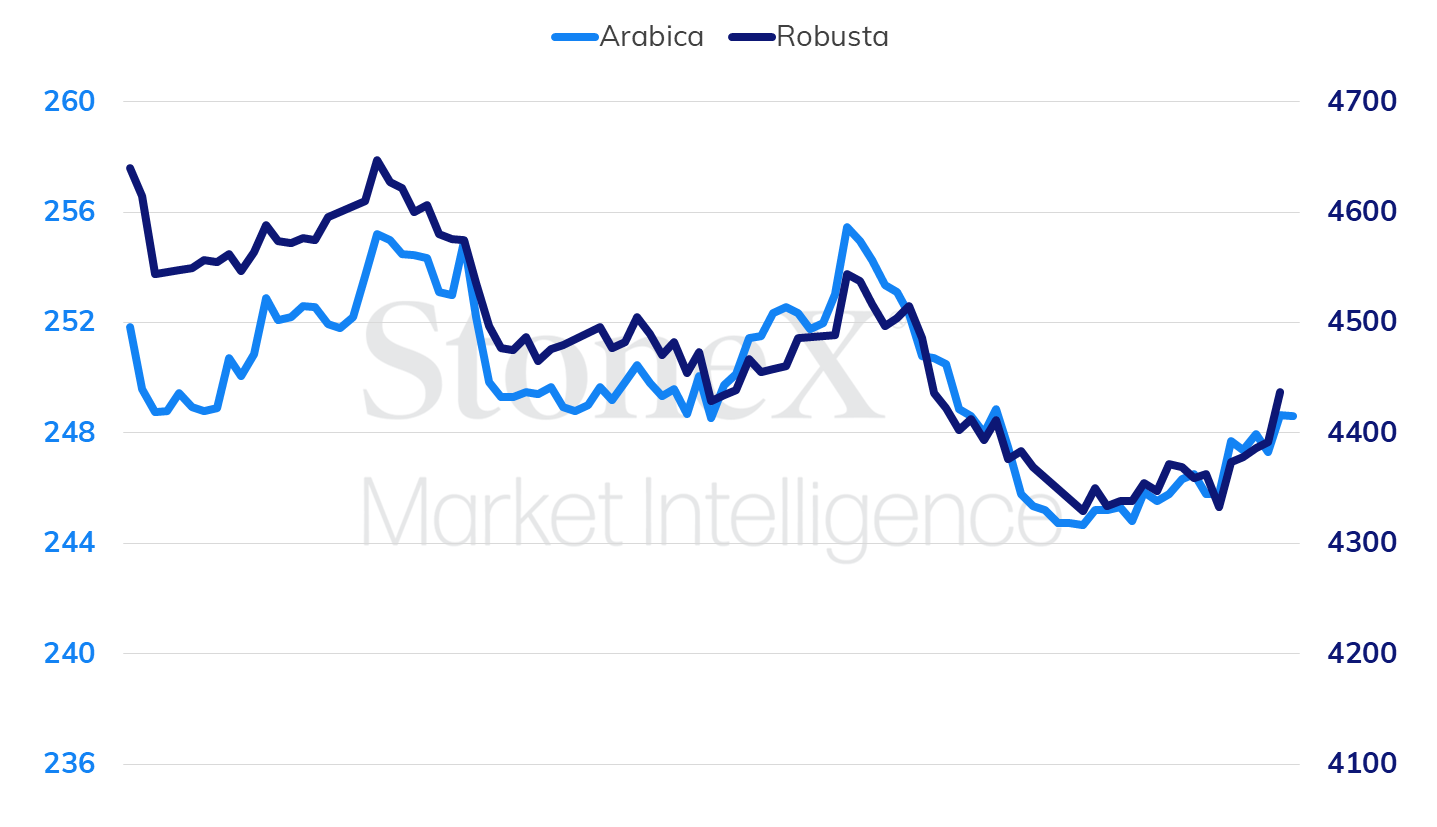
Last week, coffee futures prices fell again amid improved weather conditions in Brazil, the flowering of Arabica coffee, and the beginning of the harvest in Vietnam. In New York, Arabica coffee futures dropped by 890 points (-3.5%) for the most liquid contract, closing on Friday (25) at 248.40 US¢/lb—the lowest level since October 7, reached on Thursday (24).
In London, the beginning of Vietnam’s coffee harvest also pushed Robusta coffee prices down. Although the harvest has started, heavy rainfall has slowed progress. However, it is expected that the harvest will gain momentum by mid-November, increasing the availability of coffee in the physical market. The most active contract, for January, ended the week with a decline of USD 204/ton (-4.4%), hitting the lowest value since mid-August on Thursday (24) and closing at USD 4,411/ton on Friday (25).
This Monday (28), coffee prices have resumed gains amid increased trading activity, with some roasters taking advantage of the recent price drop, which hit its lowest levels since the start of the month in New York and since mid-August on the London exchange.
Weekly intraday (most active contract) – 10/21 to 10/25
In the Brazilian domestic market, coffee prices followed the trend observed abroad, ending the week lower. However, the decline was less sharp, as the Brazilian real remained at a high exchange rate, gaining 0.1% for the week, closing at BRL 5.70. The Cepea index for Arabica coffee fell 1.8% to BRL 1,500.20/bag, while the index for Robusta decreased by 1.3% to BRL 1,409.57/bag.
From a fundamental’s perspective, some factors point to a more bearish scenario in the short to medium term. While reduced supply in Vietnam and Indonesia, combined with dry weather in Brazil and the potential implementation of the EUDR legislation, had supported prices at the end of September and early October, some of these factors have faded.
Weather conditions in Brazil are no longer a concern. Any damage to flower buds before the rains began would have irreversible impacts, but the return of rainfall has promoted the blooming of the main Arabica coffee flowers. Forecast models indicate that favorable weather will persist in the coming months.
As for Robusta coffee, weather conditions have not posed any challenges, and crop development continues to benefit from favorable conditions and irrigation systems. The size of Brazil’s upcoming crop will play a crucial role in determining future coffee prices. Although issues affected some Arabica areas, the robust development of Robusta coffee could offset part of the production loss. StoneX will release its first official forecast for the 2025/26 crop in Brazil during the first half of November.
In Vietnam, despite expectations for lower production, the progress of the harvest and increased availability in the physical market are likely to continue to pressure prices, at least in the short term. In a recent interview with CoffeeNetwork, a StoneX group company in the U.S., Warren Ng, CEO of the Vietnam Resource Import Export Corporation (VIMEXCO), said that the current crop (2024/25) is similar to 2023/24, possibly 3-5% smaller, with an estimated production of 28.3 million bags. On the other hand, Nguyen Nam Hai, CEO of the Vietnam Coffee and Cocoa Association (VICOFA), stated during the Vitória Coffee Summit that production could decline from 26.7 to 24.5 million bags.
In Colombia, the main harvest is progressing, contributing to increased coffee availability and exports. Additionally, favorable weather is aiding the country’s production recovery. Moreover, other Central American countries are in their harvest period, which is expected to increase supply and boost coffee exports from these countries.
Regarding the EUDR legislation, while it was initially expected to take effect in 2025, European importers had been building up stockpiles in anticipation. However, the European Commission recently announced a 12-month delay in the law’s implementation, easing short-term concerns for importers.
Finally, there is a growing focus on consumption trends for the coming months. IBGE data shows that consumer coffee inflation in Brazil has reached 23% over the past 12 months. In the U.S., government data reveals inflation of over 6% during the same period, with average prices for roasted and ground coffee hitting the highest levels since the series began in 1980.
The main impact of inflation on consumer prices is a slowdown in consumption. Preliminary data from the American coffee chain Starbucks shows a 7% decline in global sales last quarter, with U.S. sales dropping 6%. Keurig Dr. Pepper reported a 3.6% revenue decline in U.S. sales last quarter, with a 2.7% increase in volume but a 6.3% decrease in prices. Despite the volume growth, the lower prices suggest intensified competition for customers.
This topic was also featured in an article published yesterday (27) by the American newspaper The Wall Street Journal, titled “Coffee Price War Burns Keurig and Starbucks.” The article highlighted that Americans are saving on coffee and that coffee companies are competing for customers through discounts and coupons. It also noted that Nestlé has observed weakening consumer demand for coffee in recent months.
TABELA DE INDICADORES