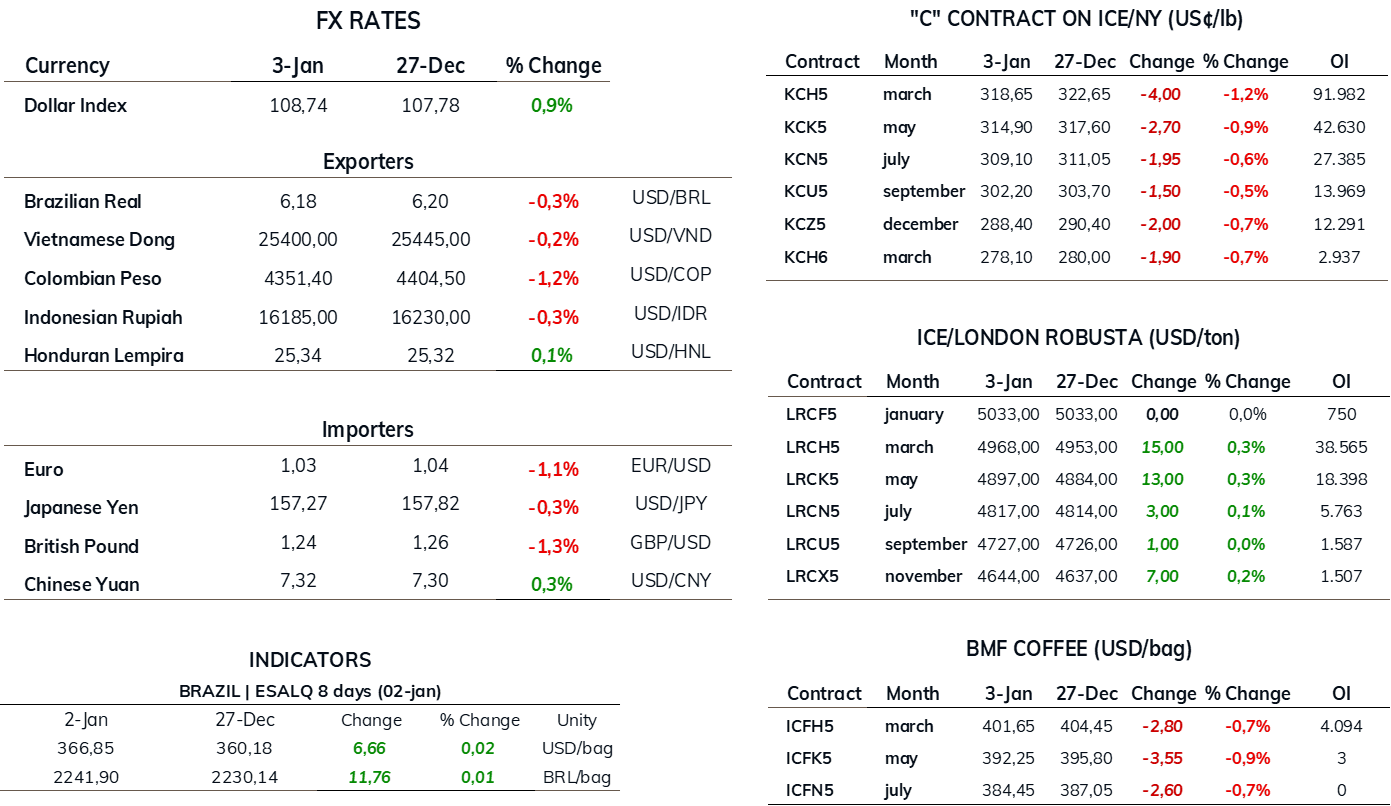
• Arabica coffee falls 1.2% during the week to US¢ 318.65/lb
• Robusta futures rose 0.3% during the week to US$ 4968/ton
• Cepea Indicator for Arabica coffee drops 0.1% to R$ 2,233/bag
• Cepea Indicator for Robusta coffee rises 0.8% during the week to R$ 1,832/bag
• Weather conditions in Brazil and crop recovery remain in focus
• Likelihood of La Niña increases in January
• Harvest delays in Vietnam are concerning, but weather is expected to stabilize
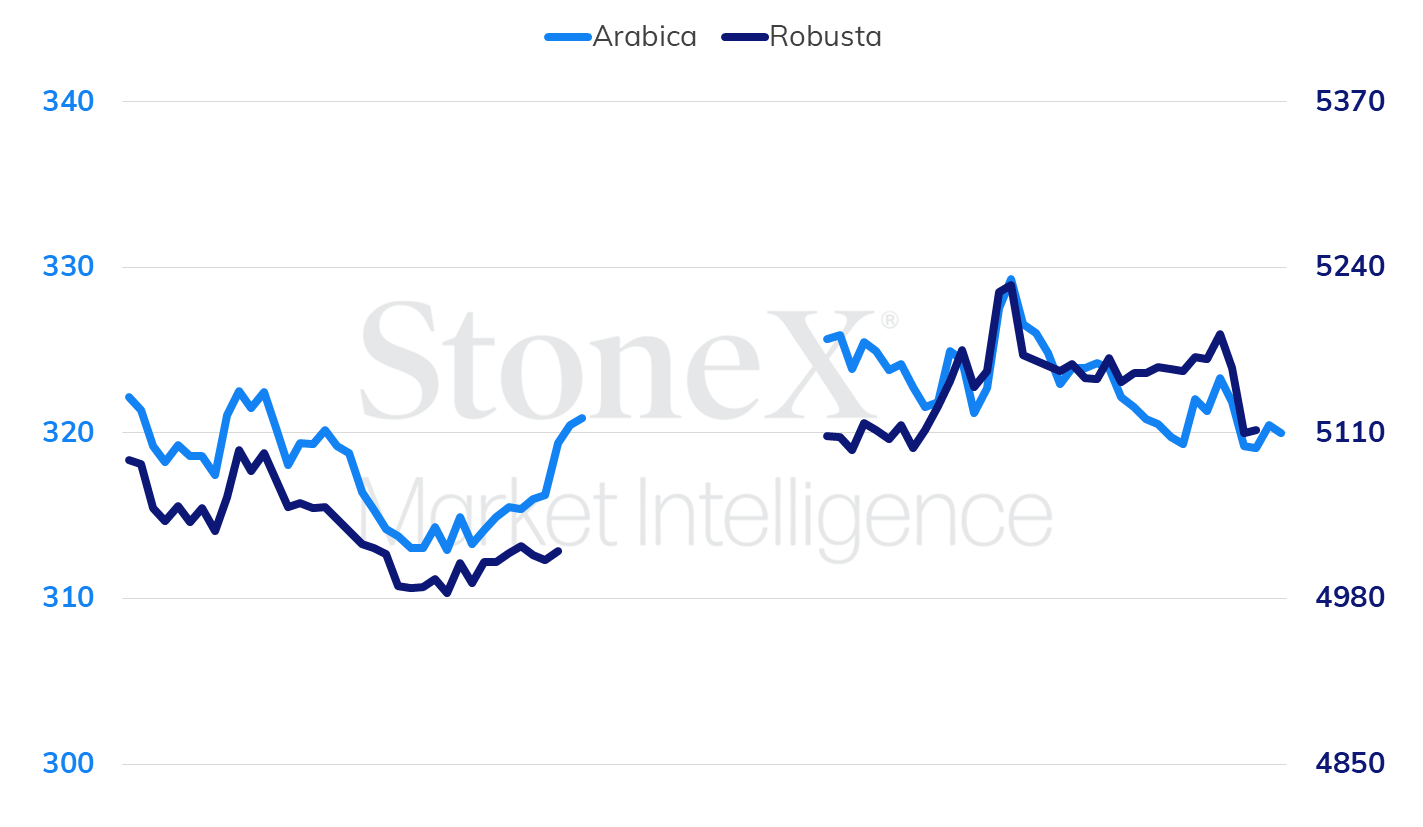
Last week saw mixed fluctuations in coffee prices. Amid a market with reduced liquidity due to the New Year holiday and a wait-and-see approach, Arabica coffee ended the week down 1.2% on the New York exchange, with the March 2025 contract priced at US¢ 318.65/lb. Robusta coffee, on the other hand, experienced a slight increase of 0.3%, supported by reports of excessive rainfall affecting Vietnam's harvest, with the equivalent contract in London closing at USD 4,968/t.
The CEPEA indicator for Arabica coffee closed the same period at BRL 2,233.34/bag, a marginal drop of 0.1%. Meanwhile, the indicator for Robusta coffee finished at BRL 1,832.57/bag, a weekly increase of 0.8%.
Weekly Intraday (most active contract) – 12/30 to 01/03
2024 Closing
2024 was a year of high volatility for the coffee market. After cocoa, which saw a 178% increase for its first contract, coffee was the second most appreciated commodity on international exchanges. In New York, Arabica coffee rose 69.8% over the year, closing at US¢ 319.75/lb. Arabica was significantly influenced by bullish factors, notably driven by Robusta price increases, logistical challenges, drought preceding the flowering season in Brazil, and concerns over the new European Union anti-deforestation law (EUDR).
In London, Robusta coffee appreciated by 71.6% during the year, ending at USD 4984/t. A highlight was the historical high reached on November 28, when the second contract peaked at USD 5528/t. Robusta, which influenced Arabica prices at various points during the year, faced production issues in its two largest producers in Asia, Vietnam and Indonesia. The primary concern was drought in Vietnam, where temperatures remained above average for nearly the entire first half of the year. Robusta logistics also became a critical issue due to Middle East conflicts, culminating in attacks by the Houthi armed group in the Red Sea, blocking the main route for Asian coffee to European markets. This event significantly raised shipping costs and made Brazilian coffee even more competitive on the international market.
In Brazil, Cepea indicators for Arabica coffee closed the year at R$ 2,228.79/bag, up 120%, while Robusta indicators rose 141% to R$ 1,832.57/bag. A notable factor was the sharp 27.7% devaluation of the real against the dollar during the year, with the U.S. currency ending at R$ 6.179, further boosting domestic prices.
Early 2025 Outlook
Coffee begins 2025 with volatility, as the focus shifts to production in the two largest global producers. In Brazil, the coffee belt has seen good rainfall volumes in recent weeks, which will help to recover to some extent the leaf loss that crops suffered due to the drought – for those that did not suffer irreparable losses.
Regarding the weather, an important factor is the potential onset of a La Niña event. As highlighted in the latest weekly weather update, after a drop in average Pacific Ocean temperatures in December, a La Niña could be officially declared in January. La Niña is associated with wetter conditions in northern Brazil and cooler conditions in the south. If mild in intensity (as currently indicated), it could positively impact moisture restoration, especially in coffee-producing areas. However, given recent frost events, the phenomenon could bring market volatility, particularly if it extends into late autumn and early winter in Brazil.
If La Niña's onset is confirmed by NOAA/NCEP and subsequently by IRI, its duration throughout 2025 will warrant attention. NOAA and IRI typically update official conditions on the second Tuesday of each month, but their latest weekly report showed several ocean-atmospheric signals opposite to those in the same period in 2024, along with a sudden cooling of Pacific Ocean surface temperatures in December.
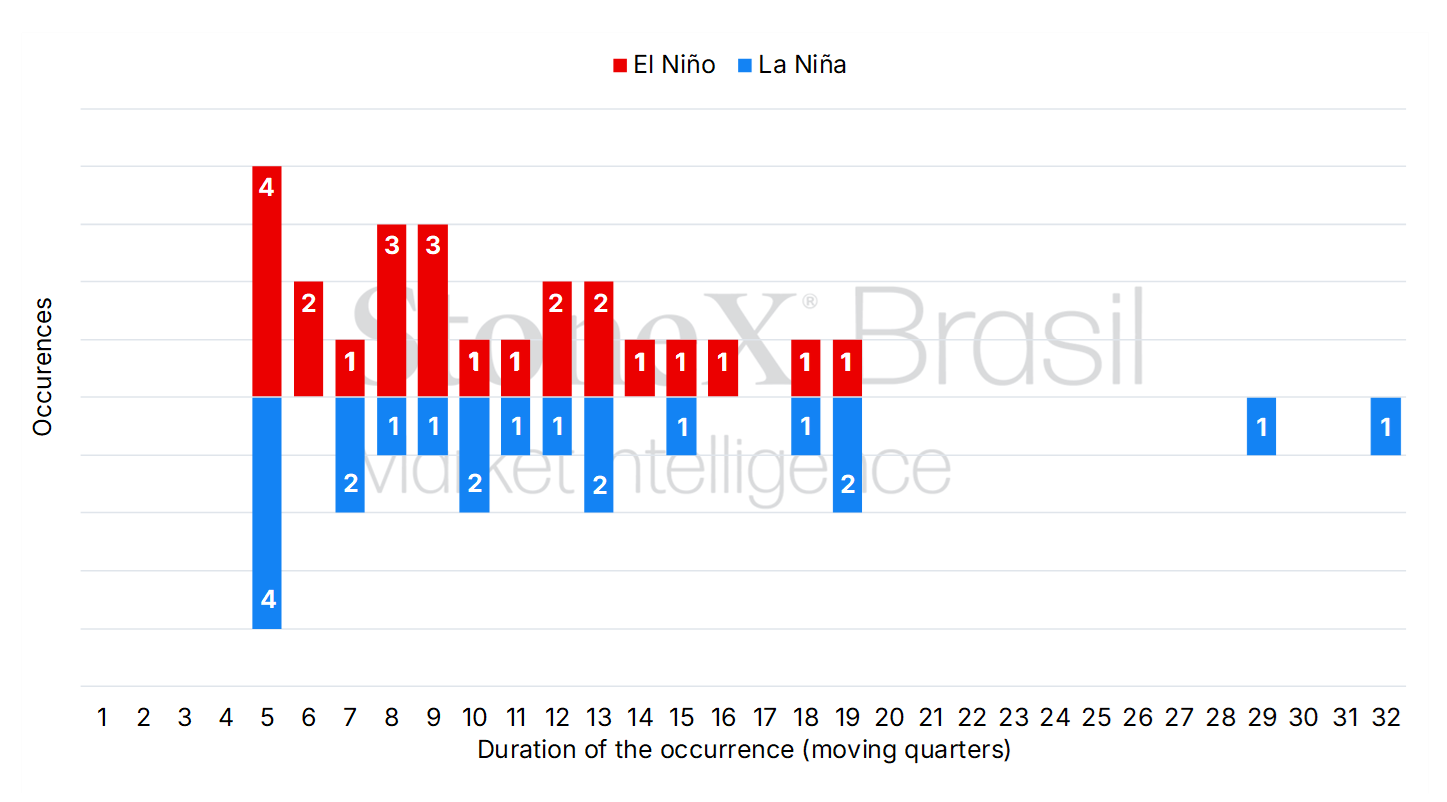
If La Niña is confirmed this month, it may persist for some time. Reviewing the history of El Niño and La Niña events since 1950, as provided by NOAA, reveals that the shortest observed duration for either phenomenon was five rolling quarters—these were also the most frequent, occurring four times for each phenomenon. While current models suggest a very short La Niña, historical data from the past 75 years implies that if it occurs, it could last at least five rolling quarters.
Count of El Niño/La Niña events by duration since 1950
Source: NOAA. Design: StoneX.
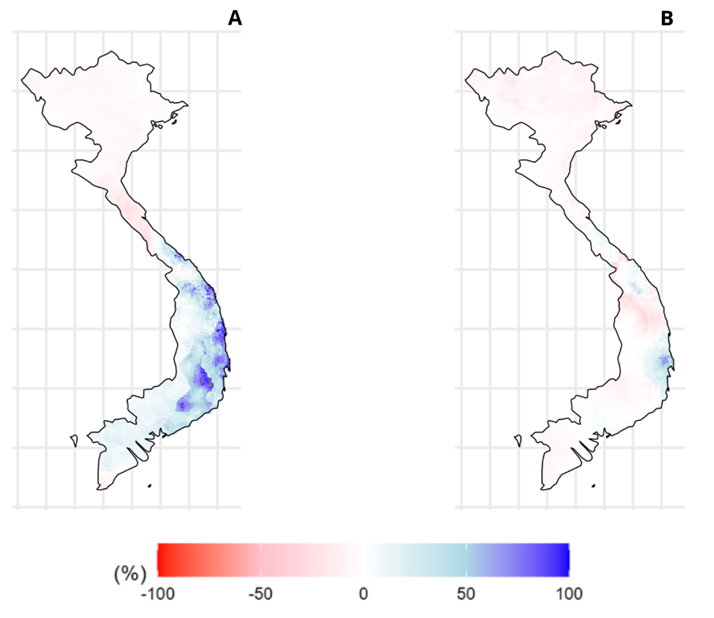
Another point of focus is Vietnam. Local market participants reported challenges with harvesting, drying, and storage due to excessive rainfall at the end of 2024. Local operators estimate that these conditions caused delays, with 20% to 30% of the crop yet to be harvested, which supported Robusta prices at the start of the year. However, throughout January 2025 and based on the forecast for the next 15 days, more favorable conditions are likely to reverse the situation, allowing work to continue in the country.
Fifteen-day accumulated precipitation anomaly, expressed as a percentage (%). Data for the period from December 23, 2024, to January 6, 2025 (A), and the forecast for January 6 to January 20, 2025
Source: CHIRPS-GEFS. Design: StoneX.
On the other hand, it is important to highlight the upcoming Lunar New Year holiday, known as Tet in Vietnam, which will be celebrated this year on January 29. This is the most important and traditional Vietnamese holiday, during which local producers typically increase sales in the weeks leading up to it to secure financial resources for the festivities, which can last up to a week. Therefore, despite harvest issues that may have a bullish effect in the very short term, the coffee supply flow is expected to increase in the coming weeks, likely acting as a significant bearish factor for prices.
TABLE OF INDICATORS