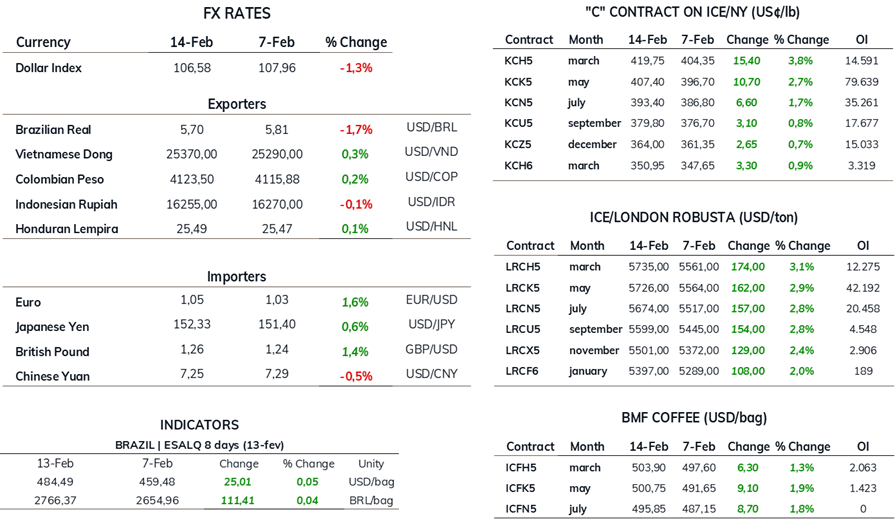
• Arabica coffee reached US¢ 419.75/lb on ICE, a weekly gain of 3.8%;
• Robusta coffee advanced 2.9%, closing at USD 5,726/t on the London exchange;
• CEPEA’s Arabica indicator rose 2.9%, reaching R$ 2,731/bag;
• CEPEA’s Robusta indicator increased 0.8%, ending at R$ 2,075/bag;
• Reduced stocks and slow logistics continue to pressure prices;
• Suspension of operations by Central do Café has raised market concerns;
• ICE raised initial margins for contracts, increasing costs for exchange operators;
• A Reuters survey shows that market participants expect Arabica prices to finish 2025 at around US¢ 295/lb, a 30% drop from recent highs;
• For Robusta, the survey projects an end-of-year level of USD 4,200/t;
• The median estimates from the survey indicate a production of 64.6 million bags for Brazil in 2025/26, a 2.7% decline;
• Southern Minas, Matas de Minas, and Triângulo Mineiro report good water conditions following significant rains in January and February;
• Espírito Santo and Bahia (robusta/conilon) face dry weather, but technology use may mitigate productivity impacts.
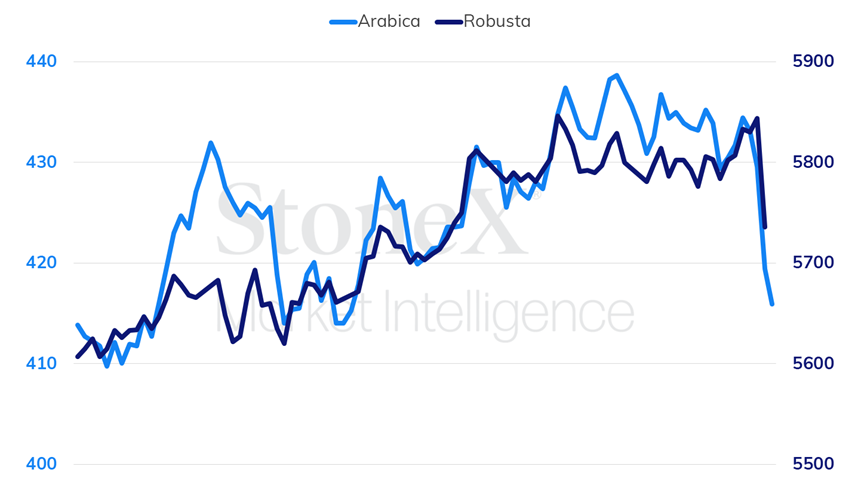
Coffee futures continued to advance, once again setting records on the New York exchange, while the market remains highly pressured as excessively high prices complicate trading, and reduced stocks combined with slow logistics are causing some consumer distress. News that a trader in Minas Gerais suspended operations last week has further heightened market apprehension about the potential impact of high prices on the coffee supply chain. The March/25 screen ended Friday at US¢ 419.75/lb, a weekly gain of 3.8%. Robusta coffee on the London exchange followed Arabica’s lead, advancing 2.9% to close at R$ 5,726/t.
The CEPEA indicator for Arabica coffee rose 2.9% over the week, ending at R$ 2,731/bag, while the Robusta indicator advanced 0.8%, closing at R$ 2,075/bag.
Weekly Intraday (Most Active Contract) – Feb. 10 to 14
As mentioned earlier, concerns regarding the financial situation of companies in the sector—including potential defaults and difficulties in meeting supply commitments—have created tension among operators. Last week, it was reported that Central do Café, a mid-sized trader located in Muzambinho, Minas Gerais, temporarily suspended operations to renegotiate its debts. The company stated it would remain closed indefinitely while it evaluates its financial situation.
Additionally, last week ICE raised the initial margins for contract operations on the exchange as a measure to mitigate risks and reduce the possibility of operator defaults. This increase in initial margins deserves attention if it becomes recurrent. Last year, the cocoa market faced a similar situation when ICE made successive adjustments to initial margins amid a price surge driven by concerns over global commodity production. The significant increase in margins resulted in several market participants—both speculators and commercial players—exiting the market, reducing liquidity on the exchanges and contributing to greater price volatility.
Despite coffee being at significantly high levels, market participants believe that current prices are expected to ease over the course of the year. According to a survey conducted by Reuters with coffee market participants, the median response indicated that the price of the most active coffee contract on the New York exchange is expected to close the year around US¢ 295/lb, representing a 30% retracement from recent highs. For Robusta, the outlook is similar, with respondents expecting the year to end at USD 4,200/t.
Traders’ Price Estimates for Coffee on Exchanges at the End of 2025
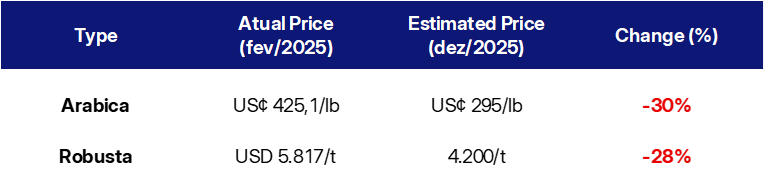
Sources: Reuters. Preparation: StoneX.
The main reason behind the expected price reduction is the potential impact of high prices on beverage consumption, as companies begin to pass on increased costs more aggressively to final product prices. In Brazil, price increases are already being noticed on store shelves. After the record levels seen in February, some roasters have informed their partners of further price adjustments of over 10% for both roasted and ground coffee as well as soluble coffee starting in March.
For the production of Brazil’s 2025/26 crop, the median estimates project a 2.7% decline to 64.6 million bags. This performance is driven by an expected 6.6% drop in Arabica supply—from 43.4 million bags in 2024/25 to 40.55 million in 2025/26. For Robusta, the median forecast indicates a 16.7% increase to 24.5 million bags. Next month, StoneX will release a revision of its estimates for the Brazilian crop. In its preliminary report published in November, StoneX estimated a 10.5% drop in Brazil’s Arabica production to 40 million bags, along with a 20.9% increase in Robusta production to 25.6 million bags, totaling a slight overall decline of 0.4% in Brazil’s production to 65.6 million bags.
Finally, for Vietnam, the median estimates expect a 3.6% increase in production, rising from 28 million bags in 2024/25 to 29 million in the next season. The expectation is that milder weather in the country, which last year experienced above-average temperatures followed by excessive rains, will contribute to a recovery.
Traders’ Production Estimates for Brazil and Vietnam 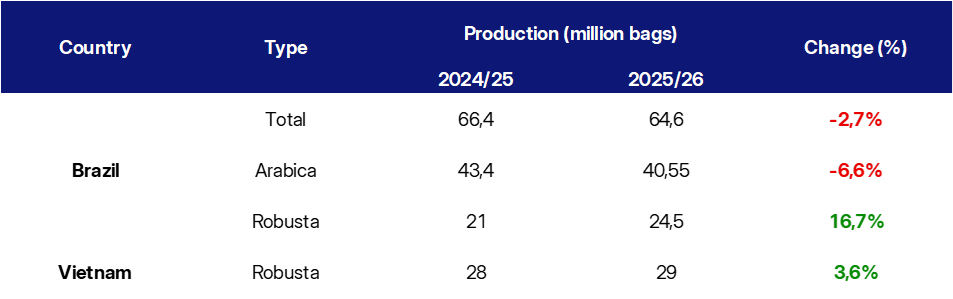
Source: Reuters. Preparation: StoneX.
Climate Update for the Coffee Belt
Southern Minas, Matas de Minas and Triângulo Mineiro: Forecasts indicate below-average rainfall and high temperatures in these regions. This suggests the occurrence of convective summer rains (brief afternoon showers) and cloudiness, which can influence temperatures. However, throughout January, rain volumes were significant, with totals exceeding 200 mm. As of February 16, Triângulo Mineiro and Southern Minas, near the São Paulo border, have already recorded over 100 mm of precipitation. Thus, the soil still maintains good moisture conditions, favoring crop development. This scenario indicates that the crop can weather the dry spell without major losses, ensuring good bean development and maintaining positive yield expectations.
Cumulative rainfall observed in January (A) and until February 16 (B) 2025
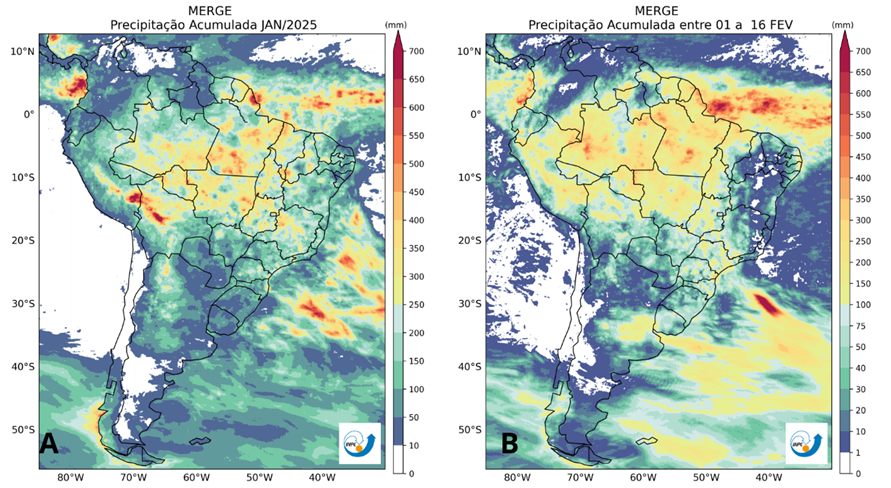
Source: INPE.
Conilon (Espírito Santo and Bahia): Production areas in these regions are experiencing consecutive periods without significant rainfall, resulting in dry weather and high temperatures. However, field observations indicate that flowering has developed somewhat earlier and more uniformly. Additionally, January’s climatic conditions were excellent for the initial stages of bean development. A particular aspect of the Robusta production system is the use of advanced technologies, such as irrigation and improved clones. Among the clones widely adopted, some have a larger leaf area, which can help protect the fruits against sunscald and maintain a more favorable microclimate within the plantation. This factor may allow the crops to withstand the dry spell without compromising expected yields.
INDICATORS TABLE