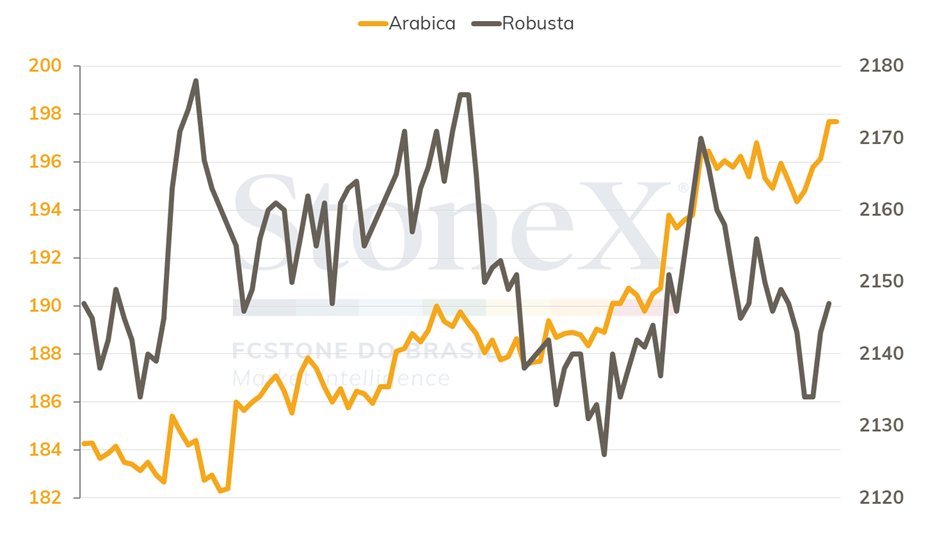
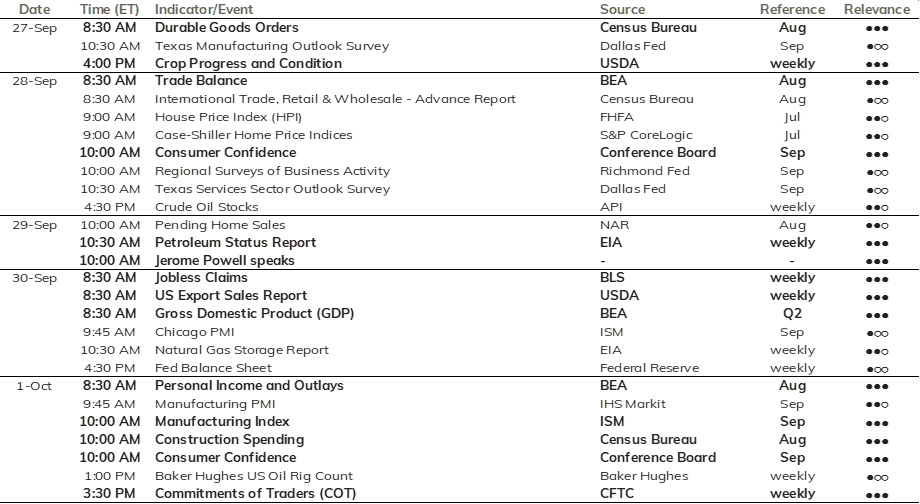
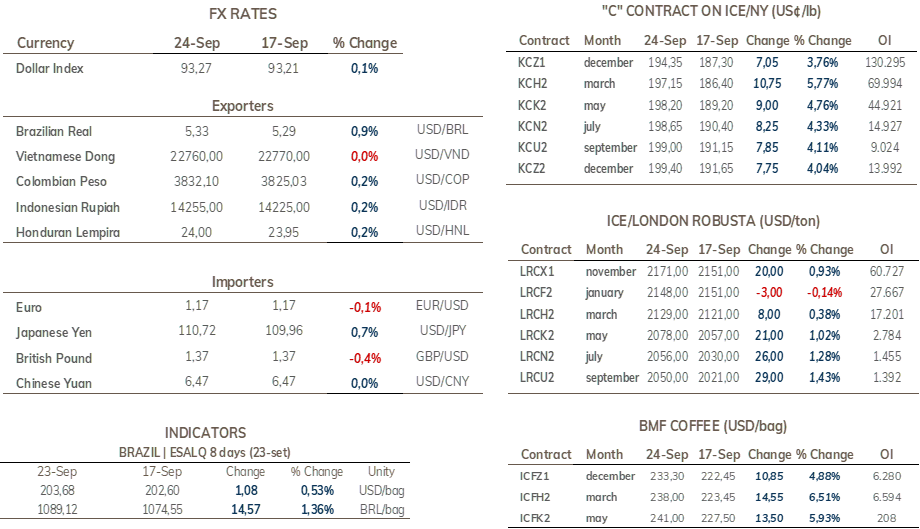
In addition to the weather and global logistics problems, Arabica coffee prices have been directed by the reduction in certified coffee stocks – last week, there were some rumors that commercial agents are withdrawing coffee from certified stocks. As noted in a special analysis published in May, certified stocks are related to price differentials at origin and logistics costs. Given the differentials levels in the main origins, logistical difficulties and costs, there is a lower probability that new coffees will be certified. Furthermore, costs and logistical problems encourage the withdrawal of coffee from certified stocks, a trend that is expected to continue over the next few weeks. The reduced certified stocks lead to a bullish tone in the coffee market.
In Brazil, the CEPEA indicator for the Arabica variety advanced 3.45% to close the week at BRL 1,111.63/bag. On the other hand, the CEPEA indicator for Robusta pointed to an increase of 6.4% to close at BRL 811.86/bag. As mentioned in the last weekly report and seen in the Weekly Coffee Basis Report, the Brazilian Robusta coffee market continues with a positive differential, reaching around USD 250/ton last week.
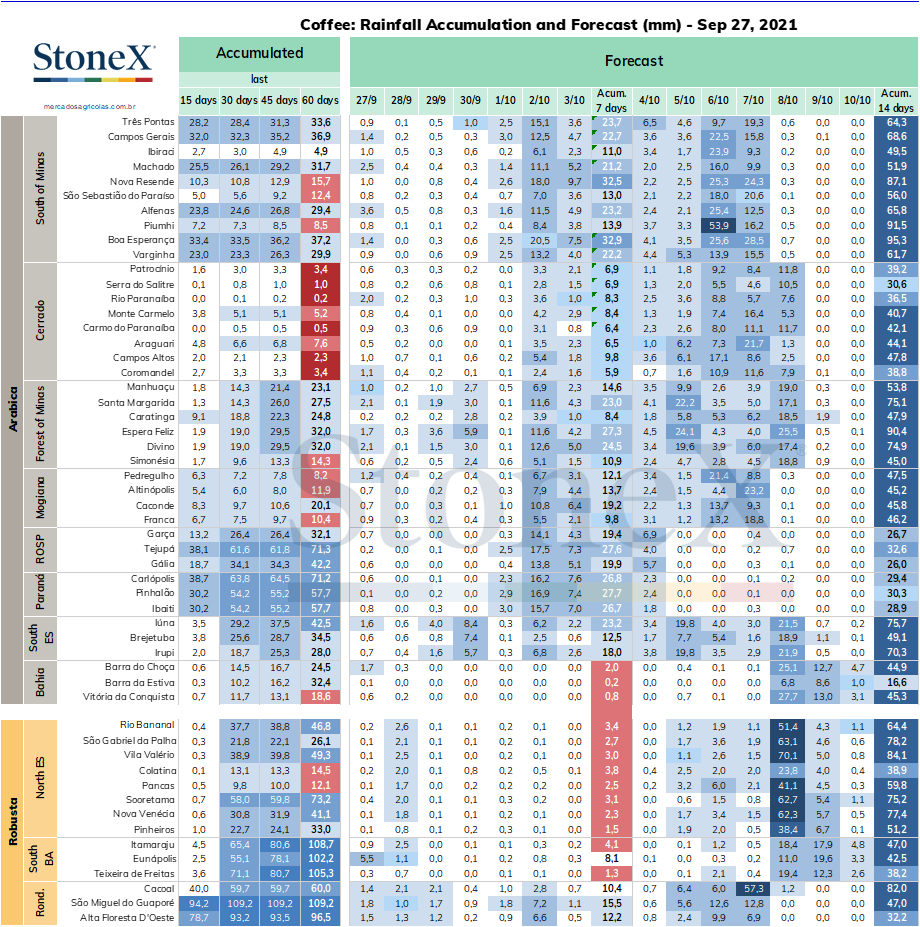
As often commented in recent weeks, prices likely become more sensitive to weather forecasts, especially the rainfall forecasts, which need to occur in volumes and at the correct time so the coffee flowering can reach its full potential. Amid the dry weather and rainfall below the historical average in the last 60 days in Southern Minas Gerais and the Cerrado region, the first flowering observed is at risk of suffering losses. The Cerrado, an area with the highest indications of drought stress in crops, holds the greatest potential for losses. Currently, the forecasts have pointed to rains only at moderate levels in the region, generating uncertainty regarding the second flowering period.
Source: NOAA. Design: StoneX.
Thus, fundamentally, the scenario remains positive, with fears of a significant reduction in the current and next crop year, despite the adverse weather, represented both in the drought and water crisis in Brazil and in the torrential rainfall in Colombia as the logistical complications that remain. Last week, the ABTTC (the Brazilian association of retro port terminals and container-transporting companies) indicated that the crisis at ports is expected to ease only in January 2022. Furthermore, the recovery of the global economy, the large increase in freight costs, and the greater profitability in Asia, the United States and Europe for transport companies to weigh on containers to remain limited for Brazilian exporters, who have sought to delay their shipments. This situation may be reflected in even lower than expected export volumes for the 2021/22 season, keeping coffee supplies limited in the short term.
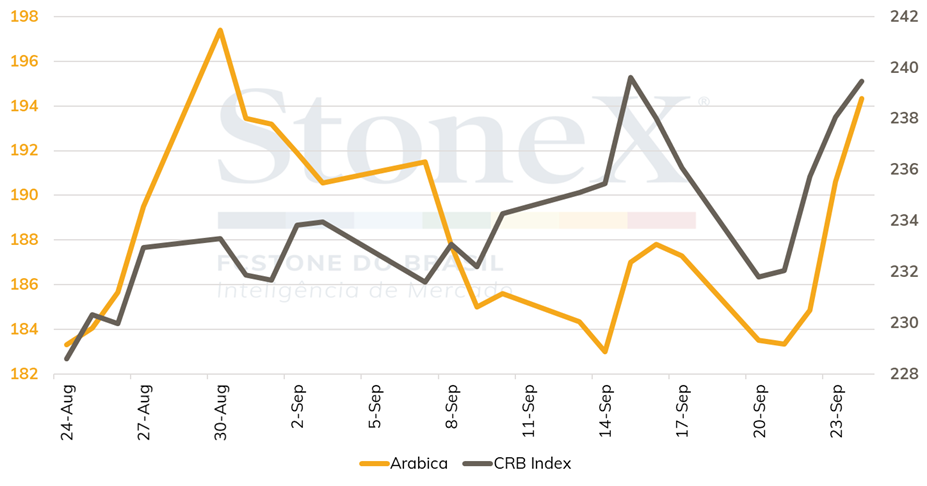
The latest Commitment of Traders (COT) report, released by the CFTC, informed that between September 14 and 21, spec funds increased their long positions in futures and options by 2,318, while they reduced their short positions by 795, increasing their net long positions by 3,113 to 37,144. At first, this movement tends to have a bullish effect on prices. However, the most active contract in New York retreated by 210 points, ending September 21 at US₵ 183.35/lb. The explanation for this result lies in the index funds movements. As seen in last Friday’s CFTC Commitments of Traders report, index funds reduced their net long balance by 4,289 positions, weighing on coffee prices.
ARABICA COFFEE quote IN NY VS. CRB INDEX
Source: Reuters. Design: StoneX.
It is worth remembering that index funds do not respond directly to the fundamentals of the coffee market but rather to fundamentals linked to macroeconomic factors and a set of globally traded commodities. In this period, we have observed an increase in the dollar index and a drop in commodity prices in general, with the CRB commodities index posting a drop of 1.4%. In general, the commodities complex followed an increase in global risk aversion in this period due to the threat of insolvency of the Chinese property developer Evergrande, which could limit Chinese demand for several products.
In Nicaragua, the country’s coffee sector is being impacted by a trifecta of challenges; logistics, weather and the global pandemic have all put a strain on the supply chain.
There have been reports that major shipping lines have been skipping Nicaragua’s ports as ships continue to struggle to stay on schedules and avoid delays. Producers in Nicaragua have told CoffeeNetwork that there are increasing challenges in fulfilling contracts with limited space on ships departing. The latest data from the International Coffee Organization (ICO) showed that the cumulative export figures from Mexico and the traditional washed arabica Central American bloc; Costa Rica, Guatemala, Honduras, Nicaragua and El Salvador increased 1.40% in the first ten months of the current coffee year, however, Nicaragua’s exports fell 7.8%.
In terms of weather, Hurricanes ETA and IOTA hit the North Central Region of Nicaragua and the Caribbean Coast at the end of November and early December 2020. Producers reported significant losses due to the excessive rainfall due to the hurricanes. Some coffee companies estimate that hurricanes ETA and IOTA caused significant damage to at least 5% of the coffee plantations, several plantations suffered total losses from landslides. Since then, the country has seen a dry spell in late July and early August. Because of this, the USDA forecast limited growth for the 21-22 coffee year. Coffee associations anticipate a moderate growth of at least 5% for a total of 2.38 million 60-kilogram (KG) bags but do not foresee a full recovery since investments on the coffee sector remain stagnant.
And these investments that should be boosting the coffee sector are becoming less and less possible. Vaccination campaign and recent political challenges are likely to stall economic recovery. COVID-19 cases remain high, and there are rising concerns about the availability of labor.
Robusta coffee futures rallied last week, touching more than four-year highs. Overall, Robusta coffee has soared more than 55% this year after frosts in Brazil were said to have impacted the country’s Arabica crop, boosting the demand for Arabica. In top producer Vietnam, tightening COVID-19 restrictions have left the country struggling to find labor for harvesting, issues with trucks being able to travel within the country to transport the coffee to ports and challenges with availability of ships and shipping containers to export the coffee abroad.
The market failed to respond to a bearish report from Brazil’s supply agency, CONAB, which forecast a jump of 12.8% of the Robusta crop in 2021-2022 year on year. Traders say this increase in Robusta production was already factored in to the market.
Looking ahead, focus will be on the harvesting in Vietnam. Weather will be a key factor in the pace of harvesting. Logistical issues should begin to resolve following next week’s announcement from Prime Minister Pham Minh Chinh that the country plans to ease restrictions.
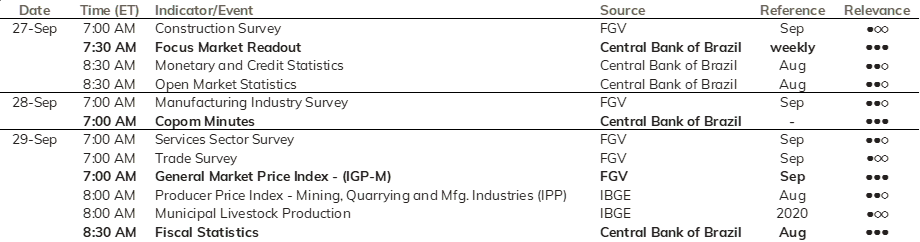
In a week marked by monetary policy decisions by the Central Bank of Brazil and the Federal Reserve, and with a preview of September inflation in Brazil, the USDBRL closed the week high by 0.9%, quoted at BRL 5.344, with less influence on coffee prices, where concerns about supply and the Brazilian flowering period prevailed.