StoneX logo

Coffee Weekly Report

By: StoneX Intelligence Brazil, StoneX Intelligence Brazil

Return of rainfall in Brazil marks the week
 
Fernando Maximiliano
Leonardo Rossetti
William Rutherford-Roberts
Alexis Rubinstein
rainfall weighs on coffee prices, but the market keeps an eye on reducing Arabica certified stocks. Cecafé and GCA to release their data this week
 
 
HIGHLIGHTS 

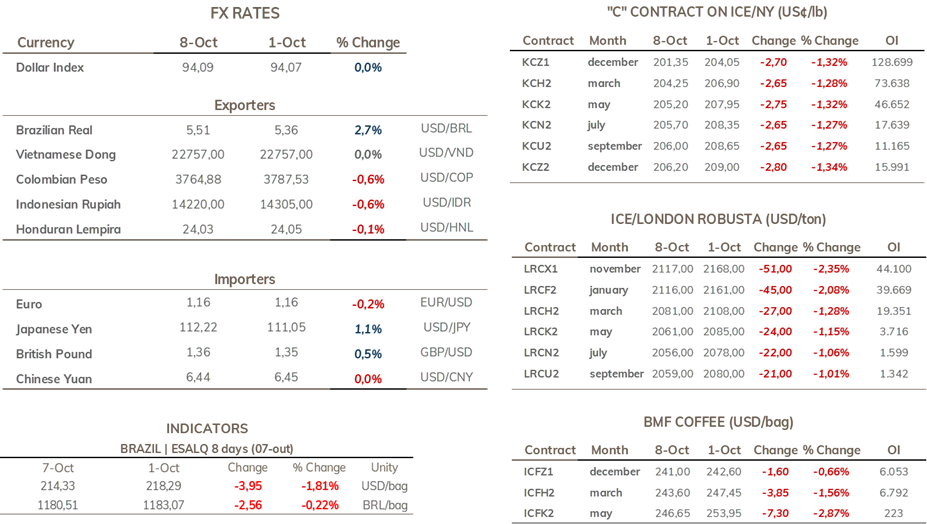
•    Arabica coffee prices dropped by 270 points (1.3%) in NY, with Cepea indicator going to BRL 1199/bag, high by 1.3%.
•    Robusta drops by USD 51 (2.3%) in London but appreciates BRL 4.09/bag (0.5%) in Brazil to BRL 834.41/bag.
•    Agents continue to receive certified stocks as a short-term alternative
•    Certified stocks fall more than 20% in just over four months in London
•    Certified stocks have dropped over 200,000 bags since mid-September in NY; the trend is for sharper drops
•    Rainfall returns to the coffee belt, and even higher volumes are expected for the next two weeks  
•    Weather agencies continue to point to the La Niña occurrence; NOAA to release updates on Thursday (14)
•    Cecafé to release export data this week, analysts expect lower volumes
•    On October 15, the Green Coffee Association will release September stocks at American ports data - a drop is expected
•    Pressure on Robusta complex amid easing of shutdowns in Vietnam  
•    Rainfall is expected to continue in Vietnam – there are risks of delayed harvest and quality problems
•    USDBRL appreciates amid global risk aversion  
•    Brazilian currency closes over BRL 5.50, highest level since April  
•    IPCA shows an increase of 6.9% in September
•    Coffee increases 5.5% on September's IPCA; the year-to-date total reaches 24.2%

   Bearish factors       Bullish factors


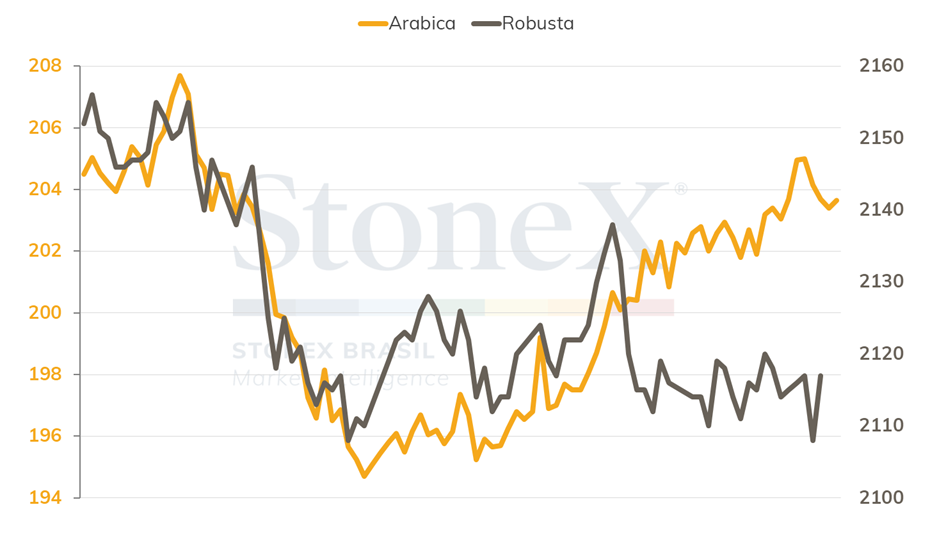
The return of rainfall in Brazil's coffee belt eased agents' concerns and contributed to weighing on coffee prices this week. On Tuesday (05), the Arabica coffee prices retreated over 800 points in response to the weather forecast models pointing to accumulations of up to 150 mm in 7 days in some Brazilian regions. For the rest of the week, prices regained territory amid declines in certified coffee stocks on the exchange, as discussed below. The most active coffee contract in New York (December) retreated 270 points (1.3%), ending the week quoted at US₵ 201.35/lb.
WEEKLY INTRADAY (MOST ACTIVE CONTRACT) - 10/04 TO 10/08
image 19590
Source: Commodity Network Trader's Pro. Design: StoneX.

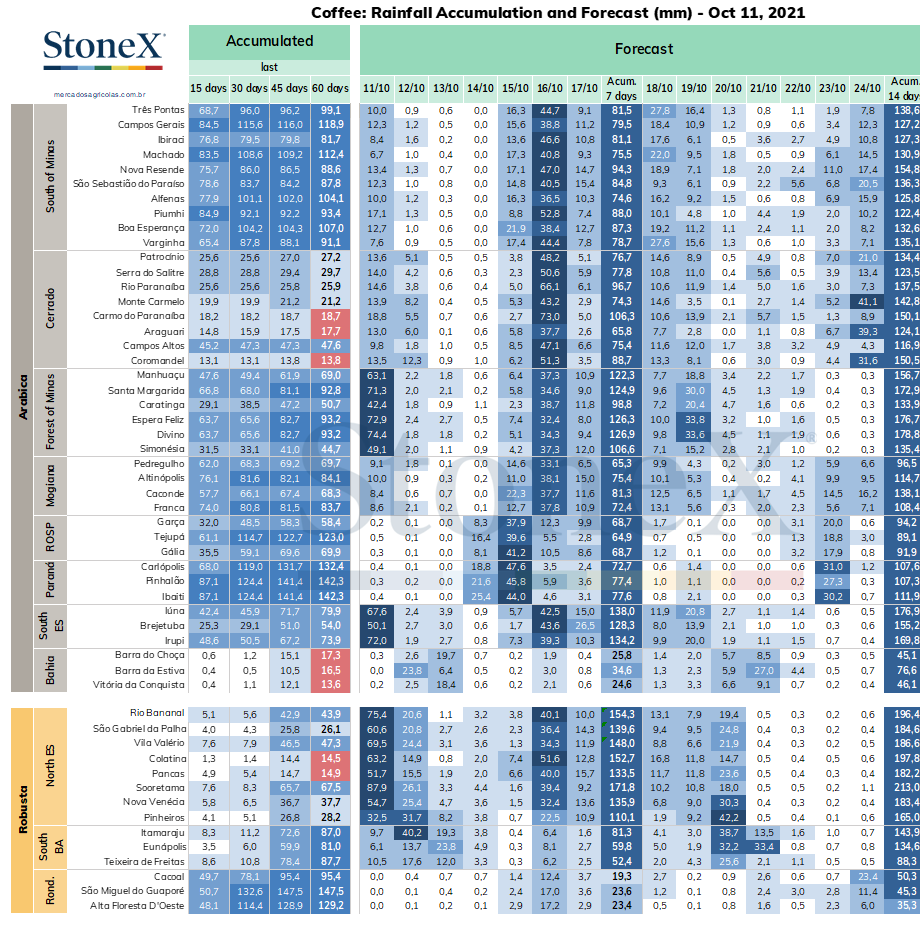
The latest weather bulletin from StoneX, produced from data from US agencies NOAA and NASA, shows producing municipalities in the Southern Minas Gerais received around 80 mm in the last 15 days. The Matas de Minas, Mogiana, ROSP, Paraná, and Southern Espírito Santo regions received between 40 and 90 mm of rainfall. The Cerrado region of Minas Gerais continues with the lowest accumulation, around 30 mm. For the next 14 days, the model points to between 100 mm and 200 mm in most producing regions. Recent precipitation has been sufficient to start a new round of flowering, which has been reported in some Southern Minas Gerais and Matas de Minas municipalities. Moreover, the forecasted rainfall should continue to stimulate flowering in producing regions and favor the production development in Brazil. 

The American NOAA and Australian BOM agencies continue to point to the La Niña occurrence weak to moderate at the end of this year and early next year. However, as mentioned in other editions of the Coffee Weekly Report, the La Niña occurrence between December and January could be associated with excessive rainfall in Colombia, Central America, and Asia – most countries in this region will be in their harvest period. The next update to the NOAA forecast will be released on Thursday (14).

image 19591
Source: StoneX, with data from NOAA/NCEP/EMC.
This week, the data for Brazilian coffee exports in September will be released by Cecafé, which should point to a reduction in Brazilian exports amid the logistical crisis that has been set amid the Covid-19 pandemic. Cecafé's data had already shown a 28% reduction in exports in August. For September, the preliminary data from Secex had already pointed to a reduction of more than 20% in coffee exports, a scenario that the council's data can confirm. Like other countries, Brazil has been facing serious logistical problems, which have limited the supply of containers and caused an increase in ocean freight costs.
While on the one hand, the return of the rainfall has a bearish tone for New York, the sharp drop in certified coffee stocks brings a positive sentiment and is the main reason for the recovery of prices at the end of last week. Since mid-September, Arabica coffee's certified stocks have fallen by over 200,000 bags, returning to a level of around 1.94 million bags. As we have commented in previous articles, certified stocks are closely related to price differentials at origin and related to transport costs for certification. Therefore, certified stocks are expected to decline since the reduction in coffee supply tends to keep differentials strengthened, which discourages coffee certification. In addition, this process depends on freight costs, but as they are sky-high, it makes the certification process unattractive. 
In addition to certified stocks, the recovery in coffee consumption also brings a positive sentiment to coffee prices. As will be addressed in a specific section below, data has pointed to the recovery of coffee consumption to pre-covid levels in the United States. Recently, the International Coffee Organization itself raised its estimates for coffee consumption in 2020 by 247,000 bags, to 167.258 million bags. 
On Friday (15), GCA stock at US ports data for September will be released. The stock data from GCA gives an overview of the coffee dynamics in the US domestic market. The latest report showed an increase of 56,000 bags in August, but this was still 9% less than in August 2020. For September, stocks have fallen by approximately 100,000 bags on average over the last five years. Considering the pace of consumption in the United States, the seasonality of stocks and logistical problems, which may be affecting the arrival of coffee at ports, the GCA report is expected to point to a significant reduction in stocks in September, which could have a bullish effect on prices.
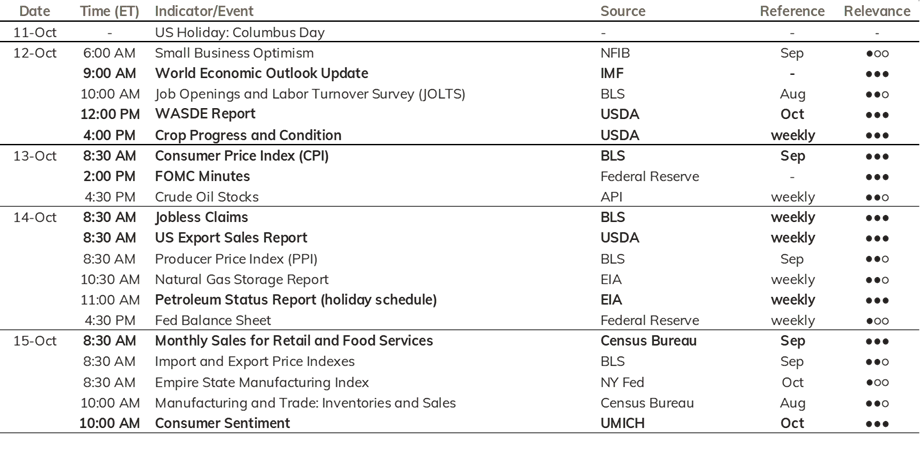
Overall, from a fundamental perspective, the market sentiment is still positive. Despite the return of the rainfall, which brings a bearish sentiment, several bullish factors should support prices. Among them are the negative S&D balance, the losses for the production potential in Brazil next year, the logistics crisis, the La Niña occurrence with expectations of excess rainfall in Central American countries, Colombia, and Asia, etc. This week, the market will be keeping an eye on certified coffee stocks, the weather in Brazil, Brazilian coffee export data, the NOAA update, and the release of stock data by the GCA on October 15. 
Demand Returns to Pre-Pandemic Levels


The global COVID-19 pandemic impacted coffee consumption globally, as offices closed and coffee shops were forced to shut their doors. While there was some compensation in the form of a shift from out-of-home to in-home coffee drinking, overall, it is estimated that in the height of the pandemic, people were simply drinking less coffee.

However, with the roll out of vaccines, the reopening of many economies and a gradual return to what
will now be know as the “new normal,” new data suggests that demand has been returning to prepandemic levels.

In the newest edition of the National Coffee Association Drinking Trends Study, data shows that coffee consumption in the US is trending toward recovery of pre-pandemic routines. Out-of-home coffee consumption is up 16% since January 2021, nearly back to January 2020 levels, Overall, signs point to Americans venturing away from home again with coffee consumption during travel/commute rising 9%, at an eating place rising 20% and consumption at work up. The report noted that COVID restrictions hit young people hard, but younger generations’ coffee drinking is on the rise again. 71% of Americans are already visiting coffee shops or plan to in the next month Up nearly 50% since January 2020. Ordering out via Drive-through and app remain well above pre-pandemic levels.

Robusta driven lower by a weakening technical picture with Arabica stockpiles a point of focus last week
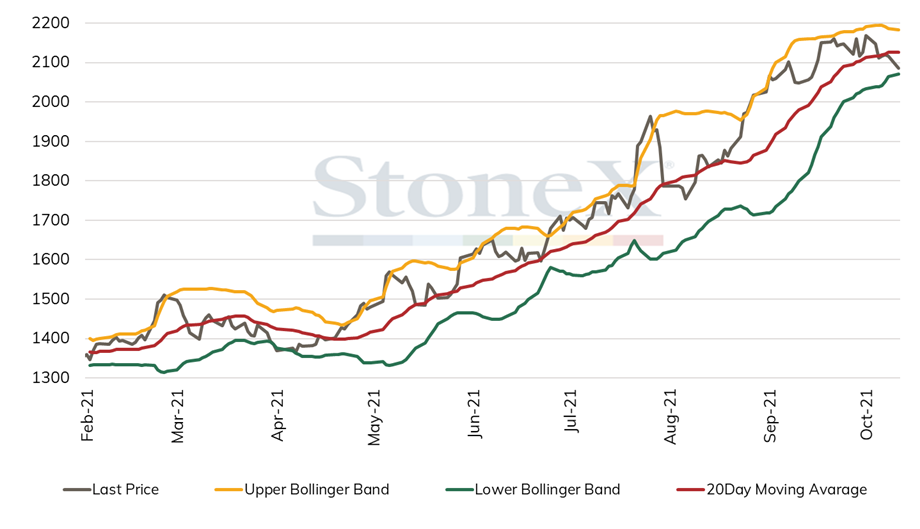
The most active London Robusta contract declined by 2.4%, with general downward momentum associated with a more prominent focus on the large withdrawals from the Arabica stockpile over the course of the past week with 133,368 bags withdrawn from the stockpile W/W. Up until this morning November had found support around the $2,100/t level with resistance reflected around the $2,145/t level. The Bollinger band study shows a steady narrowing of the upper and lower bands, accompanied by the trend towards the lower band in a signal of declining technical strength within November. The Robusta certified stockpile has continued to decline with the total volume held now at the lowest since mid-October 2020, although the 14,500 bag decline W/W was small when compared against the drawdown in Arabica stocks.

Robusta NOVEMBER w. Bollinger Bands
image 19592
Source: Bloomberg. Design: StoneX.
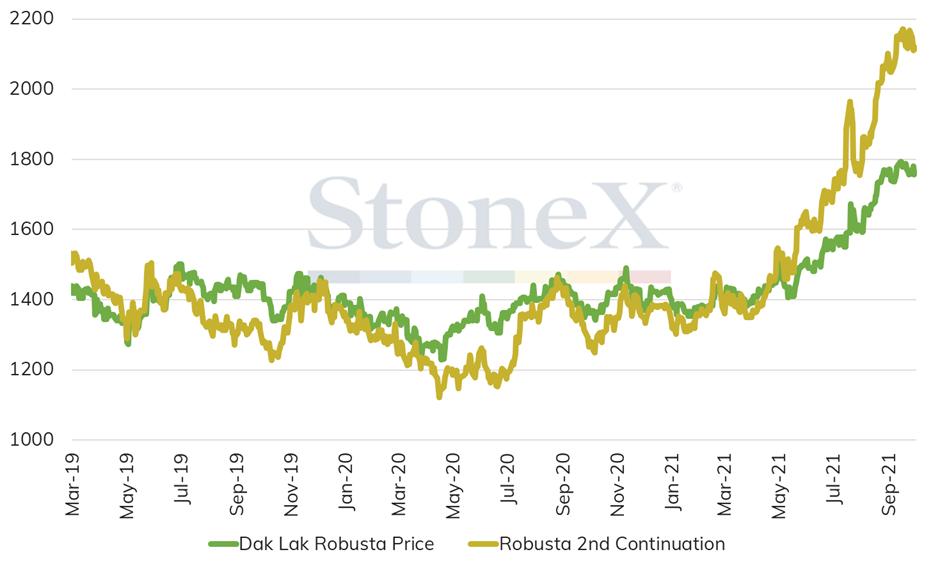
Further pressure in the Robusta complex can also be attributed to the easing lockdown restrictions in Vietnam, although trading volumes are reported to be thin as new crop is yet to arrive in abundance. Rainfall is expected to continue for longer than normal according to Vietnamese weather forecasters, with the rainy season expected to last into the beginning of November. In turn, this is likely to bring harvest delays for the Vietnamese 2021/22 crop, while also raising potential quality issue risk as well. Domestic prices in Vietnam hover around $1,760/t as of the end of last week, increasing by just $3.8/t compared to a loss of $51.0/t in the London front month. The comparative sideways trend in the Dak Lak price reflects higher production and shipping costs while potential delays in new crop reaching the farm gate also add support.
Robusta 2nd Continuation vs Dak Lak Price
image 19593
Source: Bloomberg, Giacaphe. Design: StoneX.
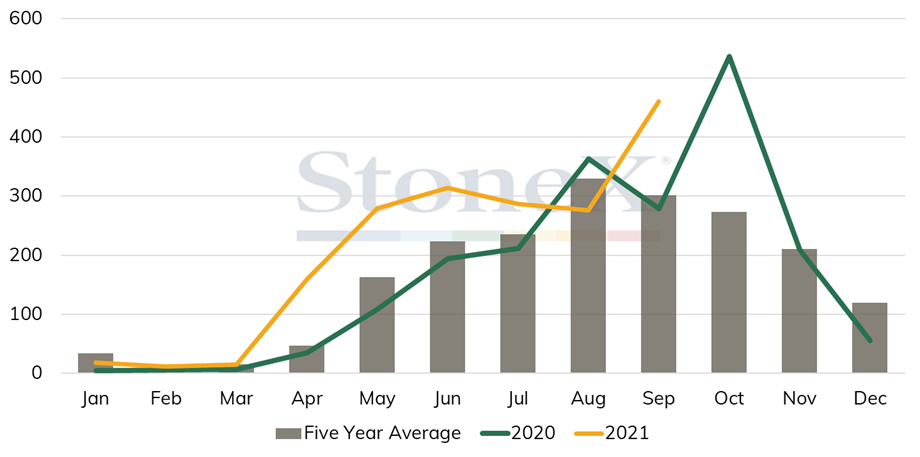
The Vietnamese Central Highlands received above average rainfall in September with Refinitiv weather data showing approximately 460mm of rain was received last month, compared to a five-year average of around 300mm. With forecasters expecting tropical storms to bring further heavy rainfall in the weeks ahead, quality issues as well as harvest delays should be factors that should be kept under consideration. 

Central Highlands Monthly Rainfall
image 19594
Source: Refinitiv. Design: StoneX.


Managed money participants opted to reduce the Robusta net long last week, with the
position being reduced by 392 lots to total 33,753 lots. The reduction was predominantly
driven by a reduction to the gross long position which fell by 264 contracts to 36,493, while
the gross short was reduced by 128 contracts to 2,740. 

Amid risk aversion abroad, USDBRL has reached its highest level since April
Amid the global sentiment of increased risk aversion, the USDBRL once again broke the BRL 5.50 level, which had not occurred since April, and engaged its fifth consecutive week of appreciation in the Brazilian exchange market. As a result, the American currency closed at BRL 5.51, high by 2.7% from the previous Friday, while the dollar index ended steady, close to 94.1 points.

The week was marked by higher risk aversion in the main global markets due to concerns about a possible crisis in the supply of important energy matrices worldwide. It led the WTI oil price to its highest level in seven years, while natural gas reached its highest level in over seven years. Contributing to investors' caution was the standoff between Republicans and Democrats over the approval of a measure to suspend or raise the American public debt limit in Congress, to prevent the country from defaulting for the first time in its history.

According to the Treasury secretary, Janet Yellen, if the United States default, it would lead to "catastrophic" effects, compromising the reputation of the American debt security as the safest asset in the world, causing turbulence in the financial market and a possible recession. At the end of the week, the country's Senate managed to reach an agreement to temporarily approve an increase in the debt limit, which brought some relief to agents. However, a definitive decision should be debated and voted on only in December.

On Friday, the lower employment generation in the United States also raised doubts about the pace of the American economic recovery. According to the Bureau of Labor Statistics (BLS), the balance between hiring and firing in September was 194,000 jobs, while market expectations pointed to 475,000. Thus, the American labor market has shown difficulties following a consistent pace in its recovery, which raises doubts about whether the Fed will maintain the expectation of tapering in the face of "incomplete" recovery in the labor market.

In Brazil, data brought negative sentiment regarding the recovery of the Brazilian economy in general. Brazilian Institute of Geography and Statistics (IBGE) indicated a deterioration in the recovery outlook for the second half of the year. The monthly Industrial Survey indicated a 0.7% retraction in industrial production in August, the third consecutive month of decline, accumulating a 2.3% retraction in the last three months. In addition, the retail sector showed a 3.1% decline in August, against analysts' expectations of an increase of 0.7%. The continuity of problems in the global supply chain, the high unemployment rates, and the drop in the population's purchasing power in the face of accelerated inflation were among the main factors behind the negative performance. 

Inflation grows 6.9% in September; final consumer coffee prices rise 5.5%

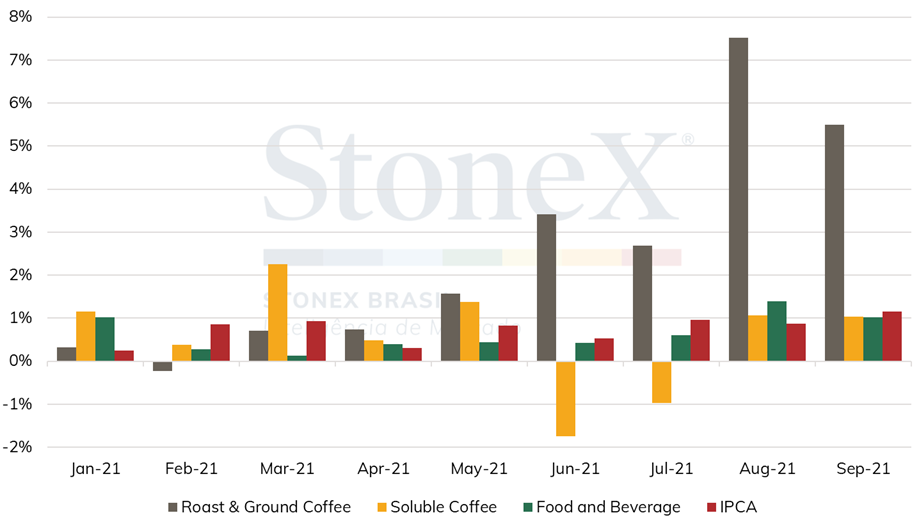
The IBGE released the Broad National Consumer Price Index (IPCA) for September last Friday, showing an increase of 1.16% to its highest variation for the month since 1994. In the first nine months of the year, the index increased by 6.9%, high by 10.25% in the last 12 months. Among the main culprits for the result was electricity (+6.47%), with the beginning of the "water shortage" tariff flag, which adds BRL 14.20 to the electricity bill for every 100-kWh consumed, with significant increases also for cooking gas and fuel.

According to the indicator, the ground coffee prices posted an increase of 5.5% in the Brazilian shelves in September, growing 7.51% in August. The results showed that the industry transferred a higher price to the final consumer in the last two months, which may have intensified after the new rally in prices from the end of July when the effects of frost in Brazil raised global prices to new levels. Prices in New York have remained between US₵ 180/lb and US₵ 200/lb since then.

MONTHLY EVOLUTION OF COFFEE PRICES FOR CONSUMERS IN BRAZIL IN 2021
image 19595
Source: IBGE. Design: StoneX.

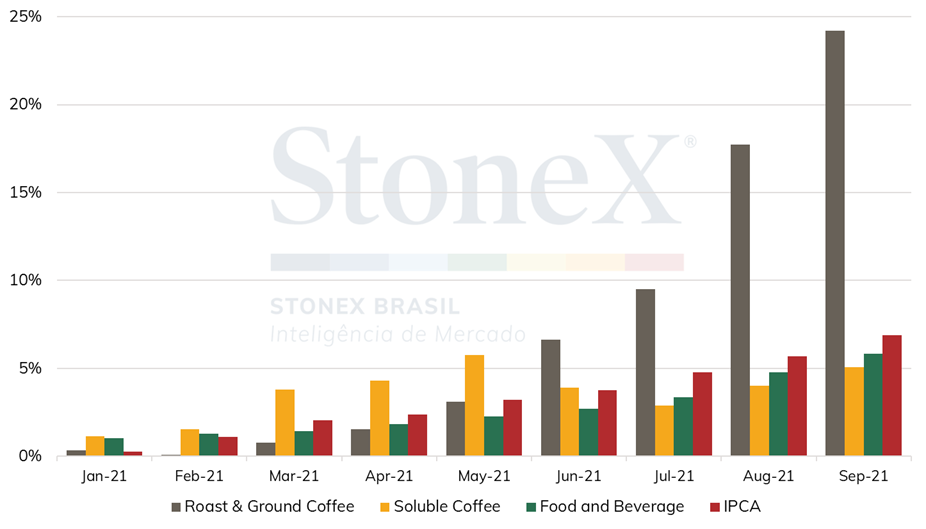
When we look at the accumulated result for the year, ground coffee showed an increase of 24.2%, a level well above the IPCA and the group and subgroup in which it is allocated, food and beverages (5.84%) and beverages and infusions (7.27%), respectively. Among the more than 400 products and services surveyed by IBGE, the price of ground coffee ranks 18th in the year's highest growth rate. Soluble coffee shows an

increase below all-products average, with an accumulated increase of 5.08% in 2021.

MONTHLY EVOLUTION OF COFFEE PRICES FOR CONSUMERS IN BRAZIL IN 2021 - ACCUMULATED IN 12 MONTHS
image 19596
Source: IBGE. Design: StoneX.
In this scenario, some questions remain, such as up to what level the industry's transfers to the supermarkets will be able to be carried out, and if a continuation of the price increases could somehow affect total consumption in Brazil.
According to the CEPEA indicator, the Arabica coffee prices sold by Brazilian producers had risen by 84.6%, while Robusta coffee increased by 102.6%. Considering these values, theoretically, there is still a significant space for the prices to the final consumer to advance for at least a few more months. However, likely, part of these increases will not be transferred to the markets. Therefore, the supermarkets are resisting to transfer roasters' prices not to damage both their profitability and the population's consumption level, which can guarantee less abrupt advances in the final stage of the product chain if compared to the volatility presented by the commodity.
However, it is certain that if the current levels of prices on the stock exchanges and domestic markets are maintained, the IPCA should show new significant increases for ground coffee by the end of 2021. Furthermore, the return of the global coffee market to normality, with the logistic chain's recovery, a successful harvest worldwide and a Brazilian currency recovery, are factors that could contribute to mitigating the intensity of global prices growth over the next few months especially in the Brazilian market.

WEEKLY AGENDA
BRAzIL
image 19597
UNITED STATES
image 19598
 
TABLE OF INDICES
image 19599
Sources: ICE/NY; ICE/EU; B3; Commodity Network Trader’s Pro.
 
 
  • Coffee

The StoneX Group Inc. group of companies provides financial services worldwide through its subsidiaries, including physical commodities, securities, exchange-traded and over-the-counter derivatives, risk management, global payments and foreign exchange products in accordance with applicable law in the jurisdictions where services are provided. References to over-the-counter (“OTC”) products or swaps are made on behalf of StoneX Markets LLC (“SXM”), a member of the National Futures Association (“NFA”) and provisionally registered with the U.S. Commodity Futures Trading Commission (“CFTC”) as a swap dealer. SXM’s products are designed only for individuals or firms who qualify under CFTC rules as an ‘Eligible Contract Participant’ (“ECP”) and who have been accepted as customers of SXM. StoneX Financial Inc. (“SFI”) is a member of FINRA/NFA/SIPC and registered with the MSRB. SFI is registered with the U.S. Securities and Exchange Commission (“SEC”) as a Broker-Dealer and with the CFTC as a Futures Commission Merchant and Commodity Trading Adviser. References to securities trading are made on behalf of the BD Division of SFI and are intended only for an audience of institutional clients as defined by FINRA Rule 4512(c). References to exchange-traded futures and options are made on behalf of the FCM Division of SFI . StoneX is a trading name of StoneX Financial Ltd (“SFL”). SFL is registered in England and Wales, Company No. 5616586. SFL is authorized and regulated by the Financial Conduct Authority [FRN 446717] to provide to professional and eligible customers including: arrangement, execution and, where required, clearing derivative transactions in exchange traded futures and options. SFL is also authorised to engage in the arrangement and execution of transactions in certain OTC products, certain securities trading, precious metals trading and payment services to eligible customers. SFL is authorised & regulated by the Financial Conduct Authority under the Payment Services Regulations 2017 for the provision of payment services. SFL is a category 1 ring-dealing member of the London Metal Exchange. In addition SFL also engages in other physically delivered commodities business and other general business activities which are unregulated and not required to be authorised by the Financial Conduct Authority. StoneX Group Inc. acts as agent for SFL in New York with respect to its payments services business. StoneX APAC Pte. Ltd. acts as agent for SFL in Singapore with respect to its payments services business. ‘StoneX’ is the trade name used by StoneX Group Inc. and all its associated entities and subsidiaries.
 
Trading swaps and over-the-counter derivatives, exchange-traded derivatives and options and securities involves substantial risk and is not suitable for all investors. Past performance of any futures or option is not indicative of future success. Indicators are not a trading system and are not published as a specific trade recommendation. The information herein is not a recommendation to trade nor investment research or an offer to buy or sell any derivative or security. It does not take into account your particular investment objectives, financial situation or needs and does not create a binding obligation on any of the StoneX group of companies to enter into any transaction with you. You are advised to perform an independent investigation of any transaction to determine whether any transaction is suitable for you. No part of this material may be copied, photocopied or duplicated in any form by any means or redistributed without the prior written consent of StoneX Group Inc.
 
© 2026 StoneX Group Inc. All Rights Reserved.

Satellite view of Earth at night showing illuminated cities across Asia and the Middle East

Discover more insights

Our subscribers have access to comprehensive market analysis from StoneX spanning commodities, equities, currencies and more.

StoneX: We open markets

Our market expertise, advanced platforms, global reach, culture of full transparency and commitment to our clients’ success all set us apart in the financial marketplace.

Reach

With access to 40+ derivatives exchanges, 180+ foreign exchange markets, nearly every global securities marketplace and numerous bilateral liquidity venues, StoneX’s digital network and deep relationships can take clients anywhere they want to go.

Transparency

As a publicly traded company meeting the highest standards of regulatory compliance in the markets we serve, our financials and track record are matters of public record. StoneX’s commitment to “doing the right thing over the easy thing” sets us apart in the industry and helps us build respect, client trust and new partnerships.

Expertise

From our proprietary Market Intelligence platform to “boots-on-the-ground” expertise from award-winning traders and professionals, we connect our clients directly to actionable insights they can use to make more informed decisions and achieve their goals in the global markets.