As we highlighted in the last weekly report, due to heavy rains during this period for the second consecutive year, the National Federation of Coffee Growers (FNC) has reduced its estimates for Colombian production in 2021 from 14 million bags to somewhere between 13 and 13.5 million bags. Accordingly, the country's production could fall below around 14 million bags for the first time after a 6-year sequence at this level. The risks that excessive rainfall could also affect the production of important Central American countries should continue to be monitored by the market in the coming weeks. Negative impacts could occur through the obstruction of logistic routes, a drop in the quality of the grain or the productivity of crops since these have varieties of plants that are less resistant to fungal diseases caused by high levels of moisture compared to those grown in Colombia.
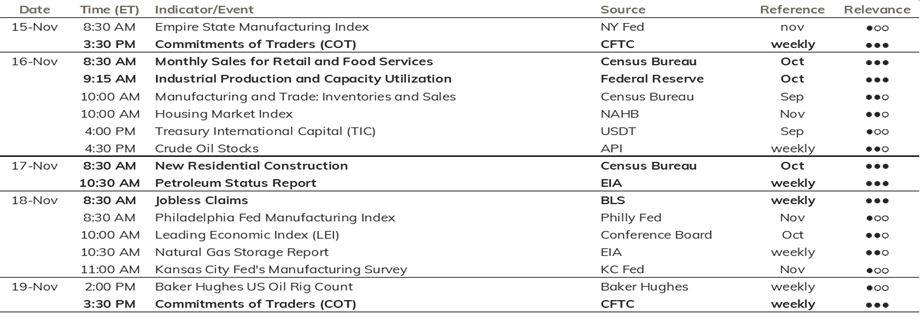
This week, besides the release of the stocks at US ports by the Green Coffee Association (GCA), which should give new signals regarding the country's demand, agents should continue to monitor the weather and coffee development in Brazil, the evolution of the global logistics situation and harvest in other countries.
Brazilian exports of green coffee dropped by 25.2% in October
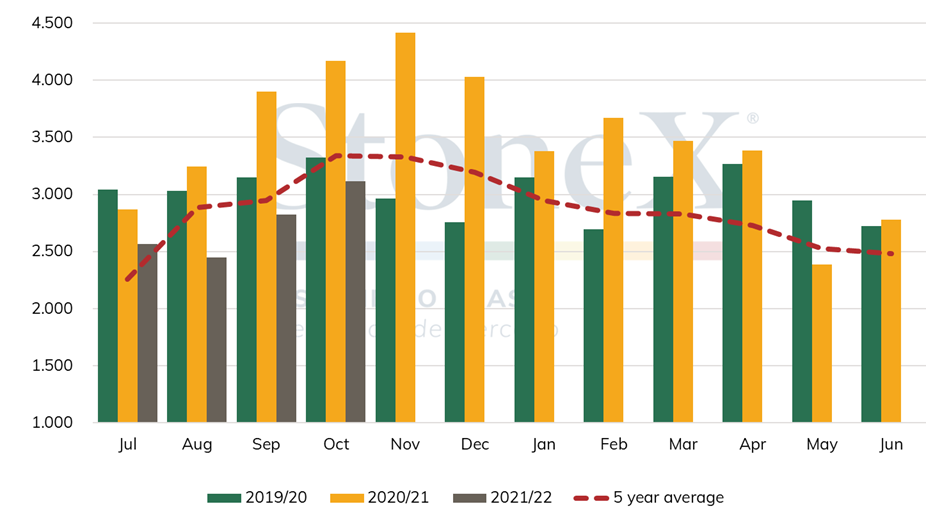
Cecafé released last week its monthly export report for October, indicating that total Brazilian exports reached 3.431 million bags, a drop of 23.8% compared to the 4.504 million bags shipped in the same month last year. Shipments of green coffee totaled 3.117 million bags, a drop of 25.2%, with Arabica coffee shipments totaling 2.883 million bags, down by 22% compared to 3.698 million bags in 2020, and Robusta coffee totaling 233 thousand bags, down by 50.4% compared to 470 thousand bags in the same month last year.
BRAZIL'S MONTHLY GREEN COFFEE EXPORTS BY CROP YEAR (THOUSAND BAGS)
Source: Cecafé. Design: StoneX.
The logistic bottlenecks continued to be the main factor for the significant retraction in exports. According to Cecafé's president, Nicolas Rueda, "The drop in export volume reflects the continuity of the well-known logistic bottlenecks in world maritime trade. The scenario is worrying because industry experts, with whom we met at various national and international events, point out that these obstacles should drag on through 2022 due to the large volume of Brazilian agricultural products accumulated at the ports and crops that are shipped from the second semester on."
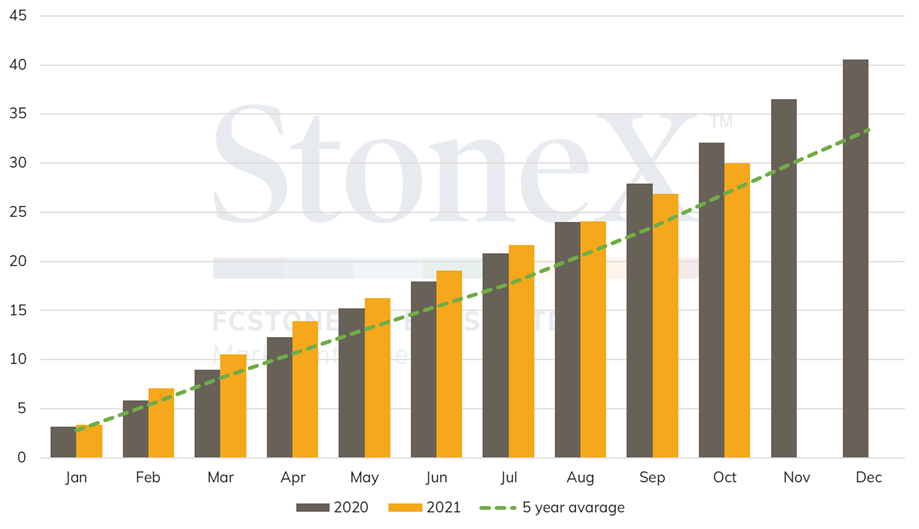
One can see that despite the lower volumes, the foreign exchange revenues continue to follow at higher levels, considering both the higher price levels for revenues in USD and the currency devaluation, in the case of BRL, which show even wider differences. While 32.1 million bags of green coffee were exported from January to October 2020, compared to 30.02 million bags in the same period in 2021, foreign exchange revenues in the current year surpass last year in both modalities. Considering revenues in USD, 2021 accumulates about USD 4.8 billion, 7.0% above last year's USD 4.5 billion, mainly due to the change in average prices from US₵ 167.53/lb to US₵ 191.43/lb. The foreign exchange revenues in local currency have even more attractive values to exporters, advancing from BRL 23.1 billion to BRL 25.7 billion, an increase of 11.6%.
GREEN COFFEE EXPORTS FROM BRAZIL YEAR-TO-DATE (MILLION BAGS)
Source: Cecafé. Design: StoneX.
Thus, the average return per bag sold from January to October advanced from BRL 719.39/bag to BRL 858.31/bag. Considering the significantly higher price levels, especially since mid-July, after the frosts occurred in Brazil, this difference should widen even more in the next two months' reports.
Port Congestion Continues to Impact Global Trade, Logistical Concerns Send Arabica Stockpiles Dwindling
CoffeeNetwork (New York) – Global trade, and the international coffee sector, continue to be impacted by logistical issues including shipping container shortages and transport delays.
Issues have been seen from the United State’s West Coast to China and Europe. Aside from delays caused by COVID-19 related restrictions and container shortages, the backlog was worsened in China after Typhoon In-Fa hit eastern China in July, restricting access to major ports such as Shanghai and Ningbo.
In Europe, in the port of Felixstowe, which concentrates 40% of containerized imports in the United Kingdom, shipping containers are said to be stacking up after congestion and a shortage of lorry drivers force shipping companies to store empty containers in a field nearby.
Protests in Italy and Greece closed port operations temporarily and ongoing civil unrest in Ethiopia have halted all trade within the country.
Danish research and analysis company Sea-Intelligence has conducted an investigation to examine how bottlenecks in the maritime supply system have impacted vessel delays. The longest delays were seen from Asia to the West Coast of the US and Asia to the East Coast of the US.
Last week, Brazil’s Coffee Exporters Association, CeCafe, revealed that 3.7 million bags of coffee are delayed for export due to the ongoing logistical challenges.
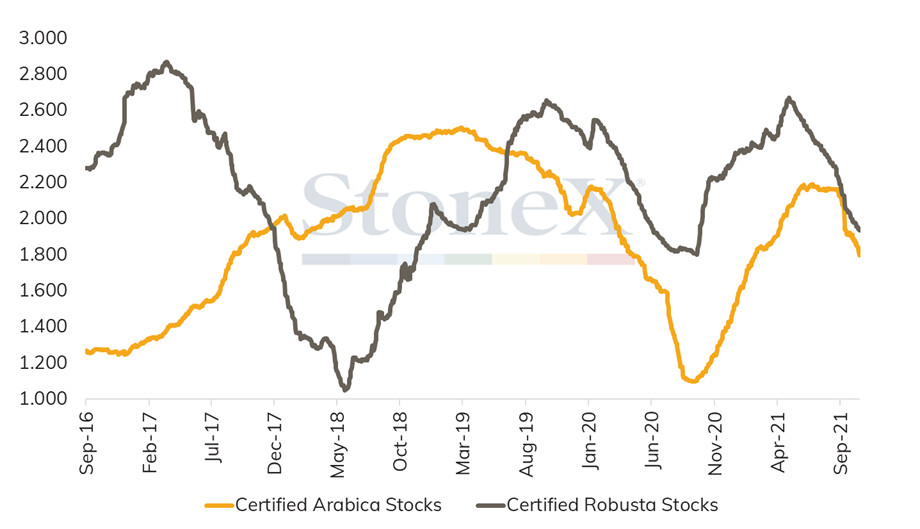
Increasing concerns surrounding the transport of coffee, coupled with the expectation of a shift to a supply deficit led to a pickup in industry buying a dwindling of stocks. While inventories touched their lowest level since April earlier this month, overall, stocks have risen 26% since the start of the 2021 calendar year.
The latest data showed certified stocks were at 1,798,415 bags as of November 11th, compared to the 1,427,057 bags registered on January 4th, the first official trading day of 2021.
Stocks from Honduras fell 8.3% in the period from 830,774 to 762,056 bags, whereas Brazilian certified stocks surged 143.4% from 381,746 bags to 929,299 bags.
ROBUSTA COFFEE PRICES surge during THE WEEK
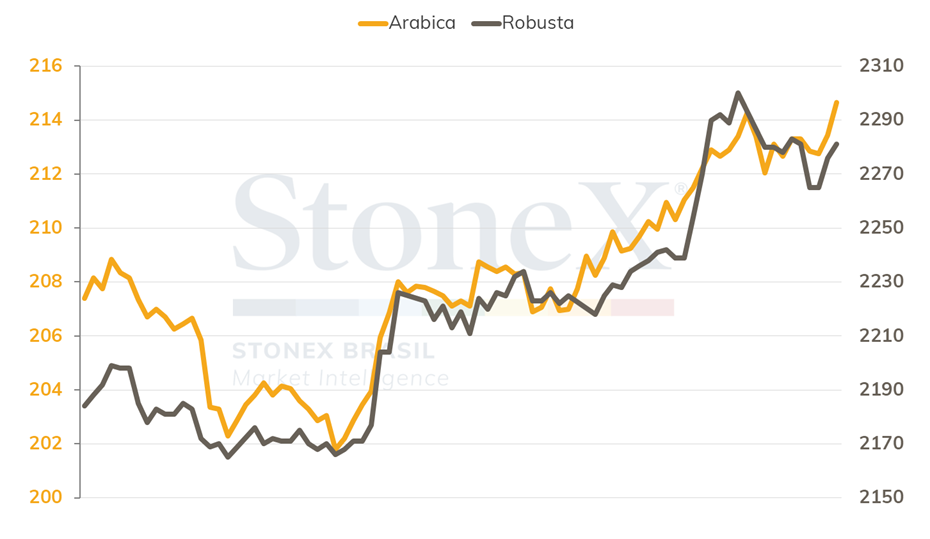
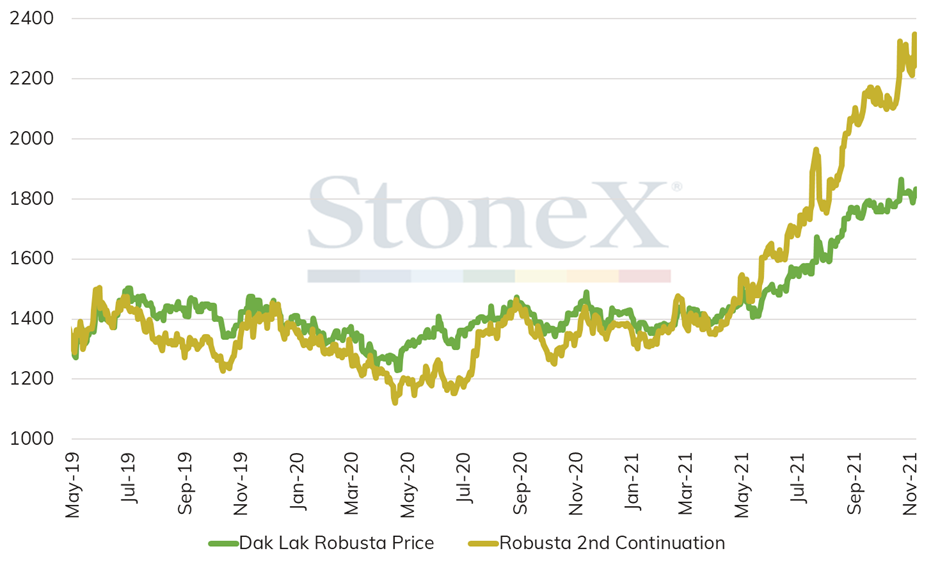
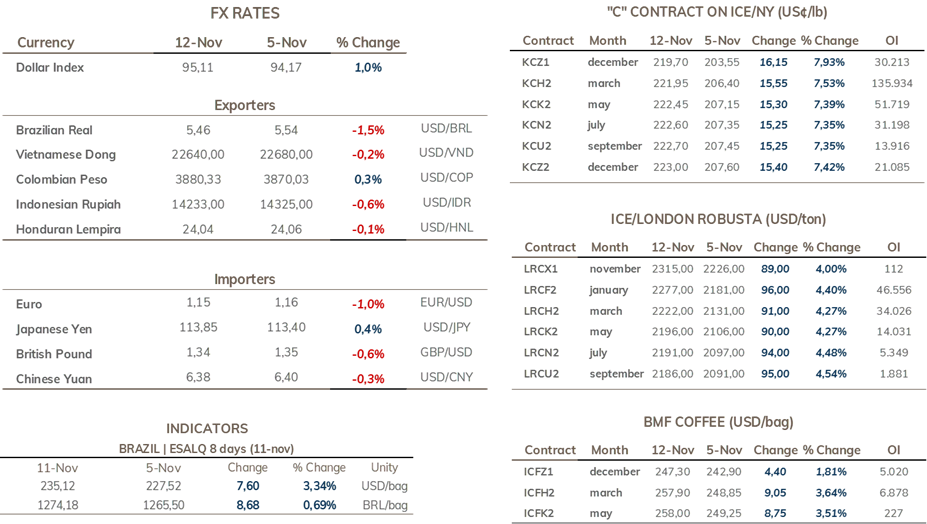
A strong week for the most active Robusta contract which gained 4.4% W/W as of Friday’s close. Upside carries across from the Arabica complex last week, which pushed to the highest levels since mid-2014 last week, driven by the increasing levels of concern surrounding supply tightness on the global scale alongside fresh estimates from Bloomberg on next year’s crop potential in Brazil. Brazil’s Arabica production was estimated between 33.7-38.7M bags for 2022/23, according to Bloomberg reports driven by the ongoing impacts of dryness in the past year, the severe frost events and rising risk of fungal disease due to recent moisture levels. The Robusta complex by comparison did not perform as well as Arabica, which gained approximately 7.9% last week. The drawdown in the Arabica certified stockpile was also significant last week with over 53,000 bags withdrawn last year. By comparison the Robusta certified stockpile recorded a withdrawal of 18,500 bags. Nonetheless, despite the smaller W/W gains in Robusta, the second continuation touched reached its strongest level since 2nd January 2017, reflecting the wider strength of the bullish sentiment that surrounds the coffee complex currently.
CERTIFIED ARABICA AND ROBUSTA STOCKS
Source: ICE. Design: StoneX.
From a fundamental standpoint, while lockdown restrictions in Vietnam are reported to have eased, there remains difficulty in securing seasonal workers for the harvest, while logistical disruption remains as well. Furthermore, rains continue to cause harvest delays which is likely to aggravate concerns surrounding crop quality. The harvest was already behind schedule due to excessive rainfall during October. Rains remain present in the Highlands this week, although volumes are forecast to be limited.
Vietnamese customs published export data for October last week, with 99,249t shipped last month (1,654,150 bags). Despite ongoing logistical issues this represents an increase of 8.6% Y/Y, a likely reflection of the larger volumes being stored in Vietnam as a result of container issues. Fresh supply from the new harvest (which is expected to be around 6.9% larger Y/Y) is also likely to have contributed to the increased volumes shipped Y/Y. On a month on month basis shipments fell by 1.1%.
Domestic prices in Dak Lak rose by 1.2% W/W as of Friday to $1,832/t. This represents a widening of the discount against London futures (basis 2nd continuation) to $444/t
Robusta 1st Continuation vs Dak Lak Price
Source: Giacaphe, Bloomberg. Design: StoneX.