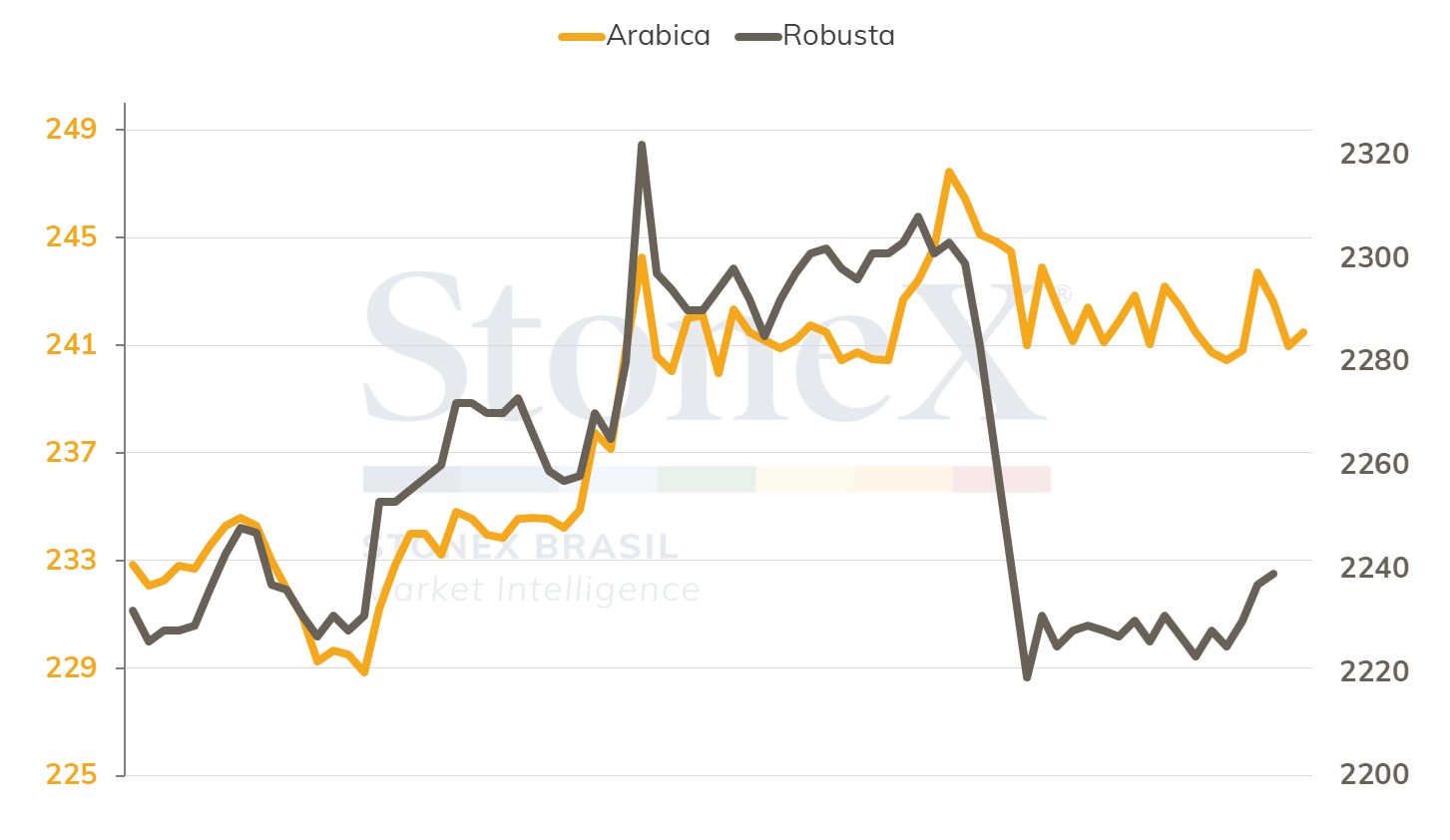
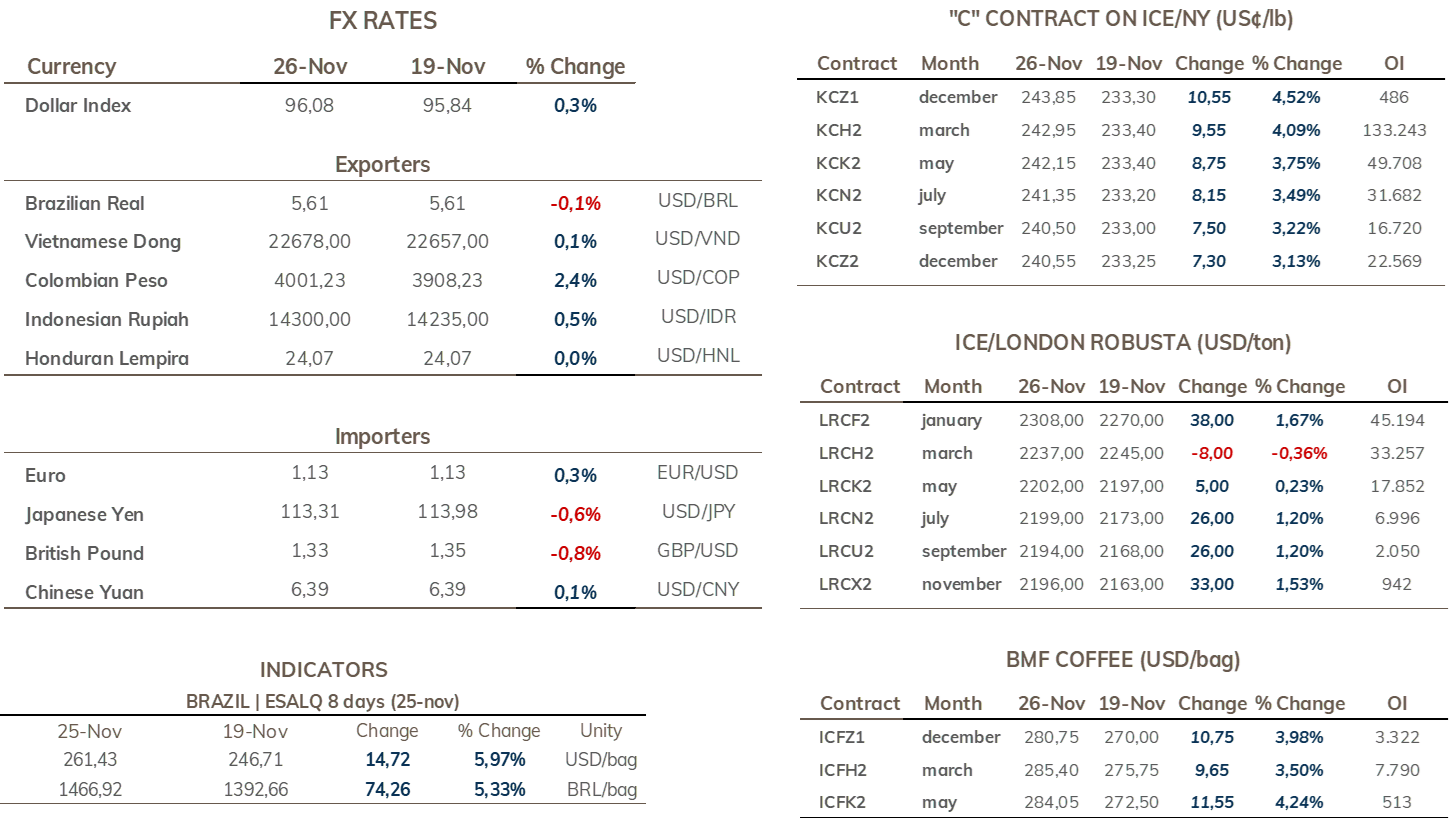
Without major news regarding the fundamentals, the market was supported by the negative supply and demand balance for this crop year associated with the expectation of a lower production next year, which has been the main long-term fundamental supporting coffee prices. Furthermore, the market reflects global logistical problems, which have limited short-term supply, and climate issues linked to the La Niña occurrence, which creates the risk of worsening the global deficit scenario.
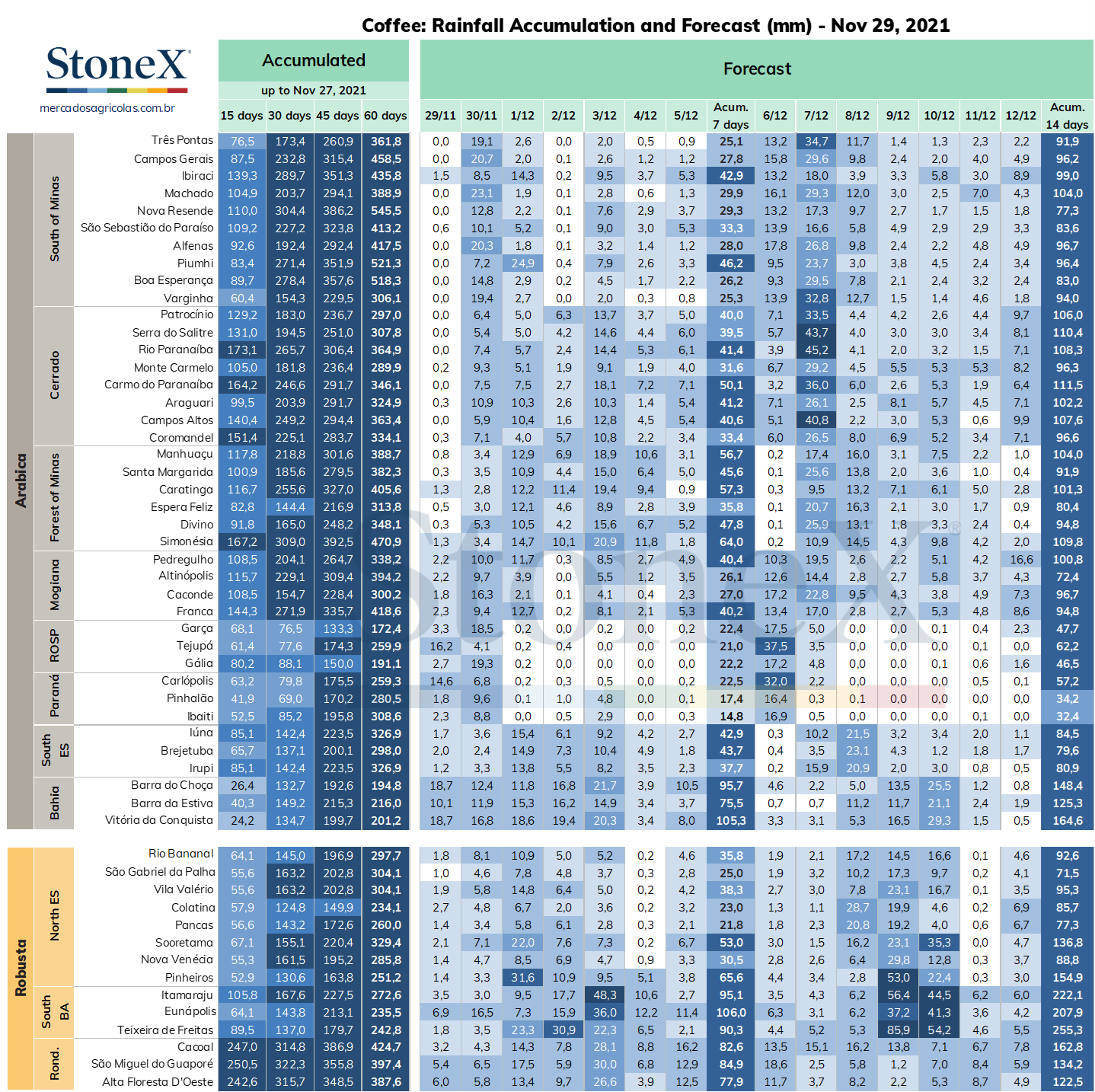
In Brazil, the entire coffee belt received significant amounts of rainfall, with some receiving above-average rainfall for the period. In general, except for the state of São Paulo, the Cerrado region of Minas Gerais and Southern Bahia, the entire belt has received above-average rainfall, with accumulated rainfall between 350 and 550 mm over the last 60 days. The scenario should remain favorable for the next 14 days, with the forecast models indicating accumulations around 100 mm for most of the producing regions.
Source: StoneX, with NOAA/NCEP/EMC (GFS: Global Forecast System), 2021.
Over the next few weeks, several reports with November country exports will be released, with Brazil, Vietnam, and Colombia being the most important. The reports will provide important information regarding the pace of exports and the condition of the global logistical crisis. In addition, the market will keep an eye on the harvest in Vietnam, the weather in Brazil and the producing countries and reflect technical factors, as long as no new fundamentals emerge.
On the demand side, the surge in Covid-19 infections, especially in Europe, deserves some attention. In recent weeks, some of the major global coffee consumers have seen a rise in the number of cases, with Germany, the largest coffee consumer on the continent, posting a record number of daily new infections since the start of the pandemic. The situation has prompted both Germany and countries in the region to re-adopt some restrictive measures. In addition, in the coming days, news from late last week regarding a new Covid-19 variant discovered in South Africa, called the Omicron variant, may inspire some caution and limit price increases. While there is still no conclusive information about the potential harm of the new variant, countries such as Italy, Germany, the UK, Belgium, and the Czech Republic have confirmed cases with the variant, raising the risk of an eventual re-adoption of tighter restrictive measures and reduced movement of people in restaurants, bars, and coffee shops.
ROBUSTA COFFEE PRICES appreciate
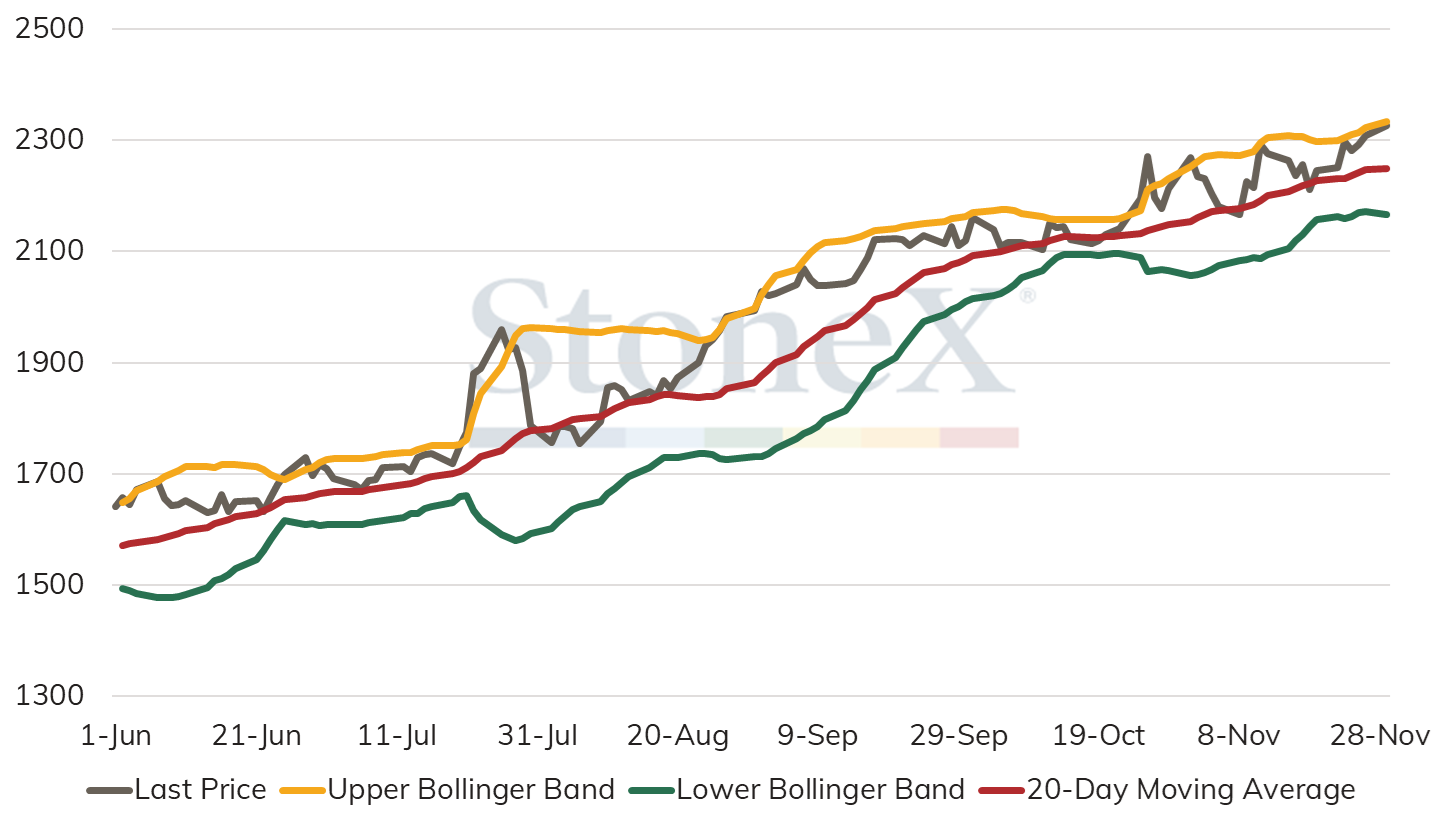
The Robusta January contract posted W/W gains of 2.8% as of last Friday amid the strength in the Arabica complex following on from a significant drawdown in the Arabica certified stockpile with a total decline of 174,324 bags. The Robusta stockpile also continues to see drawdowns with approximately 1.82M bags reported on Friday, amid the lowest levels since October 2020. The decline reflected the ongoing difficulty in sourcing Arabica from origin amid a mixture of bullish fundamentals surrounding the Arabica market. This includes reports of defaults on forward sales in Brazil as well as other major exporters such as Colombia. Furthermore, the market continues to work around the issues in sourcing containers and vessels to ship coffee around the world, and although shipping rates have been on a downward trend in recent sessions, freight rates remain very high. Despite this, the Baltic Dry Index has fallen to its weakest levels since mid-June of this year. From a technical perspective the January contract has moved in a steady upward trend over the course of the past month, reverberating between the upper Bollinger band and its 20-day MA.
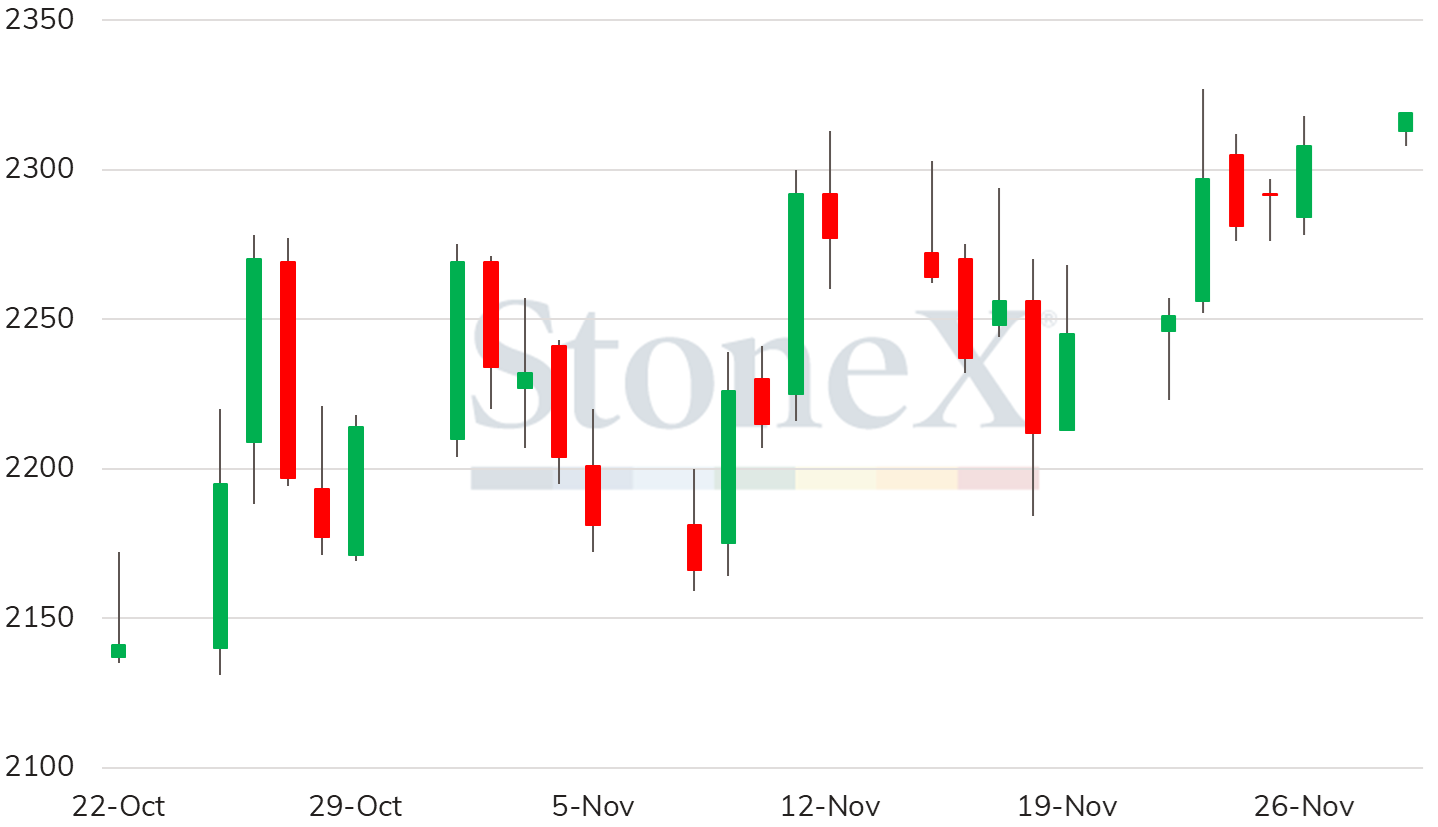
As of last week’s settlement, Jan settled marginally below the upper band and moving into this morning’s open it remains below that indicator. The 14-day RSI remains around 8 points below overbought conditions suggesting room for further technical upside. The sharp drop in the dollar coupled with overriding bullish sentiment in the coffee market would suggest supportive factors remain in place moving into this week, contrasting to the wider selloff that occurred on Friday last week, driven by heightened concerns over the discovery of a new COVID variant reported to be “of-concern” which drove the sharp selloff on Friday that hit the wider markets. The World Health Organisation stated on Sunday that initial cases have shown just “mild” symptoms. Moving into this morning January starts 0.9% higher @ $2,328/t, up by 0.9% at the time of writing.
Robusta November w. Bollinger Bands
Source: Bloomberg. Design: StoneX.
The Vietnamese General Statistics Office estimated November coffee exports at 78Kt (1.3M bags), down 6.9% Y/Y. This follows on from Customs data which showed October exports at 99,249t (1.65M bags). This would indicate a 1.2% increase in the cumulative shipment pace for 2021/22, although finalised Customs data for November is yet to be released and may show different numbers from that of the GSO. The harvest continues to progress although rainfall continues to cause issues in terms of delays with weather models showing above average rainfall expected for November and December on a delayed end to the rainy season. While delays will provide price support, one must not discount the larger volumes of coffee available in Vietnam at this stage of the year due to reduced exports and logistical issues that have resulted in larger stockpiles.
Robusta 2nd Continuation Candlestick
Source: Bloomberg. Design: StoneX.
Despite the generally bullish fundamentals for the American dollar in the international market, the US currency fell by 0.3% last week against the Brazilian real. The real/dollar pair closed at BRL 5.596. In the absence of major news regarding the coffee market fundamentals, the exchange rate decrease contributed to the continuity of the commodity's upward trend for another week.
Meanwhile, the dollar index showed a slight weekly advance of 0.1%, remaining above 96 points, the highest level since July 2020. Among the main factors that have led to the indicator's appreciation in recent weeks, the better-than-expected sectorial performance and labor market figures in the United States have indicated that the world's largest economy may be approaching the "substantive progress" targeted by the Federal Reserve. Last Wednesday (24), the US Bureau of Labor Statistics (BLS) revealed 199,000 new claims for unemployment benefits in the country, the lowest number since 1969 when 197,000 claims were made. The significantly lower-than-expected result reinforces a scenario of heated demand and economic recovery. However, it also hints that inflation may continue at high levels.