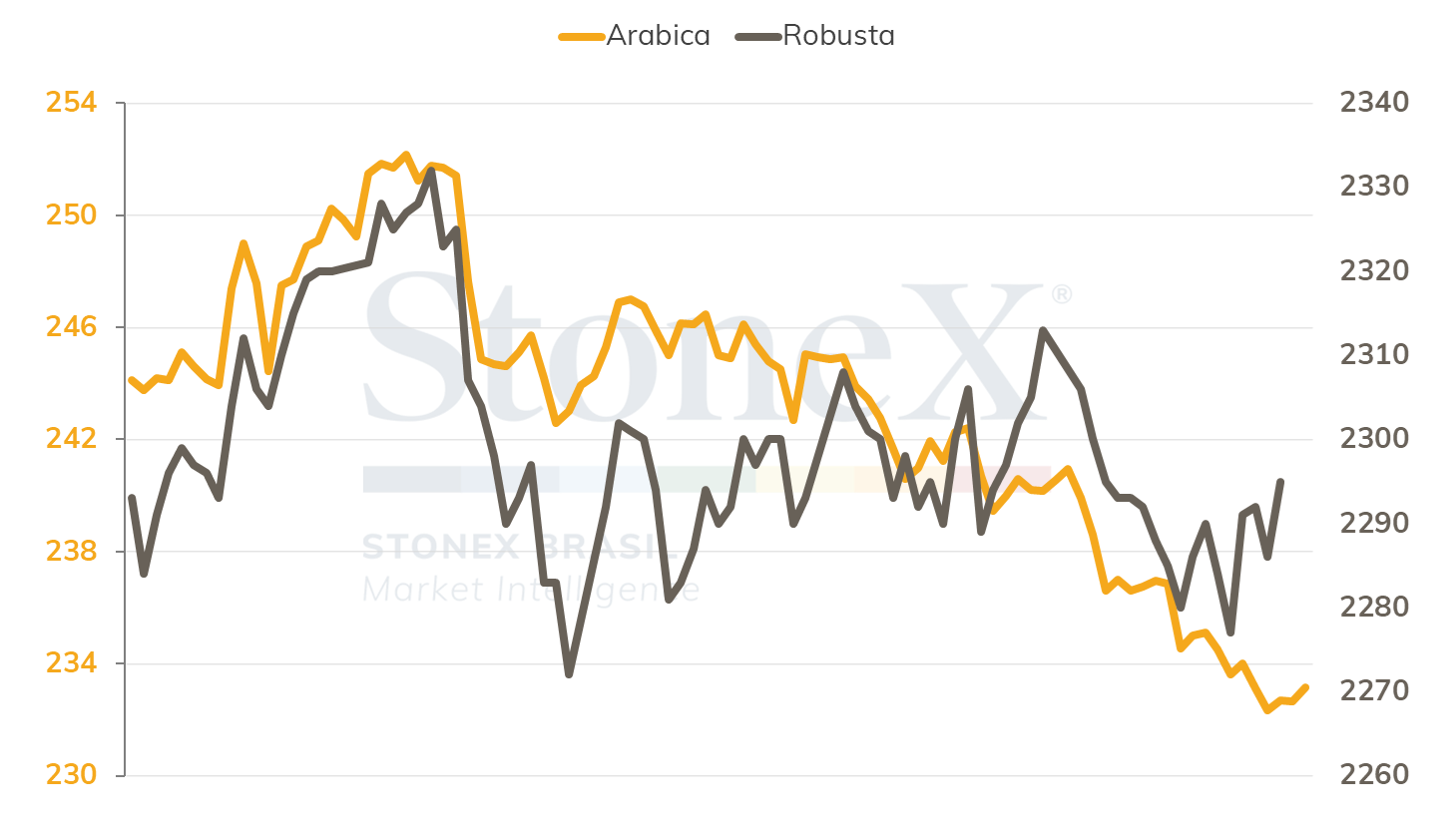
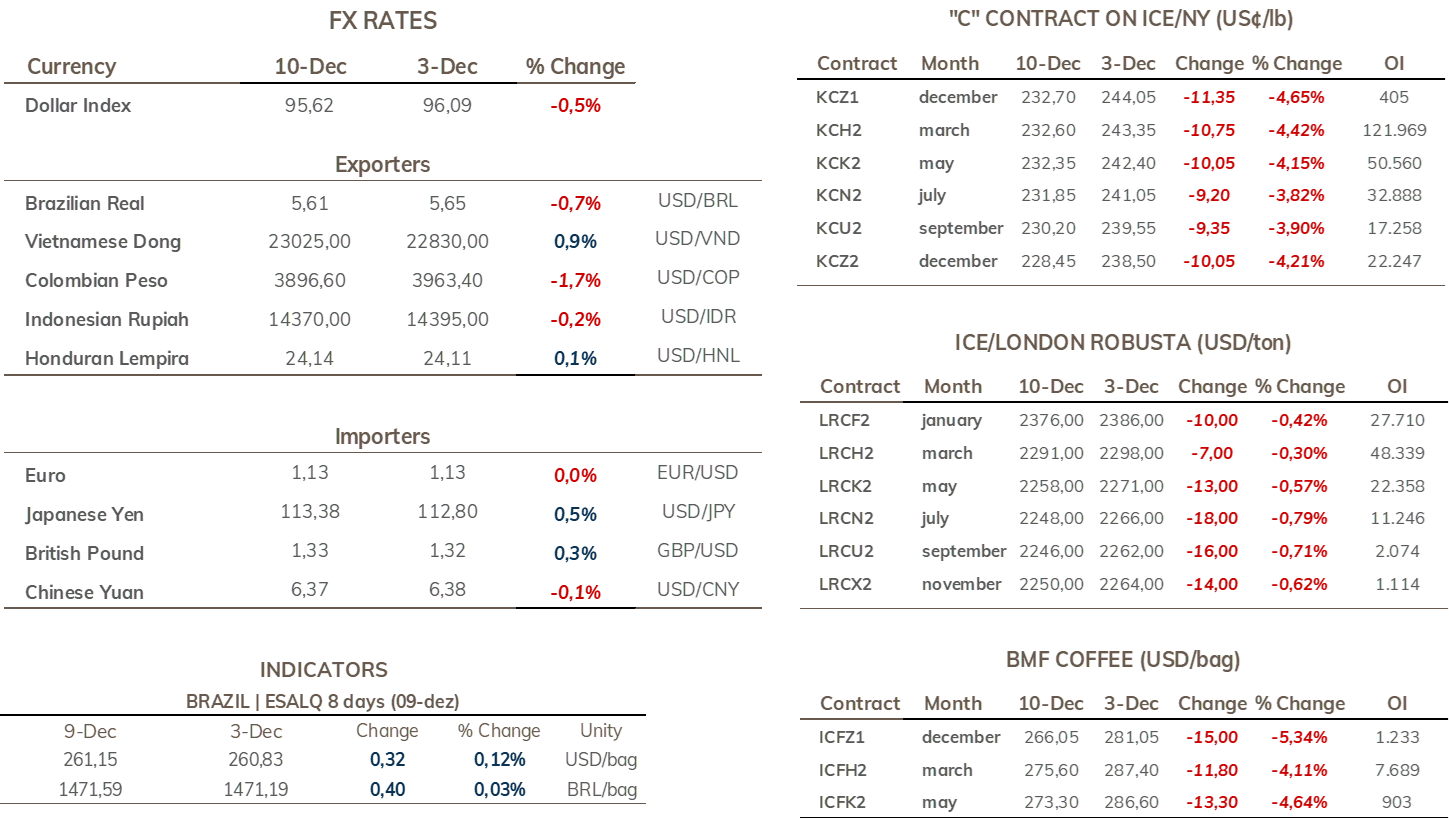
Arabica prices started the week following the strong upward movement observed since mid-November, as signs that the potential 2022/23 crop will have irreparable losses were consolidated, after a non-ideal flowering and some problems with setting in a part of the plantations. As a result, throughout the intraday on Tuesday (7), the most active contract reached its highest level in just over ten years, when prices touched US₵ 252.35/lb.
However, prices began to retreat significantly after reaching US₵ 250.00/lb, which can be considered a strong psychological resistance. On Tuesday, prices closed 655 points lower, and the movement continued, with retractions of 400 and 760 in the last two sessions of the week. Considering that the fundamentals remain predominantly bullish, the retraction seems to have occurred due to technical factors to correct the strong rise of 1660 points (7.1%) that occurred in the immediately preceding period, between December 1 and 6. Next Friday (December 17), the CFTC report, which will reveal the agents' movement between December 7 and 14, may confirm whether there were more intense volumes of selling on the part of speculative funds - which are currently at a high net long volume - indicating a technical profit-taking movement.
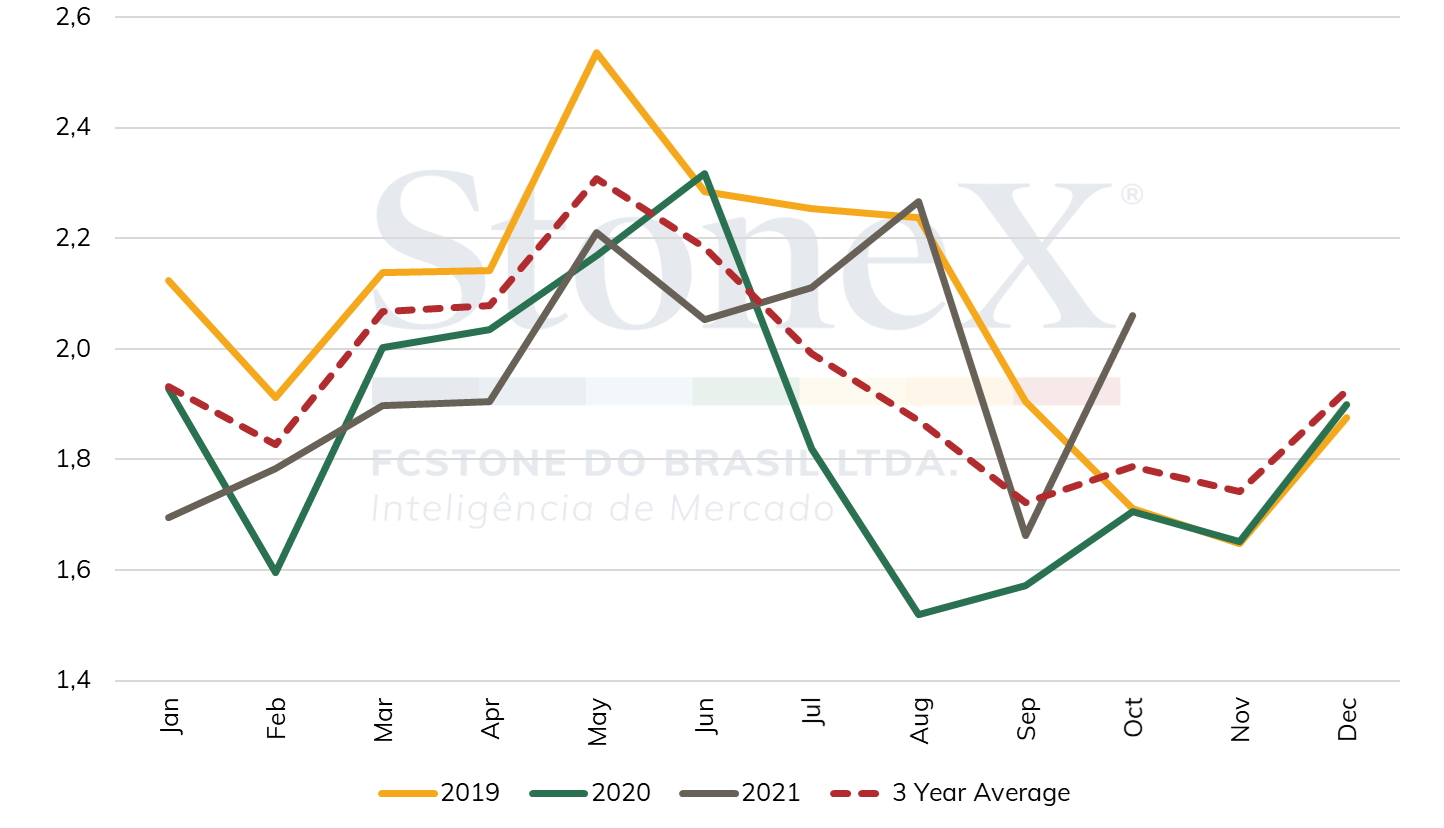
The USDA released last week the US imports data for October. The world's largest consumer imported 2.06 million bags of green coffee during the month, the highest volume for the month compared to the last six years, 20.7% higher than in October 2020 and 15.2% higher than the last 3-year average. However, as in the previous two months, the October result also showed a significant variation in imports compared to the average of recent years, reflecting the logistical issues affecting Brazil, the main supplier of coffee to the United States, and the other exporting countries. In addition, due to delays, longer periods of product in transit, and postponements of bookings, both import data from consuming countries and export data have not necessarily shown the real demand and supply for the bean worldwide, which has made the results more unpredictable and their interpretation more complex.
US GREEN COFFEE IMPORTS (MILLION BAGS)
Source: USDA. Design: StoneX.
Among the main origins, coffee imports from Brazil advanced 2.1% compared to October 2020, totaling 460 thousand bags in the month, with Colombia advancing 23.5% to 697 thousand bags and a 23.3% rise for coffee imported from Vietnam, with 263 thousand bags. Another highlight was coffee imported from Honduras, which despite seasonally lower numbers in the last quarter of the year, recorded 59.8 thousand bags, up 212% compared to the same month last year and 180% compared to the average of 21 thousand bags in the last three years, with imports of Honduran coffee accumulating 1.5 million bags in the year, 35.9% higher than the same period in 2020.
This week, in addition to the weather in Brazil, which with good indications of rainfall may contribute to pressure prices in New York, agents should reflect on Wednesday (15) the release of inventories at US ports in November of the Green Coffee Association (GCA). The last five years' average points to a drop of 3.0% or 197 thousand bags from October to November. If a drop of similar magnitude is confirmed, the level of stocks at the ports could again be significantly away from the 6 million bag level, which could contribute to a new bullish tone in prices.
Brazilian exports dropped by 41.5% in November
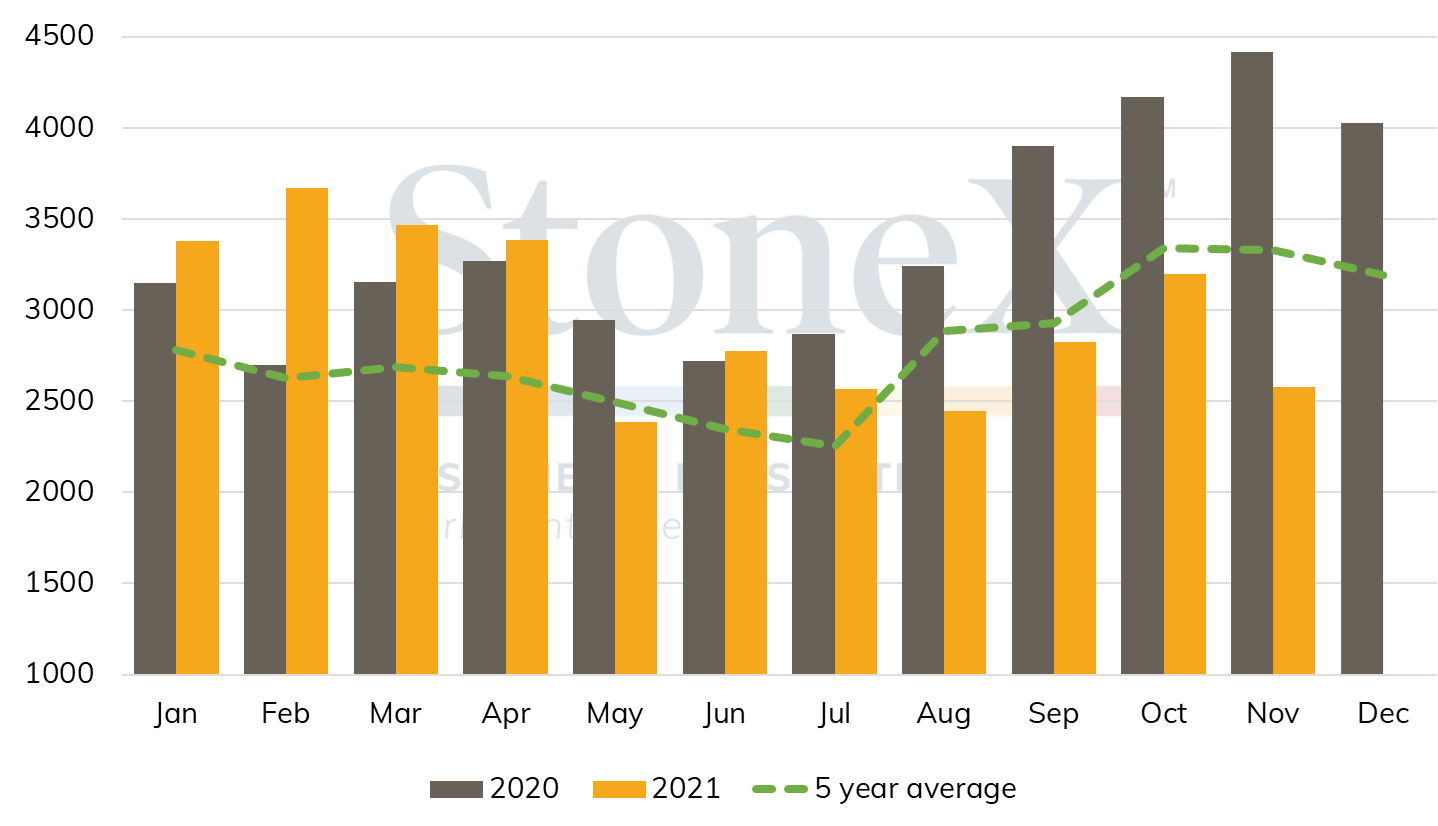
With 2.574 million bags shipped in November, green coffee exports dropped by 41.5% compared to the same month last year, when 4.415 million bags were sent abroad, according to the monthly export report released by Cecafé last Friday (10). Arabica coffee exports totaled 2.388 bags, down by 41.5% compared to the 4.080 in November 2020, while Robusta coffee exports reached 186,000 bags, down by 44.4% compared to the 334,000 bags of the previous year.
BRAZILIAN GREEN COFFEE EXPORTS (THOUSAND BAGS)
Source: Cecafé. Design: StoneX.
Logistical bottlenecks remained the main factor for the sharp drop, in addition to the fact that the current crop is in a negative biennial year. According to Nicolas Rueda, Cecafé's president, "given the lower harvest this year, we continue to live with a dispute for containers, space in ships, bookings cancellations, cargo rollovers and extremely high freight rates. As a result, it is impossible to say when the logistics chains will be re-established. Still, the difficulties with shipments will certainly drag on until mid-2022, which tends to continue supporting prices and putting pressure on stocks in the short term.
From January through November 2021, green coffee exports totaled 32.678 million bags, a drop of almost 3.9 million (-10.5%) compared to the 36.525 million bags exported during the same period in 2020. Adding roasted and ground coffee and instant coffee, shipments total 36.288 million this year, compared to 40.298 last year.
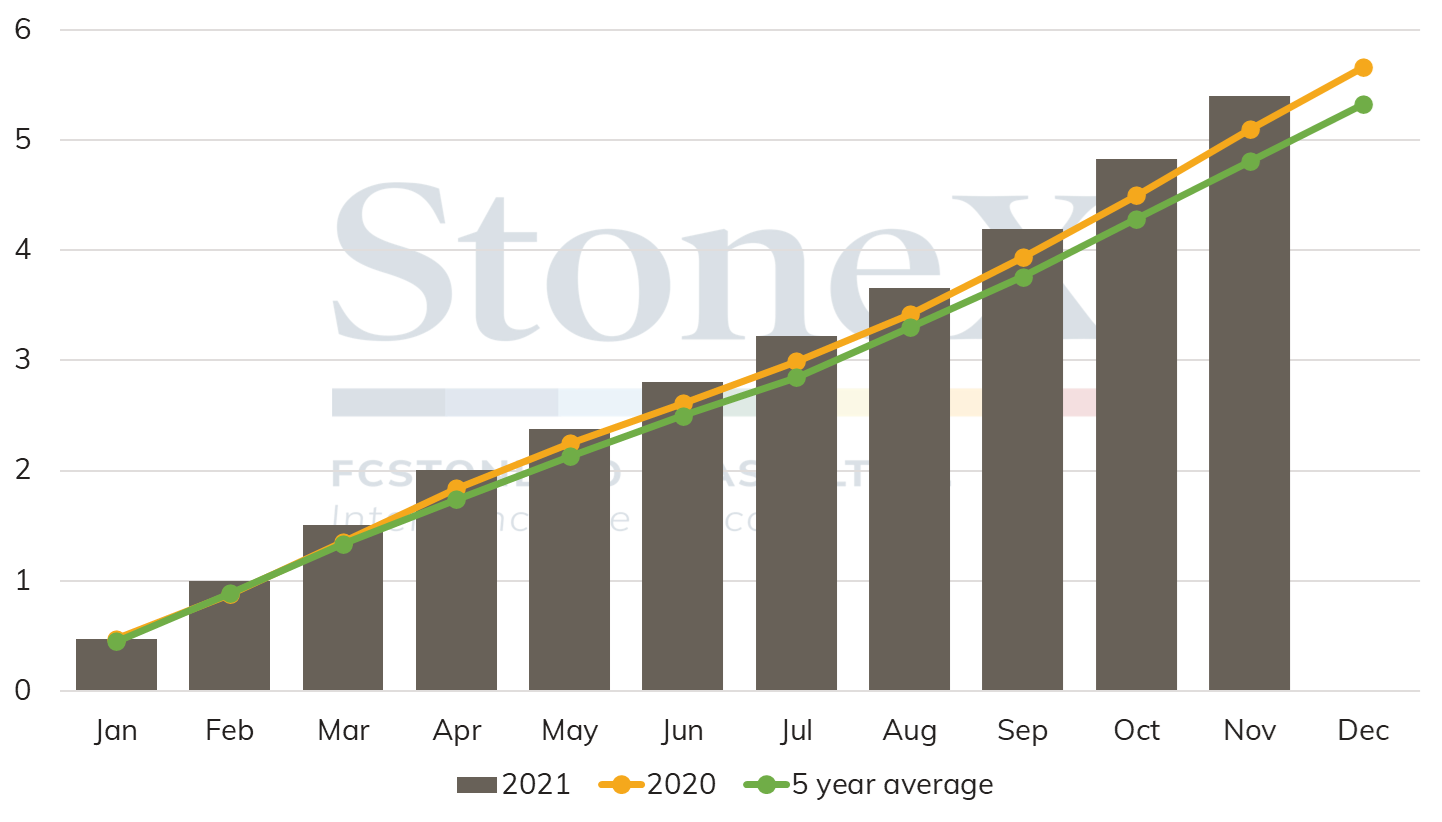
Despite the decrease, the remuneration for the coffee sold is 5.9% higher in 2021 so far, with the foreign exchange revenues totaling USD 5.4 billion against 5.097 last year, as a result of the average prices around USD 148.81/bag, significantly higher than the USD 148.81. Furthermore, considering the domestic currency, the return was very favored due to the devaluation of the Brazilian currency, reaching BRL 28.994 billion, high by 10.3% from the BRL 26.296 billion received by November 2020.
FOREIGN EXCHANGE REVENUE FROM BRAZILIAN COFFEE EXPORTS (US$ BILLION)
Source: Cecafé. Design: StoneX.
Colombia Turns to Coffee Imports Amid Lower Output
The National Coffee Growers Federation in Colombia have reported that the country’s coffee production for the month of November was 310,000 bags or 22% lower than the same month last year, at a total of 1,131,000 bags. Lower production is said to be the cause of torrential rains as the secondary rainy season merged with La Niña. The adverse weather conditions should impact output for the 2021-2022 coffee year as La Niña is expected to bring heavier rainfall during the key flowering period in January and February.
Coupled with lower output, Colombia has seen increased internal demand. By 2021, domestic consumption of coffee in Colombia increased to 2.8 kg per capita, according to new calculations based on a rigorous study by Reinova1. In the study itself, it was found that the incidence of coffee consumption increased from 86% in 2015 to 96% in 2021, that is, almost the population ceiling.
As a result, Colombia imported 1.23 million bags of 60-kg in January-September 2021, up 99.6% from the same period last year, according to figures from the country’s tax office DIAN. Imports almost doubled from the 615,933 bags of 60-kg imported in January-September 2020.
Colombia, the world’s third largest coffee producer, imports coffee from neighboring nations to supply the local market because of a shortage of low-quality coffee produced nationally. Colombia exports all of its high-quality Arabica beans, but it used to leave coffee affected by diseases such as broca worms or roya fungus for local consumption. However, in 2015, the coffee growers’ federation lifted a ban that had forbidden exporting low-grade beans. As a result, there are no leftovers of low-grade beans for the local industry, promoting the increase of imports.
Brazil is the largest supplier of coffee. Colombia imported 470,416 bags of 60-kg in January-September, almost six times higher the 85,700 bags in the same period last year. Peru shipped 208,850 bags in January-September, up from 163,983 bags on year. Colombia imported 69,400 bags of 60-kg bags from Honduras, up from 33,333 bags in the same period last year.
Panic Buying Fuels Robusta Rally
The Robusta market touched near decade highs last week, as “panic buying” was said to have fueled the rally. Coffee continues to be directly impacted by logistical challenges, including a labor shortage, lack of containers and major delays for shipping vessels. Vietnam, specifically, has been grappling with shipping delays during the peak time in their harvest. Traders believe that this “panic buying” will certainly ease following the holidays, although the logistical backlog is not expected to resolve until 2023 or later.
Supplies from main producer, Vietnam, are also tightening, which is adding support to the market. Exports since the start of the year until November are down 4.4% from last year.
The USDA most recently cut their forecast for exports for the 2021-2022 crop to 25.8 million bags from their previous forecast of 28.8 million bags.
Focus has also been on Vietnam’s weather, which has seen higher than average rainfall levels. Rain over last week slowed harvesting and drying, but sales have begun for the new crop.