StoneX logo

Coffee Weekly Report

By: StoneX Intelligence Brazil, StoneX Intelligence Brazil

War worries knock coffee prices down
 
Fernando Maximiliano
 
Leonardo Rossetti
 
In addition to risk aversion, the geopolitical conflict between Russia and Ukraine could impact coffee consumption
HIGHLIGHTS 

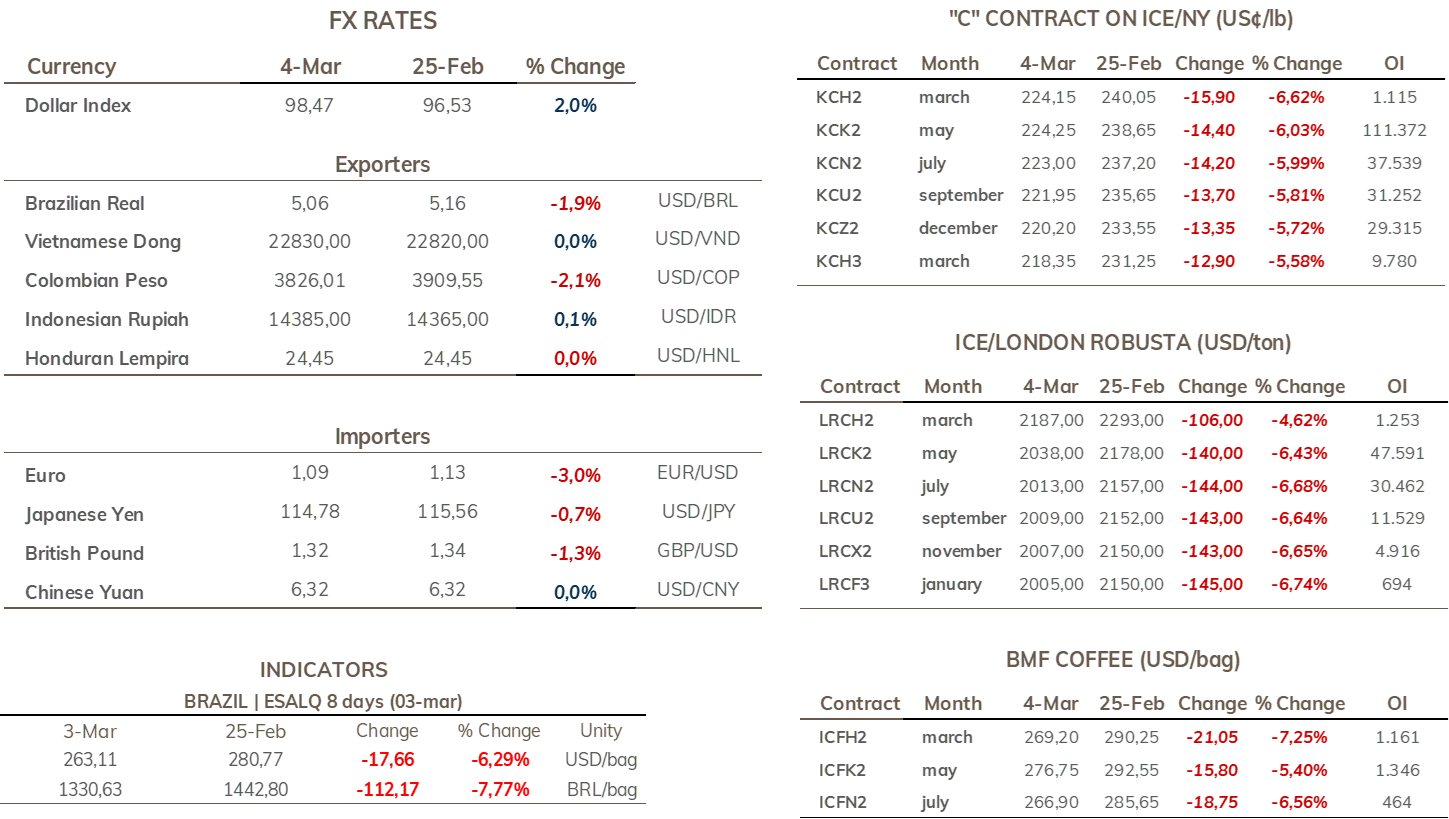
•    Arabica coffee prices dropped by 1440 points (6.0%) in NY, ending the week quoted at US₵ 224.25/lb. 
•    Cepea’s Arabica indicator dropped by 7.6%, closing at BRL 1325.98/bag.
•    Robusta prices dropped by USD 140 (6.4%) in London to USD 2038/ton.
•    Cepea’s Robusta indicator showed a drop of 4.6% and ended the week quoted at BRL 767.95/bag.
•    Tensions in Russia and Ukraine continue to put pressure on coffee prices
•    Conflict in Eastern Europe may affect coffee consumption
•    Possible drop in shipments to Russia, 6th largest importer of coffee from Brazil, worries agents
•    In Brazilian exports, soluble coffee tends to be the most impacted
•    Funds increase risk aversion and reduce long positions in the stock markets
•    Colombia's February production drop maintains concern about the current crop in the country
•    Favored by the rise in the commodities complex, BRL appreciates in the week
•    Possible interruption of Russian oil imports by the world elevates global risk aversion
•    Brazil's inflation and US inflation in February stand out among indicators

   Bearish Factors       Bullish Factors


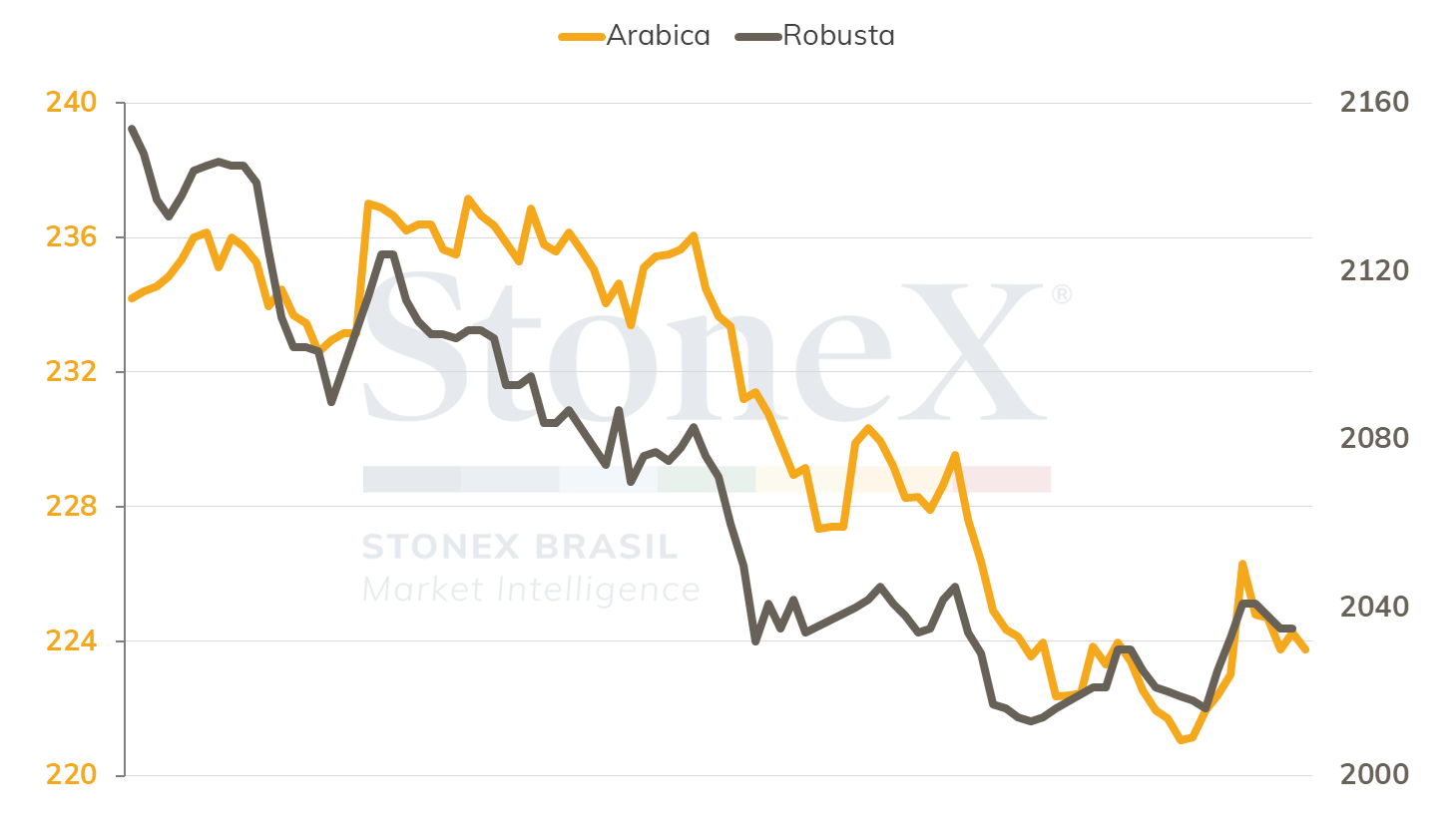
Coffee prices dropped sharply, reflecting the beginning of the war between Russia and Ukraine. The most active contract (May/22) closed Friday’s session at US₵ 224.25/lb, a retreat of 1440 points (6.0%) from the previous Friday (25). Since the beginning of the war on February 24, Arabica coffee prices depreciated 2330 points (9.4%), going from US₵ 247.55/lb to US₵ 224.25/lb. In Brazil, the Cepea's Arabica indicator followed the New York movement and ended the week lower by BRL 108.45 (7.6%), quoted at BRL 1325.98/bag. Since the beginning of the conflict, Arabica coffee prices have declined 8.1%.

Following the movements observed in New York, the Robusta coffee futures ended the week lower. Robusta's most active contract (May/22) retreated USD 140 (6.4%) to close the week quoted at USD 2038/ton. Since the beginning of the war, the most active contract in London dropped by USD 196 (8.7%). Less intensely in Brazil, the CEPEA’s Robusta indicator showed a drop of 4.6% and ended the week quoted at BRL 767.95/bag.

Weekly intraday (most active contract) - 02/28 to 03/04
image 30842
Source: CommodityNetwork Traders’ Pro. Design: StoneX.

Regarding the war, two main factors contribute to pressure on coffee prices. Firstly, the outbreak of the conflict increases the feeling of risk aversion, which decreases investors' appetite for riskier assets, such as coffee. Such a trend could be noticed in the latest COT report of the Arabica contract in New York, which showed that index funds settled 1,567 long contracts and decreased the number of short contracts by 343. 

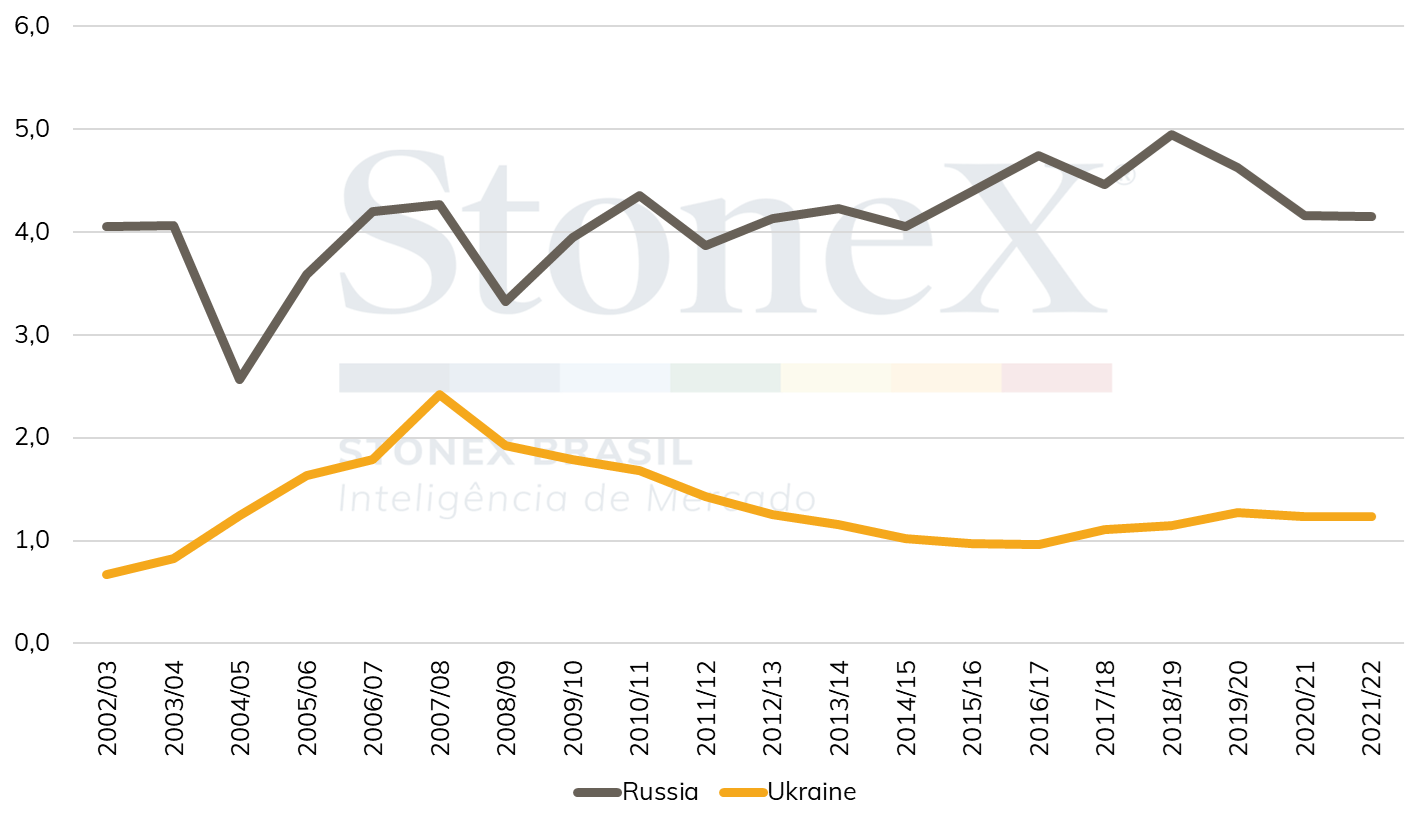
Another problem is linked to coffee consumption by the countries in conflict. The USDA data indicates that Russia consumed 4.16 million bags and Ukraine 1.23 million in 2020/21, so the two countries had an annual consumption of 5.4 million bags. 

Evolution of coffee consumption by Russia and Ukraine (million bags)
image 30843
Source: USDA. Design: StoneX.

The scenario is still very uncertain about the impacts of the war. Still, historically, due to the huge uncertainties and concerns surrounding times of armed conflict, the government and population tend to focus their resources on goods and food considered essential, which could interfere with the demand for coffee. In addition, some freight companies have interrupted their shipments to the region. There is the fear that further sanctions may also contribute to halting or reducing the flow of coffee to the region. 

As for Brazil, Russia is the 6th largest destination for coffee exports; in 2021, Brazil exported 1.2 million bags of coffee to the country. On the other hand, Ukraine is not among the main destinations of the Brazilian product, but it imported more than 217,000 bags in 2021. Among the main categories of the commodity exported by Brazil, the soluble coffee market tends to be the most affected, since Russia and Ukraine are respectively the 2nd and 7th biggest importers of the country's product, accumulating 535,000 bags imported last year, 13.3% of the total recorded in the period. According to the Brazilian Soluble Coffee Industry Association (ABICS), the countries together generated a revenue of about USD 100 million in Brazilian soluble coffee exports.

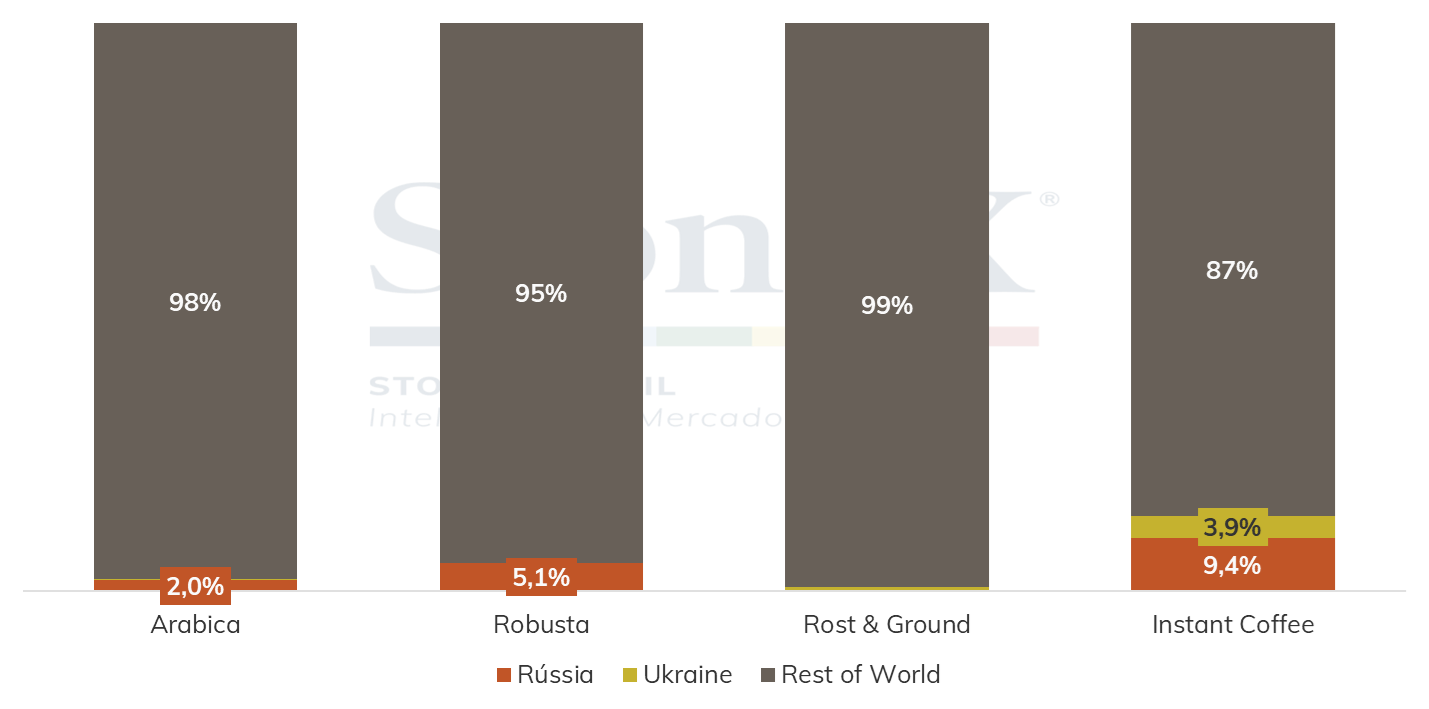
Despite smaller relative shares, it is important to consider the significant volumes of green bean exports that could be affected. Last year, 708,000 bags (2.2% of the total) of Arabica coffee were sent to these countries, with Robusta coffee shipments accumulating 190,000 bags (5.1% of the total). According to Cecafé's data, in 2021, all coffee exports to Russia and Ukraine generated an exchange revenue of about USD 210 million.

Share of Ukraine and Russia in Brazilian coffee exports in 2021
image 30844
Source: Cecafé. Design: StoneX.

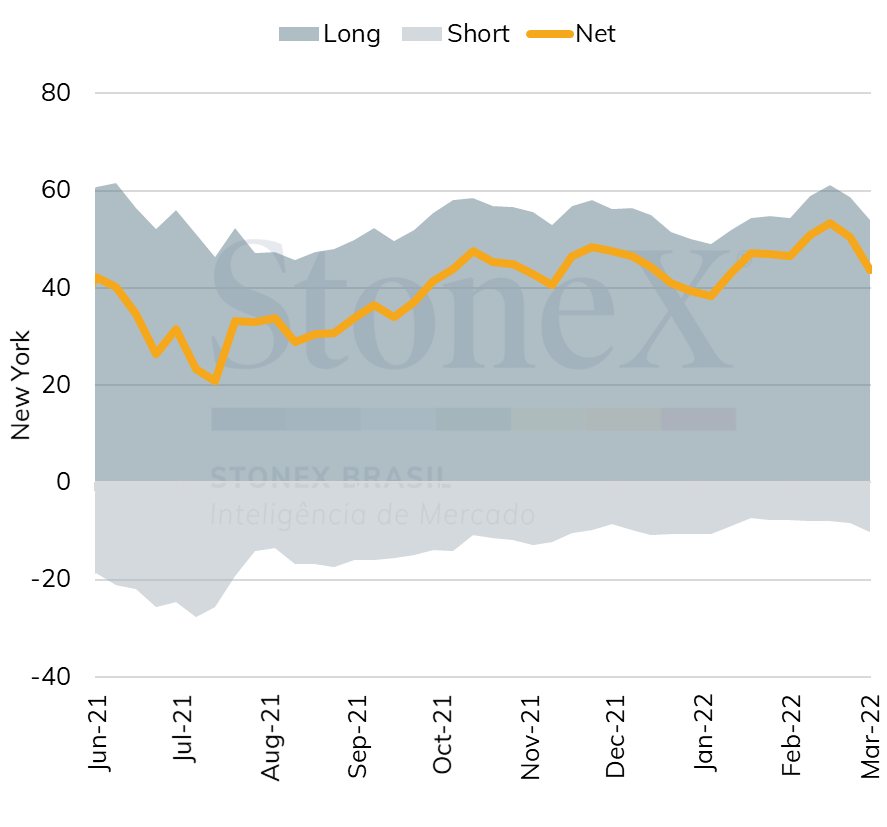
Given the scenario mentioned above, there was a strong liquidation of contracts by managed money, a sharp drop in prices and a reduction in the number of open contracts. Between 02/22 and 03/01, the funds in New York sold 4,834 long contracts and added 1,812 short contracts, reducing their net long position by 6,646 to 43,746 contracts. As a result, the total number of open interest dropped by 6,437 contracts. 

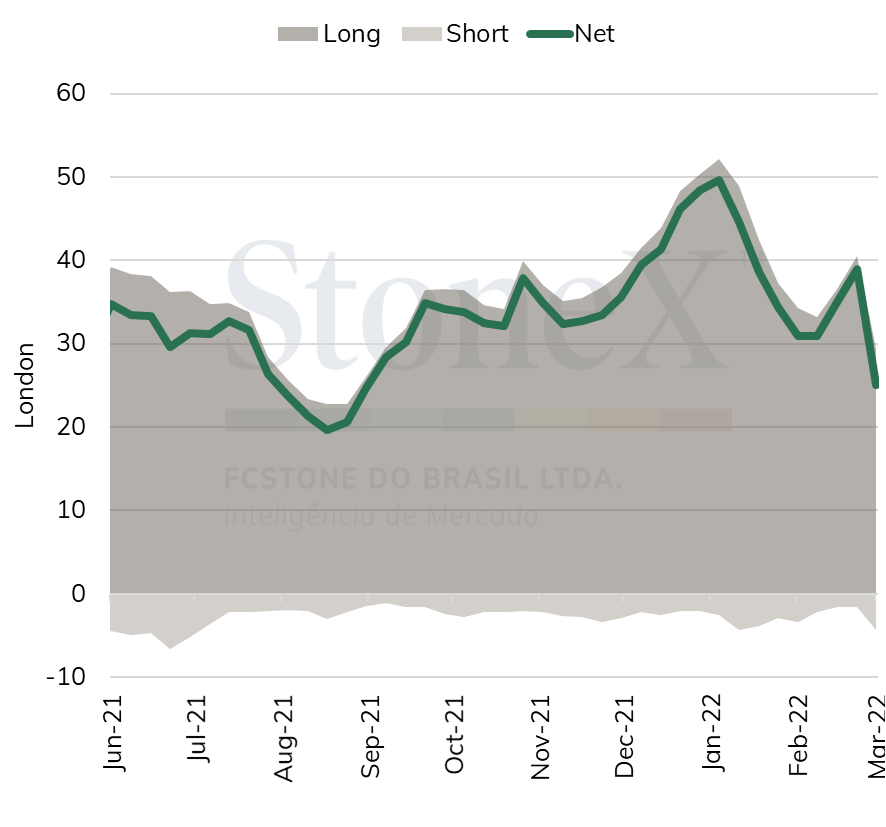
In London, there was also strong liquidation by funds. The latest COT report for Robusta coffee in London regarding 03/01/2022 showed that funds sold 13,852 contracts, with 11,057 being the liquidation of bought contracts and adding 2,795 contracts to their shorts, for a 25,074 net long. As a result, the total number of open interest fell by 6,296 contracts between February 22 and March 1.

Spec funds position in New York and London coffees
image 30845
Source: CFTC, ICE. Design: StoneX.
image 30846
 

Apart from war-related factors, there are still several positive elements for the coffee market, such as the sharp decrease in Colombia’s production, lower production in Brazil, and the drop in export estimates from Honduras. For example, the most recent data released by the National Federation of Coffee Growers showed that Colombian production fell by 16% in February, when it produced 928,000 bags, compared to 1.1 million bags produced in February 2021. Furthermore, the Association of Coffee Exporters of Honduras (ADECAFEH) adjusted its estimates for coffee down by 20% to 4.6 million bags in 2021/22. 

Preliminary data from the Vietnam General Statistics Office indicated that the country's exports were 5.7% higher in February, totaling 2.16 million bags. Furthermore, the International Coffee Organization (ICO) report indicated that world coffee exports advanced 2.8% to 10.9 million bags in January, compared to the same month in 2021.  

BRL appreciates favored by the rise in the commodities complex

After record highs in the week of the beginning of the war between Russia and Ukraine, following most of the global currencies in a strong movement of risk aversion, the USDBRL retreated again last week in the Brazilian exchange market, going in the opposite direction of most other currencies. As a result, the real/dollar pair closed last Friday (4) quoted at BRL 5.078, a weekly drop of 1.5%, while the dollar index registered a significant advance of 2.1% to close at 98.6 points its highest level since May 2020.

The Brazilian currency has benefited from a rise in demand for commodity-related assets, with several key feedstocks appreciating. However, the biggest fear in global markets continues to be concerning the supply of some commodities that Russia, Ukraine and Belarus have great importance in global supply as energy commodities, especially oil and natural gas, wheat, corn, fertilizers, aluminum and nickel.

It is worth remembering that the BRL had already been on a positive path since the beginning of this year, reflecting the significant increases in the basic interest rate (Selic) in the country and the entry of foreign investments in assets considered significantly cheap due to the impacts of the pandemic in the Brazilian economy.

The investors' attention should continue on the conflict in Eastern Europe and all the distortions that future events and a prolonged duration of the war could cause to the global economy. At the beginning of this week, one concern is about a possible advance of sanctions imposed on Russia, which could significantly affect global oil supplies. On Sunday, US Secretary of State Antony Blinken said that the White House and its European allies are looking in a coordinated way at the prospect of banning Russian oil imports without jeopardizing adequate oil supplies in global markets.

House of Representatives Speaker Nancy Pelosi said she is with her Democratic allies "exploring strong legislation" to ban Russian imports. A halt to Russian oil and gas imports would be strongly bullish for the price of these commodities, which would tend to prolong the effects of accelerating inflation in major global economies.

In this context, it is necessary to accompany the behavior of the central banks of these countries, with the possibility that amid the international crisis, they may lose room for maneuver to control a new acceleration of inflation and guarantee the stability and growth of their economies.

Thus, there are expectations for what will be debated and the stance of the monetary policy decision of the European Central Bank this Thursday (10) and the Fed on March 16.

Last week, Fed Chairman Jerome Powell, in testimony before the US Congress, reinforced the firm stance of the American central bank in fighting inflation, indicating that the Federal Open Market Committee (FOMC) should decide for a 0.25 percentage point hike in the basic interest rate next week.

This week, among the main indicators abroad, the agents should follow the Consumer Price Index (CPI) for February in the United States to be released on Thursday (10). Even though the index should only capture a few days of war effect, which started on February 24, a result above the expected should generate some caution among agents, since the strong hikes in oil prices and food commodities indicate that inflation should accelerate again in March.

In Brazil, the IBGE will release the Monthly Survey of Industry and the Monthly Survey of Trade for January on Wednesday and Thursday, which should help read the Brazilian economy's performance at the beginning of the year. On Friday (11), the IBGE will release the February National Broad Consumer Price Index (IPCA). The median of the agents' projections indicates that it should approach a monthly increase of almost 1.0%.


ECONOMIC INDICATORS
image 30847
Sources: ICE/NY; ICE/EU; B3; Commodity Network Trader’s Pro.
 
 
  • Coffee

The StoneX Group Inc. group of companies provides financial services worldwide through its subsidiaries, including physical commodities, securities, exchange-traded and over-the-counter derivatives, risk management, global payments and foreign exchange products in accordance with applicable law in the jurisdictions where services are provided. References to over-the-counter (“OTC”) products or swaps are made on behalf of StoneX Markets LLC (“SXM”), a member of the National Futures Association (“NFA”) and provisionally registered with the U.S. Commodity Futures Trading Commission (“CFTC”) as a swap dealer. SXM’s products are designed only for individuals or firms who qualify under CFTC rules as an ‘Eligible Contract Participant’ (“ECP”) and who have been accepted as customers of SXM. StoneX Financial Inc. (“SFI”) is a member of FINRA/NFA/SIPC and registered with the MSRB. SFI is registered with the U.S. Securities and Exchange Commission (“SEC”) as a Broker-Dealer and with the CFTC as a Futures Commission Merchant and Commodity Trading Adviser. References to securities trading are made on behalf of the BD Division of SFI and are intended only for an audience of institutional clients as defined by FINRA Rule 4512(c). References to exchange-traded futures and options are made on behalf of the FCM Division of SFI . StoneX is a trading name of StoneX Financial Ltd (“SFL”). SFL is registered in England and Wales, Company No. 5616586. SFL is authorized and regulated by the Financial Conduct Authority [FRN 446717] to provide to professional and eligible customers including: arrangement, execution and, where required, clearing derivative transactions in exchange traded futures and options. SFL is also authorised to engage in the arrangement and execution of transactions in certain OTC products, certain securities trading, precious metals trading and payment services to eligible customers. SFL is authorised & regulated by the Financial Conduct Authority under the Payment Services Regulations 2017 for the provision of payment services. SFL is a category 1 ring-dealing member of the London Metal Exchange. In addition SFL also engages in other physically delivered commodities business and other general business activities which are unregulated and not required to be authorised by the Financial Conduct Authority. StoneX Group Inc. acts as agent for SFL in New York with respect to its payments services business. StoneX APAC Pte. Ltd. acts as agent for SFL in Singapore with respect to its payments services business. ‘StoneX’ is the trade name used by StoneX Group Inc. and all its associated entities and subsidiaries.
 
Trading swaps and over-the-counter derivatives, exchange-traded derivatives and options and securities involves substantial risk and is not suitable for all investors. Past performance of any futures or option is not indicative of future success. Indicators are not a trading system and are not published as a specific trade recommendation. The information herein is not a recommendation to trade nor investment research or an offer to buy or sell any derivative or security. It does not take into account your particular investment objectives, financial situation or needs and does not create a binding obligation on any of the StoneX group of companies to enter into any transaction with you. You are advised to perform an independent investigation of any transaction to determine whether any transaction is suitable for you. No part of this material may be copied, photocopied or duplicated in any form by any means or redistributed without the prior written consent of StoneX Group Inc.
 
© 2026 StoneX Group Inc. All Rights Reserved.

Satellite view of Earth at night showing illuminated cities across Asia and the Middle East

Discover more insights

Our subscribers have access to comprehensive market analysis from StoneX spanning commodities, equities, currencies and more.

StoneX: We open markets

Our market expertise, advanced platforms, global reach, culture of full transparency and commitment to our clients’ success all set us apart in the financial marketplace.

Reach

With access to 40+ derivatives exchanges, 180+ foreign exchange markets, nearly every global securities marketplace and numerous bilateral liquidity venues, StoneX’s digital network and deep relationships can take clients anywhere they want to go.

Transparency

As a publicly traded company meeting the highest standards of regulatory compliance in the markets we serve, our financials and track record are matters of public record. StoneX’s commitment to “doing the right thing over the easy thing” sets us apart in the industry and helps us build respect, client trust and new partnerships.

Expertise

From our proprietary Market Intelligence platform to “boots-on-the-ground” expertise from award-winning traders and professionals, we connect our clients directly to actionable insights they can use to make more informed decisions and achieve their goals in the global markets.