The risk-averse sentiment should remain among global investors. Last week, the United States moved ahead with sanctions on Russia, banning Russian oil imports and blocking imports of several other products, notably vodka, seafood, and diamonds. The UK has also said it will eliminate oil imports by this year. The measures aim to hit the Russian economy even harder since oil represents a significant slice of export revenues. On the other hand, the Kremlin has restricted exports and imports of a list of products, including feedstocks, to nations it considers "hostile," such as the United States, the United Kingdom, and members of the European Union.
In this context, the Brazilian currency has been favored. Despite the global risk aversion and the search for safety assets, such as the dollar and US treasury bonds, Brazilian assets related to these products have received greater demand from investors due to the strong appreciation of much of the commodities complex. There is also an expectation that Brazil can position itself as an alternative both due to the interruption of countries' trade with Russia, either through sanctions, the fear of being "badly seen" for trading with the country or the fear of suffering defaults after the withdrawal of Russian banks from the global Swift financial system.
However, the effects of the war tend to be reflected in inflation in most countries. Last week, the US Bureau of Labor Statistics (BLS) revealed that the Consumer Price Index (CPI) accelerated by 0.8% in February. Although within expectations, the accumulated figure for the last 12 months reached 7.9%, the highest since 1982. March will likely register an even greater acceleration since the month will capture more of the effects of the war that started in late February on the prices of energy, food and metal commodities. It is worth remembering that the target sought by the American central bank is an average of 2.0% per annum.
Thus, a greater expectation is created for the Federal Open Market Committee (FOMC) meeting, which will take place this Wednesday (16). Fed is expected to follow through with the previously signaled 0.25 percentage point increase, which should continue to increase the attractiveness of the dollar in the current global scenario. However, it will be important to follow the position of the Committee members about how the Fed should behave in the context of the war between Russia and Ukraine and what actions can be taken in case inflation gets out of control in the country. The meeting will also be marked by the release of the first quarterly projections by FOMC members for the main indicators of the US economy, which usually act as a marker for the expectations of agents for the year.
In Brazil, the IBGE released the National Broad Consumer Price Index (IPCA) for February, which showed a rise of 1.01%, slightly above expectations. Thus, the accumulated figure for the 12 months went from 10.38% in January to 10.54%.
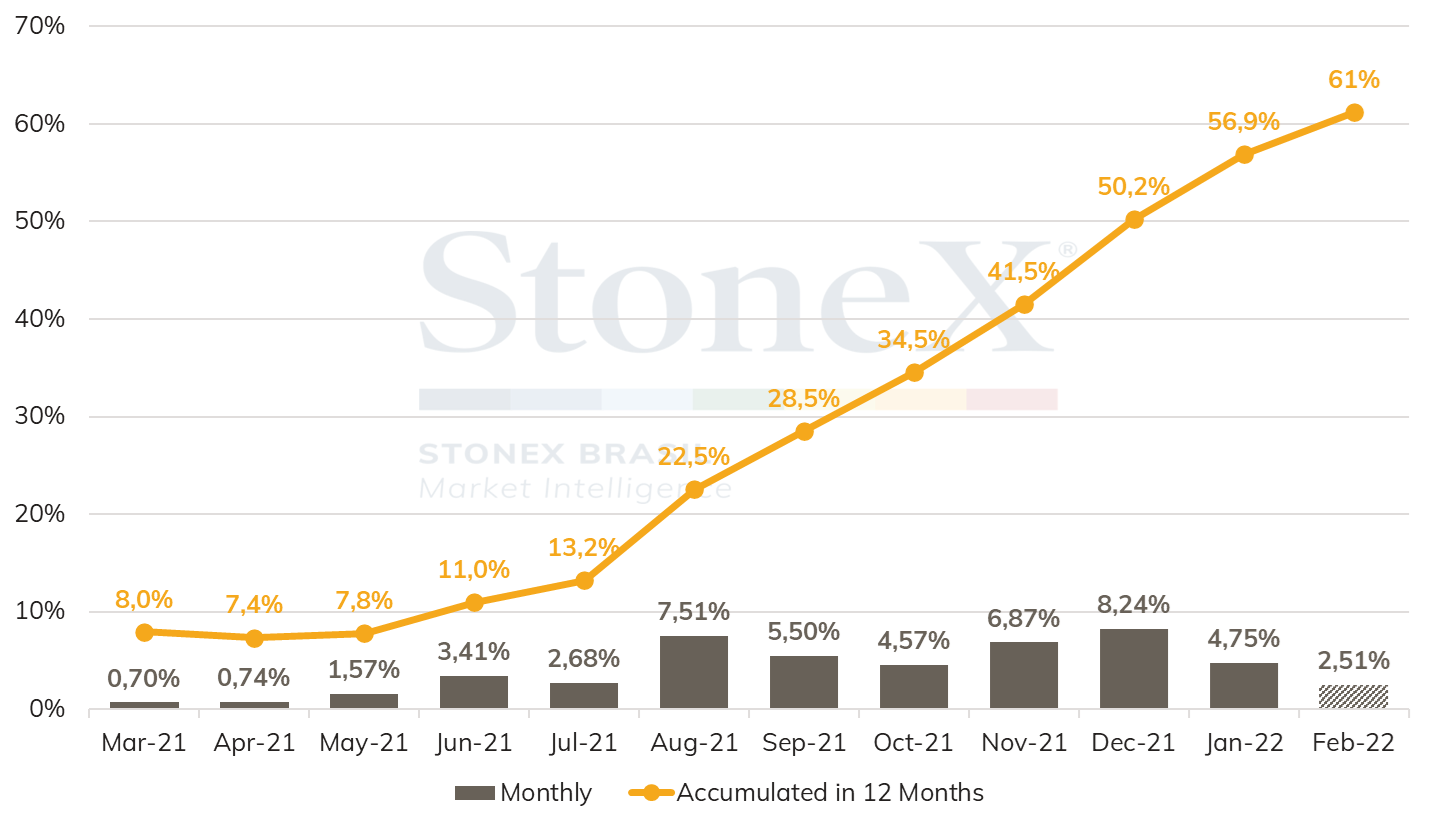
According to the report, the price of ground coffee was adjusted by 2.51% for the final consumer, a lower increase than the one observed in January (4.75%), and the lowest monthly increase since May 2021, when it registered a 1.57% increase. However, the accumulated figure for 2022 already reaches 7.38%, with the accumulated figure for the last 12 months rising from 56.87% in January to 61.19% last month. According to the IBGE, instant coffee prices for consumers advanced 1.81% in February, with the year-to-date total reaching 3.93% and the accumulated figure for the last 12 months rising from 13.81% in January to 15.43%.
Evolution of roasted and ground coffee prices in Brazil
over the last 12 months
Source: IBGE. Design: StoneX.
The impacts of the war can also be seen in the prices for Brazilian consumers. Last week, Petrobras announced an 18.7% readjustment in gasoline, 24.9% in diesel and 16% in cooking gas prices due to the strong rise in oil prices in the international market. Thus, the IPCA is expected to continue to register an expressive advance in prices in Brazil in March.
The agents’ focus should remain on the Monetary Policy Committee (Copom) meeting that will also take place this Wednesday (16). The signal given at the last meeting of the collegiate was that the Central Bank should raise the basic interest rate (Selic) by one percentage point, from 10.75% to 11.75% per year. However, due to the expectation that the effects of the war will promote a higher than expected growth in prices, it will be important to monitor what Copom's stance will be for its next meetings. The Focus Bulletin of the Central Bank this Monday showed a strong readjustment in market projections, with last week's bets that the IPCA will end 2022 at 5.65%, rising to 6.45%, already significantly above the upper limit of the Central Bank's target of 5.0%. The bets that the Selic rate at the end of 2022 also suffered readjustments, going from 12.25% to 12.75%, implying readjustments in the pace planned by Copom for its next meetings.