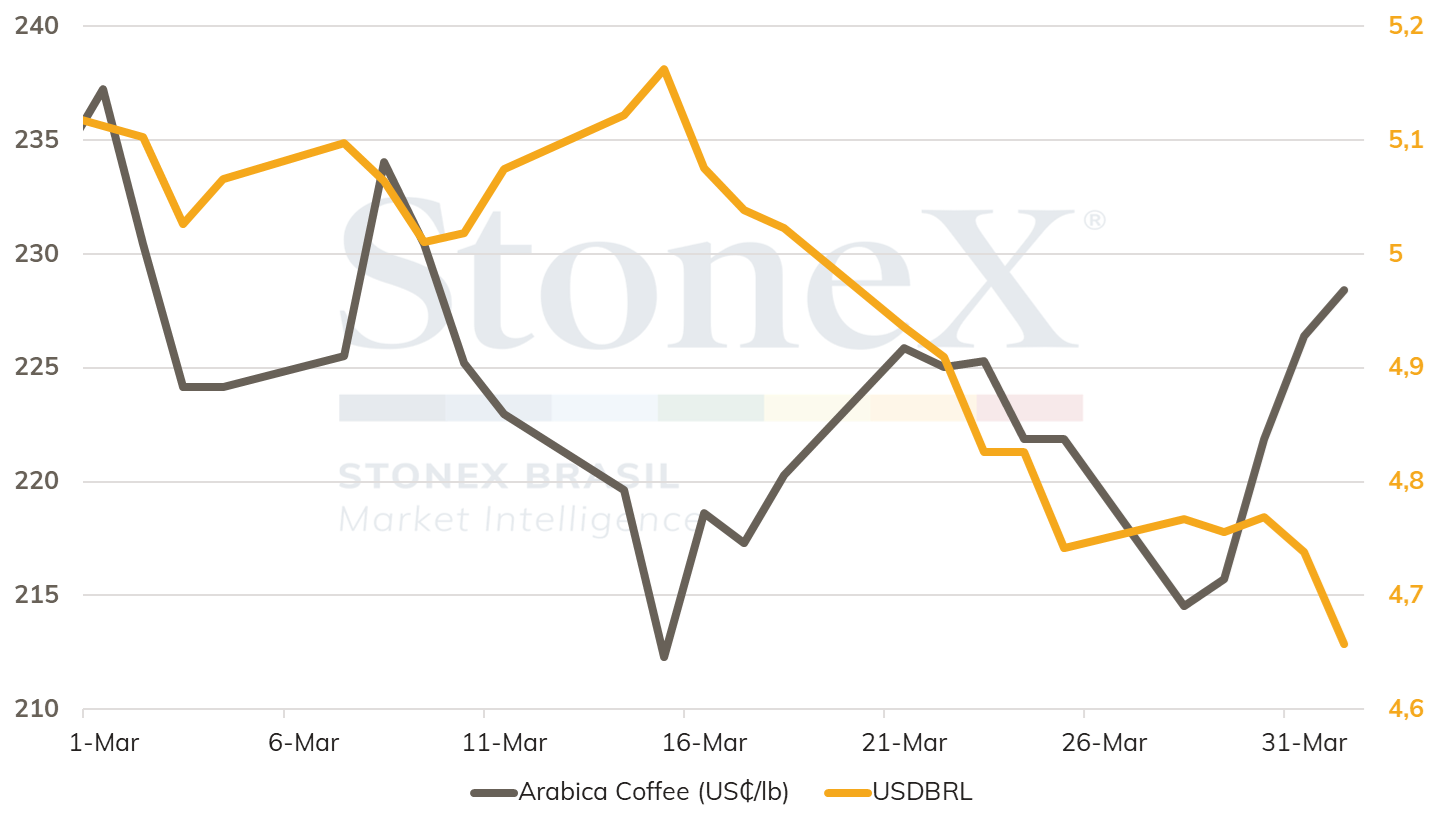
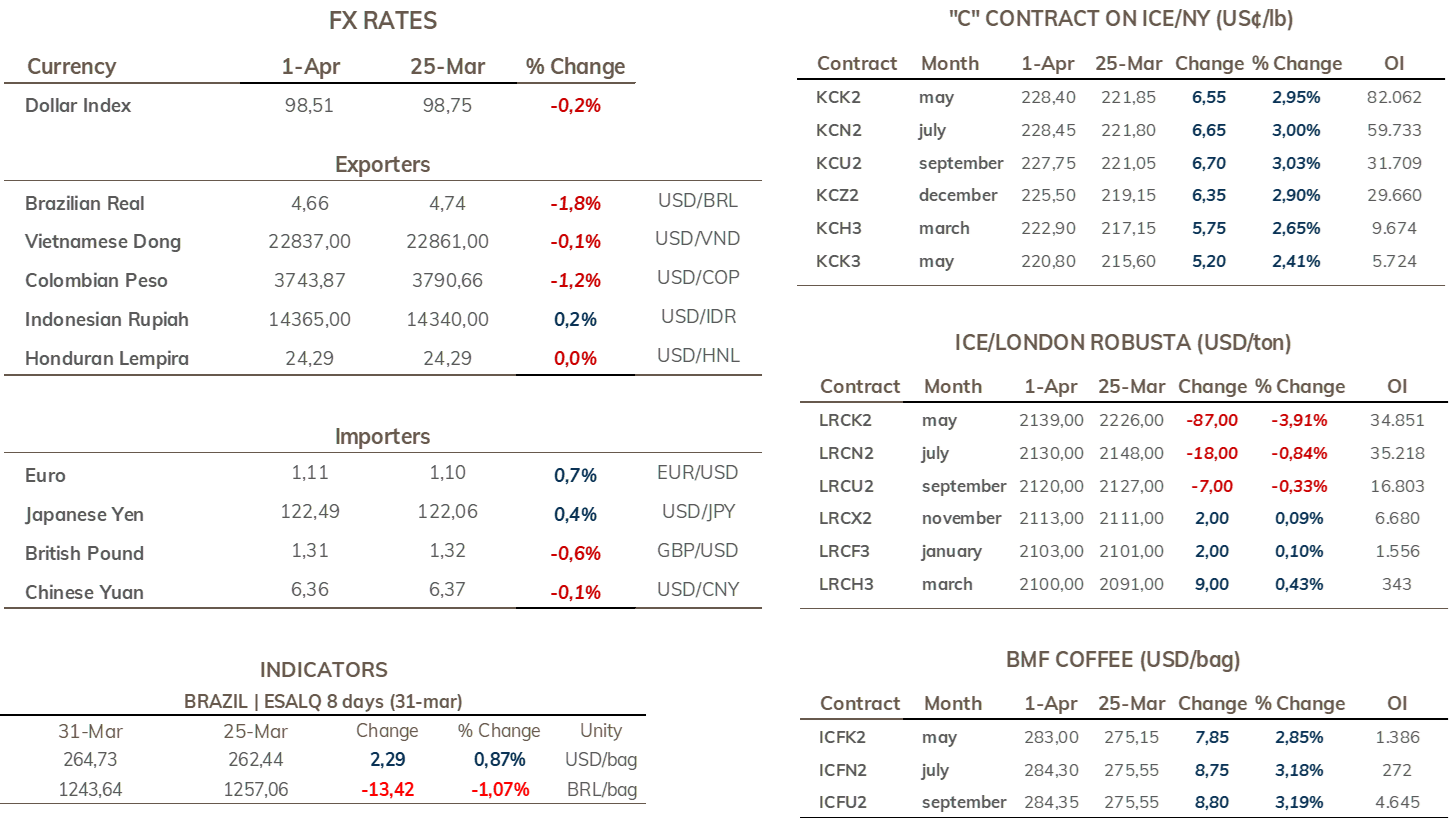
With a virtually unchanged scenario in terms of fundamentals, the coffee market continued to be impacted by macroeconomic and technical factors. As presented, the Arabica coffee market in New York was supported by the recovery of the Brazilian currency and the dollar decline in the domestic market. In addition, the market still feels the impacts caused by the war between Russia and Ukraine, as already presented in other editions of this report.
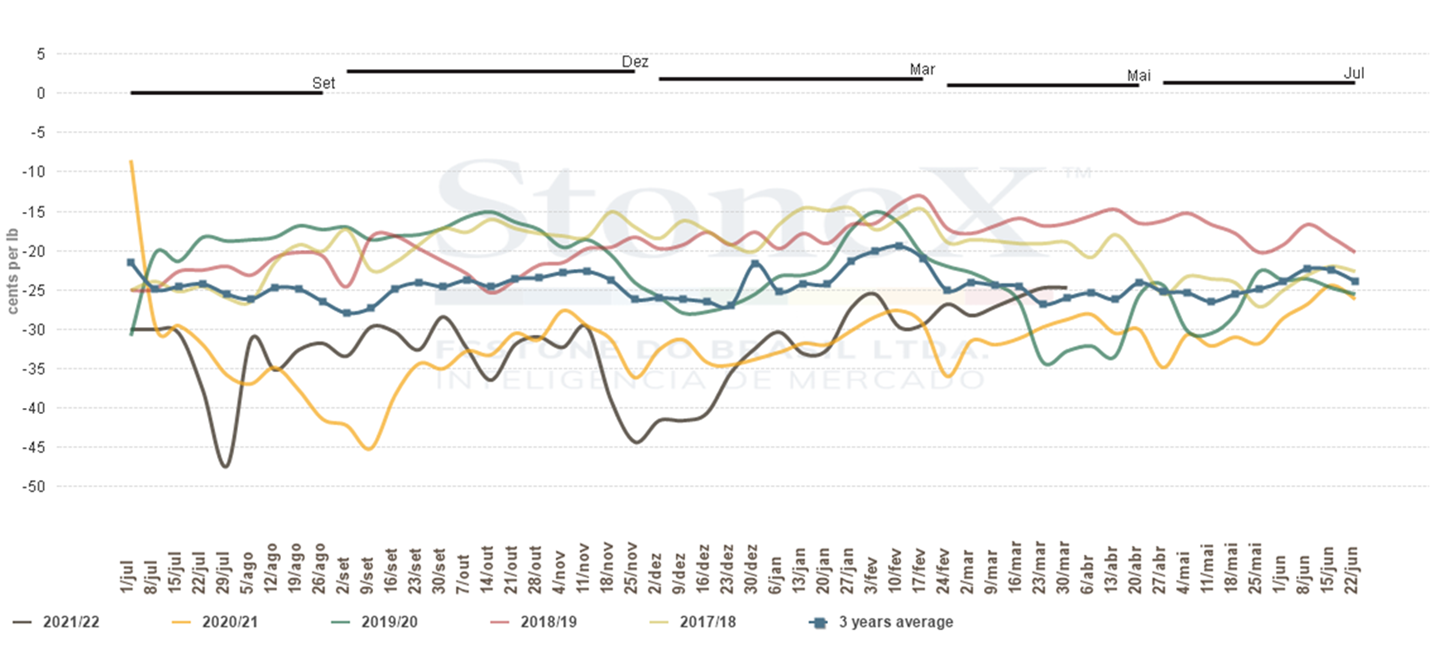
As for the Arabica coffee market, the differentials in Brazilian markets have been significantly strengthened to the New York reference exchange. The increase in differentials was mainly due to the sharp drop in the dollar in the Brazilian market. In addition, the retreat of the highs of the year in New York amid the impacts of war contributed to this movement - the differential of coffee type 6 between Sao Paulo and New York was US₵ -30 /lb mid-February to US₵ -25 /lb last week.
SEASONALITY OF ARABICA COFFEE DIFFERENTIALS IN SÃO PAULO (US₵/LB)
Source: ICE, CEPEA. Design: StoneX.
Concerning Robusta, it is worth mentioning that the estimates of exports from Vietnam released by the General Statistics Office (GSO) indicated an increase of 0.2% in exports in March, which totaled 2.83 million bags, compared to the same month last year. The year-to-date total for the crop year (Oct-Mar) was 12.91 million bags, increasing 1.41%.
The increase in exports of Robusta coffee from Vietnam comes amid a sharp drop in Brazilian exports of the type, as a reflection of the differential condition. Due to the tight supply of coffee in Brazil and the high prices of Arabica coffee, the demand for Robusta coffee by industries has increased, resulting in positive differentials in the Brazilian domestic market; last week, the differential between the Cepea’s Robusta indicator and the London futures market reached values above BRL 750.00.
Secex: Brazilian exports dropped by 15.9% in March
Preliminary data on the Brazilian trade balance for March, released by the Foreign Trade Secretariat (SECEX), indicate that Brazil exported 3.38 million bags in March, representing a 15.9% decrease compared to the same month last year when the country exported 4.02 million bags. The sharp decline in exports results from the lower availability of coffee amid reduced production in 2021/22 and logistical problems that continue to impact exports.
In the coming weeks, the coffee market should be impacted by movements in the macroeconomic and exchange rate fields – in case of a continued recovery of the Brazilian currency, prices in New York would tend to react positively, while the domestic market would continue to be pressured. Furthermore, due to the great uncertainties linked to the conflict between Russia and Ukraine, the coffee market and other commodities will continue to react to events linked to the war.
The export data from Secex already indicate that the exports in March had a strong reduction.
In the next weeks, Cecafé will release official data for Brazilian exports, which tend to be in line with what was released by Secex. The reduced volume of exports in Brazil corroborates the perspective of lower supply, which, together with the logistical problems, brings a bullish tone to the market.
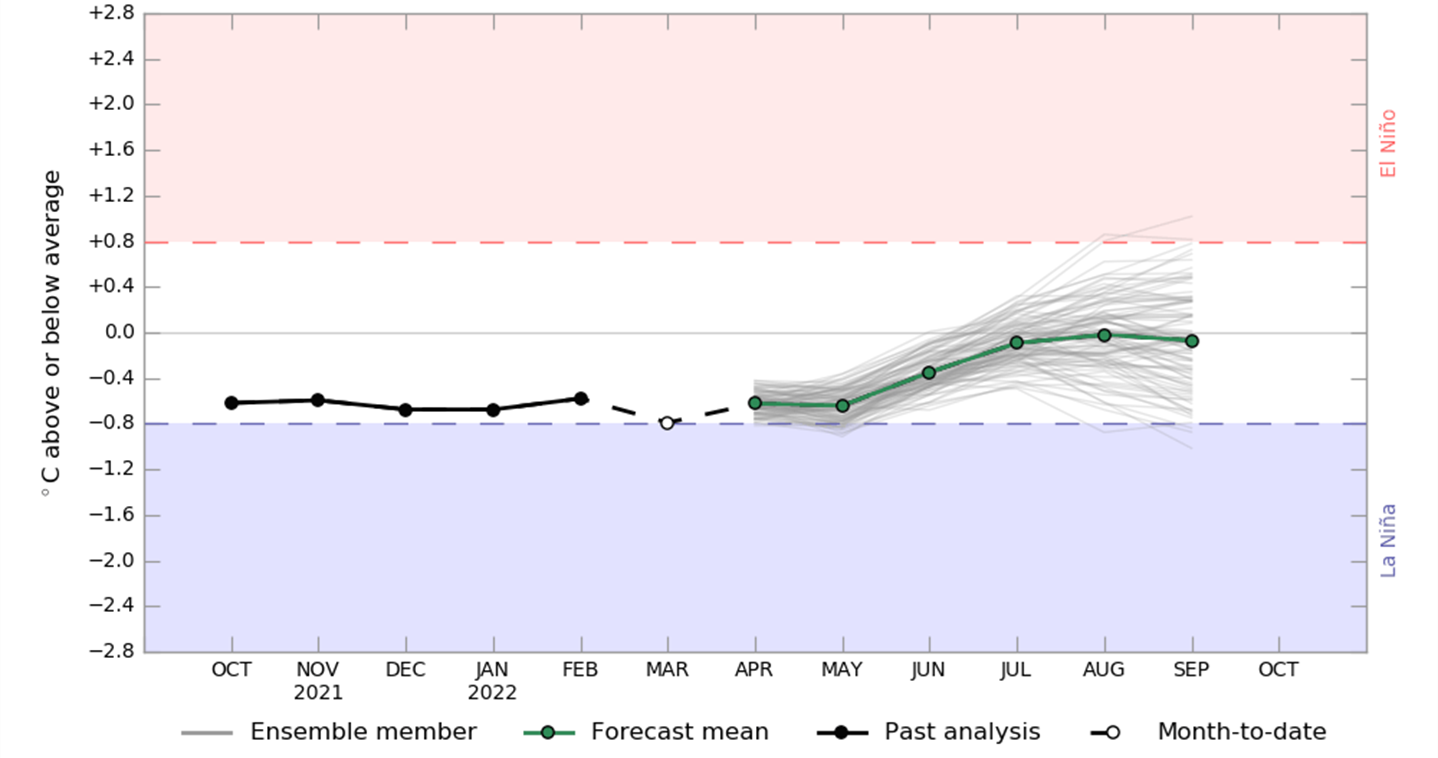
In addition, the agents will follow closely the weather in producing countries and the release of the probability of maintenance of La Niña that will be published on April 14 by the US agency NOAA. The last update released by Australia BOM indicated that La Niña remains active, but the peak of the phenomenon has passed. Moreover, according to the agency, most of the seven international climate models point out that La Niña will lose strength in the next three months and will return to a neutral condition, most likely in late fall or early winter in the southern hemisphere. A confirmation of this scenario, with improved weather conditions in producing countries, can act to put pressure on prices on the exchanges.
MONTHLY SEA SURFACE TEMPERATURE ANOMALIES FOR NINO3.4 REGION
Source: Australia's Bureau of Meteorology.
Inverse correlation between USDBRL and coffee stands out in the last weeks