
Daily Coffee Report 8/5/26
Daily coffee report
StoneX Coffee Team
- Coffee
By: StoneX Intelligence Brazil, StoneX Intelligence Brazil


• Arabica prices dropped by 1165 points (-5.2%) in NY, closing the week quoted at US₵ 210.45/lb
• Cepea’s Arabica indicator remained near unchanged, increasing by 0.3% to close at BRL 1,244.41/bag
• Robusta prices retreated by USD 25 (1.13%) in London to USD 2083/t
• Cepea’s Robusta indicator dropped by 2.7% to BRL 770.84/bag
• Effects of the war continue to put pressure on coffee prices ▼
• Colombia's coffee production fell by 7% in April ▲
• Excessive rainfall caused by La Niña continues to affect production in Colombia ▲
• Vietnam's coffee exports fall in April but are still higher than the previous year▼
• Starbucks' financial results indicate a recovery in demand ▲
• The emergence of new cases and the adoption of new restrictive measures in China creates concerns about the demand ▼
• In the coming weeks, Cecafé and GCA data will be released
• USDBRL closes the week above BRL 5.00 for the first time in 7 weeks
• Despite Fed's interest rate hike as expected, the currency market posts great volatility during the week
• Agents raise concerns about prolonged inflation and low growth
• April inflation data in Brazil and United States are highlights of the week
▼ Bearish Factors ▲ Bullish Factors
StoneX released last Thursday (05) the outlook for the coffee market [May-July]; access the full report here.
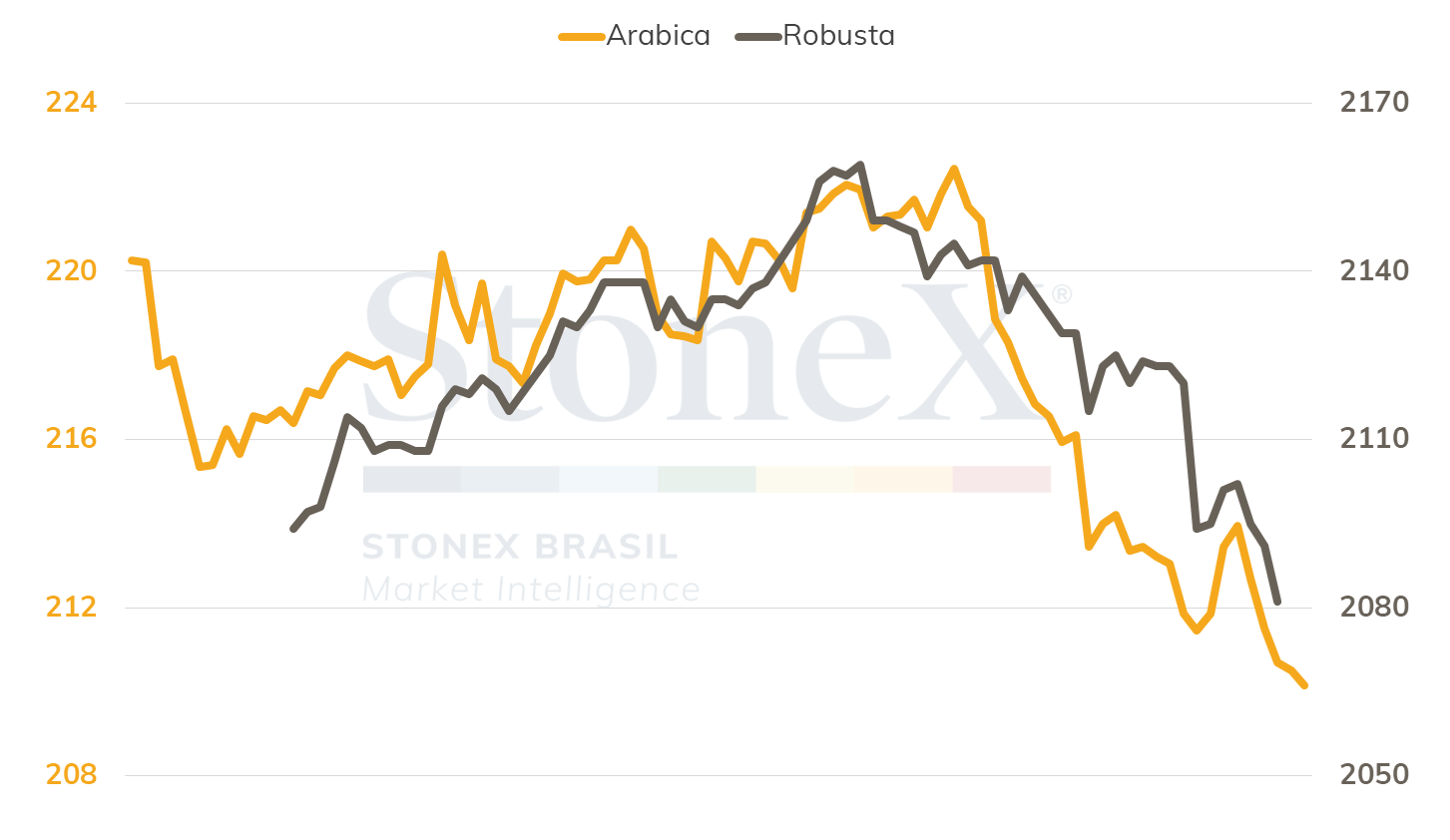
As presented in the Outlook for the Coffee Market report, the expectation of a more balanced supply and demand (S&D) balance or surplus in 2022/23, after a year with a significant deficit, has cooled agents' concerns regarding coffee supply in 2022/23. Furthermore, during the week, the rising dollar, which reacted to the Fed's decision, put pressure on coffee prices, as discussed in the macro session. Moreover, traders observed the sell-off of contracts by the speculative funds, which still maintain a very long position, in 21.8 thousand contracts, a volume above the last 3-year average, which was 8.5 thousand contracts.
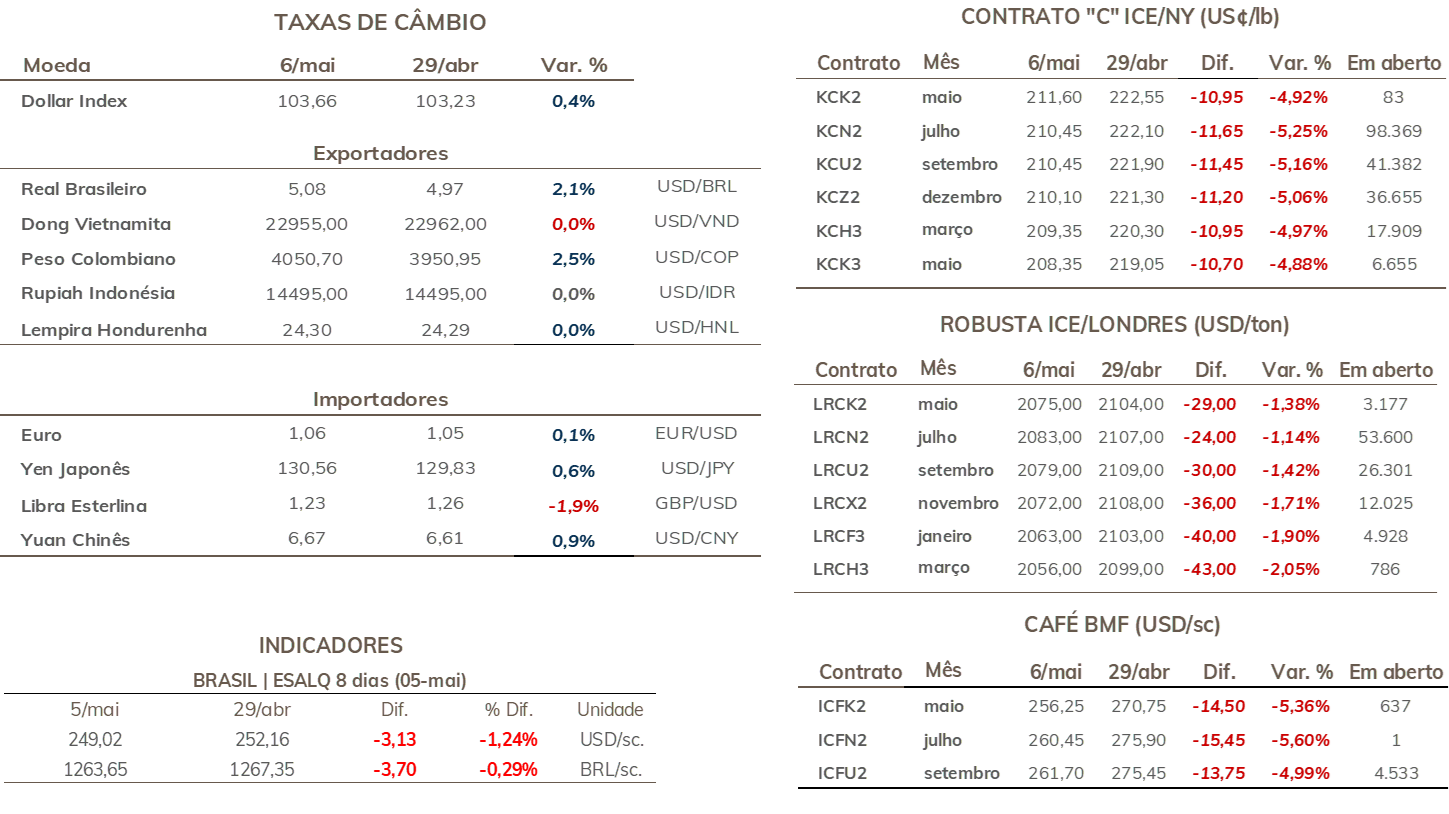
Arabica’s most active contract (July/22) ended Friday (06) at US₵ 210.45/lb, posting a retreat of 1165 points (-5.2%) compared to the previous Friday (29). Following the same trend, in Brazil, the CEPEA indicator for Arabica coffee ended the week with a drop of 1.8%, quoted at BRL 1,244.41/lb – the fall in prices was not as intense as in New York due to the 2.6% rise in the dollar during the week.
For the Robusta market, prices also ended the week in decline, with the most active Robusta contract (July/22) falling USD 25 (1.13%) and ending the week quoted at USD 2,083. The Cepea's Robusta indicator closed 2.7% lower in Brazil, quoted at BRL 770.84/bag. As already mentioned in other editions of this report, the beginning of the Robusta harvest in Brazil increases its availability and puts pressure on prices.
Despite the doubts that still permeate the next Brazilian crop, Colombia's production has been showing significant losses while suffering from excessive rainfall. Data from the Colombian Coffee Growers Federation (FNC) indicated that the country's production in April totaled 750,000 bags, 7% less than the same month last year. Colombian production continues to be impacted by excessive rainfall in the country, a reflection of the impact of La Niña on the weather. As a result, the accumulated production for the first four months of the year totals 3.460 million bags, 14.5% below the same period in 2021, when the country produced 4.048 million bags.
The Robusta coffee market keeps a close eye on coffee exports from Vietnam, which have reached higher volumes this year. As presented in more detail in the outlook report, the differentials for Robusta coffee in Brazil are high, while the differentials in Vietnam continue to weaken, indicating the country's increased competitiveness. Thus, Brazilian export volumes have fallen while Vietnamese shipments have advanced.
Seasonality of Vietnamese coffee exports (million bags)
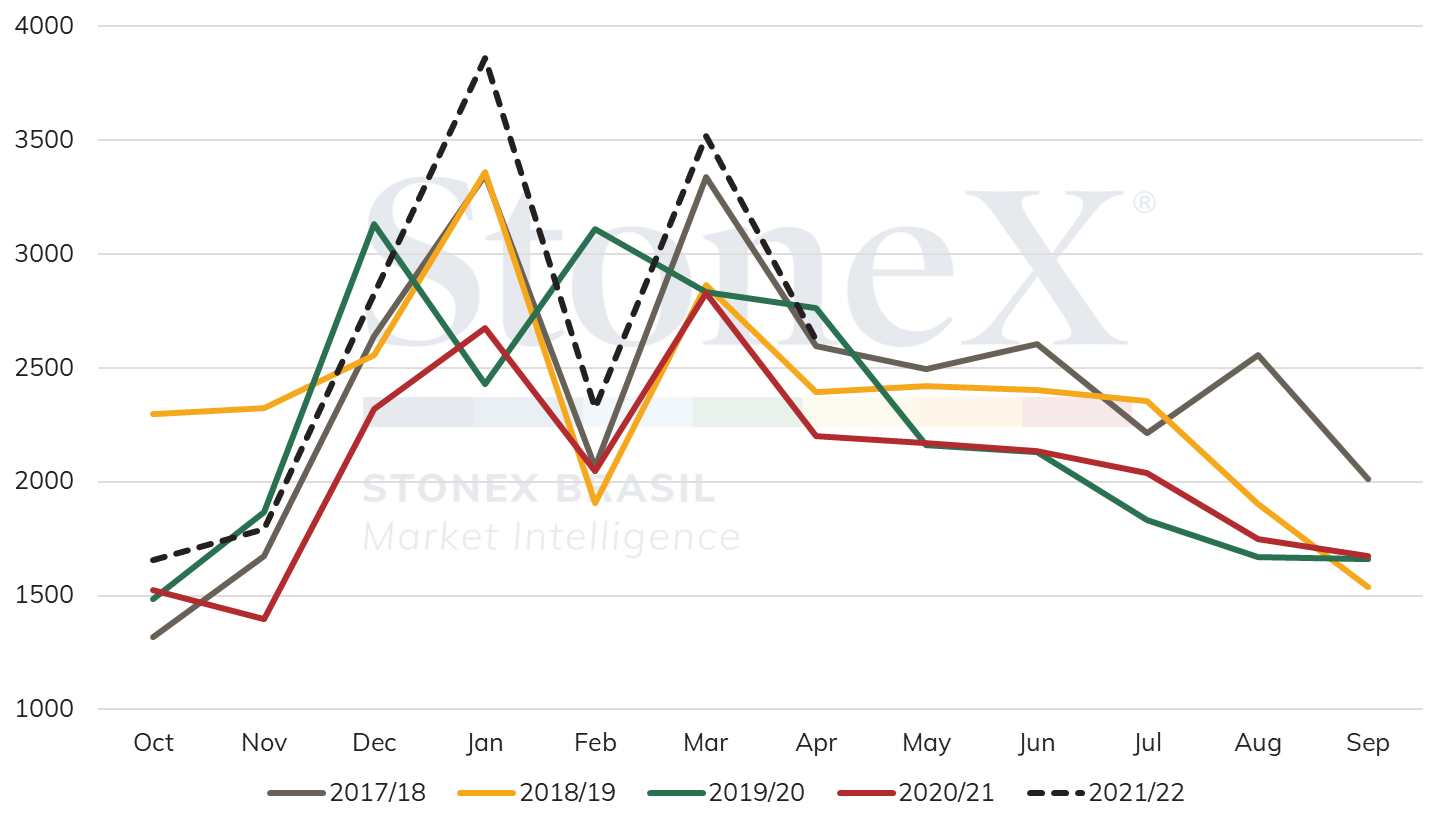
Data released by the Vietnamese Customs indicated that Vietnam exported 2.6 million bags in April, 19.2% higher than in April 2021 but 24% lower than the volume exported in March, indicating a slowdown in exports from Vietnam. As we can see in the seasonality of the exports chart, there is a tendency to reduce exports due to the country's inter-crop period. The Vietnam harvest starts in mid-November and continues until January.
As for demand, Starbucks' financial data pointed to strong consumption, but the new cases in China are worrying. With the end of the pandemic in most countries, coffee consumption is recovering. Starbucks data shows that its sales advanced 7% in its fiscal second quarter, which ended April 3. The growth reflects the reopening of economies after the shock caused by the pandemic. However, a point of attention is the new cases of Covid-19 in China, leading the country to readopt restrictive measures to prevent the spread of the disease.
The latest Commitment of Traders report released by the CFTC showed a slight movement of spec funds in coffee futures and options on the New York exchange. According to the report data, speculators reduced their longs by 1,331 between April 26 and May 3, going for 31,510 contracts. In addition, the short positions also posted a drop, with a decrease of 749 contracts to 9,652 on the exchange. Thus, the spec's net balance slightly declined by 582, standing at 21,858 long positions.
Spec funds position in coffee futures and options vs. most active contract on ICE NY
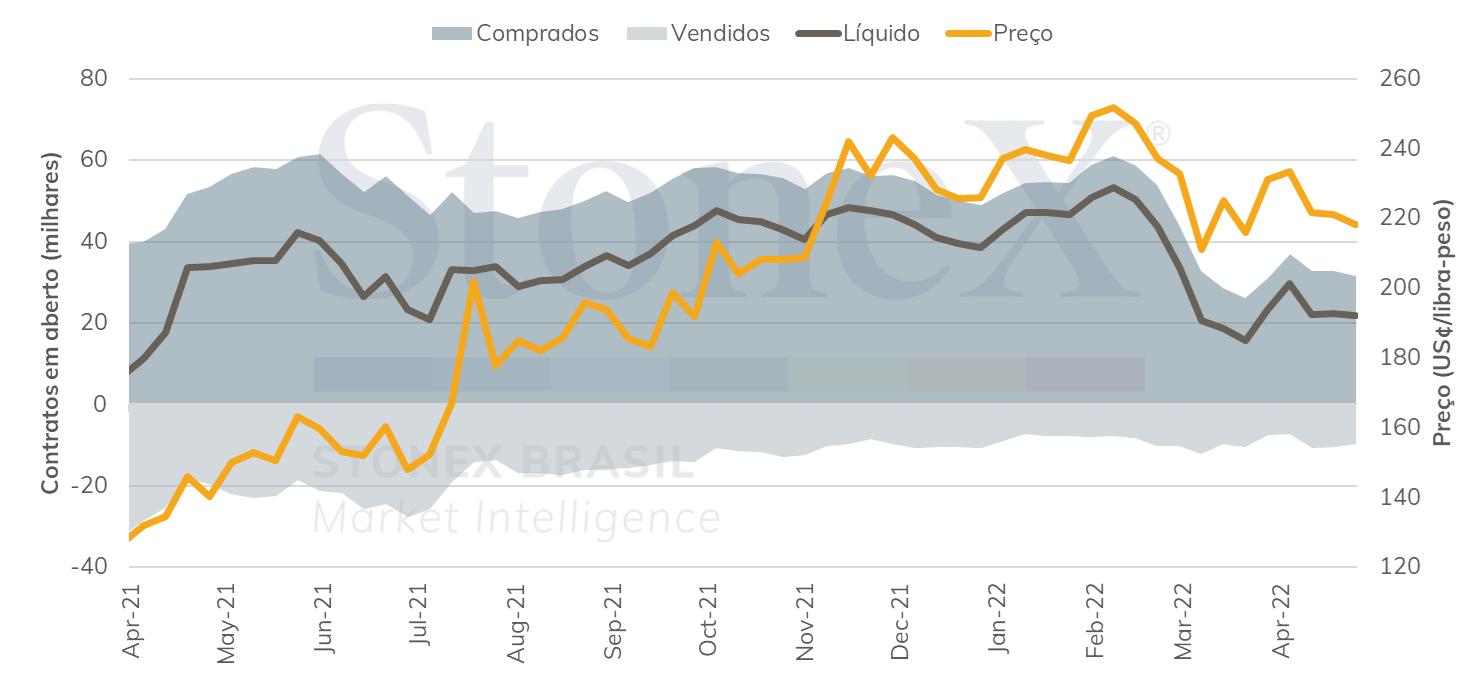
Through the chart above, it is possible to observe that since mid-December last year, after stock prices had absorbed most of the impacts of dry weather and frosts on the outlook for Brazilian production and the global S&D balance, prices and the funds' net positions began to relate more intensely, showing very similar movements over the weeks. This suggests that the most intense drops registered in the last few sessions, which extended to reach their lows since November on Monday and do not find a strong explanation on the fundamentals side, have a great influence from speculative funds' technical movements.
For this week, the attention of the agents is on the release of Brazil’s Cecafé export data. Cecafé's data, in addition to showing the pace of shipments and the possible impacts of the logistical problems in the country's exports, can also help to dimension the size of the impact of the war through the indicators of exports to Russia and Ukraine. Export data released by the Secretariat of Foreign Trade (Secex) indicate that Brazil exported 2.76 million bags in April, representing a 20% decline compared to April 2021. However, it is important to highlight that Secex and Cecafé's data usually diverge, which indicates that the numbers that Cecafé will release may present a different scenario.
Next week the Green Coffee Association will release the report for coffee stocks at US ports. The last report showed an increase of almost 55,000 bags (0.95%) in March compared to the previous month. As can be seen in the seasonal graph of GCA stocks, there is a tendency for stocks to increase from March onwards. The seasonal pattern of GCA stocks reflects the higher import volumes of coffee from Central America, starting in March/April, and then the volumes coming from Colombia and Brazil in the second half of the year. Therefore, stock data may show substantial advances in April, which would act in a bearish manner for the coffee market.
Seasonality of coffee stocks at US ports - GCA (million bags)
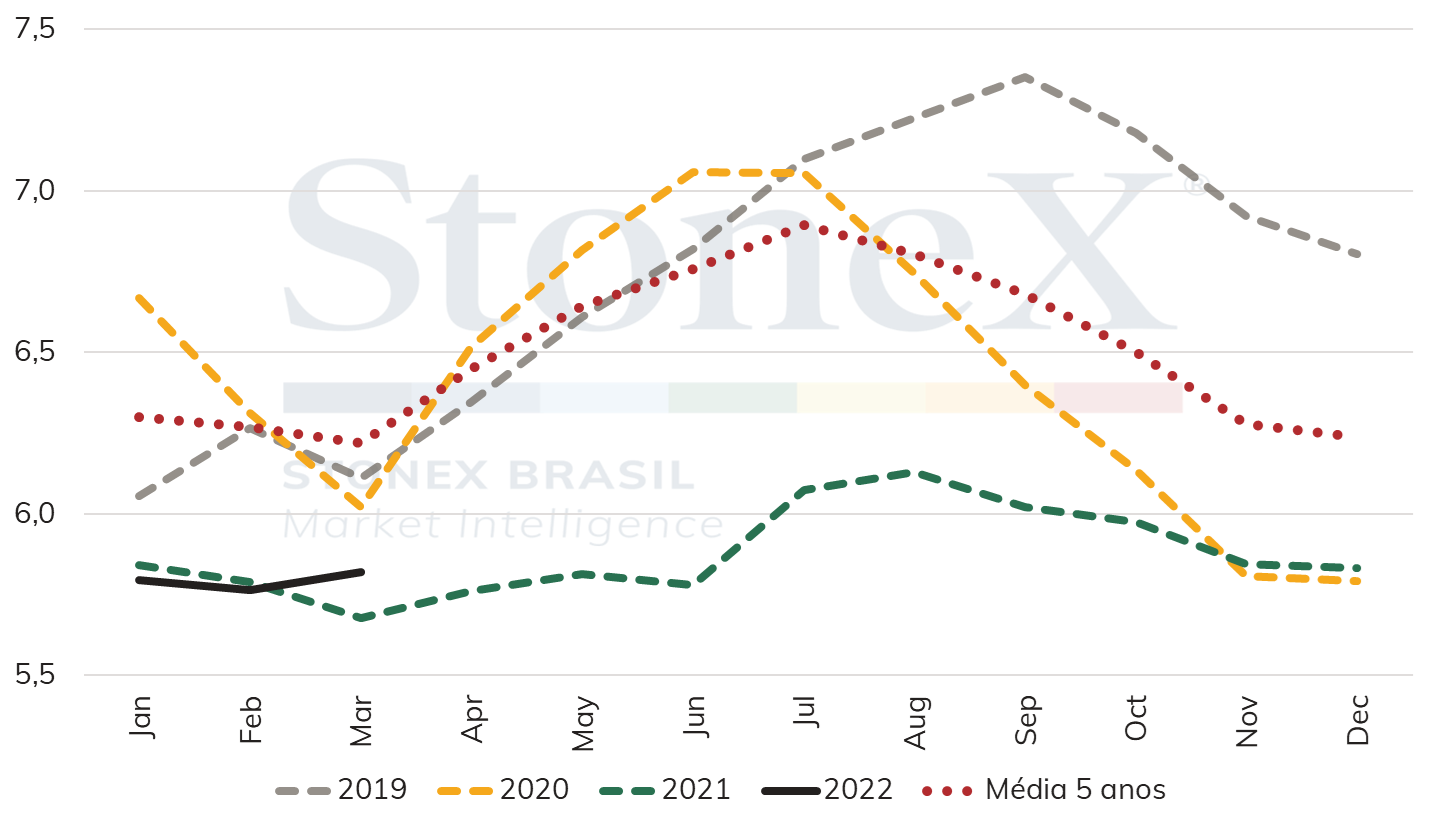
The USDBRL recovery continues to be a factor of pressure for coffee quotes on the stock exchange. The US currency recorded its third consecutive week of appreciation against the Brazilian real, with the exchange rate registering a weekly increase of 2.6% to end Friday (6), quoted at BRL 5.073.The dollar index, in turn, maintained its appreciation pace abroad for the fifth week in a row, advancing 0.7% to end the week quoted at 103.7 points, the highest level in 20 years.
Last week was a week of exacerbated volatility in the Brazilian foreign exchange market. The dollar posted a range of more than 10 cents in all sessions, indicating a moment of great uncertainty and instability in global markets.
The main event that influenced the week's oscillations was the decision by the Federal Reserve's Monetary Policy Committee (FOMC), which confirmed expectations and raised the US basic interest rate by 50 p.p. to a range between 0.75% p.a. and 1.00% p.a. What came as a surprise, however, was Fed Chairman Jerome Powell's statement that the Committee was not actively considering adjustments of 0.75 p.p. in the basic interest rate. Nevertheless, despite the statement, the futures market has oscillated over the last few days, even signaling majority bets for a 0.75 p.p. hike in the next meeting, even with Powell's statements.
This dispersion of bets, the main factor for the volatility of the dollar over the last few sessions, should ease this week after the interviews of various members of the FOMC, which should help to clarify the scenario that the American central bank is drawing for the coming months and its next meeting.
The decision on Thursday (5) of the Bank of England (BoE) to raise the country's interest rate by 0.25 p.p., for the fourth consecutive time to 1.0% per annum, also contributed to the oscillations in the international exchange market. Along with the interest rate hike, the BoE increased its projections for inflation in 2022 to 10% and 2023 to 6.6%, historically high levels for the country. In addition, the monetary authority maintained its projection for economic growth of 3.75% in 2022 and revised the 2023 GDP to a change of -0.25%. The forecasts of still high inflation and contraction of the economy in 2023 heated the debates about the possible prolonged effects of global inflation and the possibility of a stagflation scenario in the world's leading economies.
Added to the visualization of this scenario was the advance of the spread of the Omicron variant of Covid-19 in China and the continued adoption of strict measures to contain the spread of the virus, so far without success. Last week, IHS Markit released a result of 36.2 points for the country's April Services PMI, which, together with the Manufacturing PMI result (47.4), indicated the second consecutive month of falling activity in both sectors. It is worth remembering that a PMI below the 50-point threshold signals a contraction in activity in the sector in question, while above 50 points indicate an expansionary condition. Thus, market participants have been increasingly reading about the prospect of lower growth in the country (and consequently the global economy) and a further worsening of global logistics problems, which increases the risk of affecting the coffee chain again.
The Monetary Policy Committee (Copom) confirmed expectations in Brazil and increased the basic interest rate (Selic) by 1.0 p.p., to 12.75% per year. In the statement, the collegiate affirmed that due to the challenging global situation, with the continuation of the Russian-Ukrainian war and the worsening of the Covid-19 situation in China, it will understand the monetary tightening cycle with a next adjustment of "lesser magnitude," with market bets indicating that the Central Bank will raise 0.5 p.p. in June.
This week, the release on Wednesday (11) of the National Broad Consumer Price Index (IPCA) and the Consumer Price Index (CPI) for April in Brazil and the United States should also be highlighted. The decisions will help market participants' projections about the next steps to be taken by the countries’ central banks, with higher-than-expected results tending to contribute to a greater attraction of foreign exchange to the respective currency markets and, consequently, to favor the strengthening of their currencies.
The StoneX Group Inc. group of companies provides financial services worldwide through its subsidiaries, including physical commodities, securities, exchange-traded and over-the-counter derivatives, risk management, global payments and foreign exchange products in accordance with applicable law in the jurisdictions where services are provided. References to over-the-counter (“OTC”) products or swaps are made on behalf of StoneX Markets LLC (“SXM”), a member of the National Futures Association (“NFA”) and provisionally registered with the U.S. Commodity Futures Trading Commission (“CFTC”) as a swap dealer. SXM’s products are designed only for individuals or firms who qualify under CFTC rules as an ‘Eligible Contract Participant’ (“ECP”) and who have been accepted as customers of SXM. StoneX Financial Inc. (“SFI”) is a member of FINRA/NFA/SIPC and registered with the MSRB. SFI is registered with the U.S. Securities and Exchange Commission (“SEC”) as a Broker-Dealer and with the CFTC as a Futures Commission Merchant and Commodity Trading Adviser. References to securities trading are made on behalf of the BD Division of SFI and are intended only for an audience of institutional clients as defined by FINRA Rule 4512(c). References to exchange-traded futures and options are made on behalf of the FCM Division of SFI . StoneX is a trading name of StoneX Financial Ltd (“SFL”). SFL is registered in England and Wales, Company No. 5616586. SFL is authorized and regulated by the Financial Conduct Authority [FRN 446717] to provide to professional and eligible customers including: arrangement, execution and, where required, clearing derivative transactions in exchange traded futures and options. SFL is also authorised to engage in the arrangement and execution of transactions in certain OTC products, certain securities trading, precious metals trading and payment services to eligible customers. SFL is authorised & regulated by the Financial Conduct Authority under the Payment Services Regulations 2017 for the provision of payment services. SFL is a category 1 ring-dealing member of the London Metal Exchange. In addition SFL also engages in other physically delivered commodities business and other general business activities which are unregulated and not required to be authorised by the Financial Conduct Authority. StoneX Group Inc. acts as agent for SFL in New York with respect to its payments services business. StoneX APAC Pte. Ltd. acts as agent for SFL in Singapore with respect to its payments services business. ‘StoneX’ is the trade name used by StoneX Group Inc. and all its associated entities and subsidiaries.
Trading swaps and over-the-counter derivatives, exchange-traded derivatives and options and securities involves substantial risk and is not suitable for all investors. Past performance of any futures or option is not indicative of future success. Indicators are not a trading system and are not published as a specific trade recommendation. The information herein is not a recommendation to trade nor investment research or an offer to buy or sell any derivative or security. It does not take into account your particular investment objectives, financial situation or needs and does not create a binding obligation on any of the StoneX group of companies to enter into any transaction with you. You are advised to perform an independent investigation of any transaction to determine whether any transaction is suitable for you. No part of this material may be copied, photocopied or duplicated in any form by any means or redistributed without the prior written consent of StoneX Group Inc.
© 2026 StoneX Group Inc. All Rights Reserved.
Our subscribers have access to comprehensive market analysis from StoneX spanning commodities, equities, currencies and more.
Daily coffee report

August 5 – U.S. equities markets are on fire this week, with both the Dow Jones and S&P 500 setting new all-time highs yesterday with futures indicating further gains again today; the marketplace remains optimistic over a deal with Iran despite no evidence of such as of yet. Crude oil is working on a lower high and low today but remains slightly on the high side on the session, while the dollar is retreating back towards Monday’s nearly two-month low. The ten-year note is steady-to-lower this morning (though solidly lower so far this month) at 4.605%, while the VIX index continues to rebound into mid-week at almost a 17-point reading this morning.


Brazil could still deliver a record arabica crop, but the bigger question for growers is what the next season holds. Out of season flowering and the swing of El Niño have put the spotlight on the rains still to come.

Our market expertise, advanced platforms, global reach, culture of full transparency and commitment to our clients’ success all set us apart in the financial marketplace.
Reach
With access to 40+ derivatives exchanges, 180+ foreign exchange markets, nearly every global securities marketplace and numerous bilateral liquidity venues, StoneX’s digital network and deep relationships can take clients anywhere they want to go.
Transparency
As a publicly traded company meeting the highest standards of regulatory compliance in the markets we serve, our financials and track record are matters of public record. StoneX’s commitment to “doing the right thing over the easy thing” sets us apart in the industry and helps us build respect, client trust and new partnerships.
Expertise
From our proprietary Market Intelligence platform to “boots-on-the-ground” expertise from award-winning traders and professionals, we connect our clients directly to actionable insights they can use to make more informed decisions and achieve their goals in the global markets.