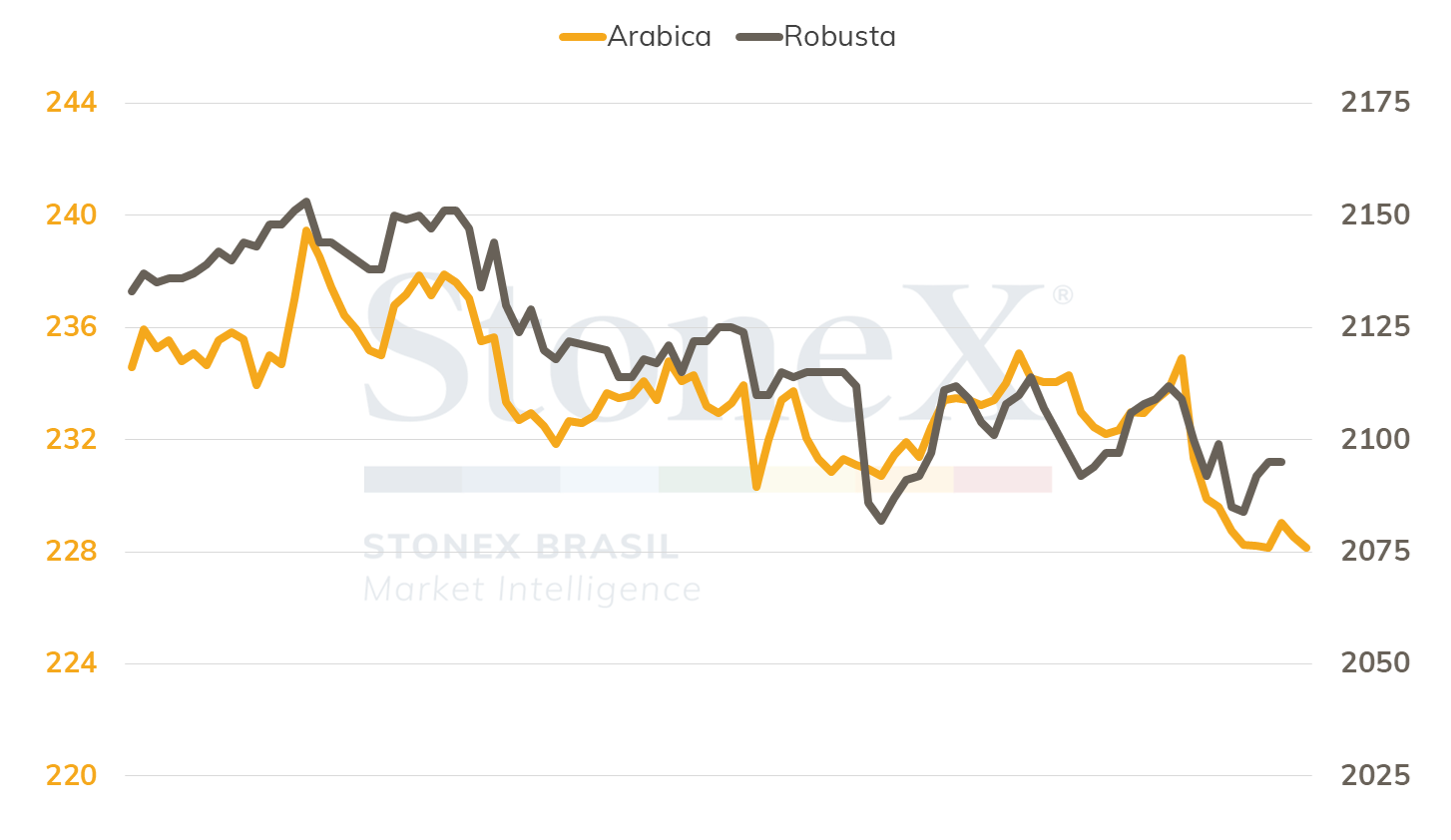
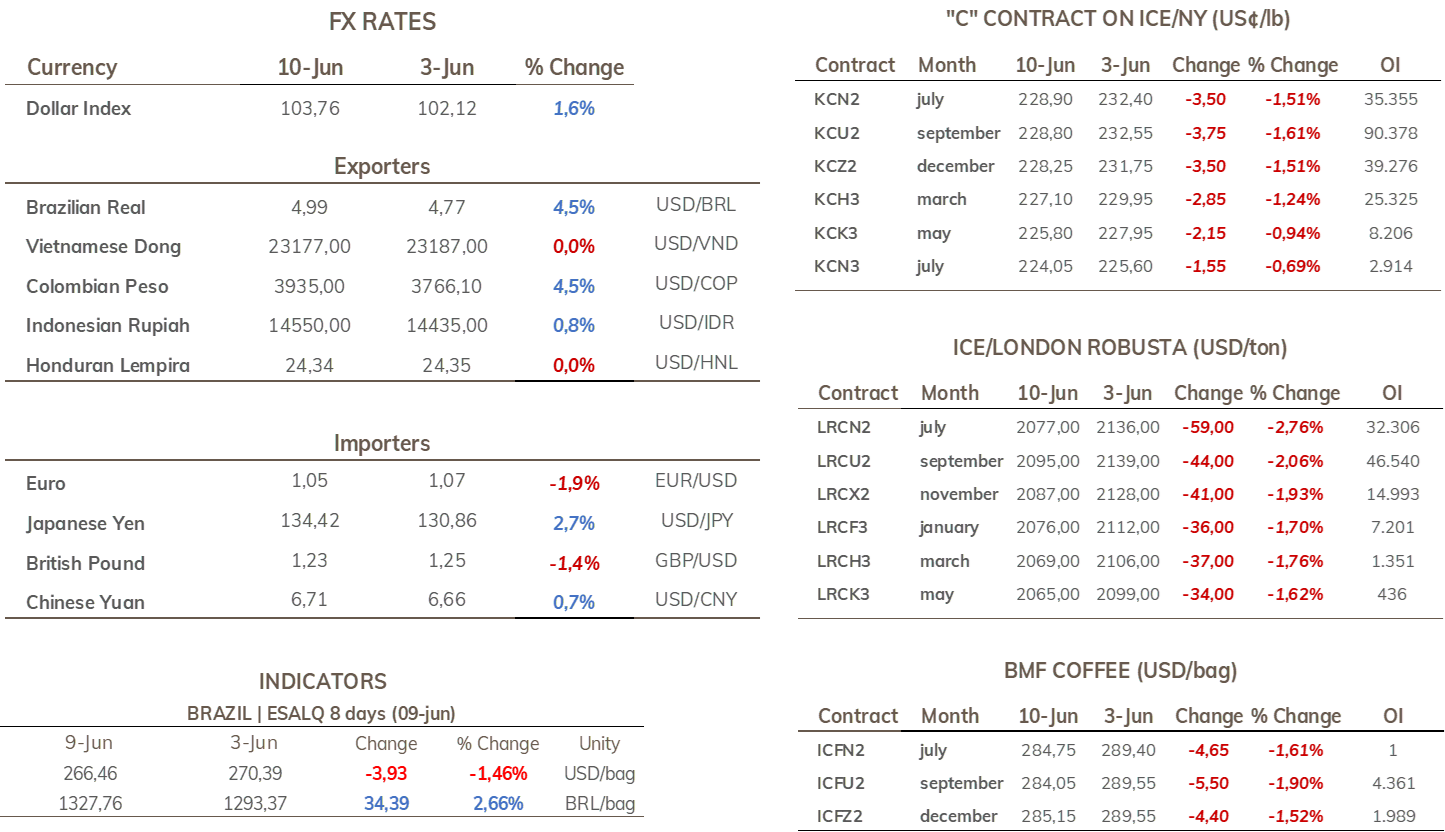
In Brazil, Arabica coffee prices to the producer have followed a bullish trend, mainly due to the higher dollar in the Brazilian exchange market. As a result, the Cepea's Arabica indicator ended the week quoted at BRL 1308.09/bag, high by 1.1%.
On the other hand, Cepea’s Robusta indicator ended the week almost unchanged, closing at BRL 693.51/bag. Recently, the drop in Robusta coffee prices in the domestic market was linked to the increase in availability amid the good harvest progress in the Robusta producing states.
In the coming weeks, the market should monitor the changes in certified stocks, the release of GCA stocks on June 15, and the release of the USDA global report on June 23. In addition, any prospect of the arrival of a new cold wave could impact movements and create volatility.
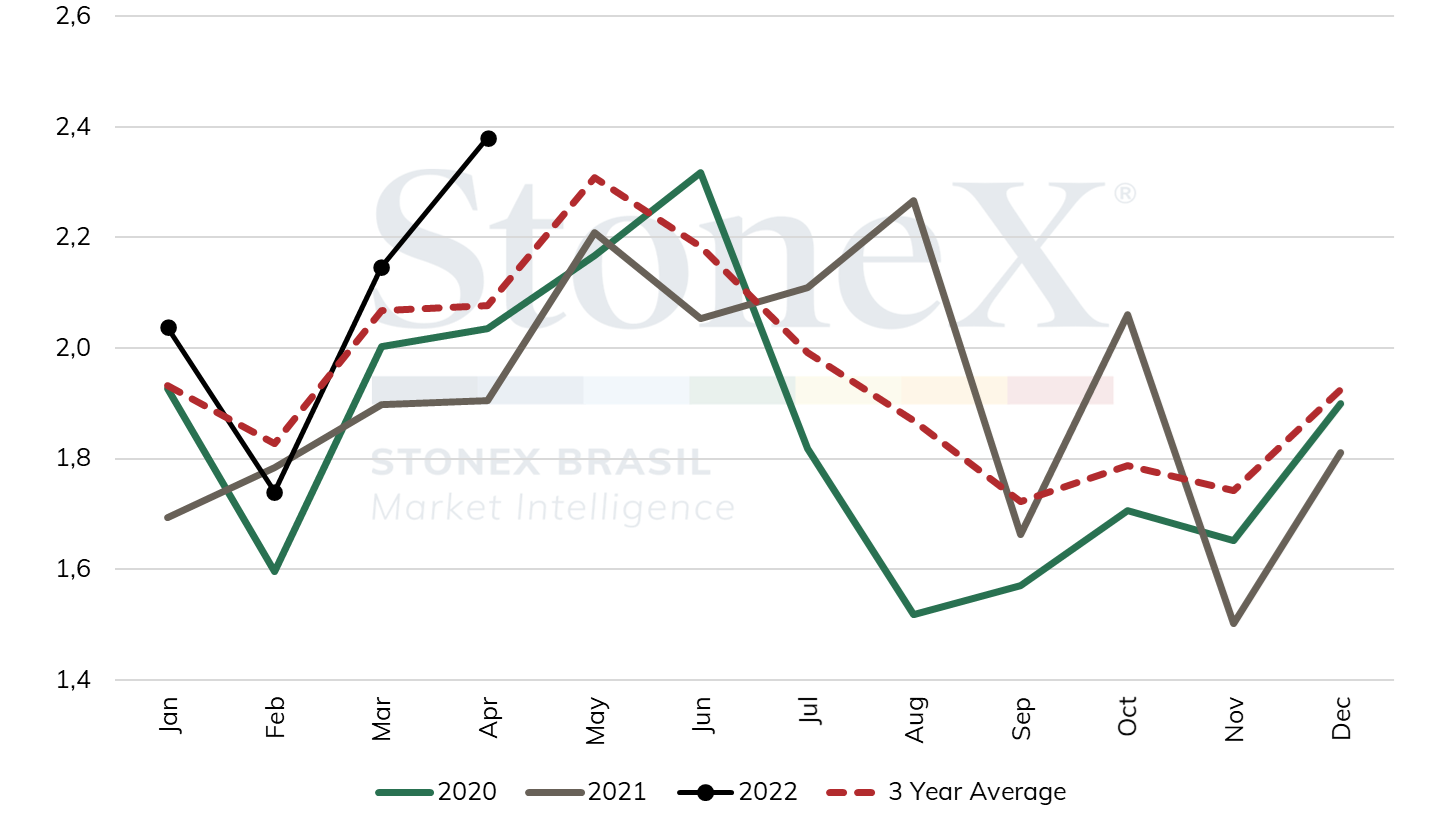
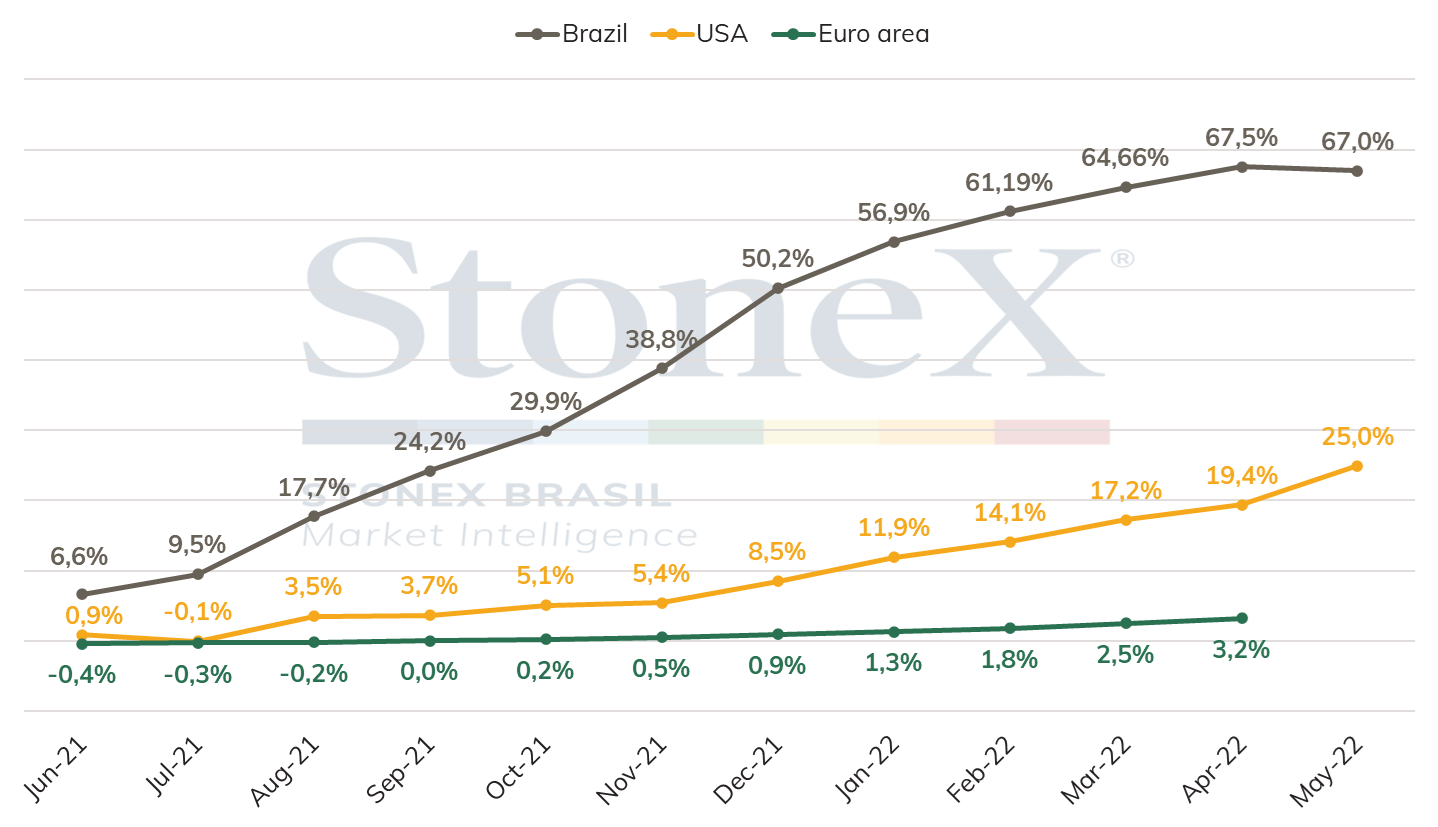
US coffee imports post an annual increase of 25% in April
According to data released this week by the USDA, in April, US coffee imports totaled 2,380,270 bags of green coffee, an increase of 11% compared to March and 25% compared to the total imported in April 2021. Among the main suppliers, Brazil accounted for 29.8% of the month's imports, followed by Colombia (26.6%), Guatemala (8.8%), Vietnam (7.9%), Honduras (6.8%), Nicaragua (6.0%), and Mexico (5.3%).
Compared to April last year, Brazil registered an appreciation increase of 28.2%, with increases also in coffee from Colombia (+23.8%), Guatemala (+25.9%), Vietnam (+18.4%), Honduras (+2.2%), and Nicaragua (+30.2%).
Seasonality of US coffee imports
Source: USDA. Design: StoneX.
According to the Green Coffee Association (GCA), coffee stocks at ports increased by 1.5% in April compared to March and 2.5% compared to April 2021, totaling 5,906,606 bags. However, looking at port demand estimates, which consider the disappearance of coffee through the balance of total imports and GCA stocks. The volume disappeared in April reached 2,293,962 bags, up by 9.6% compared to March and 25.9% compared to April last year.
Weather models indicate that La Niña should lose strength but may continue through the end of the year
According to the Australian agency, BOM, data from major forecast models indicate that conditions in the Pacific Ocean should return to a neutral state by winter in the southern hemisphere. However, two other models indicate a scenario of La Niña maintenance during the year's second half.
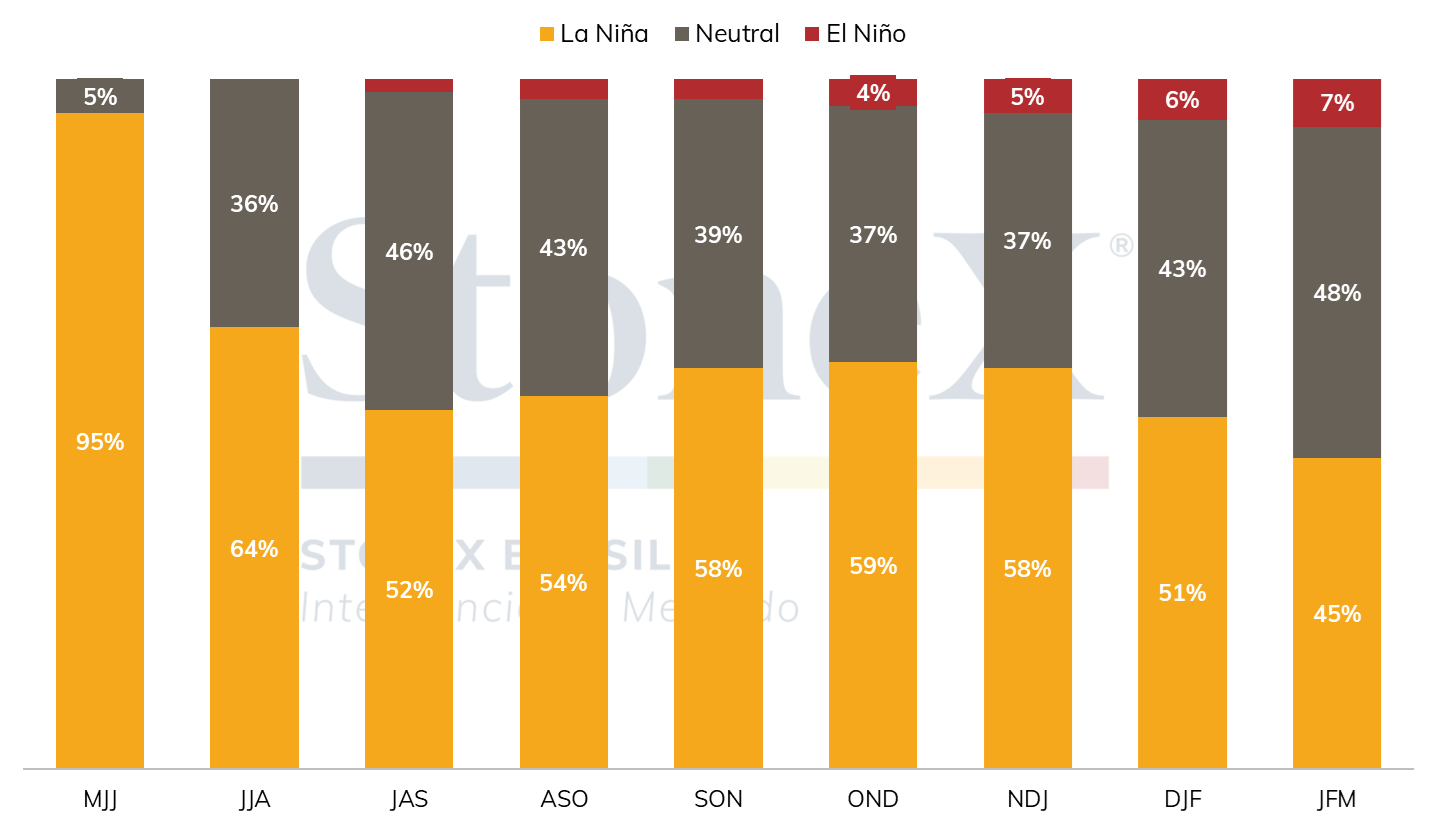
In the latest probability forecast released by the American agency, NOAA, there was a slight increase in the probability of La Niña maintenance at the end of the year, with a weakening of the phenomenon between July and September, before returning to a more intense pattern in the rest of the second half of the year. It is important to mention that the NOAA model indicates a probability of maintenance above 50% between July and September and above 55% from October to the end of the year.
EL NIÑO/LA NIÑA PROBABILITY FORECAST
Source: NOAA. Design: StoneX.
As already mentioned in other editions of the Weekly Coffee Report, the maintenance of a La Niña condition could cause a delay in the arrival of rainfall in the coffee belt during the second half of the year, which could damage coffee flowering, as has happened in the last two years. As can be seen, the large discrepancy in indicators makes the scenario uncertain and could create volatility.
USDA RELEASES NEW ATTACHÉ REPORTS, AND IBGE CORRECTS ITS ESTIMATE FOR 2021/22 PRODUCTION
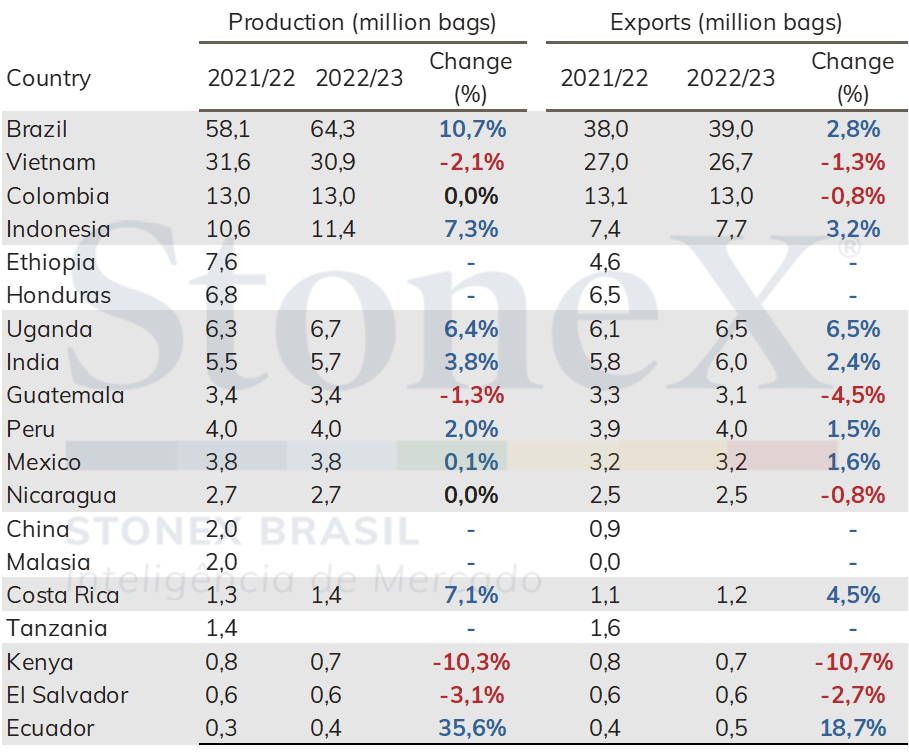
Last week, the USDA released its Attaché reports for the world's two largest producers, Brazil and Vietnam, releasing reports for 14 countries. There are still reports from 5 other countries, including Ethiopia, Honduras, China, Malaysia, and Tanzania, to be released. However, the volume produced in these countries is less expressive compared to the countries that already had their estimates released.
For Brazil, the USDA has adjusted its estimate for 2021/22 production from 56.3 million bags to 58.1 million bags, representing an increase of 3.2%. In contrast to the USDA, the IBGE revised its 2021/22 production estimate downwards by 3.7% to 52.8 million bags. For 2022/23, the country's production should increase by 10.4% to 64.3 million bags, 41.5 million of Arabica and 22.8 million of Robusta coffee.
Regarding Brazil's demand, the second-largest global consumer, the USDA has reduced its estimate for consumption in 2021/22 by 5.6% to 22.34 million bags. For 2022/23, the USDA sees consumption near unchanged, with a slight 0.5% increase to 22.45 million bags. For total exports, the USDA adjusted its estimates for 2021/22 with an increase of 14.4%, from 33.2 to 37.9 million bags. In 2022/23, according to the agency, Brazilian exports should increase by 2.8% to 39.04 million bags.
For Vietnam, the USDA has adjusted its estimate for 2021/22 upwards by 1.5%, from 31.1 to 31.58 million bags. In 2022/23, production should decrease 2% to 30.93 million bags. Regarding exports, the agency's estimate for 2021/22 had a downward adjustment of 6.6% to 27 million bags; for 2022/23, exports should drop by 1.3% to 26.65 million bags.
Considering all the data released so far, production in these countries should increase by 5.0% in 2022/23, while exports should increase by 1.2%. As already mentioned, the estimates of five producing countries are still to be released. The USDA’s final report with its estimates for the global supply and demand balance will be released on Thursday (23). Considering the data released so far, the USDA report is expected to show a large surplus in the 2022/23 supply and demand balance.
Summary of estimates from USDA Attaché reports
Source: USDA. Design: StoneX.
Cecafé: BRAZILIAN COFFEE EXPORTS INCREASED BY 5.8% IN MAY
Last week, the Brazilian Coffee Exporters Council (Cecafé) released the data on Brazilian coffee exports in May, which showed an increase of 5.9% for green coffee and 5.1% in total volume compared to May 2021. In May, 2.53 million bags of green coffee were shipped, 2.4 million of Arabica coffee and 121 thousand of Robusta coffee. Considering the total exports, the volume shipped reached 2.8 million bags.
In the month, Arabica coffee exports increased by 15.6%. In comparison, Robusta exports fell by 60.1%, reflecting the unfavorable export scenario due to the strengthened differentials and positive levels, with prices in the Brazilian market trading above London prices. Overall, the export increase was attributed to improved logistical conditions, which have been impacted since the beginning of the Covid-19 pandemic.
Considering the crop year, the volume of green coffee exported decreased by 16.3% to 32.6 million bags, reflecting the lower production observed in 2021/22. Of these, 30.1 million bags were of the Arabica variety, down by 12.9%, and 2.45 million bags of Robusta, down by 43.4%. Nevertheless, even with the lower volume exported during the crop year, the accumulated revenue in dollars increased by 35.5%, totaling USD 7.34 billion, or BRL 38.6 billion.
HIGHER-THAN-EXPECTED INFLATION IN THE US AND THE PERCEPTION OF INCREASED FISCAL RISKS IN BRAZIL SUPPORTED THE USDBRL's 4.4% APPRECIATION IN THE WEEK
Impacted by the expectation that the monetary tightening by US and Europe central banks should remain firm and by investors' perception of increased fiscal risks in Brazil, the BRL had a week marked by depreciation, contributing to pressuring coffee prices. After posting an increase in the five sessions of the week, the real/dollar pair ended Friday’s session (10) quoted at BRL 4.989, with a weekly appreciation of 4.4%, starting this Monday (13) quoted above the psychological level of BRL 5.00. As a result, the dollar index ended at 104.2 points, with a strong gain of 2.0% in the period and getting closer to its 20-year highs.