StoneX logo

Coffee Weekly Report

By: StoneX Intelligence Brazil, StoneX Intelligence Brazil

Macroeconomic scenario weigh on coffee prices
 
Fernando Maximiliano
 
Leonardo Rossetti
 
DESPITE A 64,000-BAG DROP IN ARABICA CERTIFIED STOCKS, PRICES WERE PRESSURED BY THE RISK-AVERSE SENTIMENT AMID THE PROSPECT OF RECESSION IN THE GLOBAL ECONOMY
HIGHLIGHTS

•    •    Arabica prices dropped by 420 points (1.9%) in NY during the week, closing at US₵ 220.45/lb. 
•    Cepea’s Arabica indicator dropped by 0.7%, quoted at BRL 1,348.87/bag.
•    Robusta prices dropped by 1.25% in London to USD 1981/t.
•    Cepea’s Robusta indicator increased by 0.4% to close at BRL 706.76/bag.
•    Risk aversion sentiment puts pressure on coffee prices.
•    Vietnam customs authority indicates a 3.5% drop in exports in June.
•    Robusta's certified stocks continue to increase.
•    Certified stocks of Arabica coffee down more than 64,000 bags in the week.
•    USDA: US coffee imports down by 23% in May.
•    The exchange ratio between coffee and fertilizers has fallen significantly in recent months.
•    After reaching all-time highs not seen since January, USDBRL closes lower in a week marked by volatility.
•    Fear of recession and expectations of a sharp rise in US interest rates boosted the dollar abroad.
•    The process of the PEC of income transfer programs in the Chamber of Deputies tends to contribute to increased fiscal risk in Brazil.
•    This week, agents should follow the release of inflation in the United States and the Q2 GDP in China.

   Bearish Factors       Bullish Factors

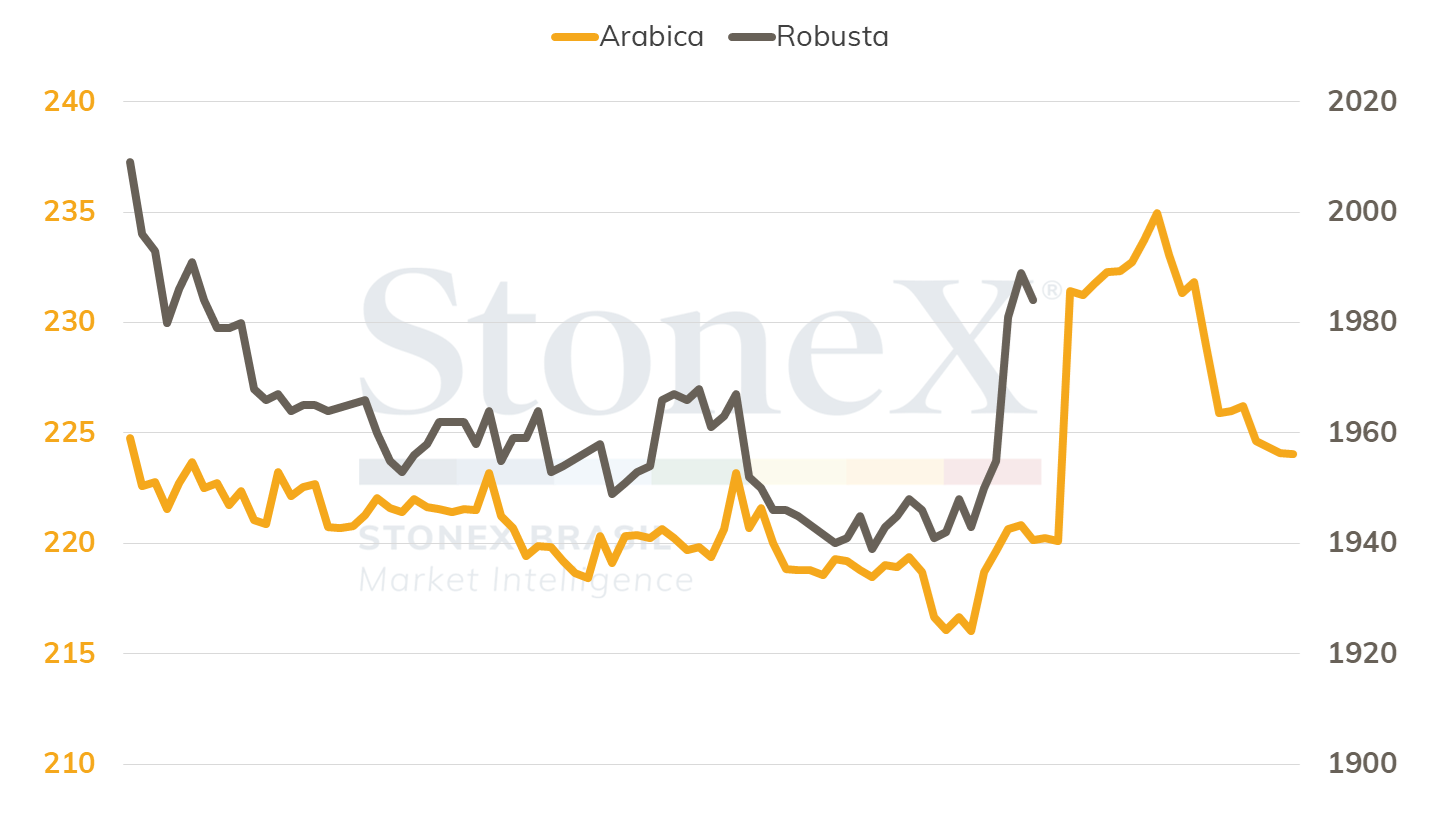
Despite the relatively positive condition on the fundamentals side, with the sharp drop in certified stocks, coffee prices were heavily influenced by macroeconomic and exchange rate factors. Concerns about a possible global economic recession fed the feeling of risk aversion, which promoted a strong increase in the dollar index and the flight of investors from risky assets, such as commodities. As a reflection of this movement, the Arabica coffee prices ended the week with a drop of 420 points (1.9%) for the most active contract (Sept/22), which ended the week quoted at US₵ 220.45/lb.

On Robusta's fundamentals side, preliminary export data released by the GSO in Vietnam indicated that the country's June exports were expected to total 2.4 million bags, posting a 13.3% increase compared to the same month last year. However, official data released by the Vietnam Customs Authority last week indicated that Vietnam's exports dropped by 3.5% in June to 2.29 million bags. Despite this scenario, cumulative exports for the first nine months of the Vietnamese crop year, which began on October/21, indicated that the country exported 22.07 million bags, an increase of 13.9%. 

Following the movements in New York, Robusta coffee futures contracts ended the week lower, pressured by macroeconomic factors. Moreover, another factor contributing to pressure Robusta prices down was the significant advance in certified stocks of the type, which have grown amidst the arrival of Vietnamese coffee, mainly coffee from Indonesia. In London (ICE Europe), the September contract closed Friday's session quoted at USD 1981/t, down by 1.25%.
 

Weekly intraday (most active contract) - July 04 to 08

image 43211
Source: Commodity Network Trader’s Pro. Design: StoneX.

Following the movement in the international market, the Arabica coffee prices in the Brazilian domestic market ended the week lower. Cepea’s Arabica indicator ended the week quoted at BRL 1348.87/bag, a decrease of 0.7%. On the other hand, Cepea’s Robusta indicator ended high by 0.4% to close at BRL 706.76/bag. 

Regarding Arabica’s certified stocks, there has been no change in the scenario observed in recent weeks. During the week, Arabica’s certified stocks fell by over 64,000 bags and broke the 800,000-bag mark, closing the week with just 789,981 bags. As already mentioned in other editions, the differentials at high levels and the freight costs at relatively high levels discourage new certifications. In addition, further drops in stocks are likely to occur since it makes sense to decertify coffees amid the current differentials and freight situation. 

With no major changes in fundamentals, the coffee market will continue to keep an eye on the movements of Arabica's certified stocks. In addition, the weather in Brazil is in the spotlight as agents try to anticipate what could affect coffee flowering to begin in the coming months. In addition, export data from Brazil should be monitored, and the GCA should release the US stock data on Friday (15).

USDA: US COFFEE IMPORTS DROP BY 23% IN MAY

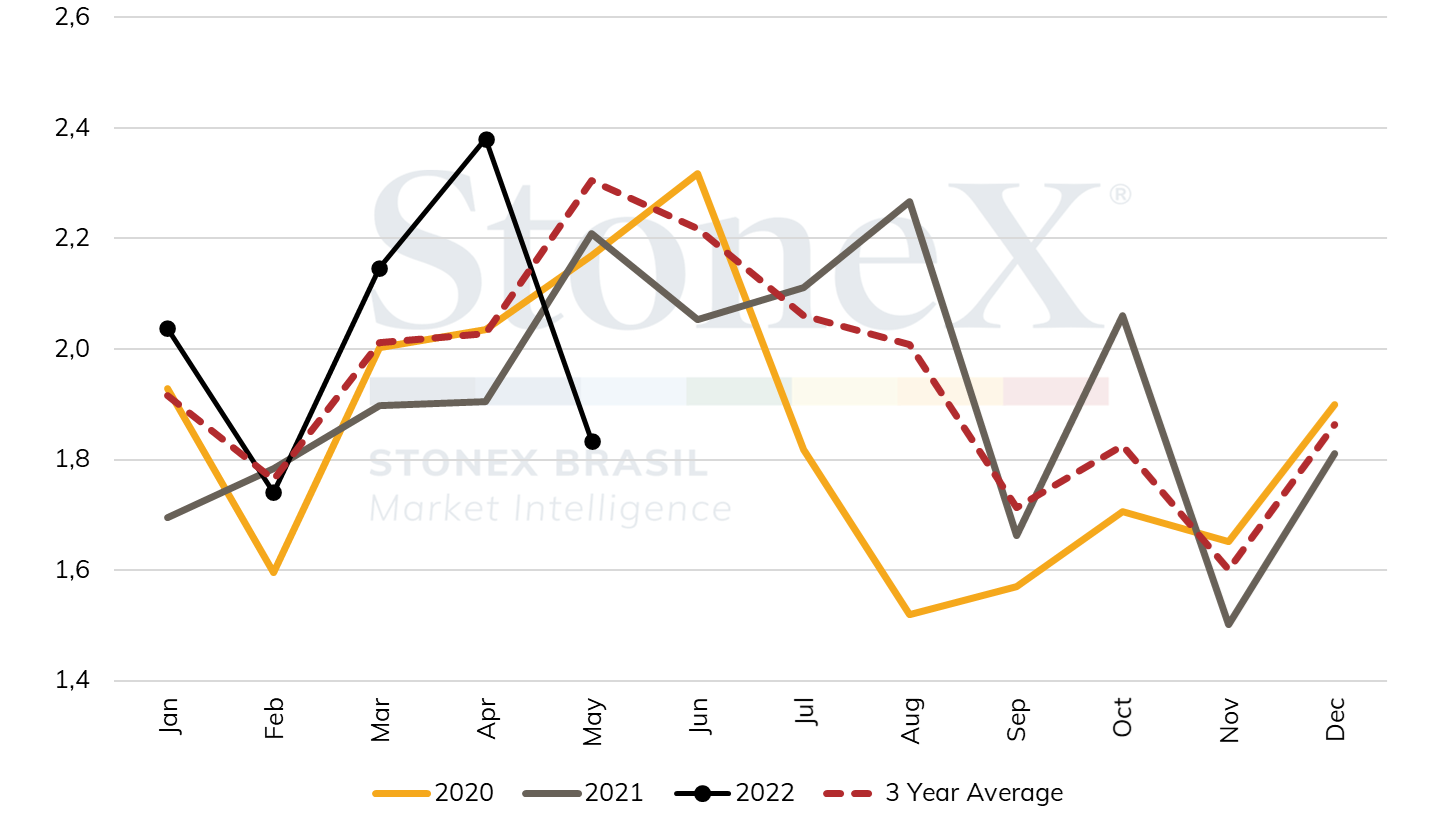
The import data released by the USDA indicated that the US imported 1.8 million bags of coffee in May, down by 23% to April and 17% to May 2021. However, when we analyze the accumulated imports (Jan-May), the US imported 10.14 million bags, an increase of 6.8% from the same period last year. 


Seasonality of US coffee imports (million bags)

image 43212
Source: USDA. Design: StoneX. 
When considering coffee stocks at American ports, there has been a drop of 19.5% in the volume of coffee that was internalized. In other words, the volume of coffee that left the ports, for a total of 1.74 million bags - indicator calculated from the balance between imports and coffee stocks in ports. However, the accumulated volume of this indicator for the first five months of the year totaled 9.96 million bags, a 5.3% increase compared to the same period last year. Despite the sharp decline in imports in May, this scenario should be viewed with caution, given the still existing problems in global logistics chains amid the Covid-19 pandemic.
EXCHANGE RATIO BETWEEN COFFEE AND FERTILIZER IN BRAZIL HAS DROPPED SIGNIFICANTLY IN RECENT MONTHS

On the fundamentals side, the coffee crop development for the next season continues to be in the spotlight, as agents, in addition to monitoring the weather, evaluate the exchange ratio and the possible fertilizer level in coffee crops. This factor is directly linked to its production potential. With the adversities brought by the Covid-19 pandemic and the beginning of the Russian-Ukrainian war, great uncertainties regarding the availability and potential use of fertilizers were created. 

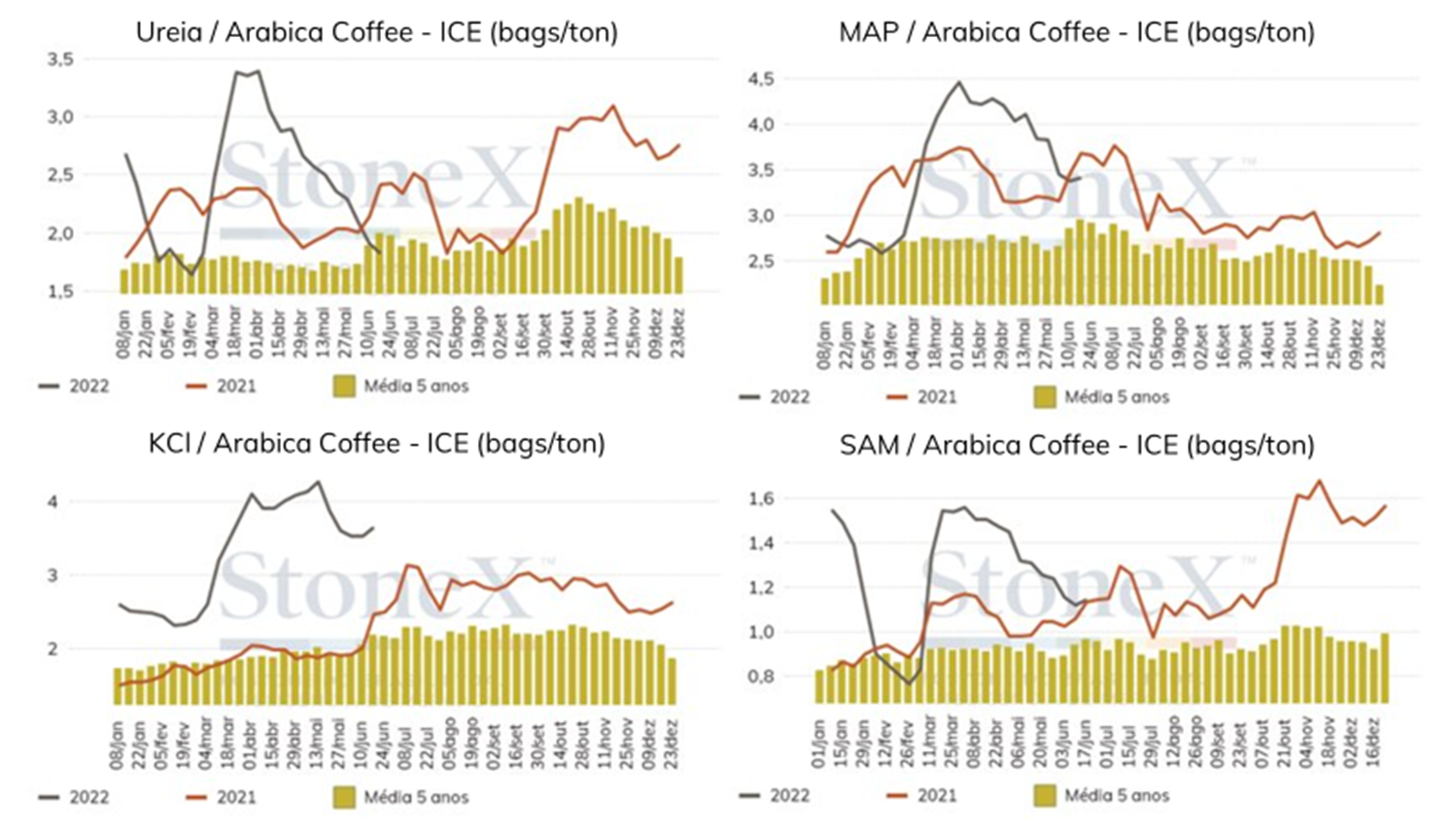
One of the most important indicators is the exchange ratio between coffee and the main fertilizers, which shows how many bags of coffee are needed to buy 1 tonne of the main fertilizer. The lower the exchange ratio, the more affordable the fertilizer is for the producer, while a high exchange ratio is unfavorable for the producer. 

Exchange ratio between coffee and fertilizer (Urea, KCl, MAP and AMS)

image 43213
Source: StoneX. Design: StoneX.
The urea exchange ratio has dropped sharply in recent months, falling from almost 3.5 bags/ton in April to less than 2 bags/ton in June, an index within the 5-year average and substantially below the level observed last year. On the other hand, the potassium chloride (Kcl) exchange ratio retreated from its high but advanced again, positioning itself at a high level, above that observed in 2021 and well above the 5-year average. 
As with Urea, monoammonium phosphate (MAP) and ammonium sulfate (AMS) have shown a strong decrease in their exchange ratio with coffee in recent months but are still above the average of the last five years but at a similar level to that observed in 2021. 
As mentioned, potassium chloride remains the fertilizer least accessible to producers, while urea remains the fertilizer with the best exchange ratio. However, considering the current scenario, despite the high exchange ratio for KCl, fertilizers, in general, remain accessible, which may contribute to an adequate fertilizer supply to producers. 


AFTER REACHING ITS HIGHEST LEVEL SINCE JANUARY, USDBRL CLOSED LOWER IN A WEEK MARKED BY VOLATILITY

In a week of great volatility in the foreign exchange market, USDBRL closed Friday (8), quoted at BRL 5.27, appreciating 1.0% and far from its highs for the week. After strong risk aversion until Tuesday, when the exchange rate came close to BRL 5.40, affected by fears of a global recession, the prospects of the Federal Reserve maintaining a contractionary stance and by the proceedings of the PEC income transfer programs in the Chamber of Deputies in Brazil, the second half of the week was marked by the Brazilian currency corrections and recovery.

In the foreign scenario, the agents mainly reflected the release of the minutes of the Federal Reserve's Federal Monetary Policy Committee (FOMC) monetary policy decision, referring to the meeting held between June 14 and 15 and the data from the labor market in the United States. However, with no major news and reinforcing the clear message that the central bank will act firmly to control inflation, the document was seen as out of context by the market, given the publication of weaker economic activity figures and the growing fears of a recession in the American economy since then. As a result, part of the market does not believe that the American central bank will be able to perform a "soft landing," i.e., controlling the acceleration of prices in the country without sacrificing the growth of the economy or the labor market during the process.

However, the positive surprise in the higher-than-expected US labor market data in June indicated that the monetary authority might maintain the pace of intense interest rate hikes in the decision at the end of July. According to the Bureau of Labor Statistics (BLS), in June, a net balance of 372,000 hirings was recorded, a number well above the median of market bets, at 268,000, and only slightly below that observed in May when 384,000 jobs were created. Additionally, statements from an FOMC member reinforced the monetary authority's inclination to follow through with a new adjustment of 75 basis points at the meeting later this month, in addition to stating that they consider it appropriate to take the basic rate to 3.5% p.a. until the end of 2022. Therefore, it will be important to follow the statements of the other Fed members this week to verify if the strong intensity of monetary tightening continues as a unanimous opinion among the collegiate.

In Brazil, the political news, with the advancement of the PEC for income transfer programs and its approval in a special commission in the Chamber of Deputies, dominated the attention during most of the week, amid concerns about the deterioration of the country's fiscal statistics. The proposal includes an increase in the income transfer program and aid for buying bottled gas, subsidies for ethanol and free transportation for the elderly, the creation of a BRL 1000 voucher for independent truck drivers and a gasoline aid for taxi drivers at an estimated cost of BRL 41.25 billion, which does not respect the spending cap rule or provide any counterpart on the revenue side. To evade the electoral law, which prohibits the creation or expansion of social programs in an election year, the text of the PEC institutes a state of emergency in Brazil. The expansion in the imbalance of public accounts and the debt tends to be accompanied by the demand for a higher risk premium by investors, which, in turn, may weaken the flow of foreign capital to the country and the BRL.

The release of the National Broad Consumer Price Index (IPCA) by the IBGE on Friday revealed that prices rose 0.67% in June, in line with what had been expected by the market, but once again indicating acceleration by surpassing the 0.47% rise posted in May. With this, the accumulated figure for the last 12-month period advanced from 11.73% in the previous month to 11.89%, marking the tenth consecutive double-digit month for the index.

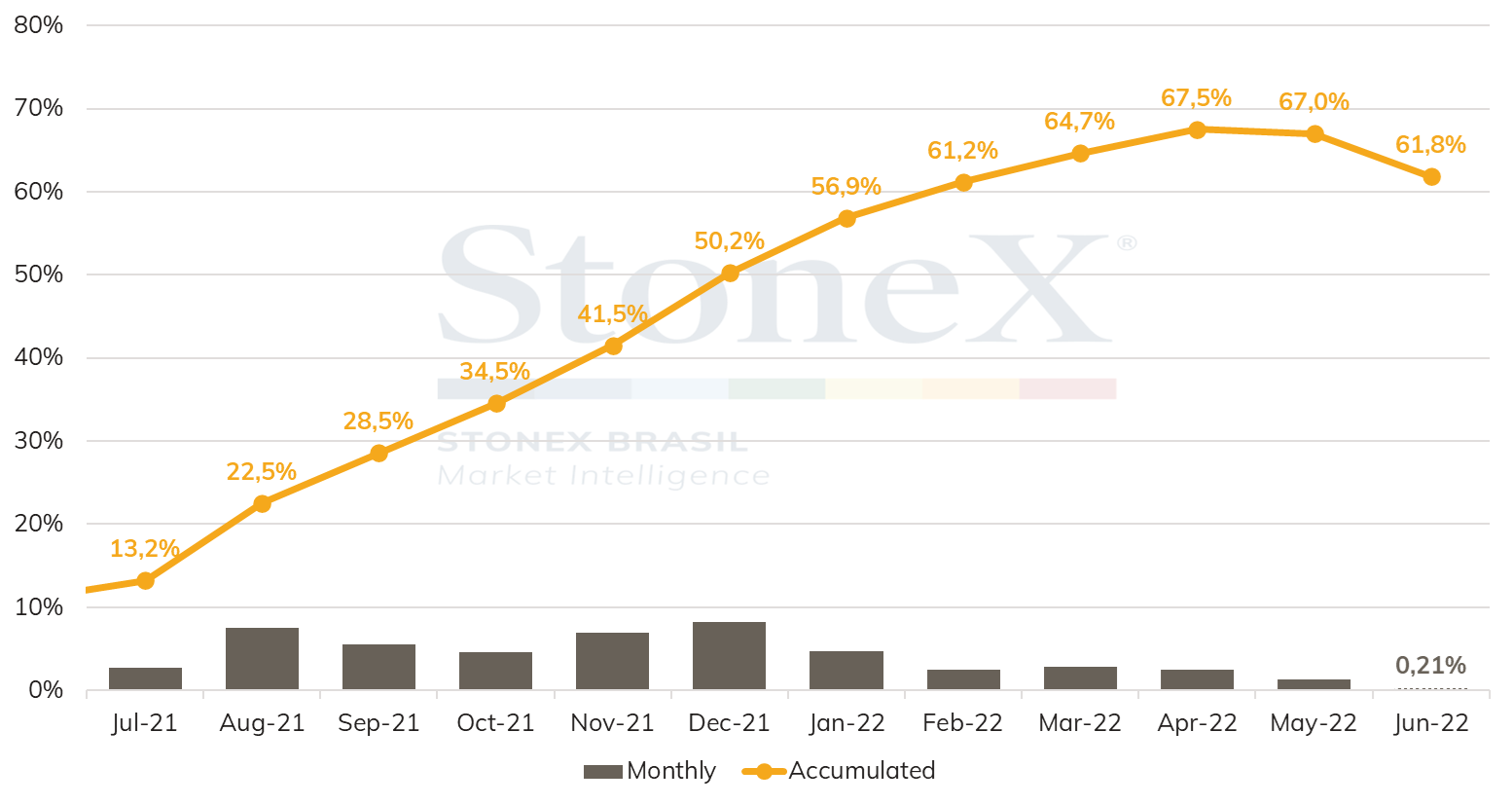
The report revealed a slowdown in the price increase of roasted and ground coffee to the Brazilian consumer, which recorded an increase of 0.21%, the lowest variation since February 2021, when it fell by 0.23%. With this result, prices registered an advance of 14.87% in the first half of 2022, with the accumulated in 12 months falling from 67.0% in May to 61.8% last month. On the other hand, instant coffee marked a 0.65% increase in prices in June, also below the 3.58% registered in the previous month, but with a 12-month increase from 19.22% to 22.12%.

Evolution of roasted and ground coffee inflation in Brazil over the last 12 months

image 43214
Source: IBGE. Design: StoneX.
This week's economic indicators abroad include the Consumer Price Index (CPI), which is scheduled for next Wednesday (13), and the Producer Price Index (PPI), which will be released on Thursday (14). The median of market expectations points to a 1.1% increase in the June CPI, a slight acceleration compared to the +1.0% variation computed in May, taking the accumulated 12-month rate of the indicator to 8.8% – its highest value since January 1982. Also worthy of attention is the release of the second half GDP for the Chinese economy on Thursday. Finally, in Brazil, the agents should follow the vote of the PEC by the Chamber of Deputies, which should happen this Tuesday (12), and the release by the IBGE of the monthly survey of services and commerce for May.
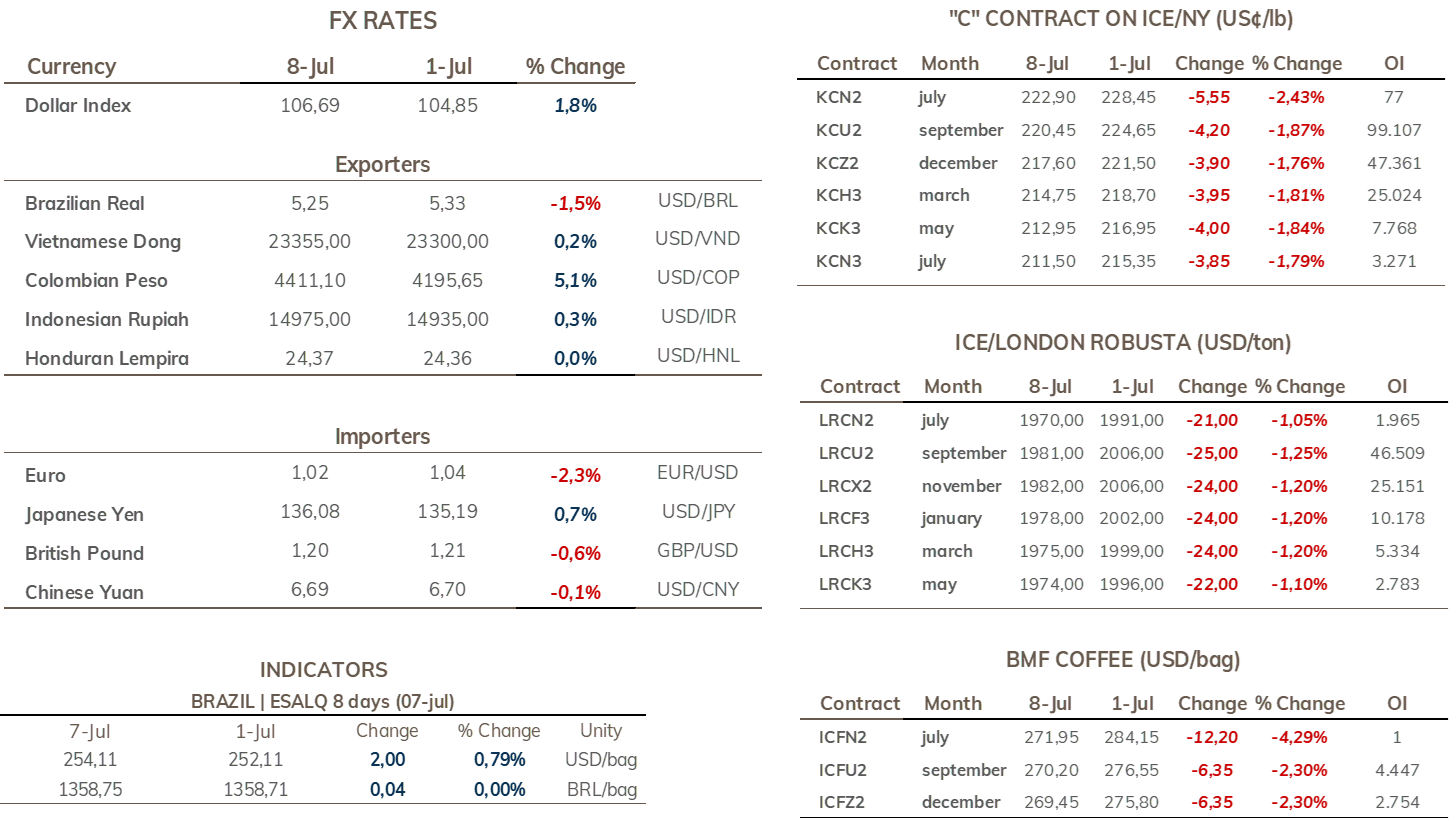
ECONOMIC INDICATORS
image 43215
Sources: ICE/NY; ICE/EU; B3; Commodity Network Trader’s Pro.

 

image 35317


  • Coffee

The StoneX Group Inc. group of companies provides financial services worldwide through its subsidiaries, including physical commodities, securities, exchange-traded and over-the-counter derivatives, risk management, global payments and foreign exchange products in accordance with applicable law in the jurisdictions where services are provided. References to over-the-counter (“OTC”) products or swaps are made on behalf of StoneX Markets LLC (“SXM”), a member of the National Futures Association (“NFA”) and provisionally registered with the U.S. Commodity Futures Trading Commission (“CFTC”) as a swap dealer. SXM’s products are designed only for individuals or firms who qualify under CFTC rules as an ‘Eligible Contract Participant’ (“ECP”) and who have been accepted as customers of SXM. StoneX Financial Inc. (“SFI”) is a member of FINRA/NFA/SIPC and registered with the MSRB. SFI is registered with the U.S. Securities and Exchange Commission (“SEC”) as a Broker-Dealer and with the CFTC as a Futures Commission Merchant and Commodity Trading Adviser. References to securities trading are made on behalf of the BD Division of SFI and are intended only for an audience of institutional clients as defined by FINRA Rule 4512(c). References to exchange-traded futures and options are made on behalf of the FCM Division of SFI . StoneX is a trading name of StoneX Financial Ltd (“SFL”). SFL is registered in England and Wales, Company No. 5616586. SFL is authorized and regulated by the Financial Conduct Authority [FRN 446717] to provide to professional and eligible customers including: arrangement, execution and, where required, clearing derivative transactions in exchange traded futures and options. SFL is also authorised to engage in the arrangement and execution of transactions in certain OTC products, certain securities trading, precious metals trading and payment services to eligible customers. SFL is authorised & regulated by the Financial Conduct Authority under the Payment Services Regulations 2017 for the provision of payment services. SFL is a category 1 ring-dealing member of the London Metal Exchange. In addition SFL also engages in other physically delivered commodities business and other general business activities which are unregulated and not required to be authorised by the Financial Conduct Authority. StoneX Group Inc. acts as agent for SFL in New York with respect to its payments services business. StoneX APAC Pte. Ltd. acts as agent for SFL in Singapore with respect to its payments services business. ‘StoneX’ is the trade name used by StoneX Group Inc. and all its associated entities and subsidiaries.
 
Trading swaps and over-the-counter derivatives, exchange-traded derivatives and options and securities involves substantial risk and is not suitable for all investors. Past performance of any futures or option is not indicative of future success. Indicators are not a trading system and are not published as a specific trade recommendation. The information herein is not a recommendation to trade nor investment research or an offer to buy or sell any derivative or security. It does not take into account your particular investment objectives, financial situation or needs and does not create a binding obligation on any of the StoneX group of companies to enter into any transaction with you. You are advised to perform an independent investigation of any transaction to determine whether any transaction is suitable for you. No part of this material may be copied, photocopied or duplicated in any form by any means or redistributed without the prior written consent of StoneX Group Inc.
 
© 2026 StoneX Group Inc. All Rights Reserved.

Satellite view of Earth at night showing illuminated cities across Asia and the Middle East

Discover more insights

Our subscribers have access to comprehensive market analysis from StoneX spanning commodities, equities, currencies and more.

Related articles for Coffee

Perspective: Morning Commentary for August 6

August 6 – This morning’s stronger-than-expected U.S. labor data offered markets some relief, reinforcing confidence in the economy while giving the Fed greater flexibility to raise rates should inflationary pressures reaccelerate in next week’s July data. Stock futures are pointing to a mixed open to start the day, with the tech-heavy Nasdaq showing the most weakness. The VIX has fallen notably from yesterday’s spike above 18.4 as it starts the day hovering just below the 16-mark. The dollar is quietly higher as it trades just above 99.8, holding in the tight range seen thus far this week as traders continue to digest data to shape expectations for the Fed’s next move, which we’ll dive into in more depth below. Long-term treasury yields have relaxed slightly from their recent spike, with 30-year yields starting the day trading just above 5.19%, while 10-year yields trade above 4.64%, and 2-year yields sit below 4.22%. Crude oil is modestly higher to start the session after sharp declines earlier in the week, with nearby WTI up 1.8% to trade at $76.40 and nearby Brent up 2.4% to trade at $81.40. Meanwhile, the ags are quietly mixed to start the day.

Mike Castle
Mike Castle
  • Grains & Oilseeds
  • Energy
  • Dairy
  • Renewable Fuels
  • Cocoa
  • Coffee
  • Cotton
  • Sugar
  • Meats & Livestock
  • Forest Products

Daily Coffee Report 8/5/26

Daily coffee report

StoneX Coffee Team
StoneX Coffee Team
  • Coffee

Perspective: Morning Commentary for August 5

August 5 – U.S. equities markets are on fire this week, with both the Dow Jones and S&P 500 setting new all-time highs yesterday with futures indicating further gains again today; the marketplace remains optimistic over a deal with Iran despite no evidence of such as of yet. Crude oil is working on a lower high and low today but remains slightly on the high side on the session, while the dollar is retreating back towards Monday’s nearly two-month low. The ten-year note is steady-to-lower this morning (though solidly lower so far this month) at 4.605%, while the VIX index continues to rebound into mid-week at almost a 17-point reading this morning.

Matt Zeller
Matt Zeller
  • Grains & Oilseeds
  • Energy
  • Dairy
  • Renewable Fuels
  • Cocoa
  • Coffee
  • Cotton
  • Sugar
  • Meats & Livestock
  • Forest Products
StoneX: We open markets

Our market expertise, advanced platforms, global reach, culture of full transparency and commitment to our clients’ success all set us apart in the financial marketplace.

Reach

With access to 40+ derivatives exchanges, 180+ foreign exchange markets, nearly every global securities marketplace and numerous bilateral liquidity venues, StoneX’s digital network and deep relationships can take clients anywhere they want to go.

Transparency

As a publicly traded company meeting the highest standards of regulatory compliance in the markets we serve, our financials and track record are matters of public record. StoneX’s commitment to “doing the right thing over the easy thing” sets us apart in the industry and helps us build respect, client trust and new partnerships.

Expertise

From our proprietary Market Intelligence platform to “boots-on-the-ground” expertise from award-winning traders and professionals, we connect our clients directly to actionable insights they can use to make more informed decisions and achieve their goals in the global markets.