The US currency devaluation had a major influence on coffee's rally during the week, since the market is still waiting for the end of the harvest to confirm the real performance of the 2022/23 crop, and for updates on weather and flowering in September, which should dictate trends for prices.
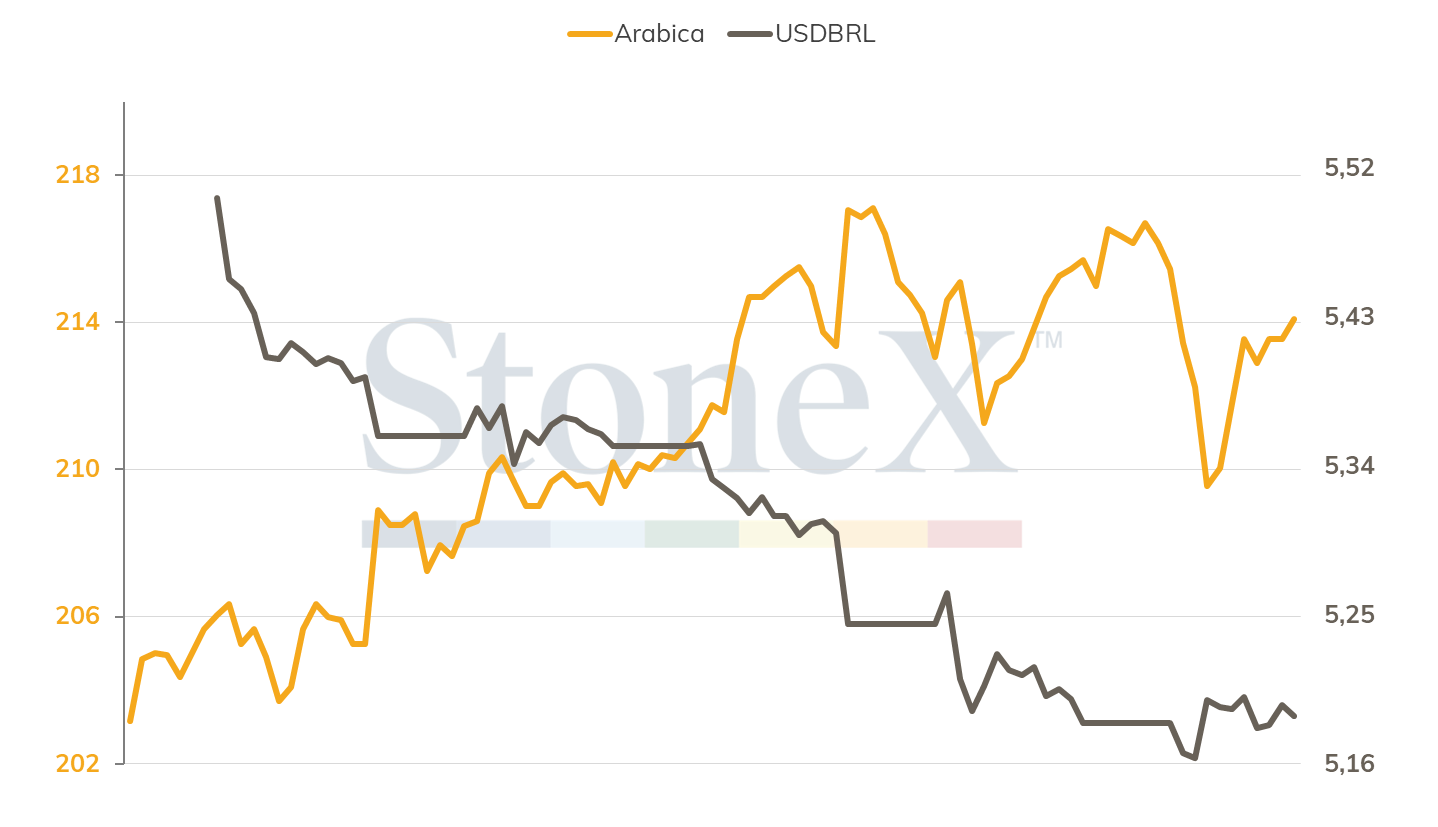
The correlation between the currency market and coffee futures was very marked in the first part of the week, when Arabica coffee secured its gains for the week. While the BRL/USD pair accumulated a drop of 4.6% until Wednesday, going from 5.497 to 5.243, the most active arabica coffee contract rose from 206.7 c/lb to 219.10 c/lb, up 6.0%. Robusta coffee, which has been operating at lower levels than arabica coffee, extended its gains until Friday.
Weekly intraday (most-active contract) vs. USDBRL — July 25 to 29
Source: CommodityNetwork Traders’ Pro. Design: StoneX.
There were no big surprises in the FOMC's decision last week. The Committee chose to raise the US basic interest rate by 75 basis points, going to the range between 2.25 and 2.50 p.a. and defending a “strong commitment to price stability”, signaling the weakening of some economic indicators and suggesting that further increases should be appropriate.
However, in a press conference after the decision, Fed Chair Jerome Powell did not guarantee an increase of the same size at the September meeting, saying that the decision will depend on the economic data that the Fed will continue to watch until then. The speech, from the market's point of view, indicated an unwillingness to repeat a 75-point increase. The prospect that the next adjustments may be smaller helped redirect a flow of investments from the US to other currencies and assets, such as commodities. In this context, it will be important to follow the statements by Fed members this week, which may seek to reaffirm the US central bank's committed position to keeping a firm monetary policy and ensure price control in the country, which can help to correct part of the of the significant drops registered in the last few sessions.
Thursday's release of a 0.9% contraction in the US GDP in the 2nd quarter, against an expectation of a 0.5% expansion, also added downward pressure to the US currency. With the performance, the US economy is considered to be in a technical recession, since Q1st GDP had a drop of 1.6%. As a result, the market's perception is that the Fed may not have room to raise interest rates too much, at the risk of sacrificing the economy and jobs in the country.
It is still too early to say whether the US economy will continue to decline, however, depending on the result of the activity indicators for the month of July, the debates about a possible situation of stagflation, that is, a retraction of the economy in the midst of inflation high, tend to intensify in the coming weeks. In this context, it will be important to follow this week's release by the ISM Institute of PMIs for the industry and the service sector in the United States last month. The July employment situation report, which will be published on Friday, should also be under the agents' attention.
In Brazil, the focus will be on the decision of the Central Bank's Monetary Policy Committee (Copom). According to an analysis carried out in our FX Weekly report, the Committee is faced with a contradictory scenario for its decision on the basic interest rate (Selic). On the one hand, there are factors that make it possible to smooth the current process of monetary tightening. Recent federal government subsidies for fuel and electricity are expected to substantially alleviate the IPCA (Broad National Consumer Price Index) in the coming months, and there is a substantial inflow of foreign funds due to a realignment of expectations about the interest rate trajectory in the United States. On the other hand, there is a forecast of worsening public accounts due to the aid programs granted by the federal government in recent months and growing expectation of higher inflation in 2023, with interest rates to fund public debt securities remaining at an extremely elevated level. Although there is no consensus, most estimates point to the Copom increasing the Selic from 13.25% p.a. to 13.75% p.a. next Wednesday (3).
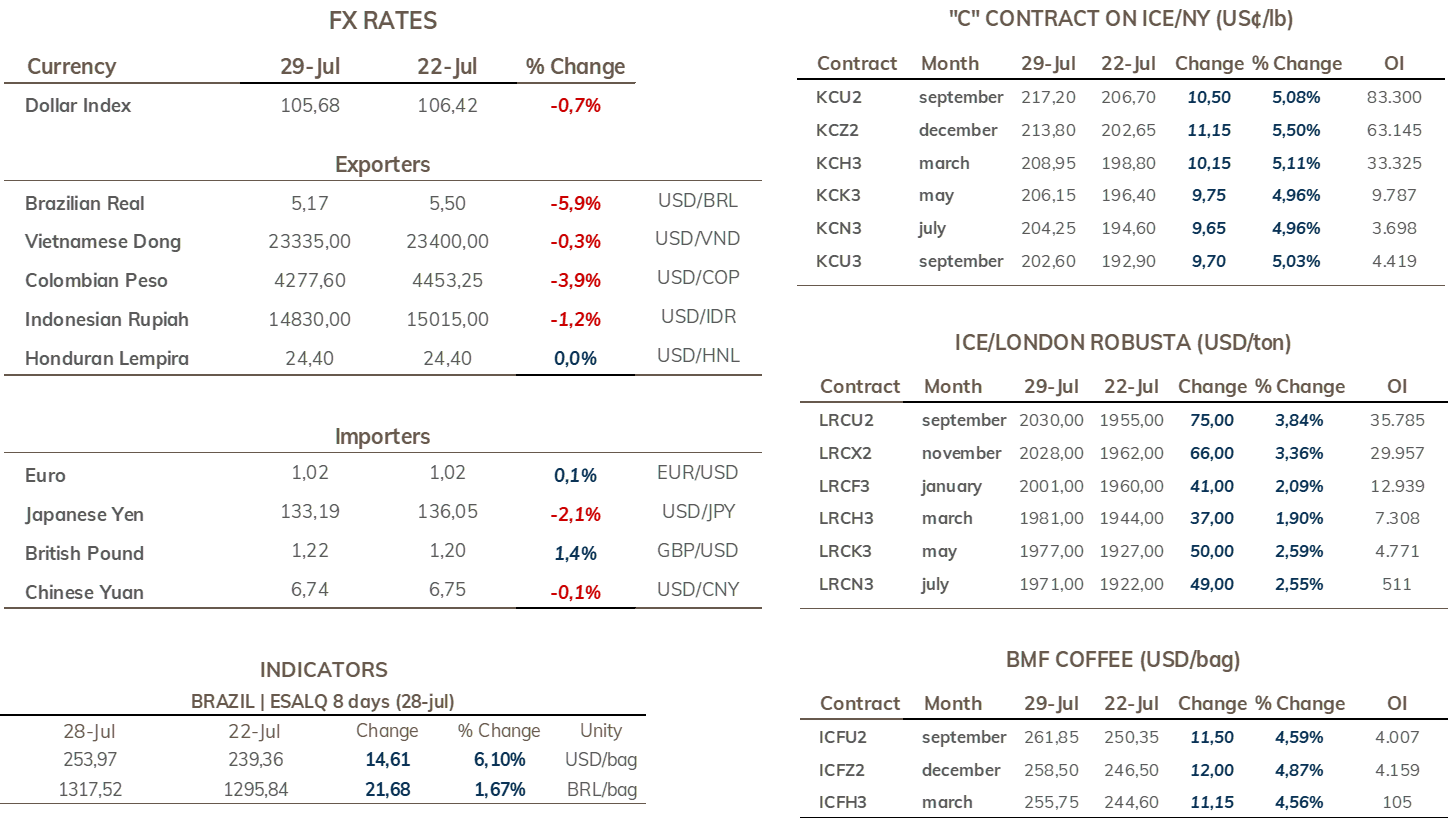
Sources: ICE/NY; ICE/EU; B3; Commodity Network Trader’s Pro.