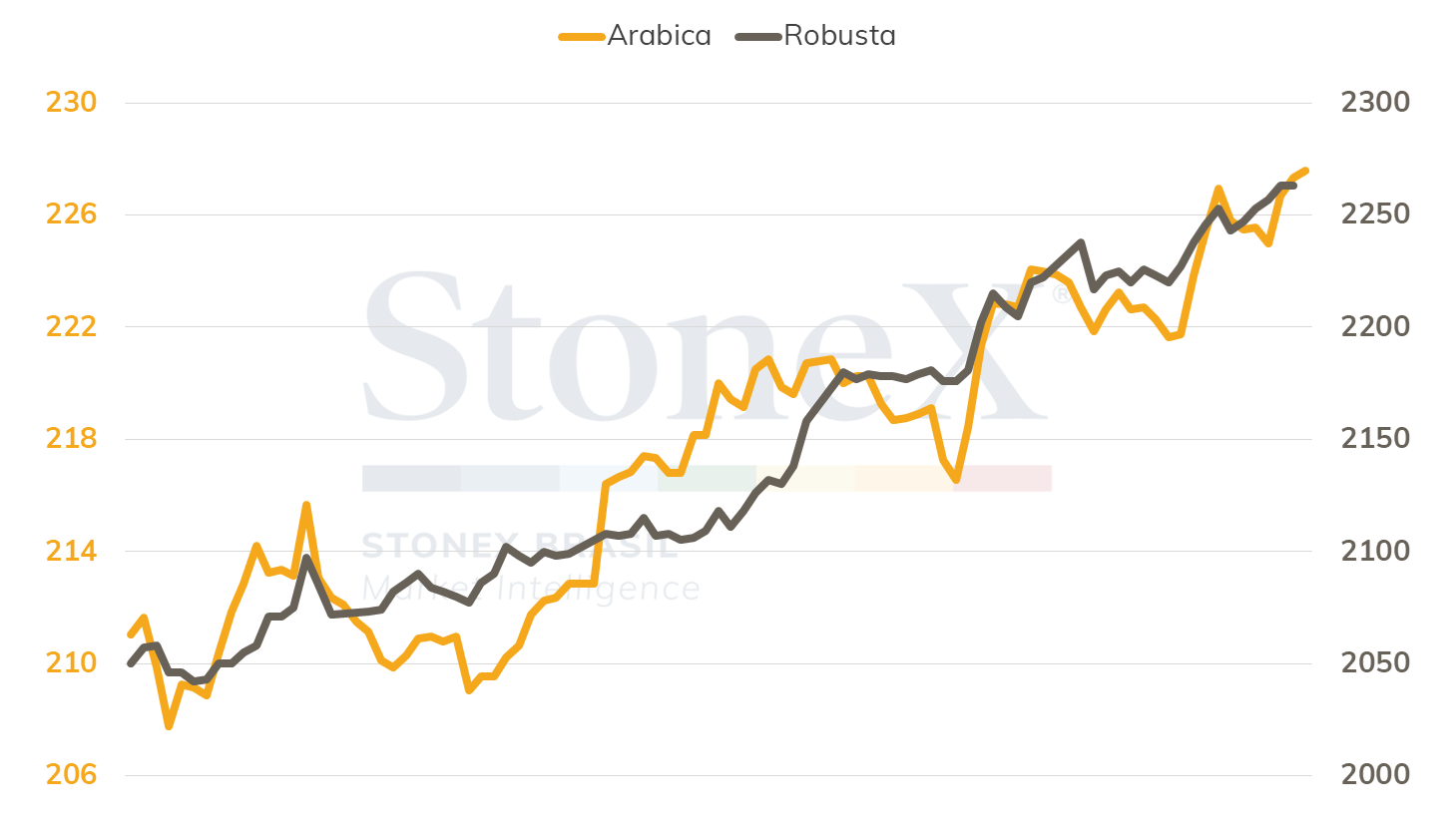
Following the movement in the international market, the Arabica coffee prices in the Brazilian domestic market ended the week lower. Cepea’s Arabica indicator ended the week (12) quoted at BRL 1,300.76/bag, an increase of 3.1%. On the other hand, Cepea’s Robusta indicator ended higher by 1.7% to close at BRL 731.38/bag.
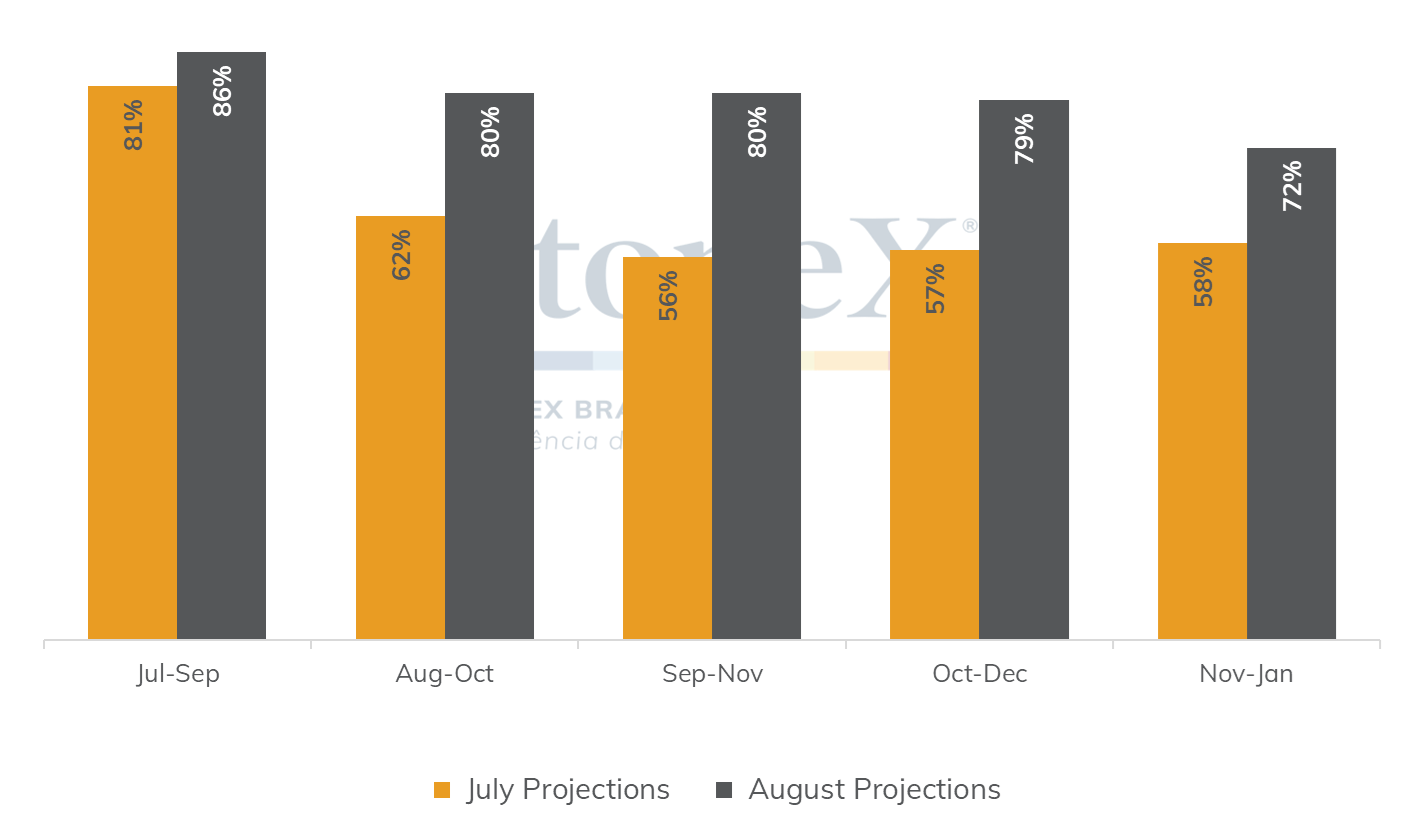
The US National Oceanic and Atmospheric Administration (NOAA) updated its probabilistic projections for the occurrence of El Niño/La Niña last Thursday (11). The data showed a significant increase in the chances of a La Niña until the end of 2022.
The August projections had significant adjustments from the August to October quarter and now point to at least about an 80% chance of the phenomenon occurring by the end of 2022. From the latest updates, it seems unlikely that this trend will change before the flowering occurs. Therefore, in addition to monitoring the probabilities of La Niña, it will be important to check the projected intensity of this phenomenon to understand its potential impact on the crop.
Change in La Niña Occurrence Probabilities
Source: IRI/CPC - NOAA. Design: StoneX.
During the week, in addition to certified stocks and the weather, which will continue to be the focus, the agents will turn to the data of coffee stocks at US ports, which will be released today (15) by the Green Coffee Association. Seasonally, stocks tend to be stable or slightly advanced in July before falling from August onwards. For example, according to historical data, stocks advanced by an average of 135 bags in July. However, it is worth remembering that despite increases in recent months, stocks are at historically low levels.
As ICE Certified Stocks Dwindle, Coffee Listed as 'Pending Grading' Doesn't Necessarily Mean it is New
Alexis Rubinstein
ICE certified stocks have been a major fundamental factor in the coffee market in recent weeks, as we saw stock levels fall to their lowest in over 23 years. As of Friday, stocks were recorded at 571,905 bags, down nearly 74% from the level they were at the same time last year. But adding to the chatter of ICE inventories was the peculiar absence of gradings. From July 11 to August 8, ICE has not recorded the grading of any coffee.
“Grading only takes place when an owner requests gradings, and once grading is requested, it takes several days for the sampling process to be completed and for the samples to arrive in the NY grading room,” Tim Barry with the InterContinental Exchange told CoffeeNetwork in an interview with morning. “There is always a delay between when a lot appears as ‘pending grading’ and when the lot is graded.”
Currently, there are 233,403 bags pending grading, but, according to Barry, the exchange does not provide a breakout of pending certs as new or re-submitted for grading. He did confirm, however, that decertified coffee is allowed to be certified again, indicating that the coffee pending grading isn't necessarily new coffee.
Brazilian exports decline in the first month of the 2022/23 crop year
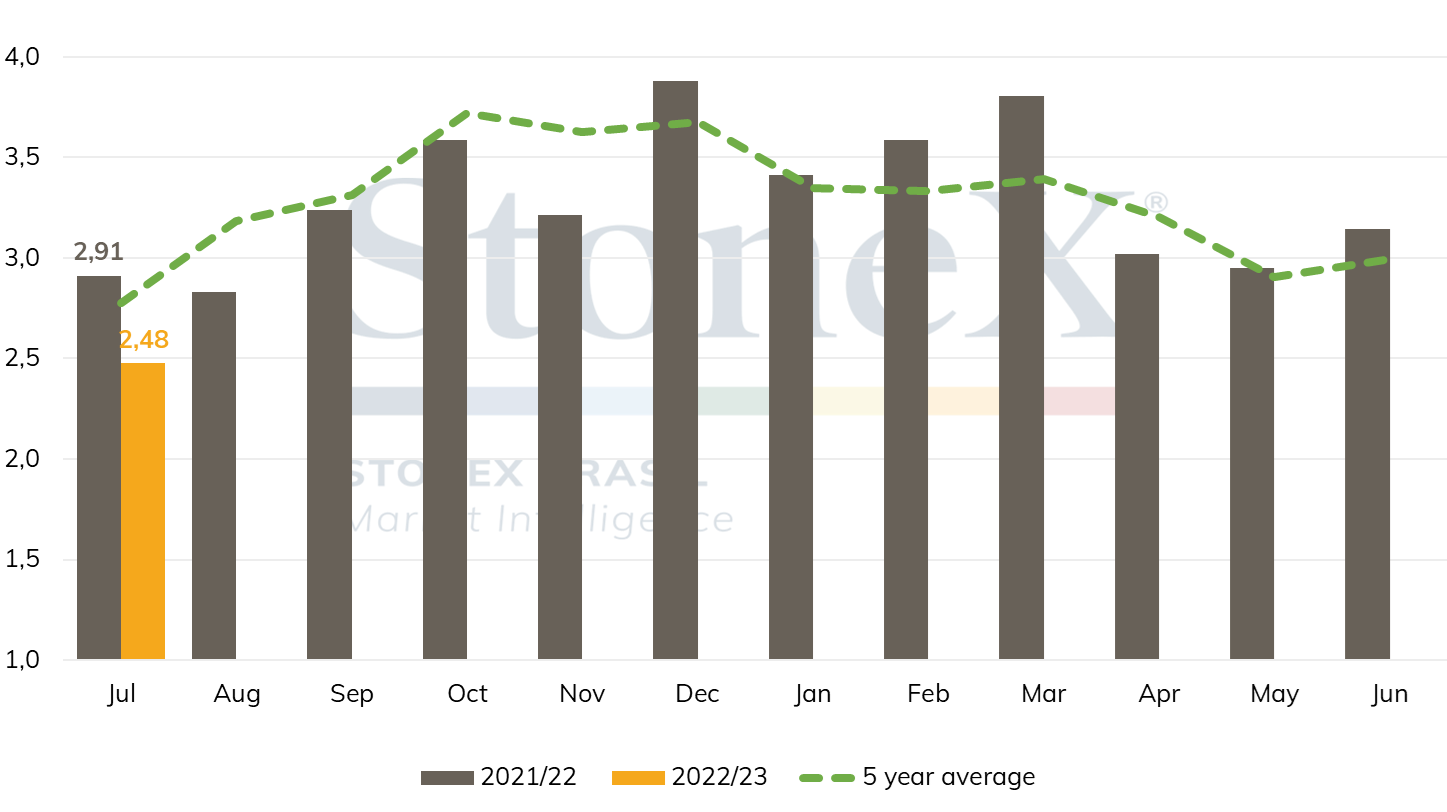
Cecafé reported last week that the country's coffee exports totaled 2.476 million bags in July. The result represents a 21.2% drop compared to the previous month and a 14.9% retraction compared to July 2021, when 2.909 million bags were exported. The main contributions to the poor result came from the 144 thousand bags of Robusta coffee shipped, 64.8% less than the 410 thousand in the same month last year, while Arabica coffee shipped 141 thousand bags (-6.5%) less this year, totaling 2.023 million bags.
Monthly coffee exports from Brazil (million bags)
Source: Cecafé. Design: StoneX.
In the document released, the agency points to the continued logistical bottlenecks and the strong demand for Robusta coffee from the domestic industry as the main reasons for the poor result. However, the harvest delays, coupled with a moment of greater uncertainty in the coffee sector and growing expectations for the development of flowering in the coming months, have contributed to a small volume of negotiations in recent weeks. This very "locked" market also seems to contribute to the lower volume of shipments, which helps to provide a bullish tone for prices in the short term.
In cumulative terms, the first seven months of 2022 total 22.4 million bags, 6.1% below the 23.8 million exported in the same period last year and 5.2% below the average of the last three years.
USDBRL depreciation and a greater global search for risk assets favor coffee prices
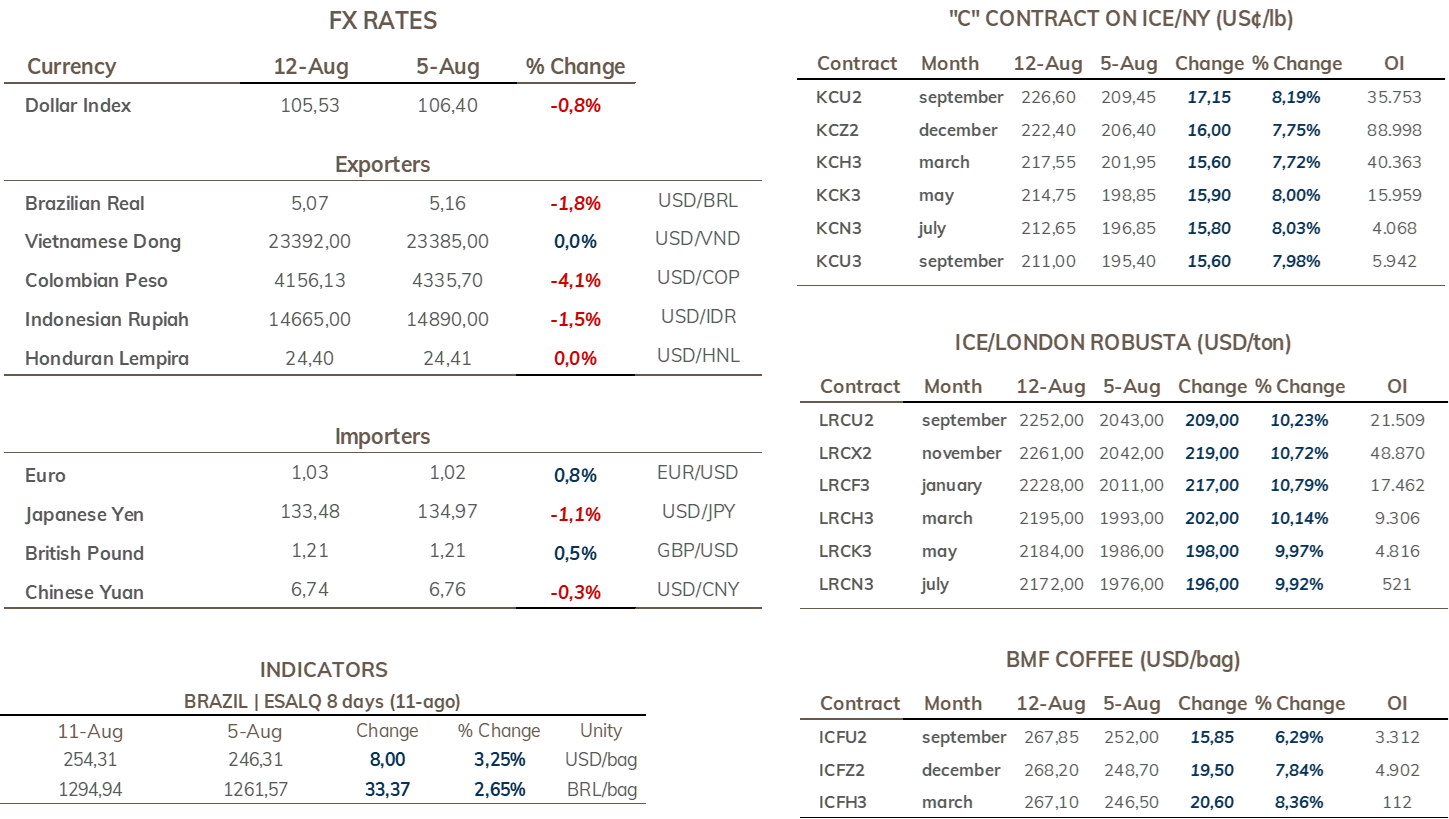
In a week of greater global market risk appetite and repositioning agents, the dollar retreated 1.8% in the Brazilian market, with the real/dollar pair closing quoted at BRL 5.074. The dollar index dropped 0.9% in the week, closing at 105.6 points.
Much of the discussion and movement about the global economy this week was based on the release of lower-than-expected inflation in the United States. On Wednesday (10), the Bureau of Labor Statistics (BLS) revealed that the Consumer Price Index (CPI) in the country was stable in July, while the market was projecting an advance of 0.2%. The reduction occurred mainly due to the monthly drop of 7.7% in the price of gasoline and 11.0% in the price of diesel, which offset increases in food and housing. Thus, the indicator accumulated over 12 months fell from 9.1% in the previous month to 8.5%, below the 8.7% expected by agents. On Thursday (11), the Producer Price Index (PPI) also showed stability, with the accumulated figure for the last 12 months retracting from 11.3% in June to 9.8%, below expectations of 10.4%.