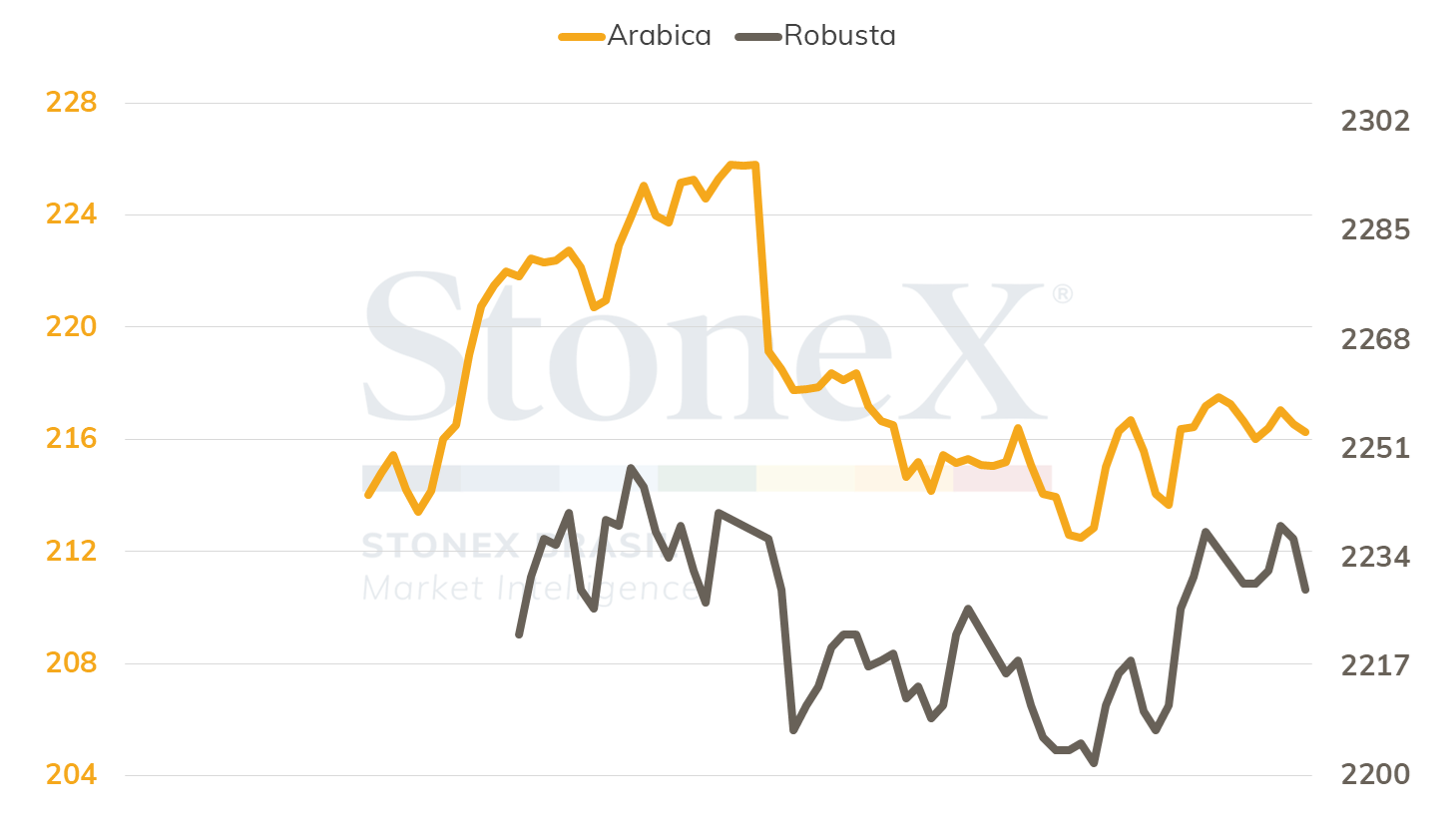
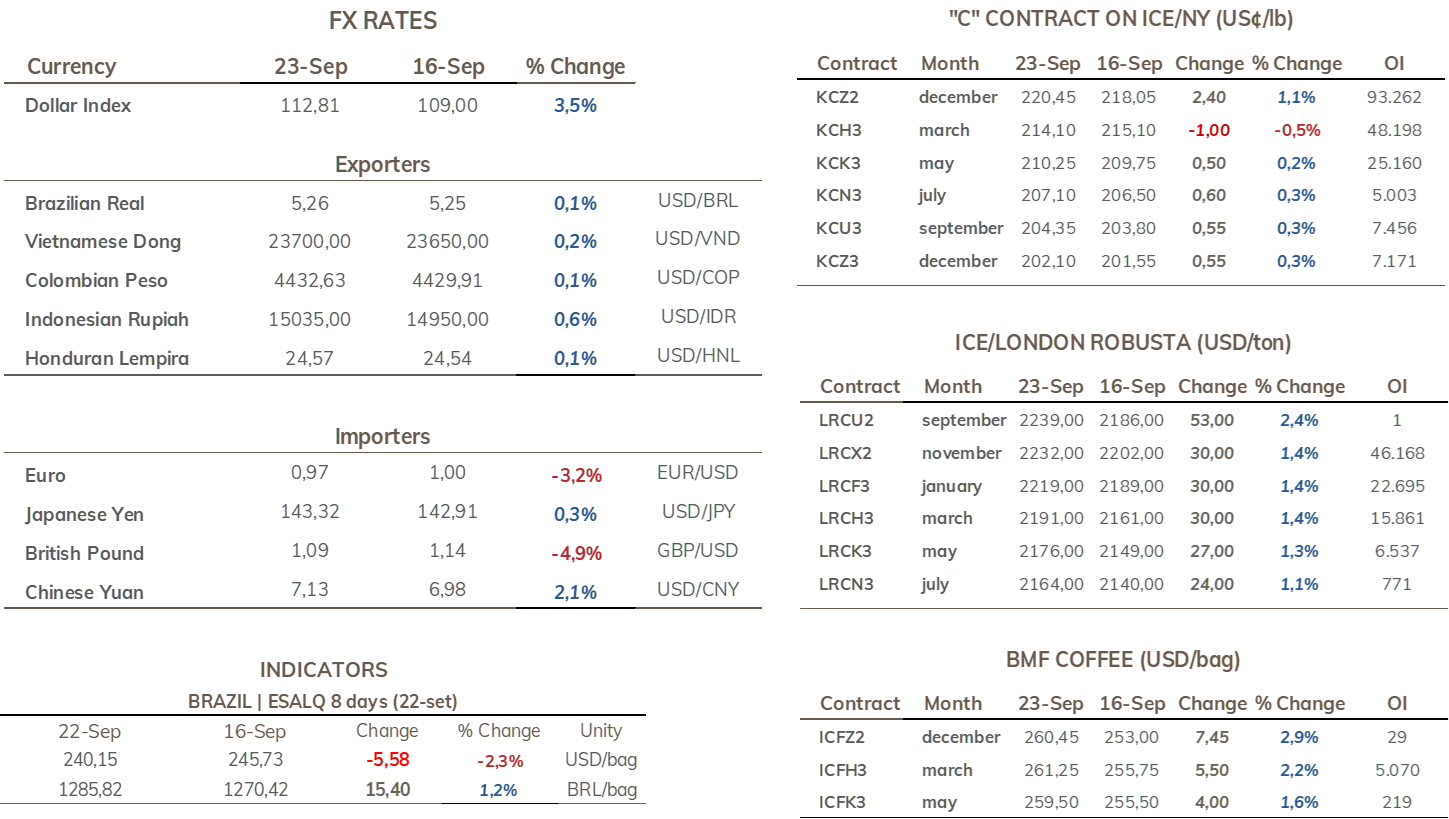
In Brazil, Cepea's Arabica indicator showed an advance of 1.4% until Tuesday (20) but fell back to end the week with a slight increase of 0.2%, quoted at R$ 1272.92/bag. On the other hand, Robusta coffee showed a slight increase of 0.7% to close at BRL 741.72/bag.
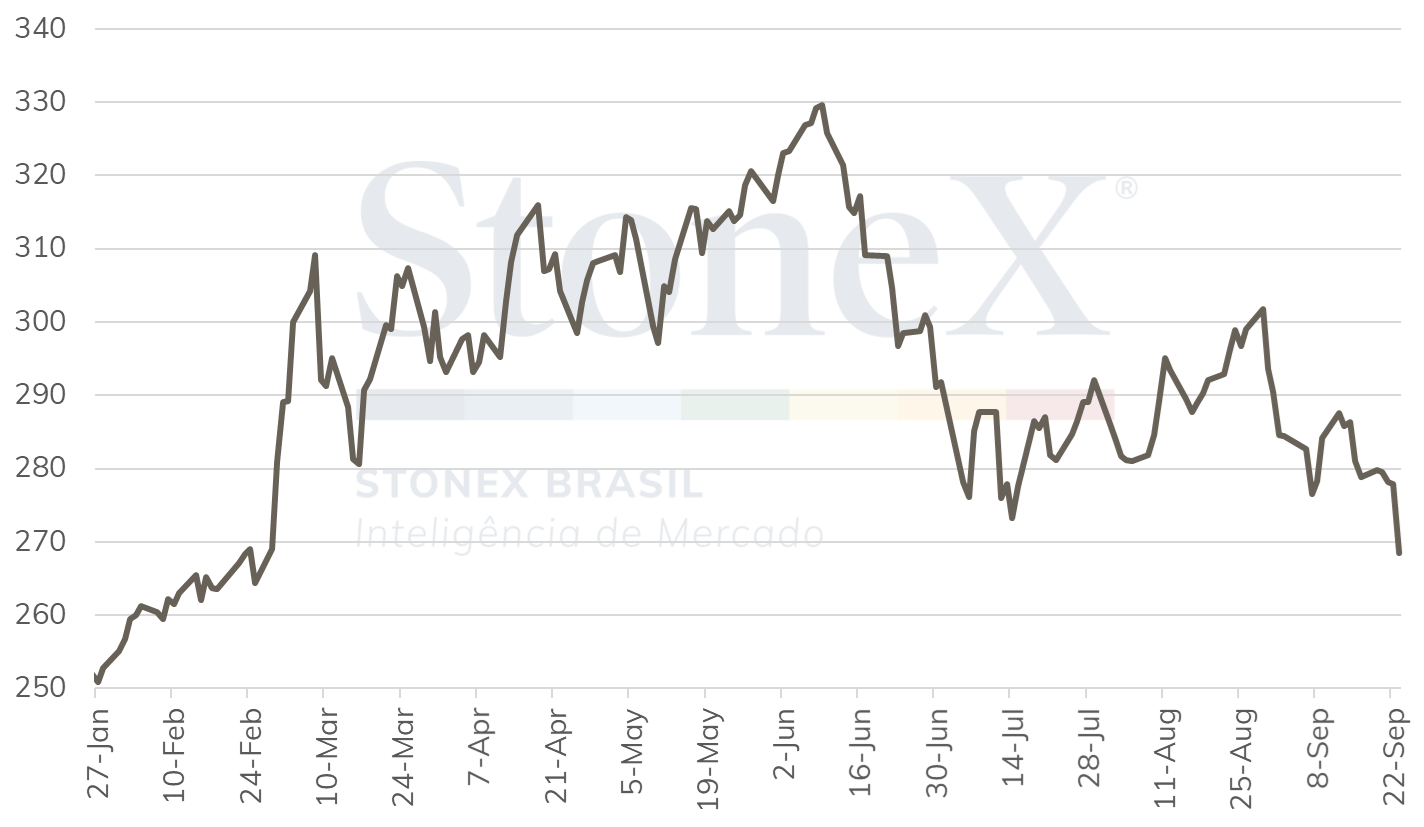
From the macroeconomic perspective, the strengthening of the US currency, which reflected the interest rate hike by the Federal Reserve last week, acted bearishly for commodities in general, including coffee. While the dollar index increased by 2.8% in the week, closing at 112.8 points, the highest level in 20 years, the CRB commodities index fell 3.7% to 268.5 points. Moreover, the risk-off sentiment is heightened amid fears of a European recession and heightened tensions in the Russian-Ukrainian war, with the call-up of Russian reservists and the threat of nuclear weapons in the conflict. For more details, access this week’s FX Weekly Summary.
CRB Commodities Index
Source: Reuters. Design: StoneX.
The reduction in estimates for Brazilian production released by Conab contributed to the week's positive moves. The agency reduced by 6.2% its estimate for Brazilian coffee production in 2022/23, from 53.7 to 50.38 million bags. Despite the adjustment, the new estimate still represents a 5.6% increase in production compared to the previous crop (2021/22). Arabica coffee production was estimated at 32.41 million bags, while for the Robusta type, it was estimated at 17.97 million.
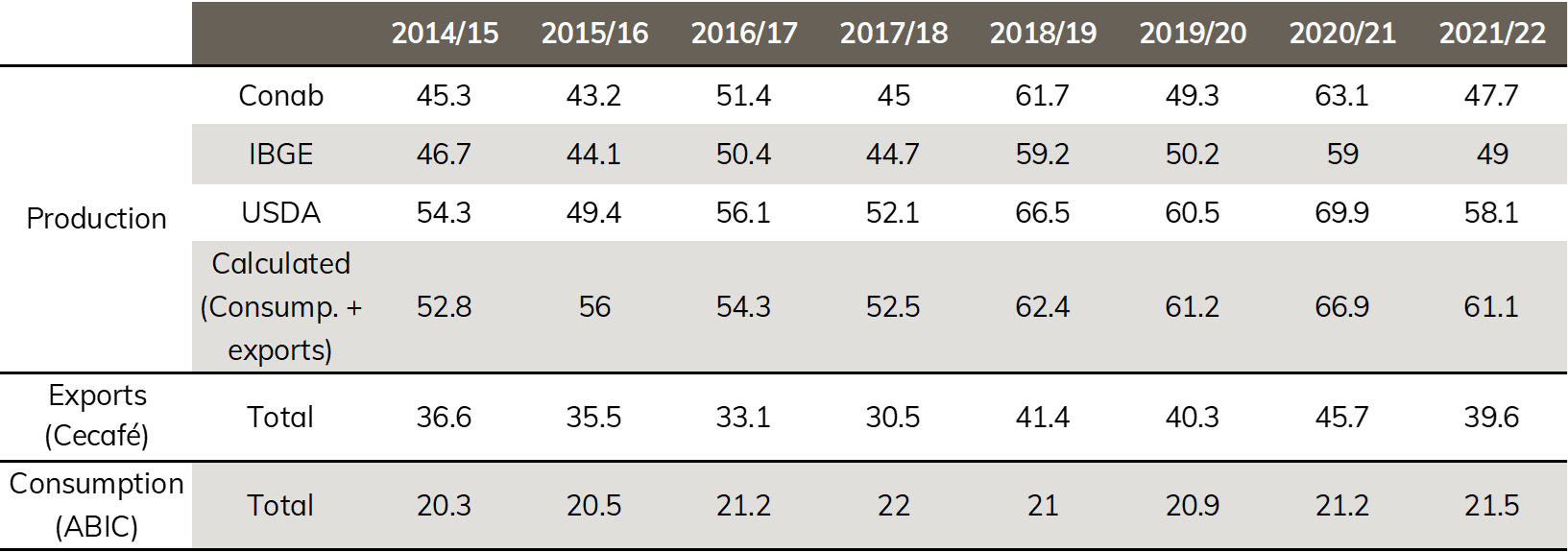
In a report published last week by the news agency Reuters, the executive director of Conab, Sergio de Zen, admitted that the estimates for coffee production in recent years have had problems and need improvement to reflect reality since the numbers estimated by Conab are lower than the sum of the volume consumed and the total exported. The inconsistency in Conab's estimates has already been the subject of a warning from StoneX analysts.
Range of Brazilian coffee production estimates (million bags)
Sources: Conab, StoneX, Cecafé, IBGE, USDA, ABIC. Design: StoneX.
On the fundamentals side, market attention is still focused on developing the early stages of the 2023/24 crop, which is in the flowering period. The weather remains a primary factor for the opening of the main flowering and satisfactory development. In recent weeks, the rainfall forecast for some regions has cooled agents' concerns. Still, this issue continues to be a risk factor since, according to NOAA forecasts, La Niña should remain until the end of the year. Besides the need to re-establish the water regime for the flower opening, good weather is necessary to guarantee the setting of the bloom and the buds. Any adversity in this period can cause damage.
The drop in Arabica's certified stocks will continue to impact coffee prices. As presented in the special report "Can certified stocks reach zero?" published in early August, market conditions are not favorable for the certification of new coffees by origins and encourage the withdrawal of coffee from certified stocks by the exchange. Last week, Arabica certified stocks fell by over 60,000 bags (11.4%) to 472,000 on Friday (23). Considering the condition of strengthened differentials and the lower availability of coffee at the origins, especially in Brazil, certified stocks should continue to follow the downward trend.
In the coming weeks, in addition to weather conditions and certified stocks, market participants are keeping an eye on September export data, which will be released starting next week. In addition, the noises on the macroeconomic front should continue to have an impact on coffee prices.