The Federal Reserve's monetary policy decision on Wednesday (2) is expected to be one of the main factors that will take attention in global markets. Last week, speculation that the Fed may begin to moderate its pace of interest rate adjustments starting in December weighed on the American currency. For this Wednesday, amid still accelerated inflation and a heated labor market, a new adjustment of 0.75 p.p., taking the basic interest rate to a range between 3.75% and 4.00%, is practically certain. First, however, the agents should react to the signals given by the chairman of the authority, Jerome Powell, in a press conference after the decision was announced. Currently, the bets for the December decision are quite divided, with 48.0% of the agents projecting an increase of 0.50 p.p. and 45.8% expecting an increase of 0.75 p.p. Possible signs of a reduction in the Fed's monetary tightening tend to be bearish for the dollar and bullish for riskier assets, such as commodities and currencies of emerging countries.
Last Thursday (27), the European Central Bank opted to make a firm adjustment of 0.75 p.p. in the economic bloc's basic interest rate to 1.50% per year to help control strong inflation. However, it is worth noting that the decision was not unanimous, and the communiqué stated that a substantial part of the inflation had already been implemented. The indication of probable softening in the next decisions provoked a bearish effect, mainly for the euro, which reached a level above parity with the dollar on Wednesday (26) but retreated again after the ECB statement.
The ECB has been facing an extremely complex situation in which it has to try to control inflation in the eurozone without compromising the level of activity of the region's economies, which have been dropping significantly in recent months and signaling a possible recessionary situation. Recent data showing that consumer prices in Europe continue to accelerate while household income tends to fall caused a strong bearish sentiment concerning coffee consumption in the bloc, representing a little over 25% of global coffee consumption, according to USDA data.
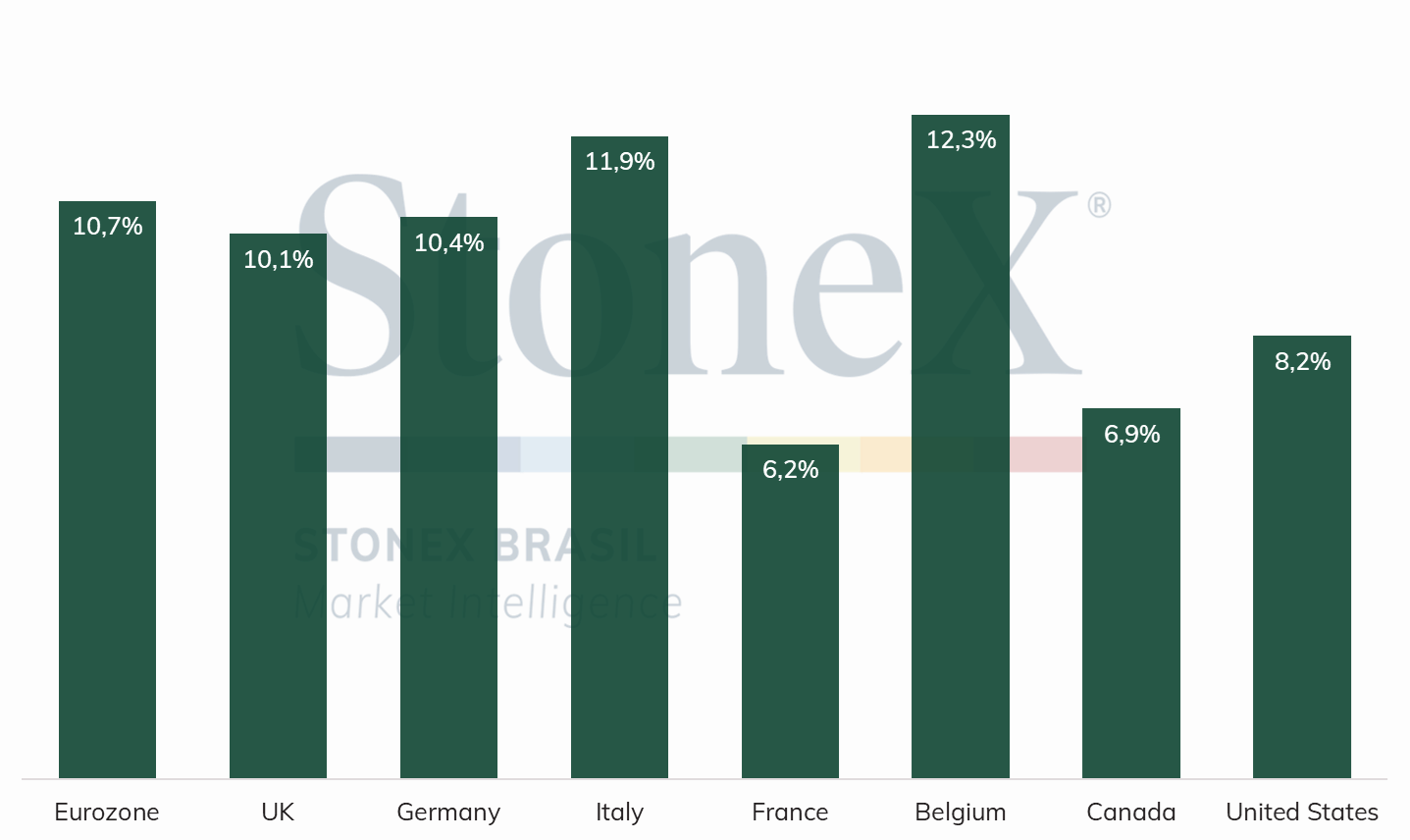
Last Friday (28), preliminary results of the Consumer Price Index (CPI) of countries in the region continued to raise this concern. In this regard, Germany stood out, suggesting an increase in the accumulated in 12 months from 10.0% in September to 10.4% in October, and Italy, indicating an accumulated growth from 8.9% to 11.9%. On Monday (31), the preliminary consolidation of the eurozone showed an advance of 1.5% in October compared to September, with the accumulated in 12 months going from 9.9% to 10.7%. The September eurozone Producer Price Index (PPI), published on Friday (4), will also be followed by market participants since the large increase in industrial production costs in Europe also generates concerns that greater pass-through may be made in consumer prices.
Consumer Price Index (CPI) accumulated over 12 months for selected economies (in %)
Source: Refinitiv. Design: StoneX.
Finally, it will be interesting to follow the movement of the Brazilian currency market after the decision of the presidential elections last Sunday (30), which gave the victory to former President Luis Inácio Lula da Silva (PT), who will assume his third term as president of the Republic starting in 2023. If on the one hand, a more bullish reaction of the dollar was expected in case of Lula's victory, these expectations have been frustrated on Monday (31). After starting the trading session higher, reaching intraday highs close to BRL 5.40, the dollar posted a significant fall of 2.30% on the day, quoted around BRL 5.175 when this report was written. From now on, investors will react to the main definitions regarding the economic policy of Lula's administration, with the market likely to give great weight to the definition of the Minister of Economy of his government.
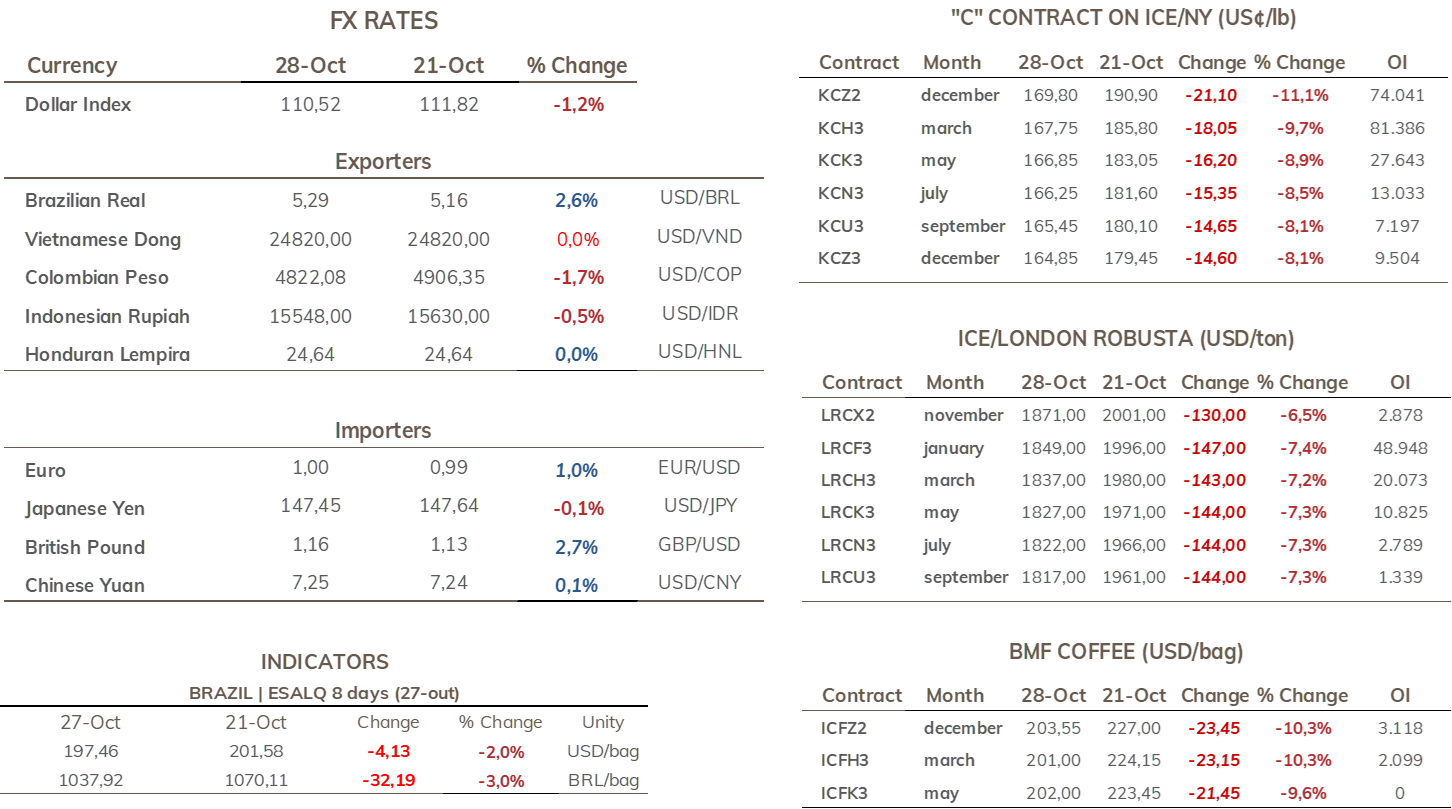
Sources: ICE/NY; ICE/EU; B3; Commodity Network Trader’s Pro.