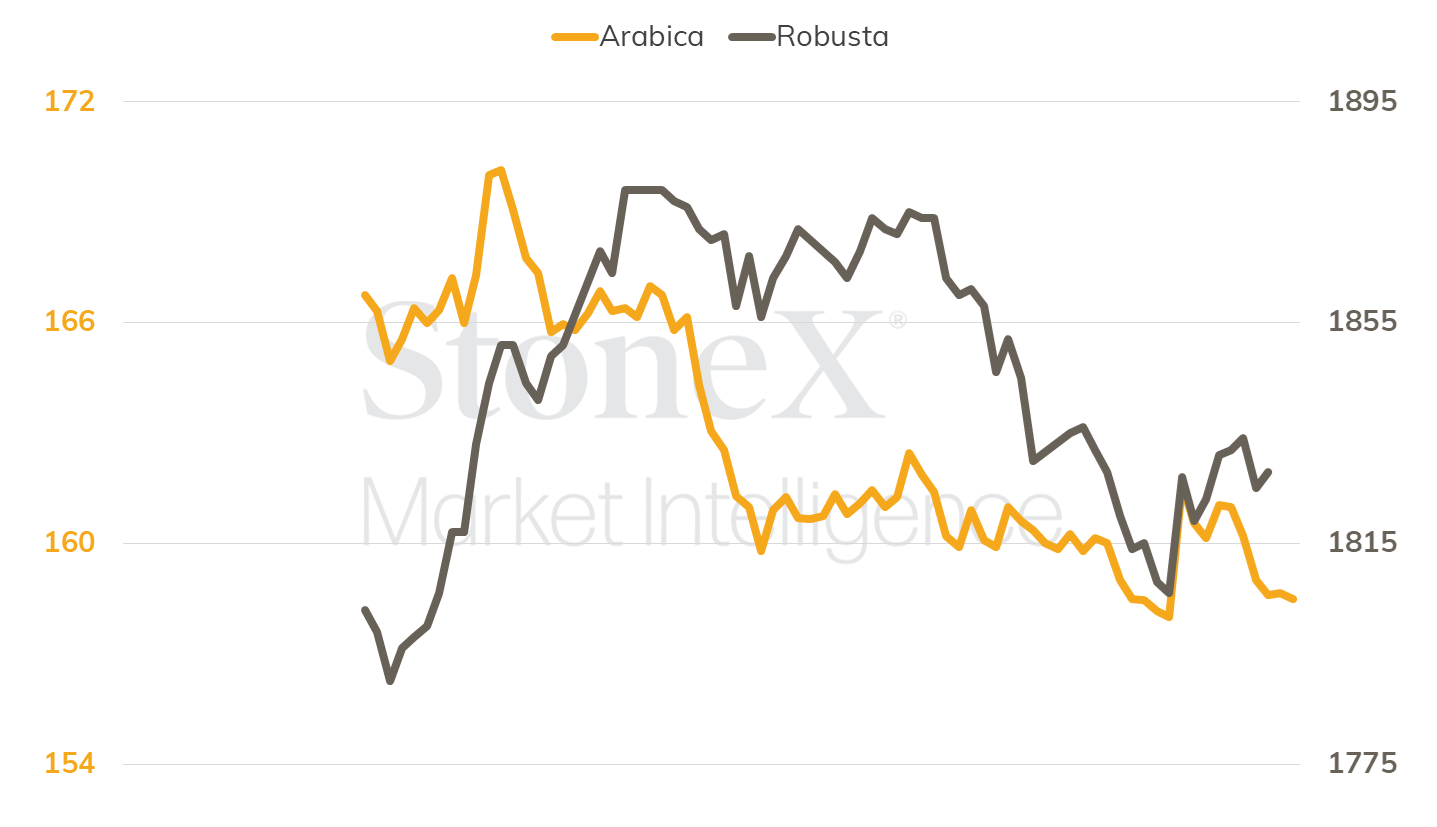
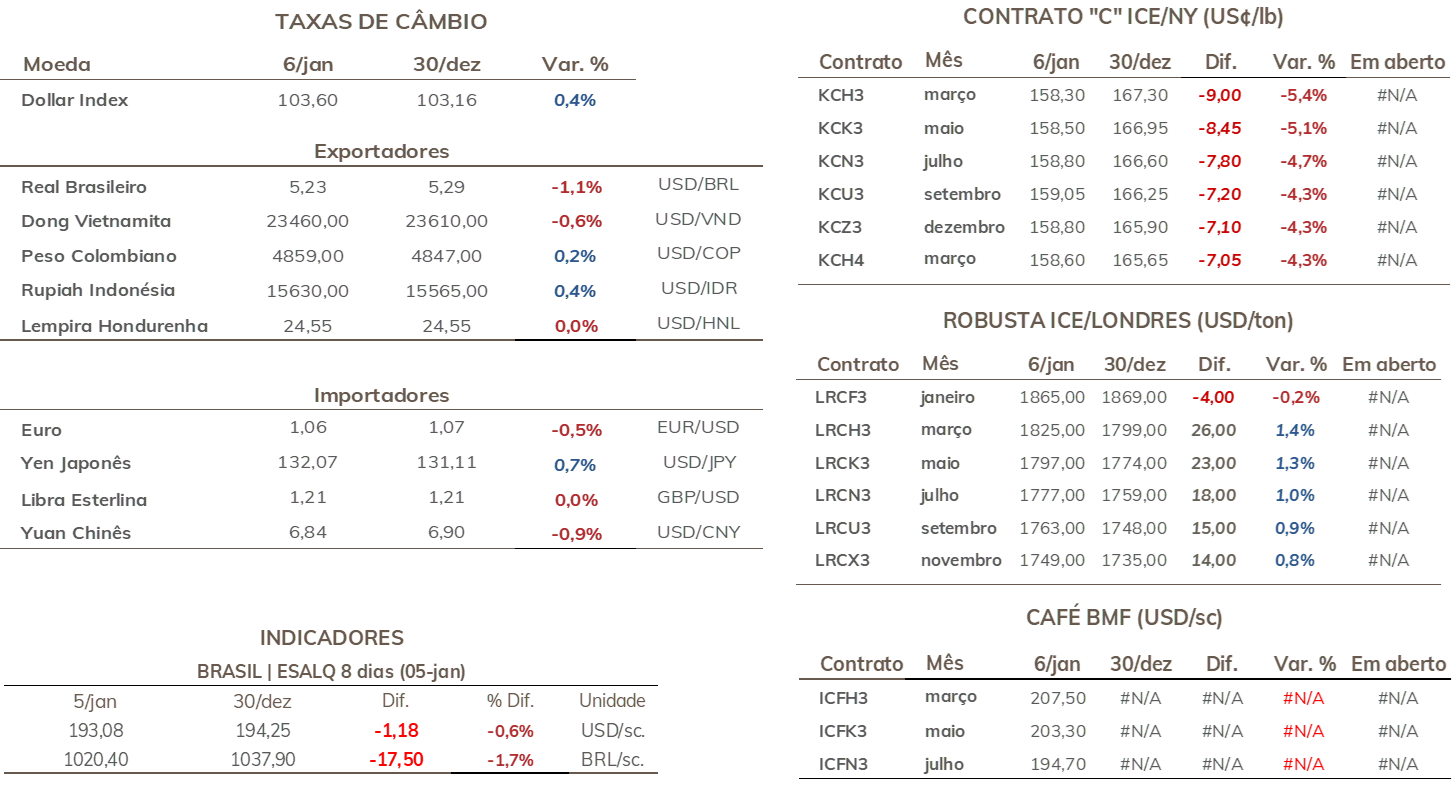
In Brazil, Arabica and Robusta coffee prices ended the week lower, following the movement of futures in New York, but in a less intense way. The Cepea's Arabica indicator ended Friday (06) at BRL 1023,47/bag, representing a drop of 1.4% compared to December 29. The drop in Robusta prices was much less intense, representing a 0.7% decline in Cepea's indicator, which closed Friday's session (06) at BRL 693.08/bag.
Part of the optimism regarding Brazilian production in 2023 has been fueled by the weather in Brazil, which has shown favorable conditions for the 2023/24 crop development. According to the latest Precipitation Forecast report from StoneX, the main producing regions received accumulated rainfall volumes of up to 550 mm in the last 60 days. Also according to the report, several producing regions in the country should receive accumulations of up to 250 mm in the next 14 days.
Export data in producing countries are also on the agents' radar. According to data from the Honduran National Coffee Institute (IHCAFE), the country exported 252.7 thousand bags of coffee in December 2022, representing a drop of 14.8% compared to December 2021. As a result, the country's accumulated exports in the 2022/23 crop year, which began in October, reached 345.5 thousand bags, a volume 3.3% lower than that observed in the same period of the previous crop year. However, the Association of Coffee Exporters of Honduras (ADECAFEH) projects a 10% increase in Honduran exports in the current crop year (Oct/22-Sep/23) to 5.1 million bags, signaling a prospect of recovery of production in the country, one of those negatively impacted by the effects of La Niña.
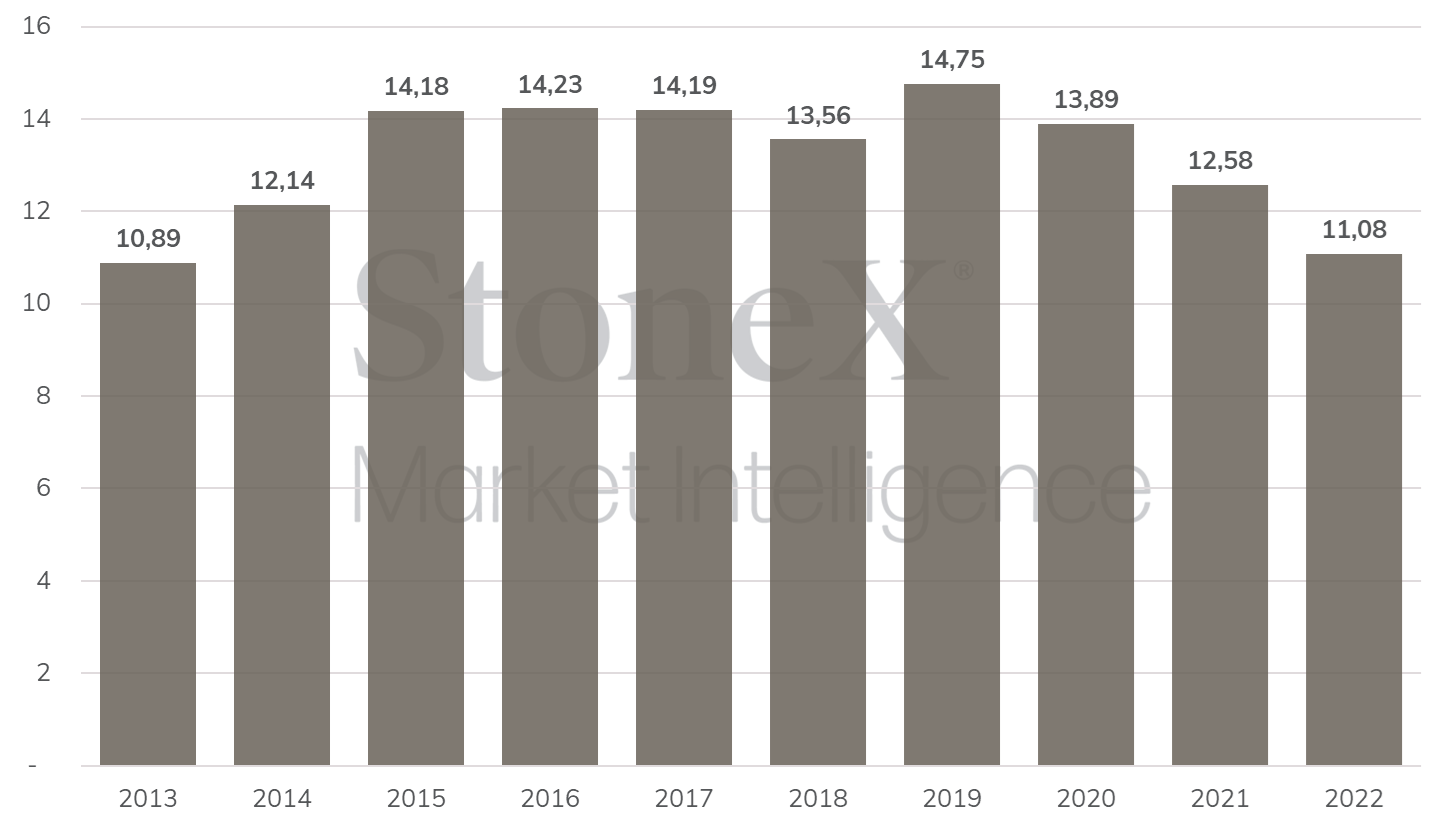
According to the Colombian Coffee Growers Federation (FNC), coffee production in the country totaled 11.08 million bags in the 2022 calendar year, representing a reduction of 11.9% compared to production in 2021. However, the volume is still 20% lower than production in the last five years, which was 13.79 million bags. The sharp reduction in production in the country is due to the impacts of La Niña on the country's production, which has faced weather adversities and excess rainfall.
Evolution of Colombian coffee production (million bags)
Source: FNC. Design: StoneX.
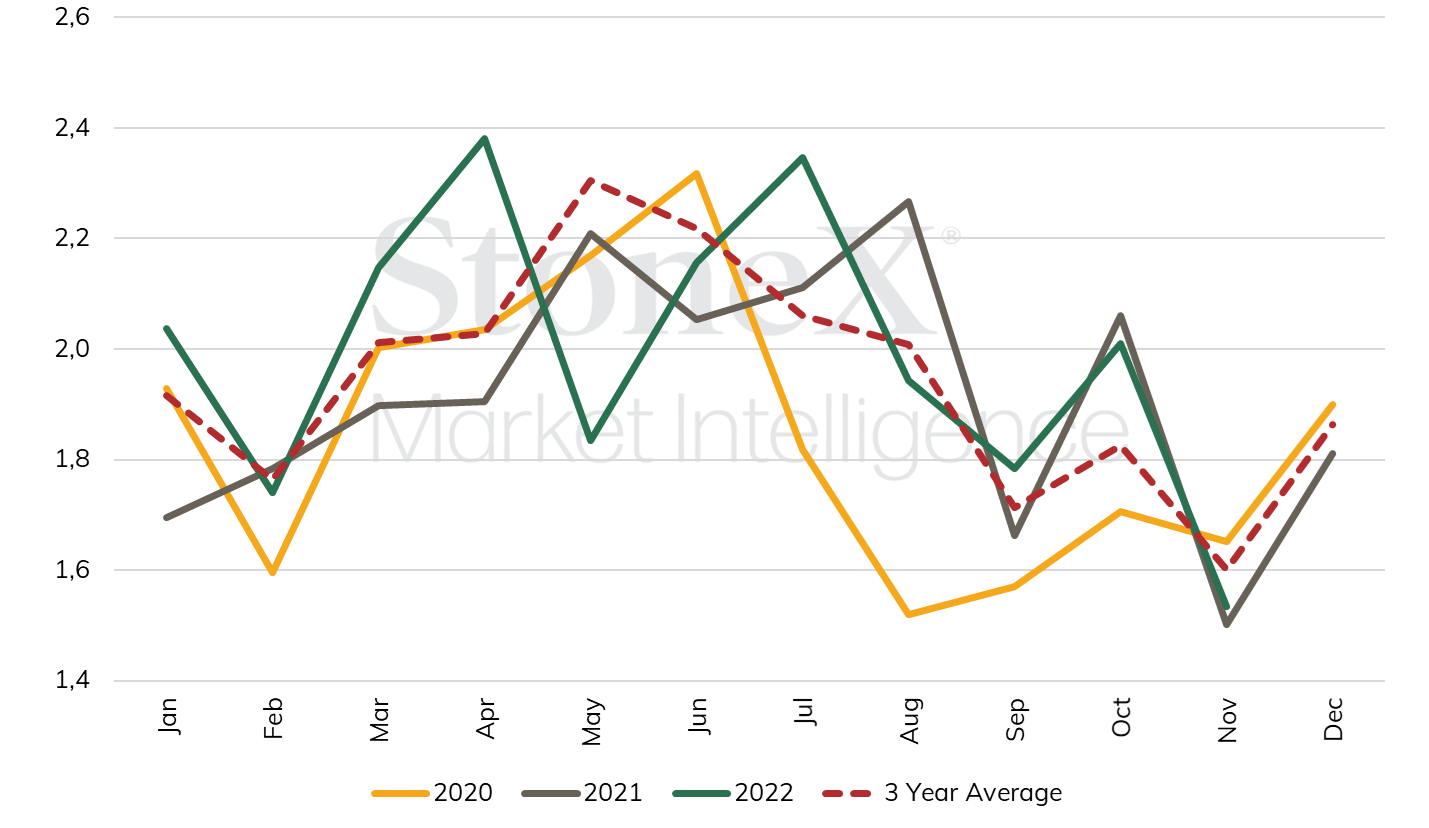
On the consumer side, recently, the USDA released data on coffee imports in the US in November, which totaled 1.53 million bags, representing a reduction of 23.7% compared to the previous month, but an increase of 2,2% compared to November 2021. However, the volume imported is 4.1% lower than the average import of the last three years. When we analyze the accumulated of the year, the US imported 21.9 million bags between January and November 2022, a volume 3.6% higher than that observed in the same period of 2021. However, the accumulated imports are still lower than observed in 2019, the pre-pandemic year. The accumulated imports in 2022 are still 4.3% lower than the same interval in 2019.
Seasonality of coffee imports in the US (million bags)
Source: USDA. Design: StoneX.
In a week of great volatility in the foreign exchange market, USDBRL ends lower
After sharp oscillations, the USDBRL ended last Friday (6), quoted at BRL 5.236, a decline of 0.8% in the first week of the year. Concerns about fiscal risks in the country were the main drivers of volatility in the foreign exchange market, which reached a weekly high of 3.7% when it touched BRL 5.478 at Tuesday's close before retreating for the rest of the week. On the other hand, the dollar index posted a change of +0.4%, closing the week quoted at 103.7 points.