The indication that the cycle of adjustments in interest rates of the main global banks has been slowing and is nearing its end tends to increase the attraction for the highest returns on fixed-income assets in emerging markets, such as Brazil. Additionally, the higher-than-expected result for the United States Q4 GDP released last week, with the reopening of the Chinese economy and news of a significant drop in the number of severe cases of Covid-19 in the country are favorable to demand for commodities in general, benefiting the Brazilian currency.
This week will be marked by the monetary policy decisions of the central banks of England, the eurozone and the United States, along with activity indicators for the major global economies and US labor market data in January. For the Federal Reserve, with more than 98% of market bets waiting for an increase of 0.25 p.p., more than the decision itself, agents will be attentive both to the statement and at the press conference of Fed Chairman Jerome Powell in search of clues about the path that the US central bank intends to follow in its next meetings.
For Powell's speech, it is expected that the chairman continues to reinforce that the US interest rate should move towards a final level above 5.00% p.a. At the same time, most current market bets, although considerably dispersed, believe in a high of 5.00% with a retreat already in the last decision of the year. If Powell's statement and speech show that the Fed will not back down from its plans to keep interest rates high for a longer period, the dollar may undergo bullish corrections in the second half of the week.
Consumer coffee inflation in 2022 ends higher in the US and Europe
In the last quarter of 2022, the coffee inflation to the final consumer in the main purchasing regions of the grain, namely the United States and Europe, added to other fundamentals, such as the return of rains and improvement in Brazilian exports, to add strong pressure to the prices of Arabica in New York. In January and December, inflation data in these areas were released, which allows us to take stock of the current price situation over the past year.
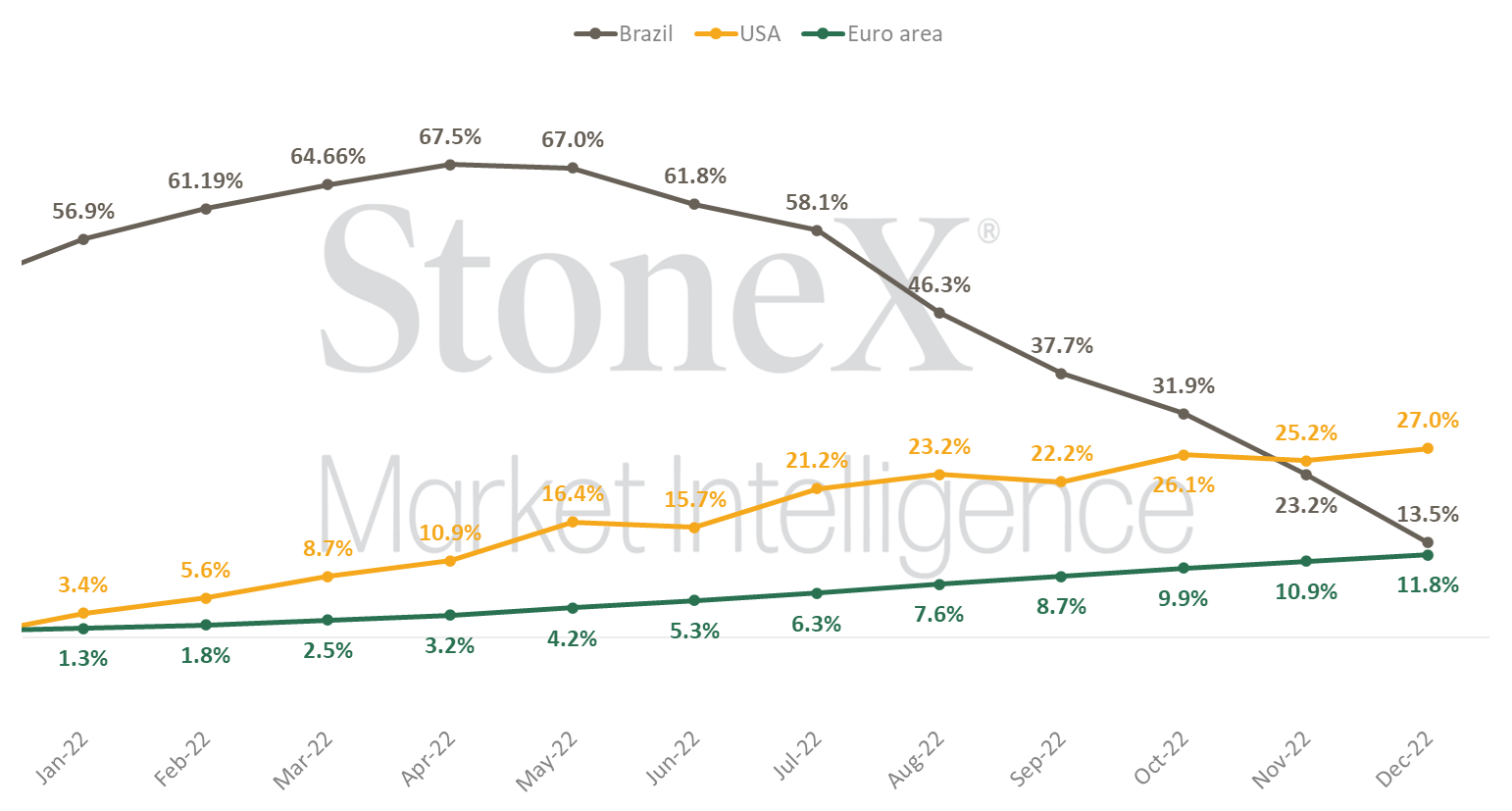
Starting with the Brazilian case, the prices of roasted and ground coffee to the Brazilian consumer, after reaching a peak in April, when accumulated in 12 months marked an advance of 67.5% in prices, began to register an intense drop in the pace of price growth, to reach December with a growth of 13.5% in the interval from January to December. Soluble coffee, on the other hand, ended the year with a growth of 18.76%, surpassing the high of roasted and ground coffee from November to December.
While the problem with strong growth in Brazil has been greatly alleviated, which should also be attributed to the reduction in prices seen in recent months, the problem in the United States and Europe still persists. The main buying and consuming regions managed to hold prices in much greater stability throughout 2021 when Brazil was already experiencing a strong rise.
Consumer roasted and ground coffee inflation accumulated in 12 months
Sources: BLS, Eurostat, IBGE. Design: StoneX.
The inflationary effects that were slow to arrive abroad now show no signs of cooling. Although accumulated inflation has oscillated between losses and gains monthly since August in the United States, advances have been more intense, leading the accumulated in 12 months to end at its highest level of the year, at 27.0%.
On the other hand, the eurozone made only advances in all months, ending 2022 with accumulated inflation of 11.8%, the highest level since the beginning of the historical series for the economic bloc in 2015. Due to the Russian-Ukraine war, the European bloc faced an energy and economic crisis throughout the year. Many European roasters depend on natural gas as an energy matrix. This commodity has undergone significant appreciation, which has compressed the margins of these companies and forced them to make greater cost transfers to the consumer.
Accordingly, consumer inflation should remain on the radar, still acting as a doubt to the prospects for global coffee consumption. The eurozone should be the most critical point to watch as long as the war and the risks of an economic recession in the bloc remain. It will also be important to note whether the new European Union sanctions on the import of oil products from Russia, which will begin to be imposed in February, will have a significant new effect on inflation in general and on the production costs of roasters, which may continue to force new transfers to the final consumer.
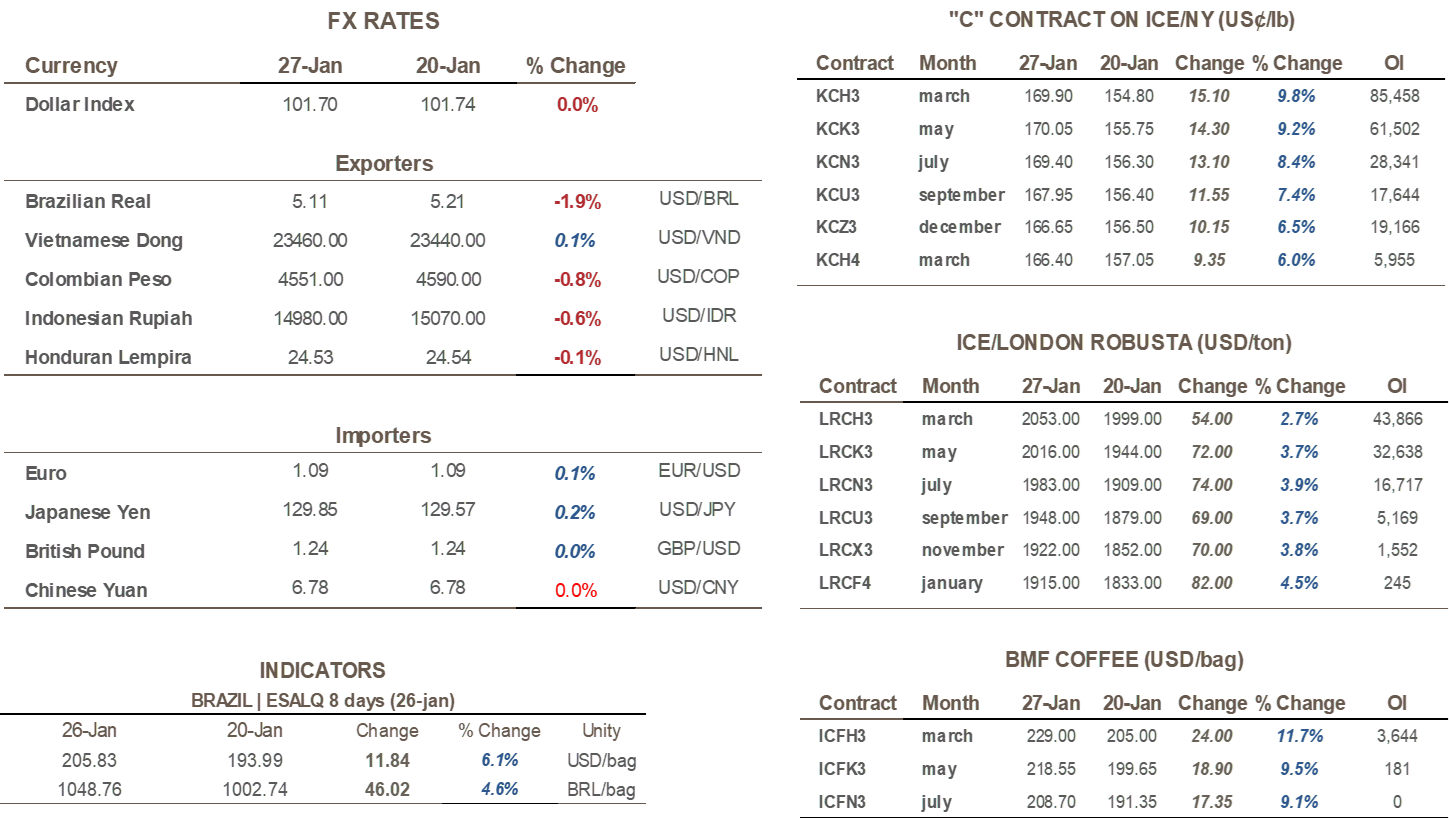
Fontes: ICE/NY; ICE/EU; B3; Commodity Network Trader’s Pro.