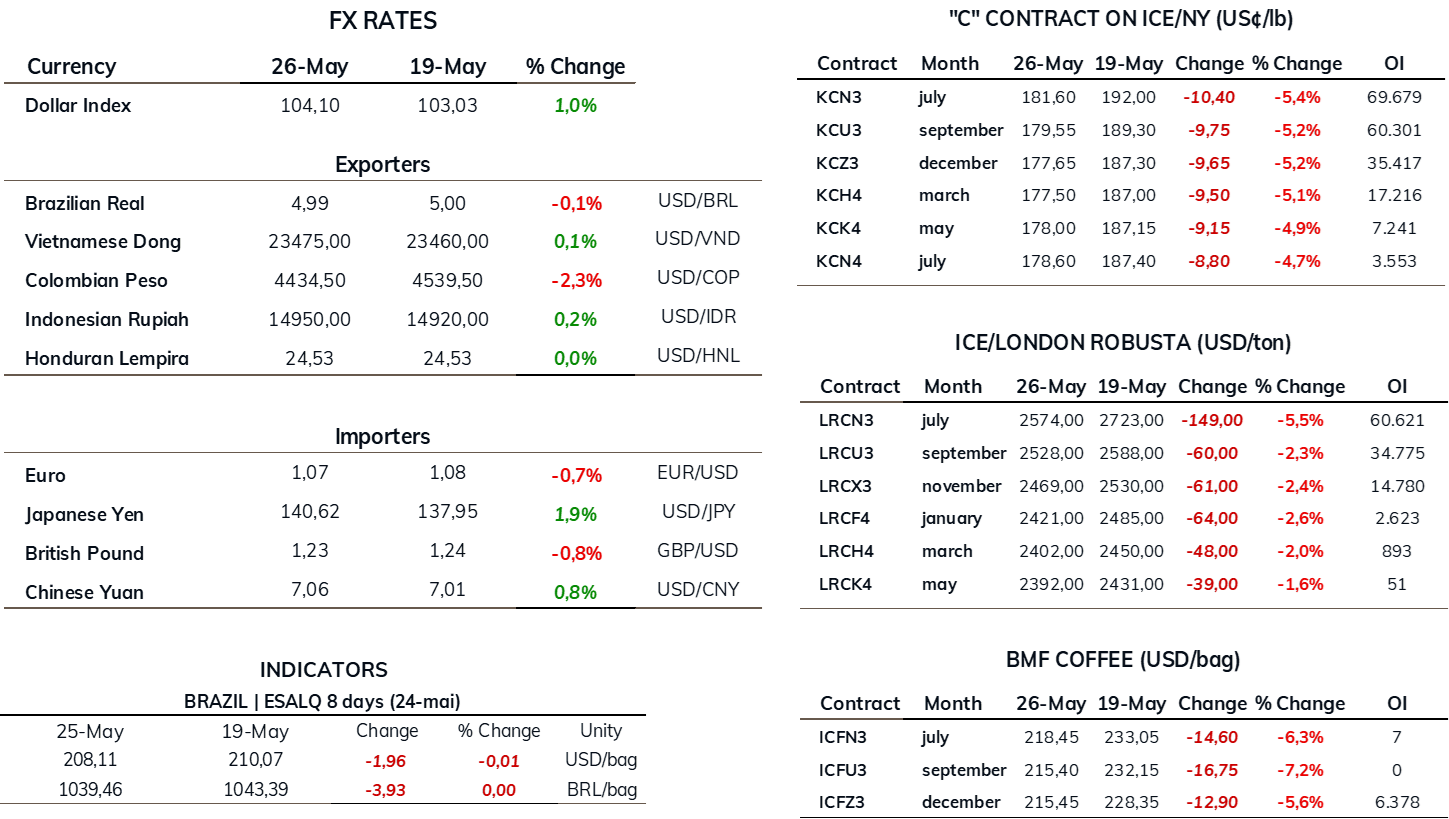
• Arabica futures fall 1040 points (5.4%) to US¢ 181.60/lb.
• Robusta fall USD 14/t (0.5%) to USD 2574/t.
• Cepea indicator for Arabica dropped by 3.7% to BRL 1.018/bag.
• Cepea indicator for Robusta coffee increased by 1.7%, ending Friday's session at BRL 696.4/bag.
• Weather concerns continued to add volatility in the market.
• Forecast of cooler temperatures puts pressure on oil prices.
• Macroeconomic environment negatively influences the commodity complex.
• Certified Arabica stocks fall to 6-month lows on ICE.
• USDA estimates for Vietnam reinforce the scenario of reduced supply in the short/medium term.
• Prospect of higher supply and weakened demand could weigh on coffee futures.
• The stock and spot markets differentials have been falling in producing countries.
• USDA releases on Brazilian crops and global market and harvest progress will be on agents' radar.
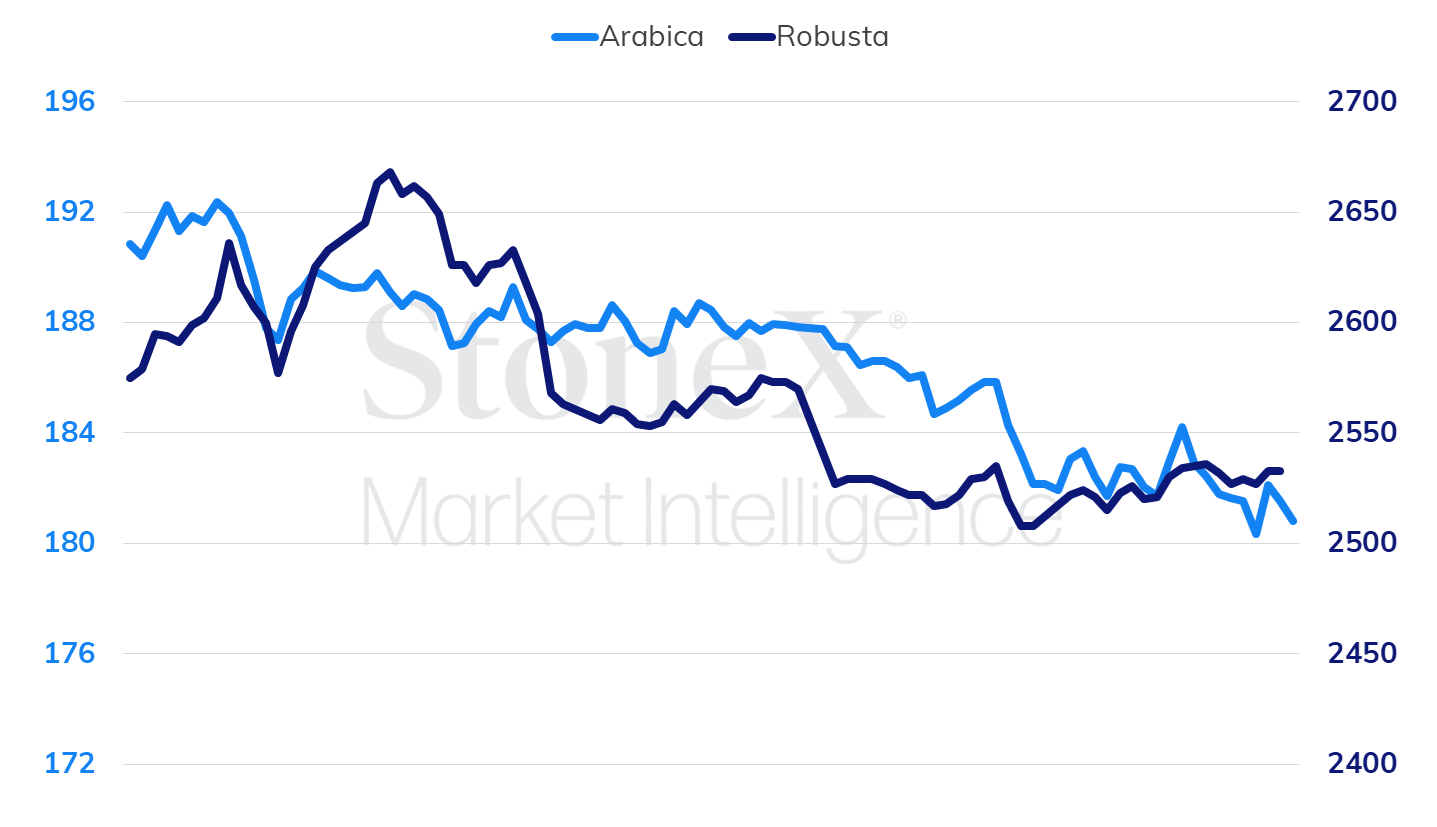
CEPEA indicator for Arabica and Robusta coffee (BRL/bag)
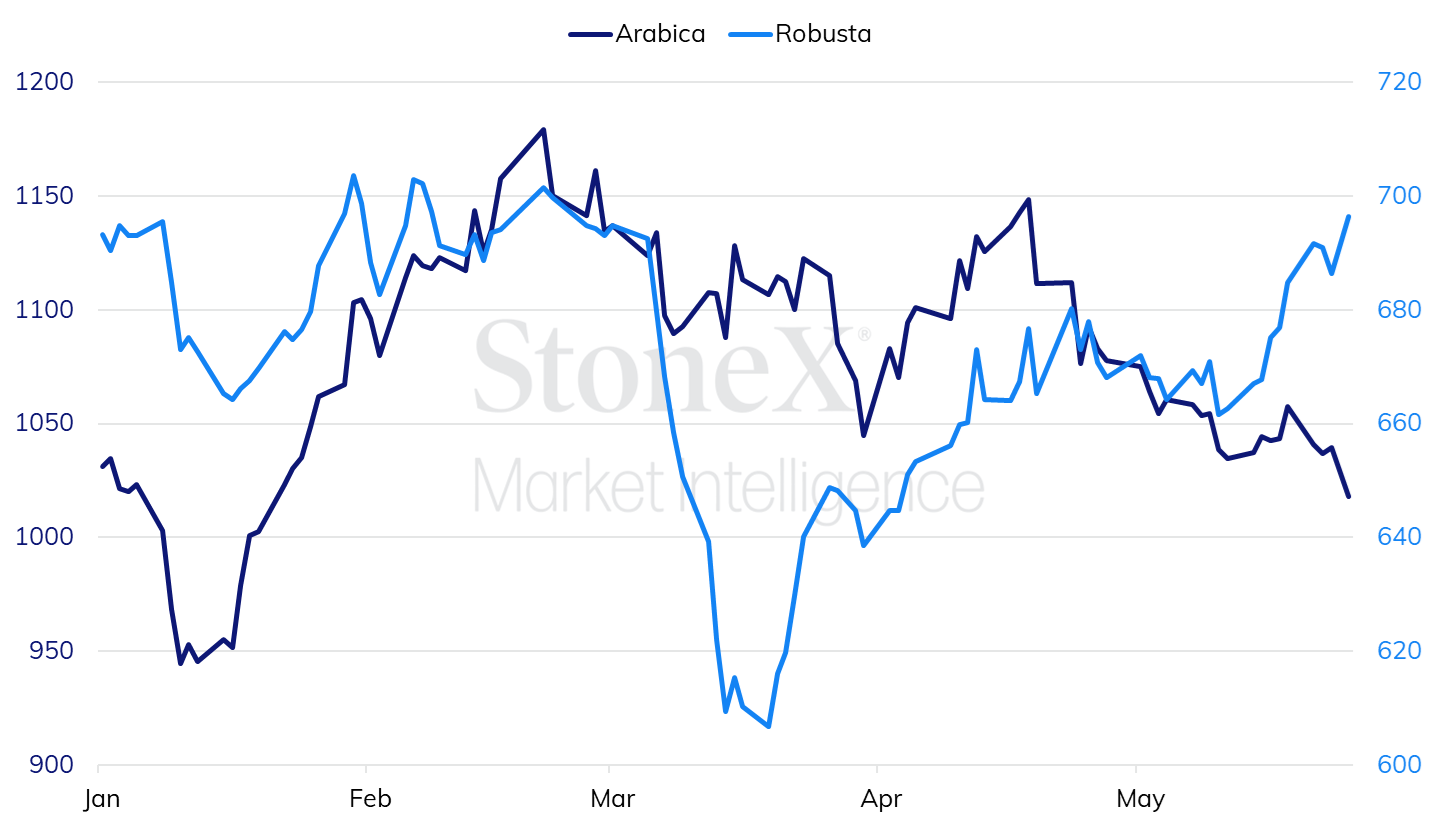
As highlighted in the last report, the colder weather in Brazil, the main factor behind the sessions of strong appreciation in recent weeks, showed milder conditions last week, which reduced the short-term fears of agents with possible impacts on production and provided the environment for corrections in recent highs. The StoneX minimum temperatures report does not indicate major risks of low temperatures for the next ten days.
The macro-environment has also not proved conducive to commodities over the past week. The dollar ended quoted at BRL 4.985 in the Brazilian foreign exchange market, a slight weekly drop of 0.2%. However, the dollar index posted a strong weekly advance of 1.0% and accumulated an advance of 2.7% in the week, ending at 104.1 points.
The main factor of risk aversion in global markets, reflected in the rise of the dollar index, is the impasse regarding negotiations for the extension of the US debt limit and the possibility that the country will default for the first time in history as early as June if an extension of the ceiling is not approved. The credit rating agency Fitch pointed out that the credit rating of US debt, currently at “AAA,” the highest possible, signaled negative risks to the country's credit quality due to the events. This weekend, the news that President Joe Biden and the Republican Party agreed to raise the debt ceiling until January 1, 2025, tends to cause a recovery with optimism. However, agents will have to monitor whether the progress of bureaucratic procedures for approval in Congress will occur as expected in the coming days.
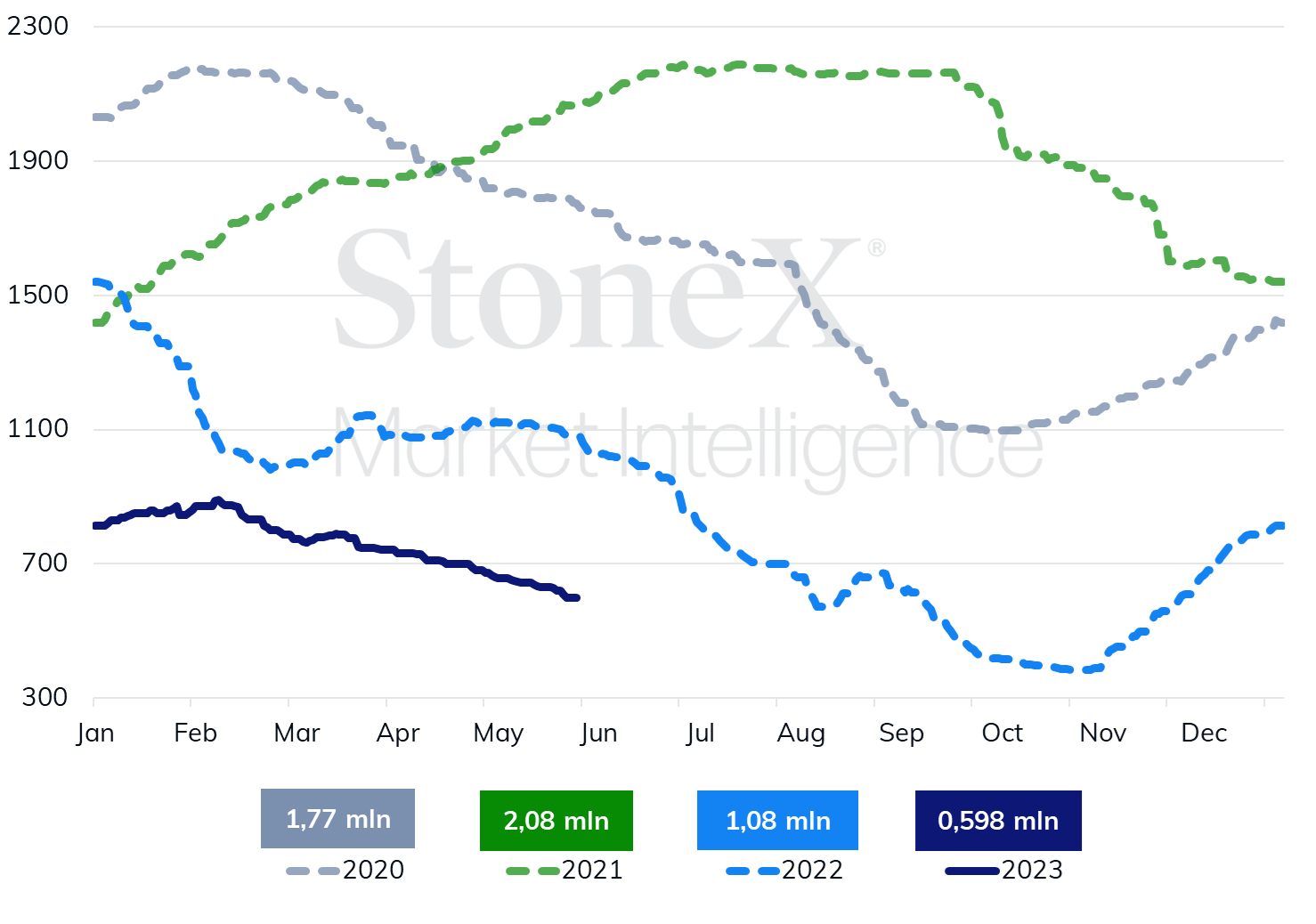
It is worth noting that the recent reductions in certified Arabica coffee stocks, which fell to the lowest level in about six months, have again attracted the market's attention. Last Friday, certified stocks on the ICE-New York retreated from the 600,000 bags since November last year, totaling 598,000 bags. In May, the stock market dropped 81 thousand bags (-12%), reducing 216 thousand bags (27%) in 2023. As will be discussed in the next session, the reduction of the differentials of the Brazilian market should provide a return of certification of Brazilian coffees on the stock exchange. However, until this process occurs, probably only in the second half of the year, smaller certified stocks tend to support prices.
Certified Arabica coffee stocks at ICE in New York
Business in the Brazilian spot market remains limited while participants wait for the progress of the new crop and directions regarding the global coffee supply and demand (S&D) balance. Another point that acts as a limitation to movements is the inverted future price curve, making it unfeasible to build and maintain coffee stocks. This scenario is even more complicated given the high level of interest rates, which increases the cost of carrying coffee stocks.
One of the main points is the uncertainty regarding the world's demand for coffee. Several players have reported difficulty finding new business and limited demand from coffee-importing countries. In addition, some indicators, such as the reduced volume of exports and the results of companies linked to the sector, have indicated that the observed inflation has impacted coffee consumption in the main consuming countries.
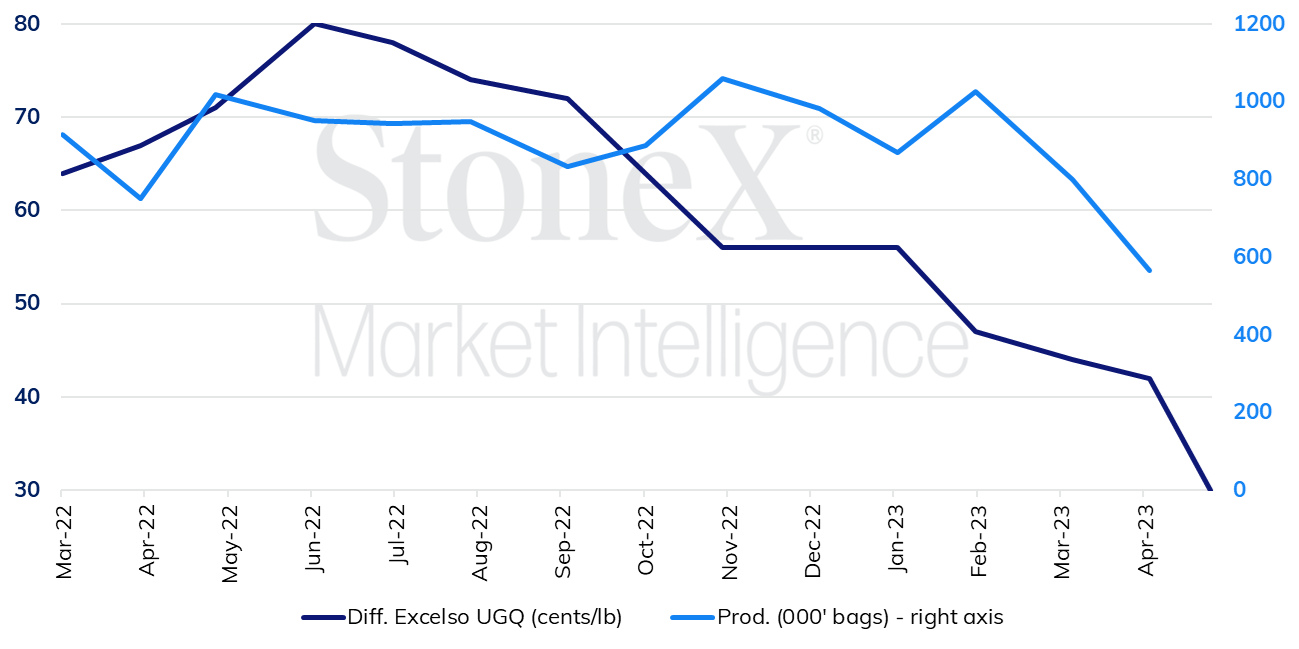
Accordingly, we can observe that this is not an exclusive condition of Brazil. Analyzing the price differentials in Colombia, it is observed that, even with the drop in the country's production, which was approximately 14 million bags in 2020 to something around 11 million in 2022, with a retreat accentuating even more in recent months, the price differential showed a strong reduction. For example, the differential of Excelso UGQ coffee went from +80 cents/lb in mid-June 2022 to +30 cents/lb in mid-May.
Price differentials and coffee production in Colombia
Over the past week, certified Arabica stocks have extended their decline and reached below 600 thousand bags. The fall in certified stocks is justified by the strengthened price differentials in producing countries, making coffee certification on the exchange less likely. However, if the differentials return to minimum levels as the Brazilian crop advances, it would be possible that new coffees would begin to be certified in the warehouses of the exchange. It is difficult to say whether this market condition will happen and when, but in the meantime, the drop in certified stocks supports coffee prices in the international market.
As the Brazilian harvest progresses, the greater availability of coffee associated with demand uncertainty may put pressure on coffee quotes in the coming weeks. However, given the participants’ memory of the frost of 2021, any new cold snap, even without the potential to cause frost on crops, can be a supporting factor for quotes. In addition, the release of the reports of the USDA Attachés to the remaining countries, including Brazil, and the release of the final report on 06/22, should indicate a large surplus for 2023/24 and contribute to pressure prices.
On the other hand, the lower availability of Robusta coffee in Vietnam, which, according to sources, has presented a lower carryout and the prospect of a tight S&D balance for the type, still follows as a bullish factor for prices in London. In addition, as mentioned above, the USDA's Attaché report on Vietnam adjusted the estimate for production in 2022/23 and pointed to an increase in 2023/24. However, the report for Indonesia adjusted the 2022/23 crop by 4.4% but pointed to an 18% drop in 2023/24 to 9.7 million bags due to excess rainfall in the country.