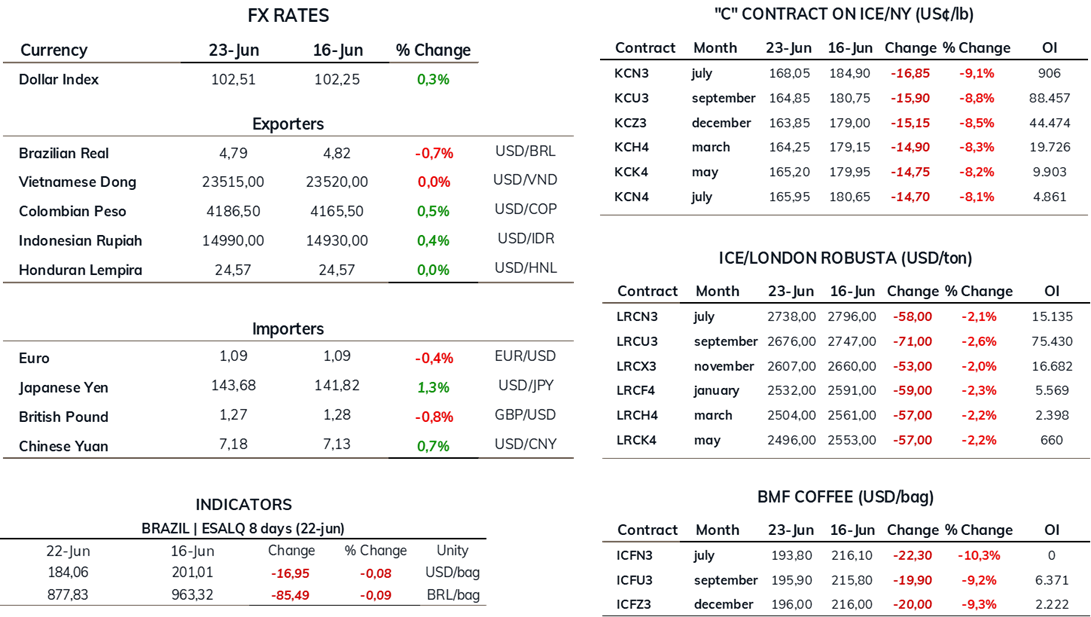
• Arabica futures retreated 1590 points (8.8%) on the week to US¢ 164.85/lb.
• Robusta retreated USD 71/t (2.6%) to USD 2676/t.
• Cepea indicator for Arabica ended the week with a drop of 11.6% to BRL 851.56/bag.
• Cepea indicator for Robusta retreated 5.1%, ending Friday at BRL 691.96/bag.
• Funds settle 5.36 thousand contracts in New York.
• In London, funds added almost 2 thousand net long contracts.
• Prospect of higher global supply weighs on quotes.
• USDA estimates 23/24 production at 174.3 million bags.
• USDBRL drops in the week and remains near 1-year lows.
• Maintenance of Selic by Copom supports the Brazilian currency.
• Focus bulletin continues to show improvement in Brazil's expectations for GDP and inflation.
• US GDP, Powell talks, and China PMIs are the week's highlights.
In the previous week, future coffee prices have fallen amid the prospect of better supply and improved weather conditions in Brazil. Concern about the weather was one factor supporting coffee futures prices, especially amid the approach of a cold snap in recent weeks. However, there are no signs of risk from the temperature drop perspective. In addition, the dry weather condition favors the harvest progress in the country.
Earlier this week, the Coffee Network released a report with its expectations for the 2023/24 crop, indicating a surplus of between 6.8 million and 7.8 million bags. On June 22, the USDA released its report that indicated a surplus of 4.1 million bags in the 2023/24 crop year. The context mentioned above, evidencing a more comfortable supply and demand balance condition in the coming season, contributed to a strong selloff of contracts by speculative agents in New York, putting pressure on coffee quotes in the week.
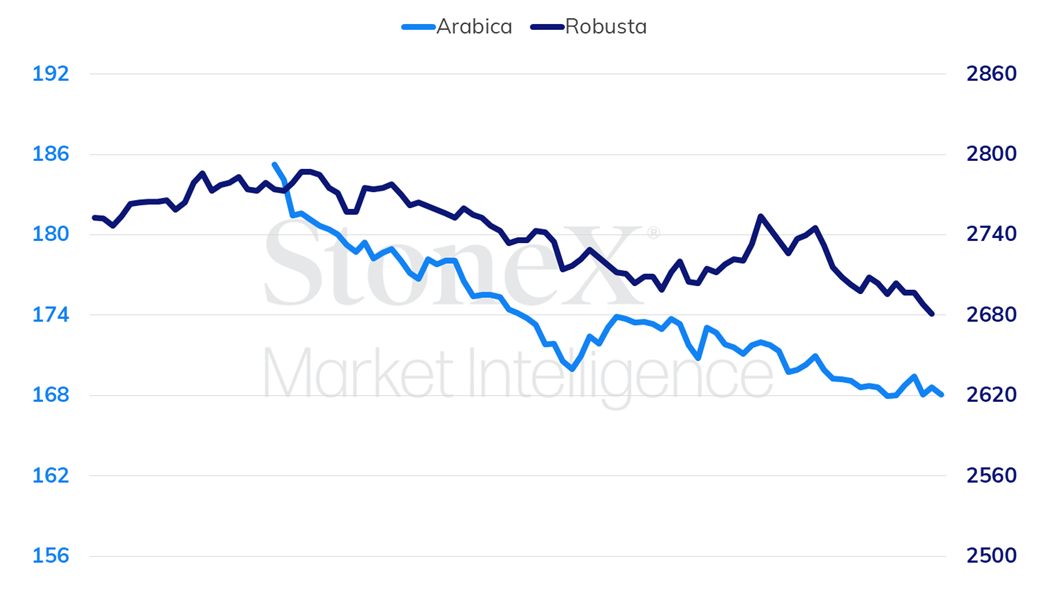
In New York, the most active contract, September/23, showed a drop of 1590 points (-8.8%), closing Friday's session (23) at US₵ 164.85/lb, reaching the lowest value in six months. In London, the most active Robusta contract posted losses of USD 71/t (-2.6%), ending the week at USD 2676/t.
Weekly Intraday (most active contract) - June 19 to 23
In Brazil, domestic prices followed moves seen in New York and London, ending the week lower. The Cepea indicator for Arabica showed a drop of 11.6%, closing at BRL 851.56/bag. For robusta, the Cepea indicator ended the period at BRL 691.96/bag, representing a drop of 5.1% in the week. The sharpest fall in the spot market is associated with the dollar depreciation in the week.
The CFCT/CIT report released on Friday (23) showed that the funds sold 5.36 thousand contracts between June 13 and 20, with a net long position of 10.69 thousand on June 20. On the other hand, in London, the funds extended their net long position by almost 2,000 contracts between June 13 and 20, when they had a net long position of more than 48,000 contracts.
As anticipated in other editions of this report, the release of the Attaché reports and the USDA estimates for the supply and demand balance would indicate a surplus for 2023/24, contributing to the prospect of greater supply and pressure on coffee quotes. From now on, the weather in Brazil will return to the center of attention, and any possibility of a temperature drop can support prices. As we progress, attention will turn to flowering in Brazil, which may indicate the 2024/25 crop.
Coffee production in Colombia totaled 806 thousand bags in May, representing a drop of 21% compared to May 2022. However, production in May showed recovery compared to April's production, which totaled 566 thousand bags. In the accumulated of the last 12 months, Colombia produced 10.67 million bags, representing a decrease of 14% compared to the same period in the previous year.
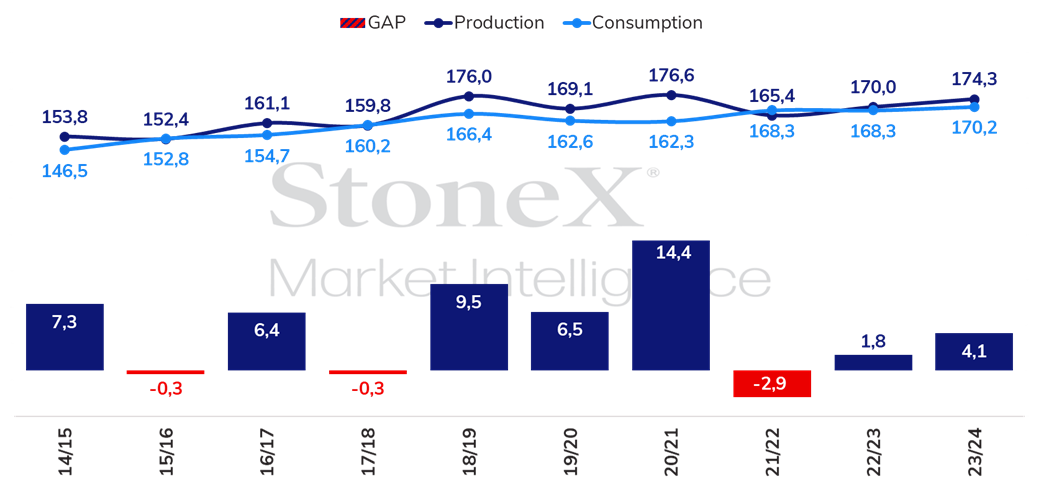
According to the report, Brazilian production in 23/24 should total 66.4 million bags, 3.8 million bags higher than in 22/23. Arabica production was estimated at 44.7 million bags (+12.3%), while Robusta production was 21.7 million bags (-4.8%). In Vietnam, production is expected to advance by 1.6 million bags to 31.3 million, reflecting favorable weather in the country.
In Central America, production is expected to total 17.9 million bags, almost unchanged from the previous crop. However, the agency projects a slight recovery for Colombian production, which should recover 300 thousand bags to 11.6 million bags. One surprise observed was the adjustment made by the USDA for Honduras' production relative to the number released a month earlier. While in Attaché's report, released in May, the agency adjusted the country's production in 2022/23 from 6 million to 7.2 million bags and projected 2023/24 production to 7.9 million bags; in this latest report, the country's production in 2022/23 was estimated at 5.4 million bags and in 2023/24 at 5.5 million bags.
In Indonesia, production was estimated at 9.7 million bags, representing a decrease of 2.2 million compared to the previous crop. The biggest drop is in Robusta production, expected to fall by 2.1 million bags to 8.4 million in 2023/24.
In the macro environment, not even the dollar depreciation could hold back the coffee drops in New York. Influenced by the stricter tone of the members of the Central Bank of Brazil regarding the country's monetary policy and the approval of the fiscal framework bill in the Senate, the real ended the last week with a 0.9% drop in the Brazilian foreign exchange market, quoted at BRL 4.77, remaining at its lowest levels in just over a year.
Last Wednesday (21), the Central Bank of Brazil's Monetary Policy Committee (Copom) maintained the basic interest rate (Selic) in Brazil at 13.75%. Despite withdrawing the possibility of new highs from its statement, the maintenance was countered by agents, who believed that the Central Bank could start a cycle of rate cuts, while the country's economic indicators have surprised positively, while inflation has shown deceleration. However, for members of the Copom, inflation is experiencing a slow slowdown, indicating that it should continue with interest rates at a high level for longer, which reduced the stakes with a possible cut at its next meeting in August. This Tuesday (27), the Central Bank will publish the minutes of the Copom meeting, which should provide more details about the committee's position on the start of the Selic reduction cycle.
The Focus Bulletin, which shows the average projections of Brazilian institutions concerning the economy, has received positive revisions in recent weeks, which has supported the Brazilian currency. In Monday's Bulletin, agents' projections for the National Broad Consumer Price Index (IPCA) retreated for the sixth consecutive week to 5.06% by the end of the year, against a projection of 5.12% last week and 5.71% a month ago. On the other hand, GDP received the seventh consecutive positive revision, advancing to 2.18% at the end of the year, up from 2.14% last week and 1.26% last month.
The bill's progress for the fiscal framework should be on the agents' radar this week. After being approved with amendments in the Senate last week, the bill will return to the Chamber of Deputies for further analysis before final approval. The point of attention is the disagreements between senators and deputies about the changes, which culminated in the postponement of the consideration by the president of the Chamber, Arthur Lira, to the second week of July. Accordingly, any new disagreements between the houses and a possible new extension of the final vote have the potential to have a bullish impact on the dollar.
Abroad, the economic calendar includes important indicators that can influence the movements of global markets, such as the release of the final revision of the United States Q1 GDP, on Thursday (29) and the PMIs for the Chinese economy on the same day. In addition, on Wednesday (28), the Federal Reserve Chairman, Jerome Powell, is expected to speak, which may impact expectations for the next steps of the US Central Bank's monetary policy.