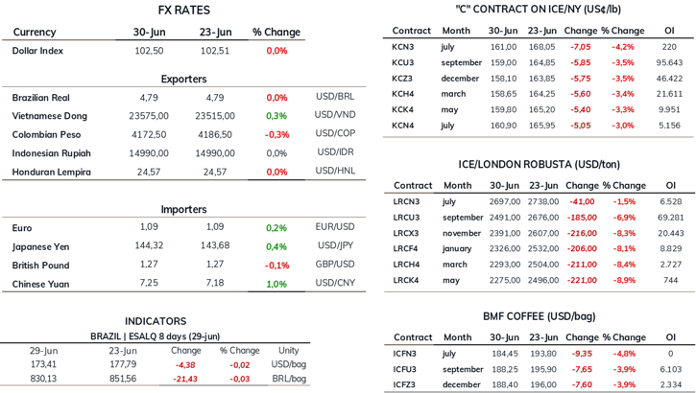
• Futuros de café arábica recuaram 585 pontos (3,5%) na semana, para US¢ 159,00/lb.- Arabica coffee futures retreated 585 points (3.5%) in the week, to 159.00 c/lb.
• Robusta coffee prices retreated USD 185/t (6.9%) to USD 2491/t.
• The Cepea Arabica indicator ended the week with a 3% drop, at BRL 825.59/bag.
• The Cepea indicator for Robusta coffee fell 6.9%, ending Friday quoted at BRL 644.31/bag.
• Funds liquidated 14,600 contracts in New York
• Expectation of surplus in 2023/24 is bearish for prices
• Current scenario for the weather in Brazil is favorable for coffee
• In the next weeks, the agents' attention will turn to coffee flowering
• Dollar drop in June increases pressure over coffee in the domestic market
• Cepea Arabica coffee indicator reached the lowest levels in almost two years
• Dollar in the second half of the year can be decisive for the recovery of domestic prices
As previously mentioned in previous editions of this report, the prospect of increased supply in 2023/24, particularly following the release of USDA reports on June 22, which pointed to a surplus of 4.1 million bags in 2023/24, amid a scenario of potentially weakened demand, has put pressure on coffee prices in the international market. Last week, coffee futures prices completed the third week of decline, reaching the lowest value in almost six months in the Arabica market.
The cool down of the agents' concerns regarding the weather also contributed to the losses. While the coming cold waves support prices even without risk of frost, the current scenario for the weather is comfortable, without concerns about the arrival of new polar masses and with a dry condition, which also favors the harvest progress.
Moreover, the excessively long position of the funds, especially in London, even with the scenario of supply restriction for the coffee type, already indicated the chance of correction, while the funds' position indicated the possibility of speculative liquidation by the agents.
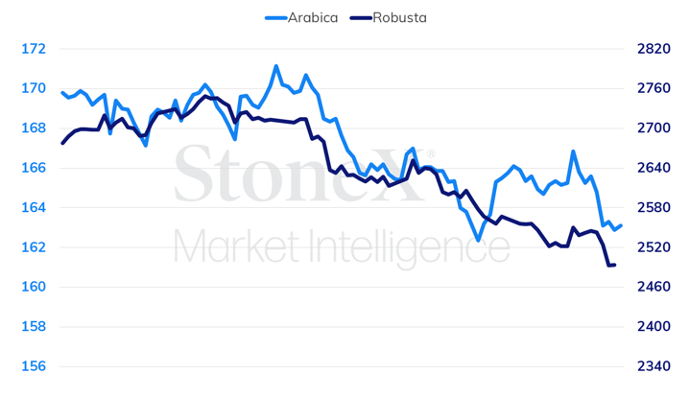
In New York, the most active September contract fell 585 points (-3.5%), closing Friday (30) quoted at 159.00 c/lb. In the month, Arabica futures prices recorded losses of 1965 points (-11%). In London, the most active Robusta contract posted losses of 185 USD/t (-6.9%), ending the week quoted at USD 2491/t. In the monthly variation, Robusta coffee prices in the London terminal recorded losses of USD 65/t (-2.5%).
Weekly Intraday (most active contract) – Jun. 26 to 30
In Brazil, prices charged in the domestic market followed the movements seen in New York and London, ending the week in decline. The Cepea indicator for Arabica fell 3%, closing quoted at BRL 825.59/bag. For Robusta, the indicator ended the period quoted at BRL 644.31/bag, representing a drop of 6.9% in the week.
The CFCT/CIT report released last Friday showed that funds sold 14,600 contracts in New York between June 20 and 27, having on June 27 a net short position of 3,900 contracts. In London, the funds sold more than 1,100 contracts between June 20 and 27, but still maintained a net long position of almost 47,000 contracts.
With no major changes in fundamentals, the prospect of a surplus in the global supply and demand balance, particularly for Arabica coffee, will act as a bearish factor. However, the lower supply of Robusta coffee tends to limit losses, a scenario that may cool down with the start of the Vietnamese crop at the end of the year. In the coming weeks, the weather market will again take center stage, especially with an eye on the flowering season in Brazil.
In addition, in the next two weeks, attention will be focused on Brazilian coffee export data for June, which will be released by Cecafé. Since the beginning of the year, Brazilian exports have been falling when compared to the previous year. However, the expectation is that exports will recover in the second half of the year.
Last week, the dollar broke off a streak of five consecutive weeks of devaluation in the Brazilian exchange market, achieving a subtle recovery of 0.2% to end Friday (30) quoted at BRL 4.789. However, the American currency ended the month of June with a significant monthly decline of 5.6%, against the BRL 5.05 registered at the end of May.
The gains seen in recent weeks amid the improved outlook for the Brazilian economy, with the Focus Bulletin registering successive revisions to a more optimistic path for the country's GDP and IPCA, were mainly due to better-than-expected results for the activity level, a slowdown in the acceleration of consumer prices, and the outcome of the proposal for the new fiscal framework in Brasilia.
In this sense, Arabica coffee prices in the physical market came under strong pressure throughout the month, while coffee on the exchange closed the month with losses of 11.0%. The dollar fell 5.6% and the Cepea indicator for Arabica coffee ended June with a significant loss of R$ 165 or 16.5% in the average bag value, reaching its lowest level in almost two years, since July 2021. Accumulated in the year, the devaluation is BRL 212 or 20.5%.
Cepea Arabica coffee indicator trend (BRL/bag)
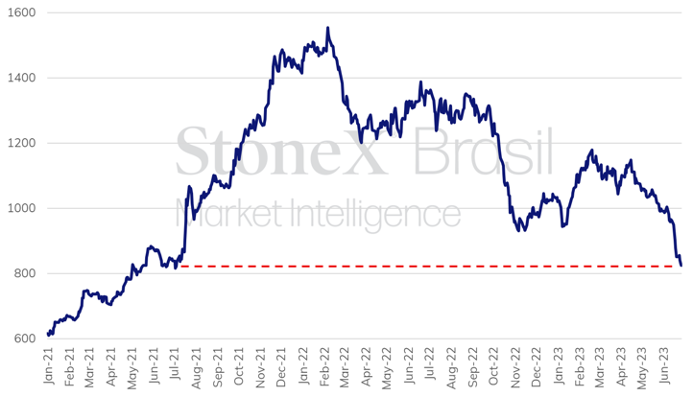
This change highlights the importance of the US dollar variation in coffee prices in Brazil's domestic market, similar to the effect that made the indicator reach all-time highs in mid-2022. In this sense, the movements in the second half of the year will also be crucial. On the one hand, if Brazilian indicators continue to show significant results and risk aversion in the global macroeconomic scenario does not undergo major increases, it is possible that the Brazilian real will remain at a stronger level.
On the other hand, seasonally, the second half of the year usually has a less intense level of commodity exports and a greater outflow of foreign exchange from the country due to profit remittances made by multinationals, which may bring corrections to the currency. It is worth remembering that the Focus Bulletin currently shows that agents project the exchange rate to end the year at BRL 5.00, which could contribute to the recovery of coffee prices in the domestic market.