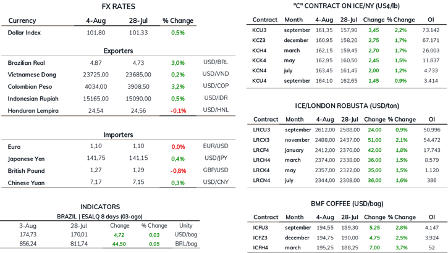
• Sept/23 Arabica coffee contract rises 345 points (2.1%,) to 161.35 c/lb.
• Nov/23 Robusta coffee contract rises USD 51 (1.7%) in London to USD 2488/t.
• Favored by the high dollar, Cepea indicator for Arabica coffee rises 3.9% to BRL 843.26/bag.
• Cepea indicator for Robusta coffee is up 2.5%, ending at BRL 658.64/bag.
• Market waits for official July export data, with expectations of a drop
• Strong rise of 3.0% in the dollar pressures prices in the second half of the week
• Copom reduces basic interest rate by 50 basis points to 13.25% p.a.
• CPI and IPCA releases should affect macro and FX environment in the week
• Coffee companies report mixed results
• JDE results point to consumption problems in Europe
Without presenting a definitive trend and oscillating between losses and gains, coffee prices ended last week on an upward trend, with indications of more restricted supply by producers in the short term prevailing for the increase, while the strong dollar gain in the Brazilian market and signs of weakened global demand acted as bearish factors. In this context, the Sep/23 contract closed the period quoted at 161.35 c/lb, up 2.2% from the previous week. On the other hand, the most active contract for Robusta coffee, Nov/23, closed the period quoted at USD 2437/t, a weekly increase of 2.1%.
In Brazil, the Cepea indicator for Arabica reflected the positive exchange rate movement and rose 3.9% to end the period quoted at BRL 843.26/bag while the indicator for Robusta posted an appreciation of 2.5%, ending Friday quoted at BRL 658.64/bag.
Weekly Intraday (most active contract) – July 31 to August 4
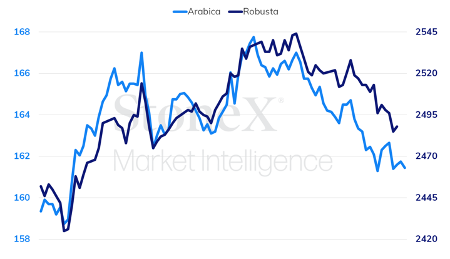
Following the harvest performance and with no signs of significant drops in temperatures or frost risks, the market has been trading more sideways while waiting for news. This week, Cecafé is expected to release data on coffee exports for July, which, according to previous data, should be below the same month last year, against an expectation of a stronger start to the crop. As mentioned in the last weekly report, the declines, if indeed confirmed, may be partly justified by producers holding on to their coffee as they wait to find better prices in the market. However, there is still concern about consumption, evidenced in some regions of the globe by the release of some companies' results in the industry.
In addition, it is worth noting that the gains achieved on the exchanges occurred until Wednesday (2), with the last two trading sessions of the week responding mostly to exchange rate and demand indicators, which pressured prices downwards. The Brazilian currency registered a strong weekly advance of 3.0%, ending quoted at BRL 4.875. Advances in the dollar against the Brazilian real increase the value of coffee in the domestic market, which tends to lead to price corrections on the exchanges for a greater balance in the physical market.
The dollar's rise was mainly influenced by the decision of the Monetary Policy Committee (Copom) of theBrazilian Central Bank on Wednesday (2), which reduced the basic interest rate (Selic) from 13.75% to 13.25% p.a., in addition to indicating a new adjustment of the same intensity for the September meeting. The prospect of a narrowing interest rate differential between the Brazilian economy and the US economy tends to reduce the attractiveness of the Brazilian currency, driving investment flows out of the country.
Despite the prospect of a Selic rate cut, which at first acts as a bullish factor for the dollar, the outlook for the Brazilian economy has been improving. The Central Bank's latest Focus Bulletin raised projections for the country's GDP growth at the end of the year to 2.26%, up from 2.24% last week and 2.19% a month ago. At the same time, the report shows that agents project an exchange rate of BRL 4.90 at the end of the year, up from BRL 4.91 a week ago and BRL 5.00 a month ago.
Macro indicators should also continue to have an influence. Last week, the release of the July PMIs showed a weakened condition for the level of activity in the main global economies, especially for the manufacturing sector. In the coming days, the highlight abroad will be the release of the July Consumer Price Index (CPI). Analysts' projections point to a moderate reading for the third consecutive month, with a median expectation of a monthly increase of 0.2%, which would represent an annualized rate below 2%, the target sought by the Federal Reserve. If these forecasts are confirmed, the data should reinforce the interpretation that inflationary pressure in the country is easing and that the Fed's interest rate hike cycle should be over, which could weaken the US currency.
Similarly, in Brazil, investors will follow the release of the National Broad Consumer Price Index (IPCA) for July, which is expected to come in close to zero for the second consecutive month, reinforcing the perception that price pressure in Brazil is moderating and there is room for the Central Bank to continue its interest rate cut.
Last week saw the release of some results from some of the large companies in the coffee market. The results, while not entirely bad, were below expectations.
One of the highlights in this regard was JDE Peet's, a group that owns a number of major brands of roasted and ground coffee and capsules in the world. The group recorded an increase in revenues of 3.5% in the first half of 2023. However, a 6.8% increase in product prices contributed to this result, while there was a 3.3% decrease in sales volume.
The main factor that draws attention is the result for Europe, which despite recording a 0.3% increase in revenues, due to an 8.9% increase in prices, showed a reduction of 8.6% in the volume sold during the period. As mentioned last week, Europe is the region that has been most concerning in terms of inflation, with cumulative Eurozone inflation at 12%, according to Eurostat data, standing at 12.8% in June. JDE's result is further evidence of the difficulties the region is facing in maintaining consumption levels.
Starbucks, on the other hand, showed progress in sales, but less than market participants' projections suggested. Same-store revenues (excluding new store openings) grew 10%, versus estimates of 11.1%. In North America, revenues rose 7%, with a 6% increase in average ticket. While the result does not make its volume performance clear, it indicates that there must have been at least a slight increase in sales volume. In the rest of the world, revenues increased by 24%, driven by strong growth of 46% in the Chinese market.