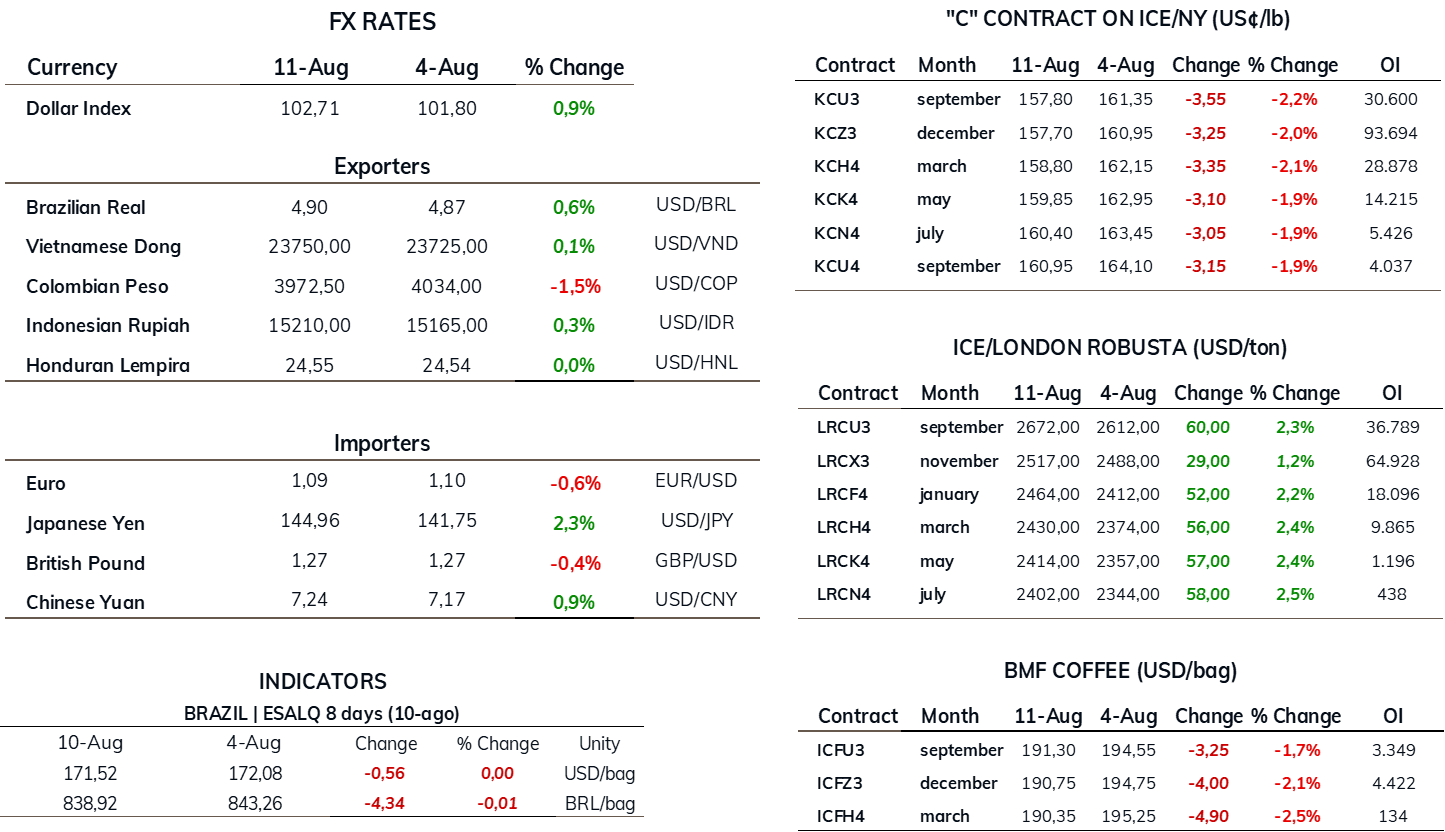
• Arabica coffee futures for December retreated by 2.0% to 157.70 c/lb. Robusta coffee prices rose 1.2% to USD 2517/t.
• The Cepea indicator for Arabica coffee ended the week down 2.1%.
• The Cepea indicator for Robusta coffee gained 1.4%.
• Cooxupé: harvest in the operating areas is at 75%.
• Restriction of Robusta coffee in Asia continues to be a bullish factor for prices.
• Colombian exports fell 17% in July.
• Flowering and weather in Brazil should become a key topic in the coming weeks.
• Brazilian shipments increased in July.
• Robusta coffee exports increased by 254%.
Last week, coffee futures prices showed divergent behavior on the New York and London exchanges. For Arabica coffee in New York, prices ended the week down, pressured by the progress of the harvest in Brazil: according to Cooxupé, the harvest in its operating area reached almost 75% last week, a faster pace than last year, when it had totaled 71.7% by the same time. On the other hand, the restriction of Robusta coffee supply in Asia continues to be a bullish factor for prices at the London terminal.
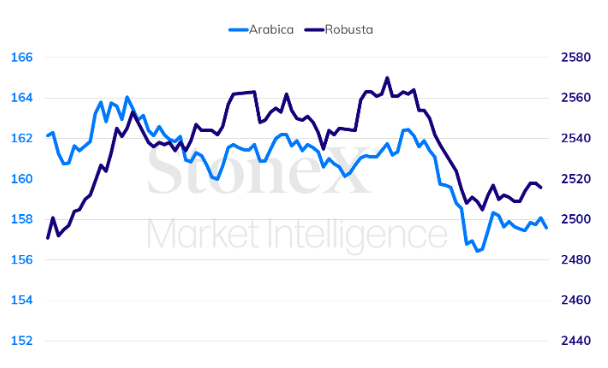
In New York, the most active Arabica coffee contract, expiring in December, ended last week down 325 points (2.0%), closing the period at 157.70 c/lb. In London, the most active contract, for November, ended with gains of USD 29/t (1.2%), quoted at USD 2,517/t.
Weekly Intraday (most active contract) – August 7 to 11
Following the movements in international markets, Arabica coffee prices in the Brazilian domestic market ended the period in decline, while prices for Robusta rose higher. The Cepea index for Arabica coffee fell by 2.1% and closed Friday (11) quoted at BRL 835.83/bag. For Robusta coffee, the Cepea indicator increased by 1.4%, closing the period quoted at BRL 666.62/bag.
From a fundamentals point of view, there are 3 major key factors: limited supply for Robusta coffee, coffee demand, and the outlook for the Brazilian flowering season, which will soon become a focus. Regarding Robusta coffee, the drop in production in Indonesia and the limited supply should remain a bullish factor until at least the beginning of the harvest in Vietnam, scheduled for mid-November. In addition, in this context, Brazilian Robusta coffee takes a major role in the world market, as will be discussed later in the session on Brazilian exports.
Demand continues to be a key theme, given the impact of inflation on retail coffee prices in the US and Europe. While the financial results of the companies in the sector indicated an increase in consumption in some regions of the world, the scenario was different for the United States and Europe, whose results indicated an increase in revenues for some companies due to the rise in prices, but losses in volumes sold. In addition, one of the countries that has been impacted is Colombia, whose July exports fell 17% amid falling differentials.
While the points mentioned above are impacting the market at the moment, the start of flowering in Brazilian Arabica crops will become the focus in the coming weeks. As flowering is a critical stage in the development of the coffee crop, its quality will indicate the production potential for the 2024 crop. From this time, the return of rains in the coffee belt will be able to initiate the first flowering in Arabica coffee crops.
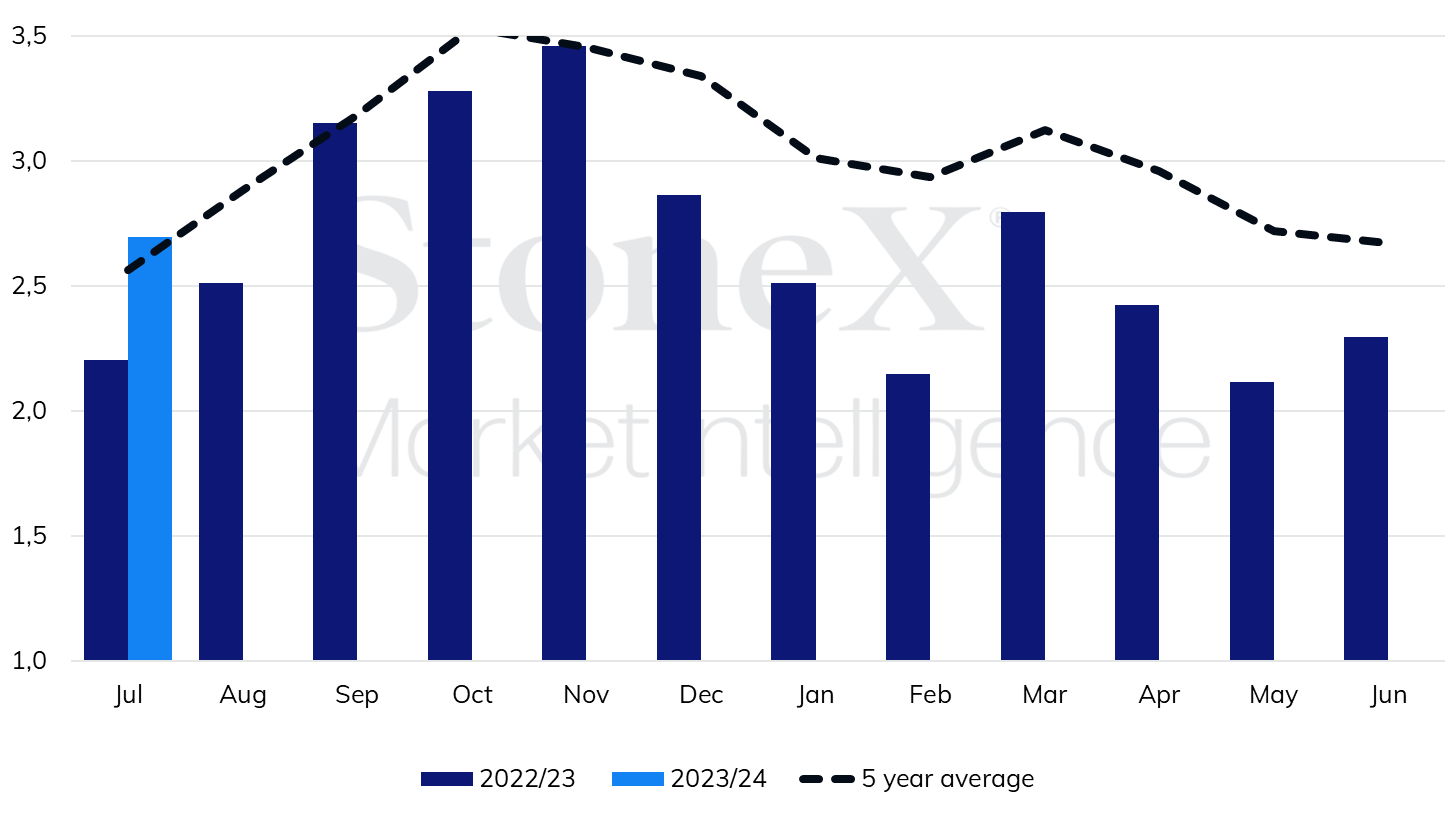
Last week, Cecafé released data on Brazilian coffee exports in July, which recorded the first growth in shipments for 2023 compared to the previous year. The first month of the 2023/24 crop year totaled 2.99 million bags shipped, a volume 18.7% higher than those observed in 2022, and the best start to the crop since the record season of 2020/21. Arabica coffee totaled 2.190 million bags, an increase of 6.5% compared to the same month last year and 1.1% compared to the five-year average.
Robusta coffee stood out with a total of 505,000 bags shipped, a 245% increase over the same month last year, when 146,000 bags of the variety were exported, and 27% above the five-year average. It is worth noting that this was the highest volume exported since September 2020, and that Robusta accounted for 18.7% of all green coffee exported in July, the highest share since June 2020.
Brazilian raw coffee exports (million bags)
A The explanation behind the strong exports of Robusta is a fact already alerted in previous reports, which addressed the differentials of coffee prices in major producers of the variety in relation to prices on the London exchange. Since the second quarter of the year, differentials in Vietnam, the largest global producer of Robusta coffee, and Indonesia, the third largest producer, have been advancing. Since mid-March, Vietnam's differentials have widened from USD 30/t to reach USD 370/t in early August, an increase of over 1100%. Indonesia showed a differential of USD 450/t at the beginning of the month, an increase of 460% since mid-March. Reduced stocks, the inter-crop period in Southeast Asian countries and the drop in Indonesian production have raised prices in the physical market, positively affecting differentials and reducing the competitiveness of these origins.
In the same period, Brazil has shown an inverse trajectory, with Robusta coffee prices falling in the domestic market, while Arabica quotes have been declining in the country and availability has increased with the recently harvested crop. In this scenario, the Brazilian differentials went from USD 430/t in January to USD -30/t in July, presenting a drop of 107% and making Brazilian Robusta by far the most competitive in the international market, a factor that tends to continue favoring the nation’s exports at least until the next Vietnamese harvest in mid-November.