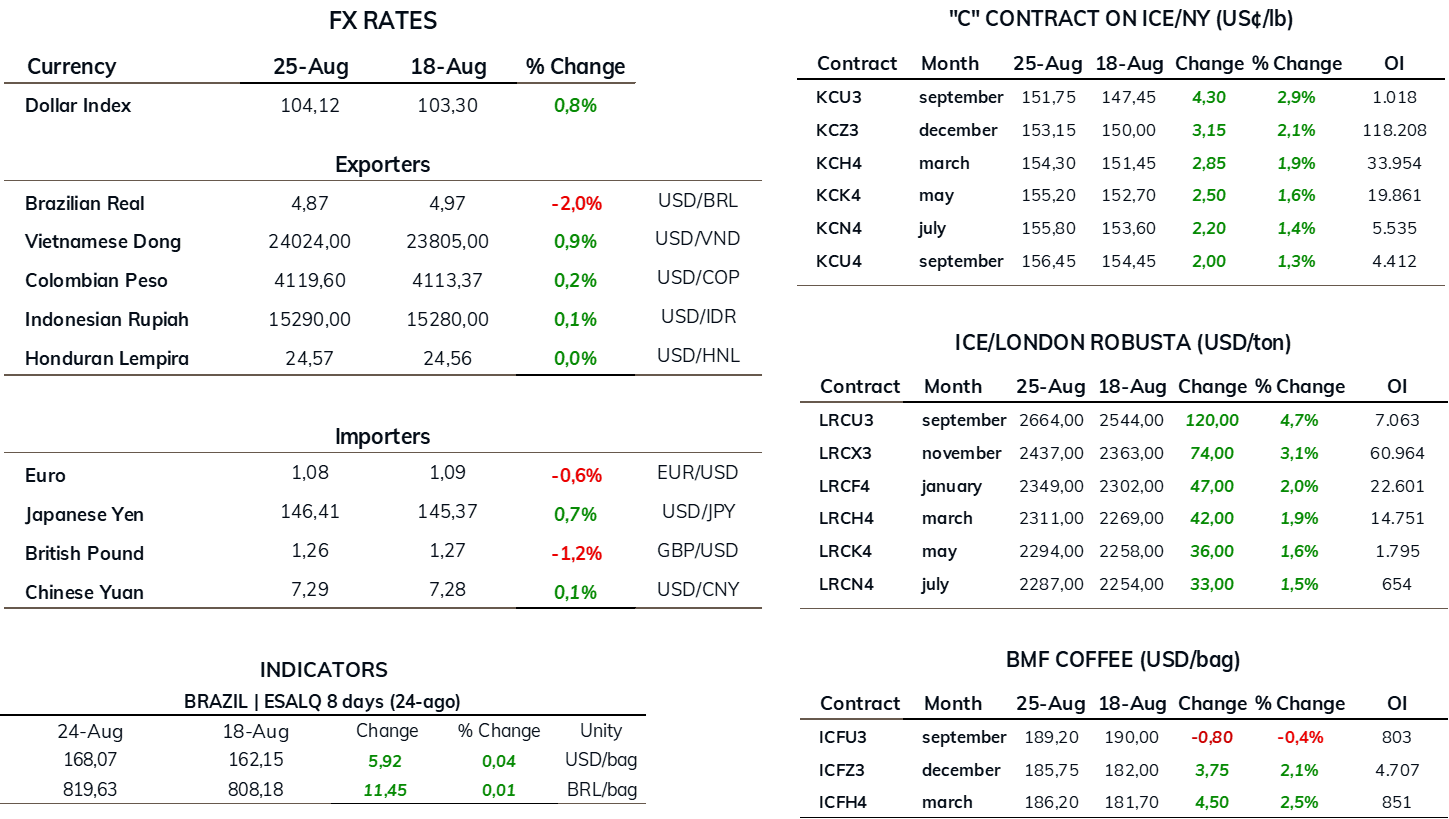
• Arabica coffee ends the week quoted at 153.15 c/lb, up 2.1%
• Robusta coffee prices up 3.1% to USD 2437/t
• Cepea indicator for Arabica coffee ended the week up 0.3%
• Cepea indicator for Robusta coffee rose 0.4% to BRL 646.98/bag
• Lower dollar supported the rise in prices
• Agents' attention is focused on the weather in Brazil
• Progress in Brazilian exports could be bearish for prices
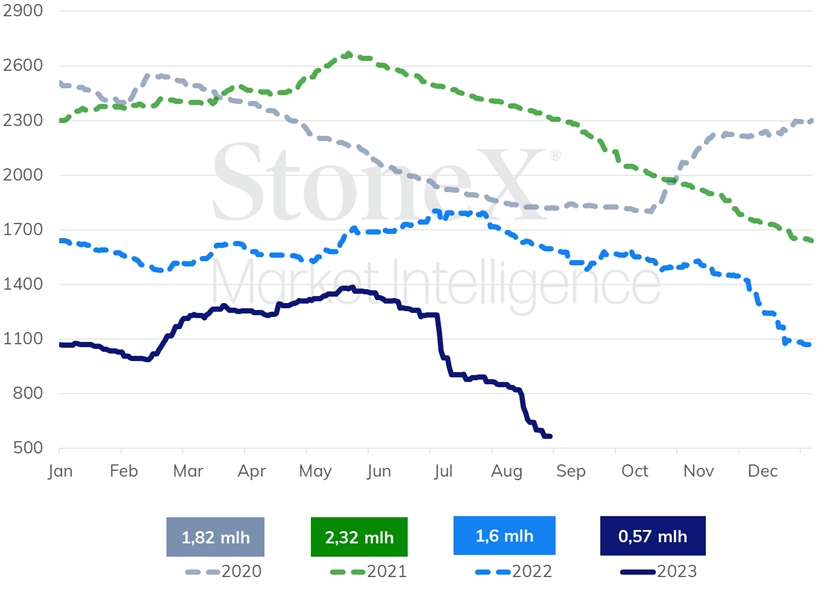
• Certified Robusta stocks fell by 76,000 bags in the week
• Consumption problem is bearish for prices
• Data indicates weakened imports in the US and Europe
Last week, coffee futures prices showed substantial gains in both New York and London, reflecting technical and exchange rate factors in New York and the limited supply scenario for Robusta coffee. One of the main factors behind the increases was the 2.0% dollar drop, reflecting a favorable external scenario and the approval of Brazil's fiscal framework. In addition, the forecast for a strong El Niño and the possibility of an impact on Brazilian Robusta production, as presented in an analysis in the last coffee weekly report, contributed to a more positive sentiment for the variety's prices.
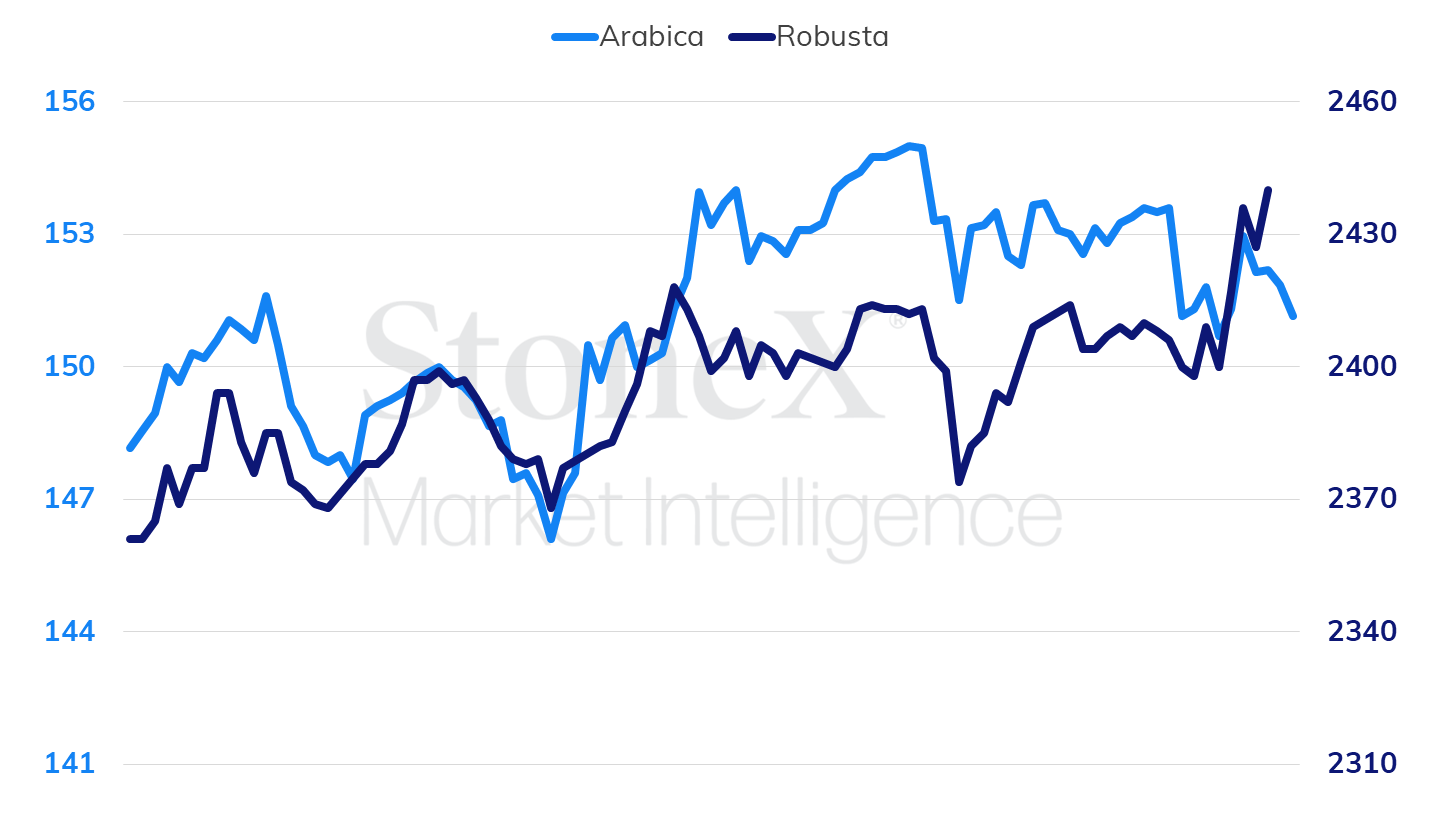
In New York, the most active contract, for December, rose 315 points (+2.1%), closing the session on Friday (25) quoted at 153.15 c/lb. On the Robusta market in London, the most liquid contract, expiring in January, ended the period quoted at USD 2437/t, representing an increase of 3.1% over the week.
On the Brazilian domestic market, Arabica and Robusta coffee prices ended the week slightly up. The Cepea indicator for Arabica was up 0.3% on Friday (25) at 810.7/bag. For Robusta, the indicator showed gains of 0.4% to BRL 646.98/bag.
Weekly Intraday (most active contract) – August 21 to 25
In terms of fundamentals, agents' attention is focused on the opening of the Arabica flowering season in Brazil, which should take place in the coming weeks. In addition, the possible impacts of El Niño on the weather are points of attention. As mentioned in the last weekly report, the scenario of a strong El Niño could have some impact on Brazilian Robusta coffee production.
In the coming weeks, Cecafé will be reporting on Brazilian coffee export data. The advance in the country's exports contributes to the feeling of better supply, which could have a negative effect on the commodity's international prices. Cecafé's latest report for the month of July pointed to a strong increase in exports, especially for Robusta coffee, a condition that should continue in the coming months, both due to the greater availability of coffee as the end of the harvest approaches and the market conditions for Brazilian Robusta coffee, which is currently the cheapest origin.
Last week saw substantial falls in certified stocks of Robusta coffee, reflecting the scenario of strengthened coffee differentials in Asia. Between the 20th and the 25th, stocks fell by 76,000 bags to a total of 568,000 bags in Friday's report. Extending the period analyzed to the whole month of August, there are already around 287,000 bags less than at the end of July, when ICE recorded 863,000 bags of Robusta. The lower availability of coffee in Vietnam and the drop in production in Indonesia have kept price differentials at high levels, discouraging the certification of new coffee by origins and stimulating the withdrawal of coffees from the exchange's certified stocks.
Certified stocks of Robusta coffee ('000 bags)
One factor that could weigh on coffee prices is the possible slowdown in consumption. Although there is a lack of transparency regarding various pieces of information, such as stock data in the US and Europe, some indicators have pointed to a possibly weakened demand. Company results data, for example, has in some cases indicated an increase in revenue due to price inflation, but a reduced volume of sales.
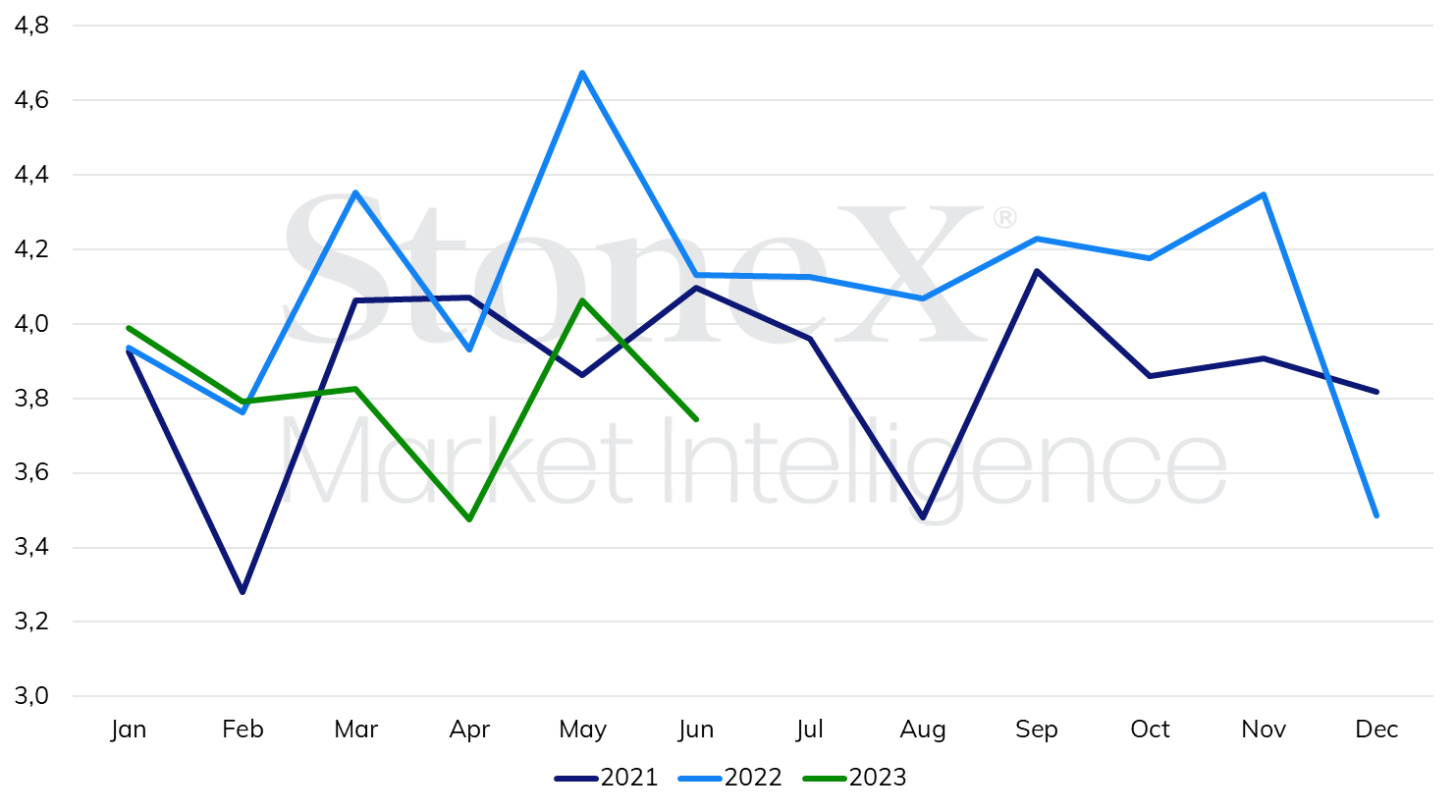
The European Union's coffee import data shows that imports fell by 12% in March, 11.6% in April, 13% in May and 9.4% in June. Considering the accumulated volume in the first half of the year, the European Union imported 22.9 million bags, 7.7% less than the accumulated volume in the same period last year. This scenario is no different for coffee imports into the US, which imported 10.9 million bags in the first half of the year, 11% less than in 2022.
Coffee imports by the European Union (million bags)
Generally speaking, while Robusta coffee still has bullish factors for the price, such as the lower supply of coffee in Asia and the possible risk to Brazilian production due to El Niño, amid the continuing fall in certified stocks, Arabica coffee prices may continue to be pressured. The approaching end of the harvest in Brazil and the expectation sourrounding the flowering season amid a scenario of better supply tends to put pressure on the prices of this type of coffee. In a scenario of favorable weather and a wide flowering in Brazil, there could be a feeling of optimism about the volume of the 2024/25 crop.