• Arabica coffee falls 800 points (5%) to end the week at 151.15 c/lb
• Robusta coffee prices fell 3.7% to USD 2461/t
• Cepea indicator down 3% for Arabica and 0.4% for Robusta
• Funds covered another 9,400 contracts in New York and bought 10,000 contracts in London
• Rain forecast for producing regions eases agents' concerns
• Conab released the results of the third survey for 2023
• NOAA updates its El Niño intensity projection models
• Macroeconomic environment weighs negatively on coffee prices
• Fed decision and updated quarterly projections increase global risk aversion
• Chinese real estate crisis could put pressure on commodities this week
After rising in the first two sessions of the week, mainly due to concerns about the weather in Brazil, coffee futures have been under pressure in the last three sessions. In the previous week and at the beginning of last week, coffee futures prices advanced due to weather forecasts that pointed to dry conditions and a heatwave in a large part of the coffee belt. As presented in the last edition of this report, after the flowering had started in the South of Minas, Mogiana and Cerrado regions, the condition of hot weather with temperatures above 34°C was a cause for concern, which encouraged agents to hedge their positions and supported price gains.
As shown in the latest COT/CFTC report, speculators covered more than 9,400 Arabica coffee contracts in New York between September 12 and 19, closing the period with a net short position of 15,600 contracts. In London, funds bought more than 10,000 contracts in the period, completing a net long position of 26,500 contracts.
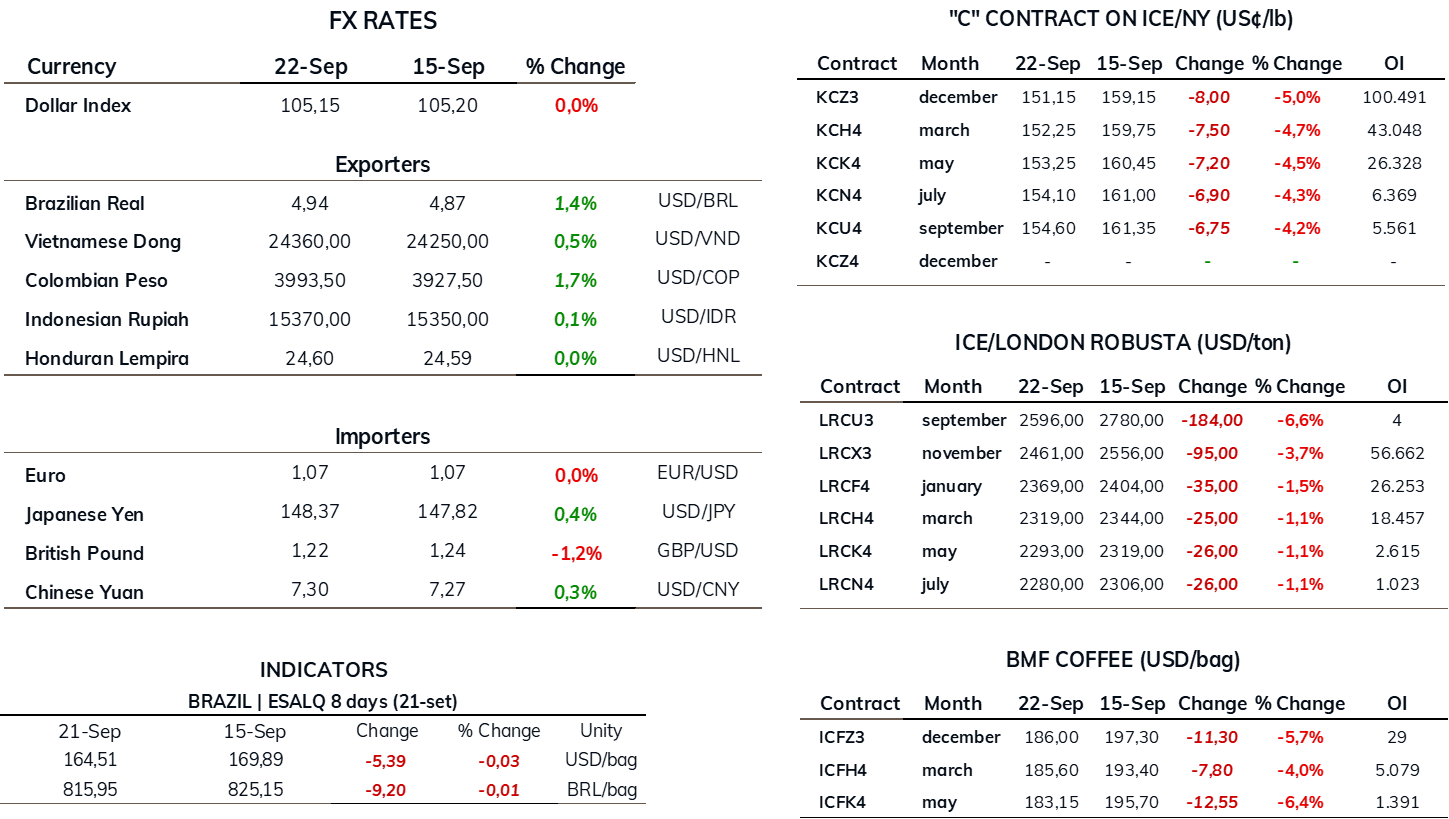
Indications that the rains will return towards the end of the month helped to ease concerns and encourage the liquidation of contracts. In addition, coffee futures prices suffered from a feeling of risk aversion amid the Fed's decision (read the macro session for more details). Prices also suffered from the 1.4% rise in the dollar over the week, which closed Friday at BRL 4.94.
In New York, the most active Arabica coffee contract ended the week down 800 points (5%), closing the period quoted at 151.15 c/lb. In London, the most active November contract ended the period down USD 95/t (3.7%), closing at USD 2461/t.
Weekly intraday (most active contract) - September 18 to 22
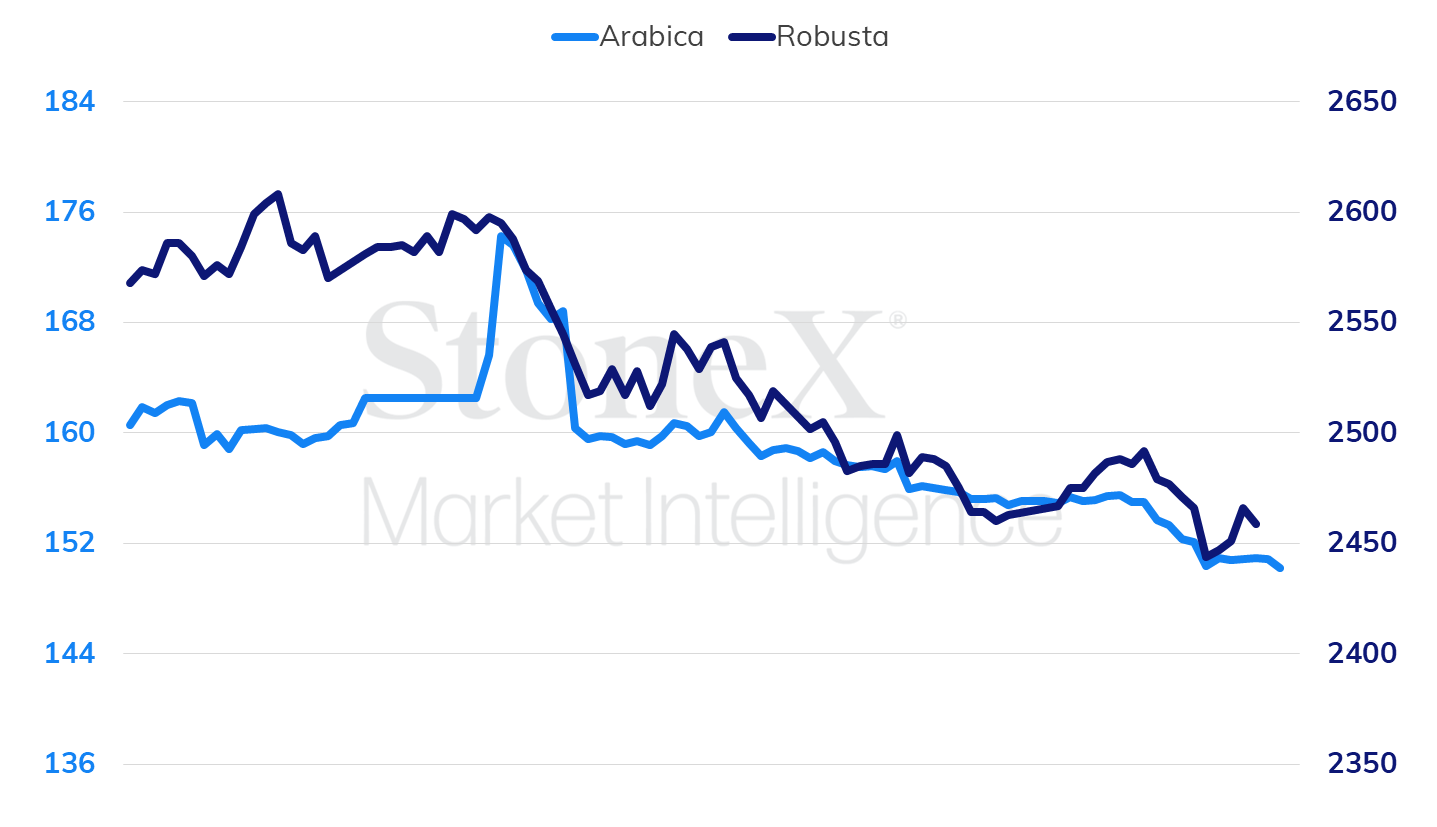
In Brazil, coffee prices on the domestic market followed the movements seen abroad and ended the week down. The Cepea indicator for Arabica coffee ended the week with losses of 3%, quoted at BRL 800.08/bag. For Robusta coffee, the indicator pointed to losses of just 0.4%, closing Friday at BRL 644.49/bag. The less intense fall in the Brazilian market was due to the dollar's rise during the week.
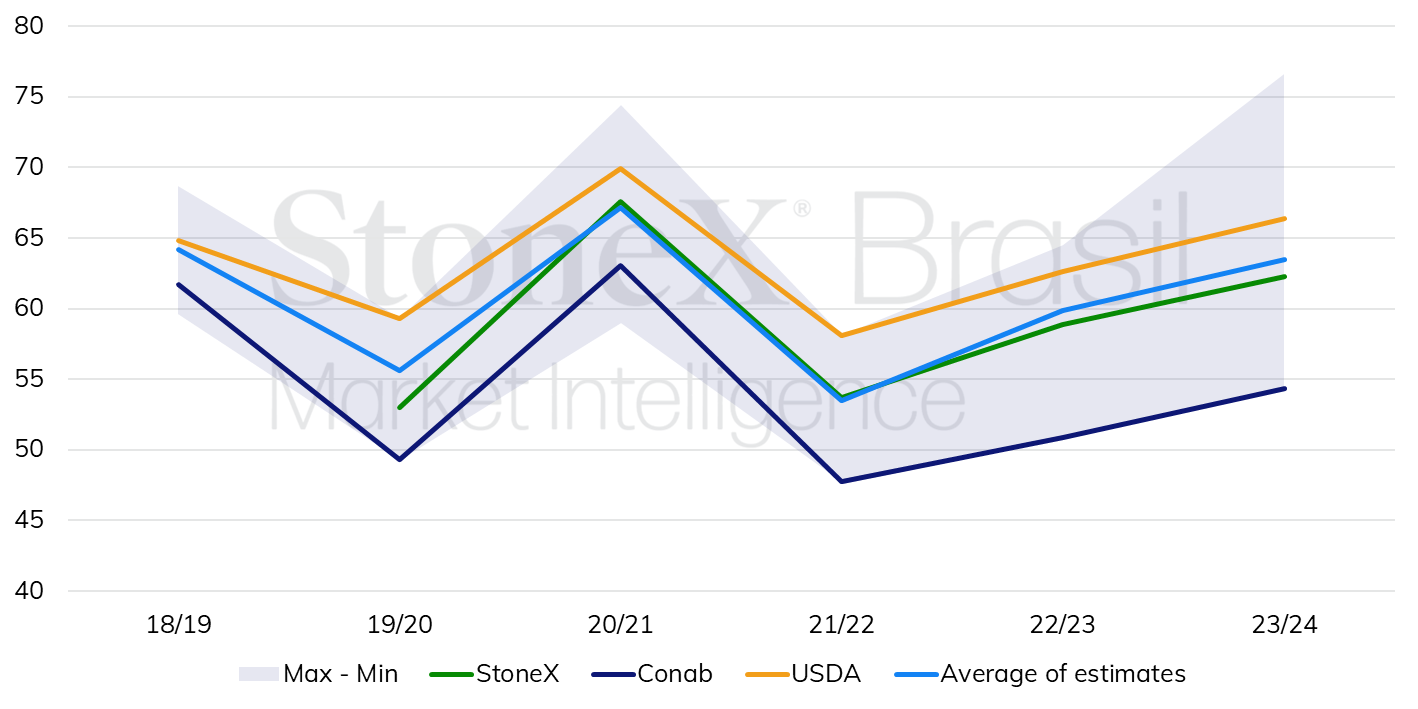
Last week Conab released the results of the third survey for 2023, which estimated Brazilian production in 2023/24 at 54.36 million bags, an increase of 6.8% compared to the previous crop. Arabica coffee production was estimated at 38.16 million bags, up 16.6% from last year. On the other hand, Conilon coffee production was estimated at 16.19 million bags, indicating a drop of 11%, due to production losses in the state of Espírito Santo.
Despite Conab's estimate, most market players believe that production will be higher. Among the available estimates, the lowest is Conab's, while the highest estimate, made by a private company in the sector, exceeds 70 million bags. The USDA estimated production at 66.4 million bags and average estimates from public and private organizations that StoneX has access to are 63.5 million bags. It is worth noting that the biggest difference between Conab's estimates and those of other market players is in the forecasts for Robusta coffee production. The average estimate for Arabica coffee is 42.4 bags/ha, 11% higher than Conab's figure. For Robusta coffee, the average is 21.1 million bags, 30% more than Conab's estimate.
In the report released by StoneX in February, after conducting a crop tour, Brazilian production was estimated at 62.3 million bags, of which 40.7 million bags were Arabica and 21.6 million bags were Robusta.
Range between estimates for Brazilian coffee production (million bags)
From the point of view of fundamentals, the weather issue in Brazil and the progress of the initial stages of development will continue to be the focus of market participants. As observed, the expected onset of rain has had a negative effect on prices, as it tends to fuel a certain optimism about the 2024 crop. However, we are still under the effects of El Niño, with the prospect of it persisting into 2024.
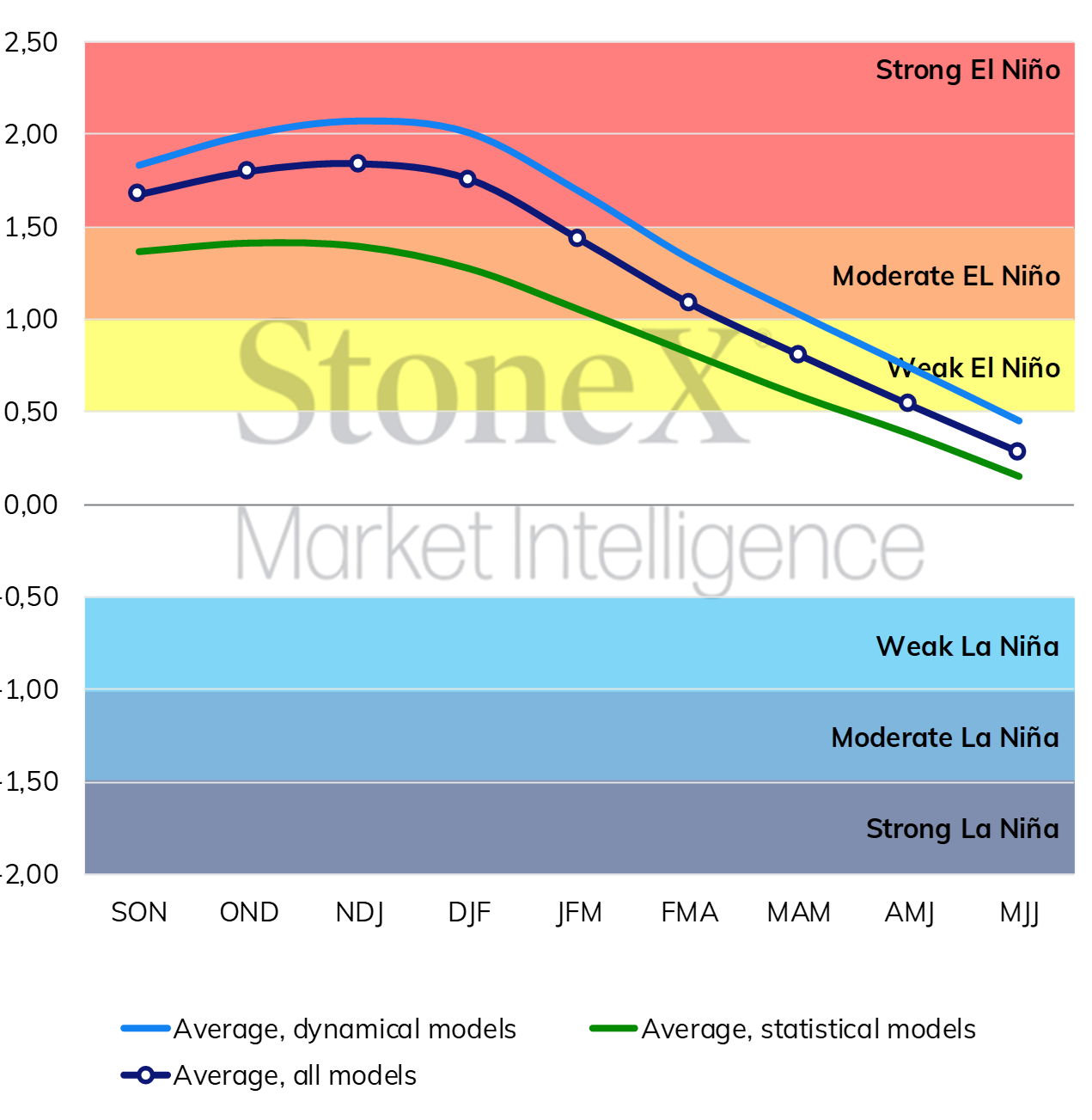
After updating its El Niño probability projections last week, showing a greater chance of the phenomenon lasting until the middle of Q2 2024, the NOAA has now updated its intensity projection models for El Niño, which have been slightly adjusted upwards. The average of the models showed an increase in the chances of a strong El Niño until the quarter between December and February, as well as indicating that it could remain at least moderate in intensity until the quarter between February and April. El Niño is associated with above average temperatures in some parts of the coffee belt, especially in Robusta growing regions. However, high temperatures in Arabica-producing areas may also have the potential to cause damage.
Projected change in the Pacific Ocean surface temperature (in ºC)
The macroeconomic situation has had an important influence on coffee prices, especially since Wednesday (20), when there was a rise in risk aversion in the global markets following the Federal Reserve's monetary policy decision and the update of the Fed members' quarterly projections. Although the Federal Open Market Committee (FOMC) decided to keep the US interest rate stable in the range of 5.25% to 5.50% p.a., the quarterly update of the members' projections and the comments made by the committee's chair, Jerome Powell, increased risk aversion in global markets, with commodities and emerging currencies being affected.
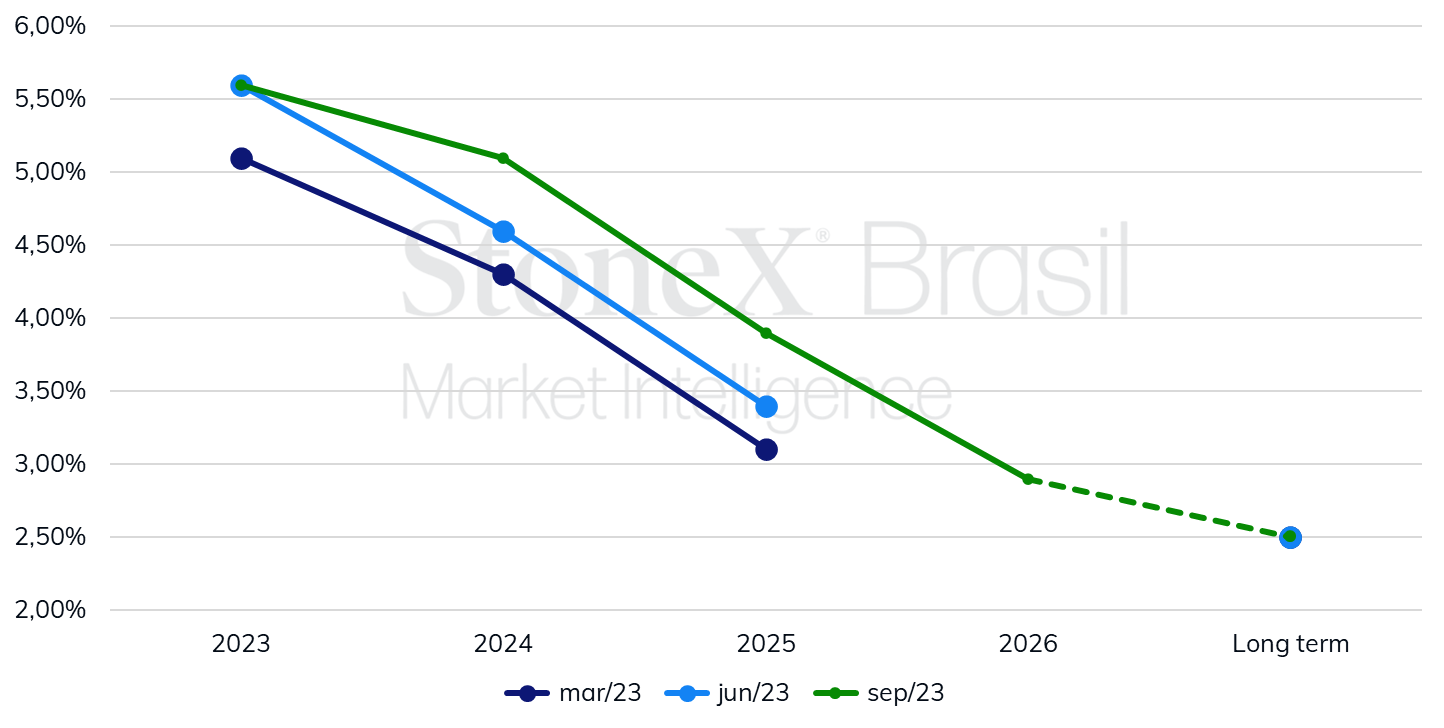
In addition to not ruling out the possibility of the rate being raised by another 25 basis points by the end of 2023, to a range of 5.50% to 5.75%, the members' quarterly projections for the interest rate over the next two years were also adjusted upwards. For 2024, the median of the FOMC members' projections now indicates an interest rate target of between 5.00% and 5.25%, 50 basis points higher than what was expected in June, in the range of 4.50% and 4.75%, an adjustment similar to that made to the projections for 2025, with the interest rate target at 3.75% to 4.00%. The new prospect of higher interest rates for a longer period boosted the dollar index, which compares the dollar to a basket of advanced economies' currencies, to its highest level in more than six months.
Changes in the median of the Fed's interest rate forecasts