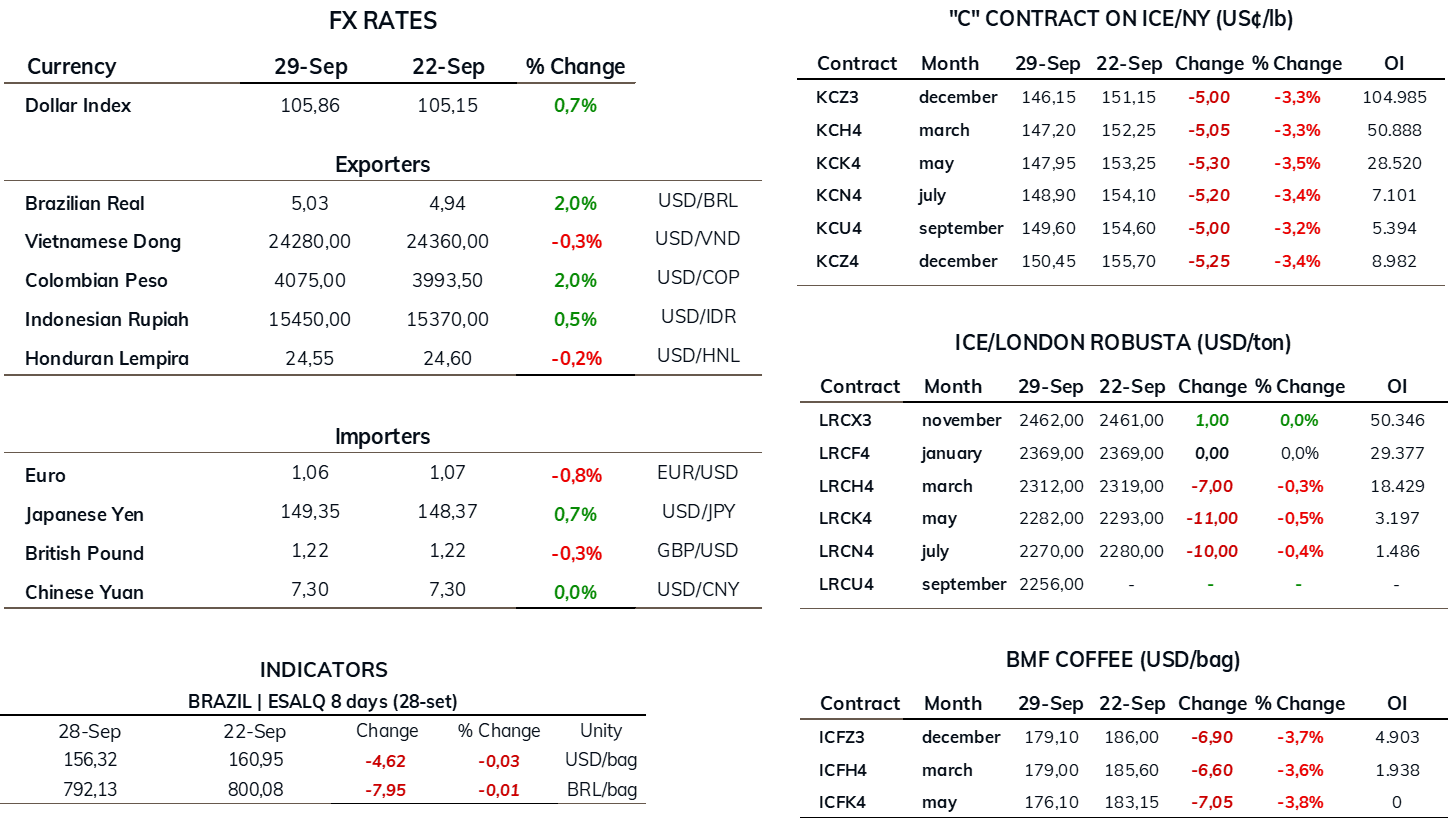
• Arabica coffee drops 500 points (3.3%) to end the week at 146.15 c/lb
• Robusta coffee prices remained almost unchanged
• Cepea indicator registers 2.5% drop for Arabica and 0.1% rise for Robusta
• Index funds reduced their net long position by more than 3,800 contracts
• Weather in Brazil continues to be a focus of market attention
• Export data from producing countries will be released
• Possible adjustments to the US prime rate and strong data support the dollar
• Increase in US treasury yields reflects global risk aversion sentiment
• Dollar ended the week up 2% at BRL 5.03
• ICE bans certification of previously certified coffee
Last week, Arabica coffee futures posted a downward trend in New York. From the point of view of fundamentals, prices retreated amid expectations of the arrival of rain in part of Brazil's coffee belt. While a few weeks ago prices rose due to forecasts of high temperatures, last week the models began to indicate considerable volumes of rain in the regions, which had a negative effect on prices as the latest forecast model no longer showed the volume it had predicted in the previous week.
In addition to the weather, an unfavorable macroeconomic scenario added even more pressure to coffee prices. The dollar ended the week higher, reflecting the rise in US treasury yields, boosted by the possibility of an adjustment in the US prime rate, as indicated in statements by Fed officials, and stronger data for productive activity in the United States. In this context, the dollar ended the week up 2%, closing Friday at BRL 5.03. Furthermore, still within the macroeconomic context, a feeling of risk aversion added to the week's downward movement.
Although the CFTC reports the position of agents only on Tuesday, the latest report from New York showed that between September 19 and 26 index funds had reduced their net long position by more than 3,800 contracts, closing Tuesday (26) with a net long position of 43,500. Index funds tend to follow only macroeconomic aspects, mainly reflecting risk aversion sentiment.
In London, Robusta coffee futures showed mixed results. While Brazil continues to export Robusta coffee and is currently the most competitive origin, the limited supply of coffee in other countries is supporting prices and limiting losses on the London exchange. In addition to the lower supply in Asia, official figures show the that Ivory Coast, a Robusta coffee producing country in Africa, exported 345,800 bags in the first seven months of the year, down 17% year-on-year.
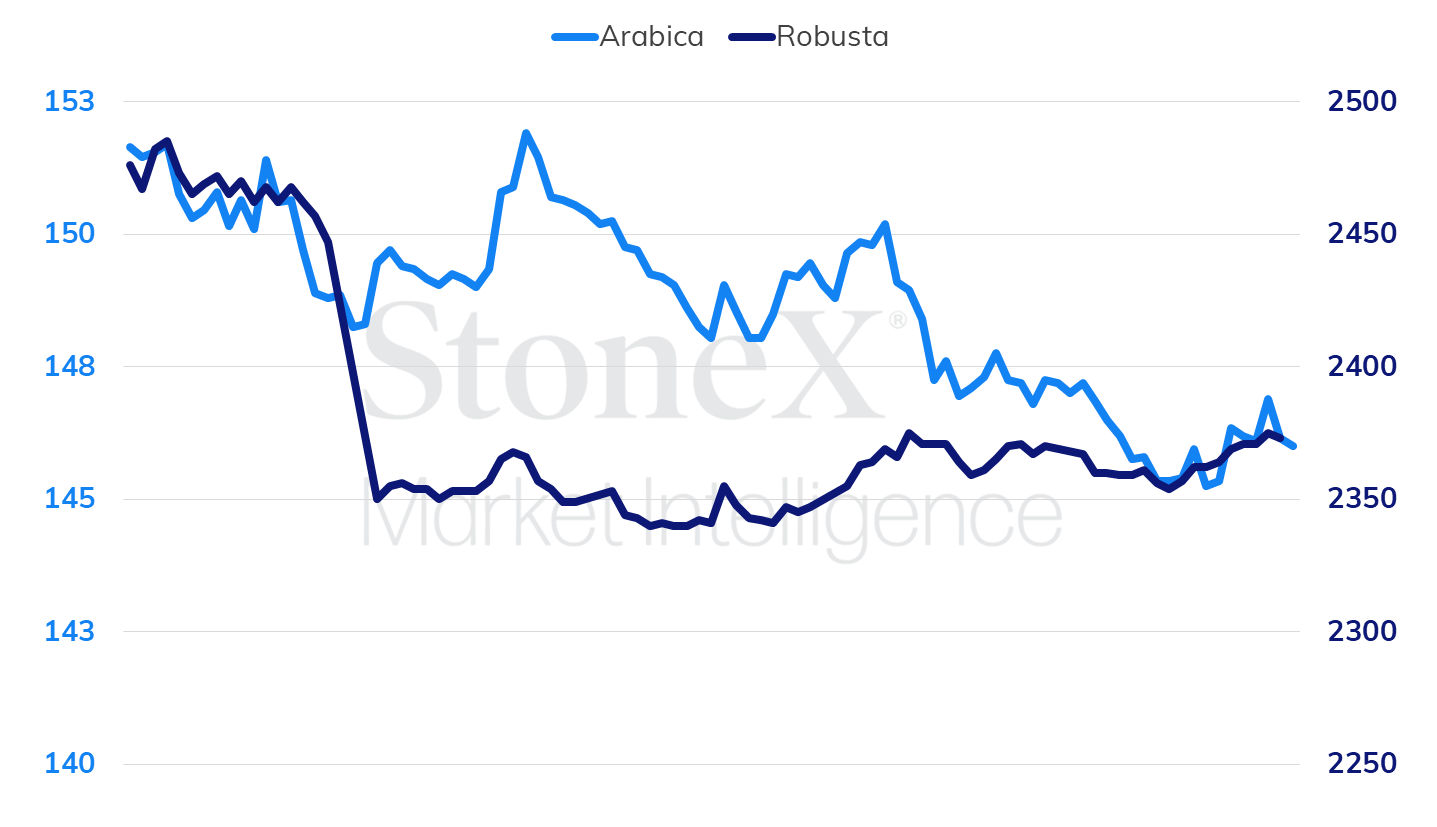
In New York, the most active contract lost 500 points (3.3%), closing Friday at 146.15 c/lb. In London, the most active contract remained almost unchanged, rising by just USD 1/t over the week. However, the contracts with more distant expirations posted slight losses, with the March/24 contract falling USD 7/t and the May/24 falling USD 11/t.
Weekly intraday (most active contract) - Sept. 25 to 29
In Brazil, coffee prices on the domestic market followed the movements seen abroad, with Arabica ending the week down and Robusta prices almost unchanged. The Cepea indicator for Arabica coffee ended the week with losses of 2.5%, quoted at BRL 779.90/bag. For Robusta coffee, the indicator pointed to a small increase of 0.1%, closing Friday at BRL 645.34/bag.
From the point of view of fundamentals, there have been no major changes in recent weeks, with the focus being on the weather and the development of the early stages of the Brazilian crop. Although the forecast for rains has put pressure on prices, the most up-to-date models are already indicating a lower volume than had been predicted. Amid the uncertainties generated by this factor, the weather market is taking center stage, a condition that should persist over the coming months.
In addition to the weather, the market will also be affected by the results of coffee exports in September in the producing countries, mainly Brazil, Vietnam and Colombia. In Brazil, export volumes are expected to increase compared to the same month in 2022, especially for Robusta coffee, which is currently the most competitive in the world. In Vietnam, following the trend of recent months, export volumes may be lower, given the high level of differentials in the country, the lower availability of coffee and the inter-crop period.
Last week, in an official statement, ICE/NY indicated that as of December 1st it will ban the certification of coffees that have already been certified and decertified. This is a topic that has been much discussed in the coffee market. As presented in special StoneX articles, the process of coffee certification at an official exchange warehouse depends on the level of price differentials in the origins. A scenario of weakened differentials favors certification, while a condition of strengthened differentials tends to discourage the process.
On a few occasions in recent years, coffee price differentials were at very strong levels, which made it impossible to certify coffee in the exchange warehouses. However, coffee certification was still observed, which raised the question of whether those coffees were being recertified, especially given that massive volumes of coffee had previously been decertified.
In that context, questions were raised to the exchange about the possibility of coffee recertification. However, until then, there had been no clear answer on the matter. According to the official statement, samples of coffees that have already been certified will still be accepted until the close of business on Thursday, November 30.