• Arabica coffee down 2.3% on the week to US₵ 166.65/lb
• Robusta coffee prices up 4.1% on the week
• Cepea registers a 1.1% drop for Arabica coffee and a 0.6% rise for Robusta coffee
• With no change in fundamentals, technical factors weighed on the market
• Certified stocks continued to fall to less than 290,000 bags
• Rain arrives in Arabica regions, but not in Robusta areas
• USDA releases appendix reports for Brazil and Colombia
• Brazilian production projected at 66.3 million bags and Colombian at 11.5 million bags
• Brazilian exports record best monthly performance in almost three years
• Robusta coffee shipments remain at historically high levels
Without any major changes in terms of fundamentals, Arabica coffee futures prices reflected the impact of technical factors, with speculative agents liquidating their positions as the first day of the December contract's expiration date approached, set for Tuesday (21). Also weighing on future coffee prices was the return of rain in some Arabica producing regions and the export volumes reported by Cecafé last week.
On the other hand, despite the progress of the coffee harvest in Vietnam, Robusta futures prices rose amid forecasts of low volumes of rain in Robusta producing regions in Brazil and concerns about the weather in Indonesia, which has been struggling with hot weather that could impact the country's crop for the second consecutive year.
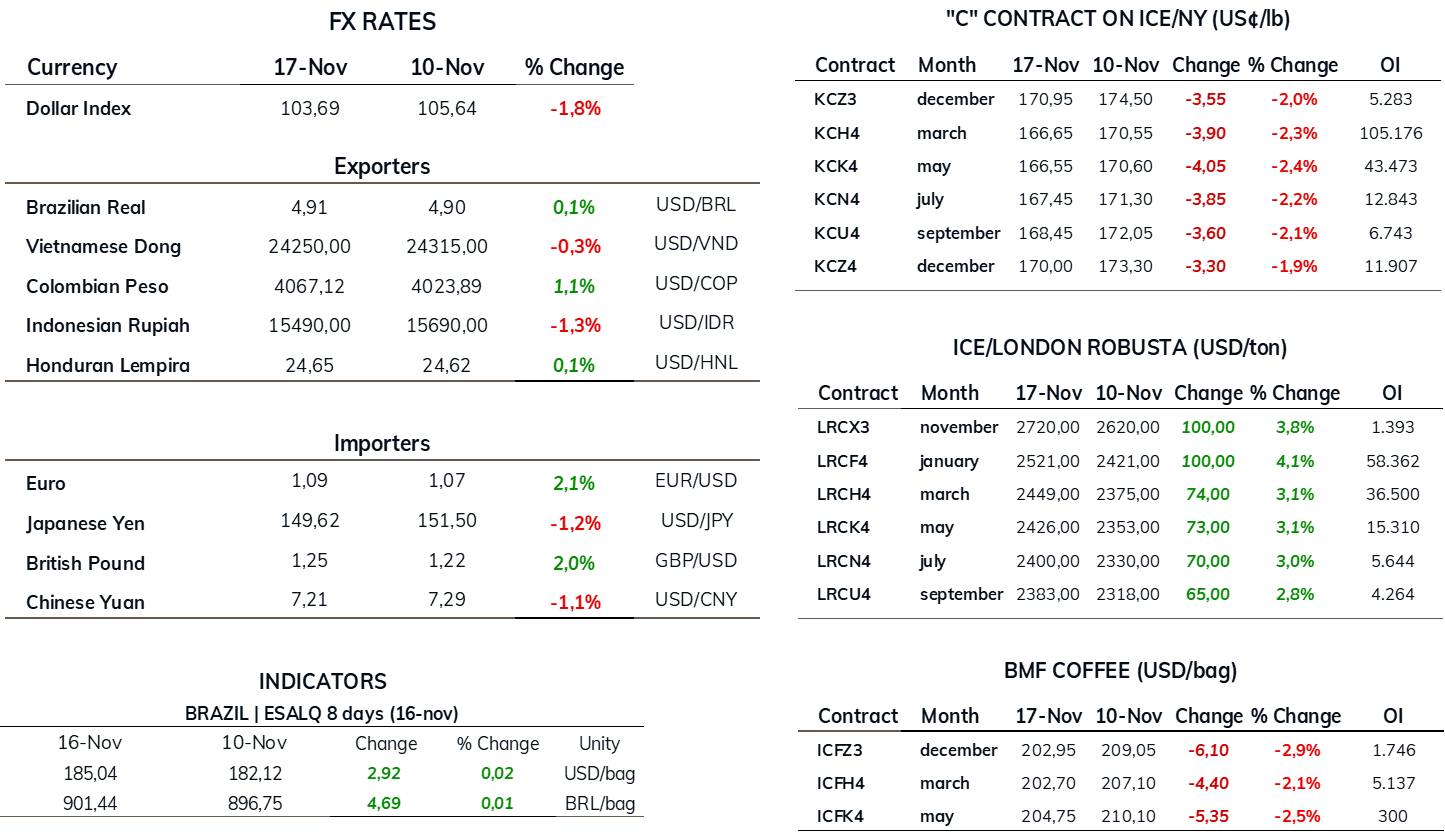
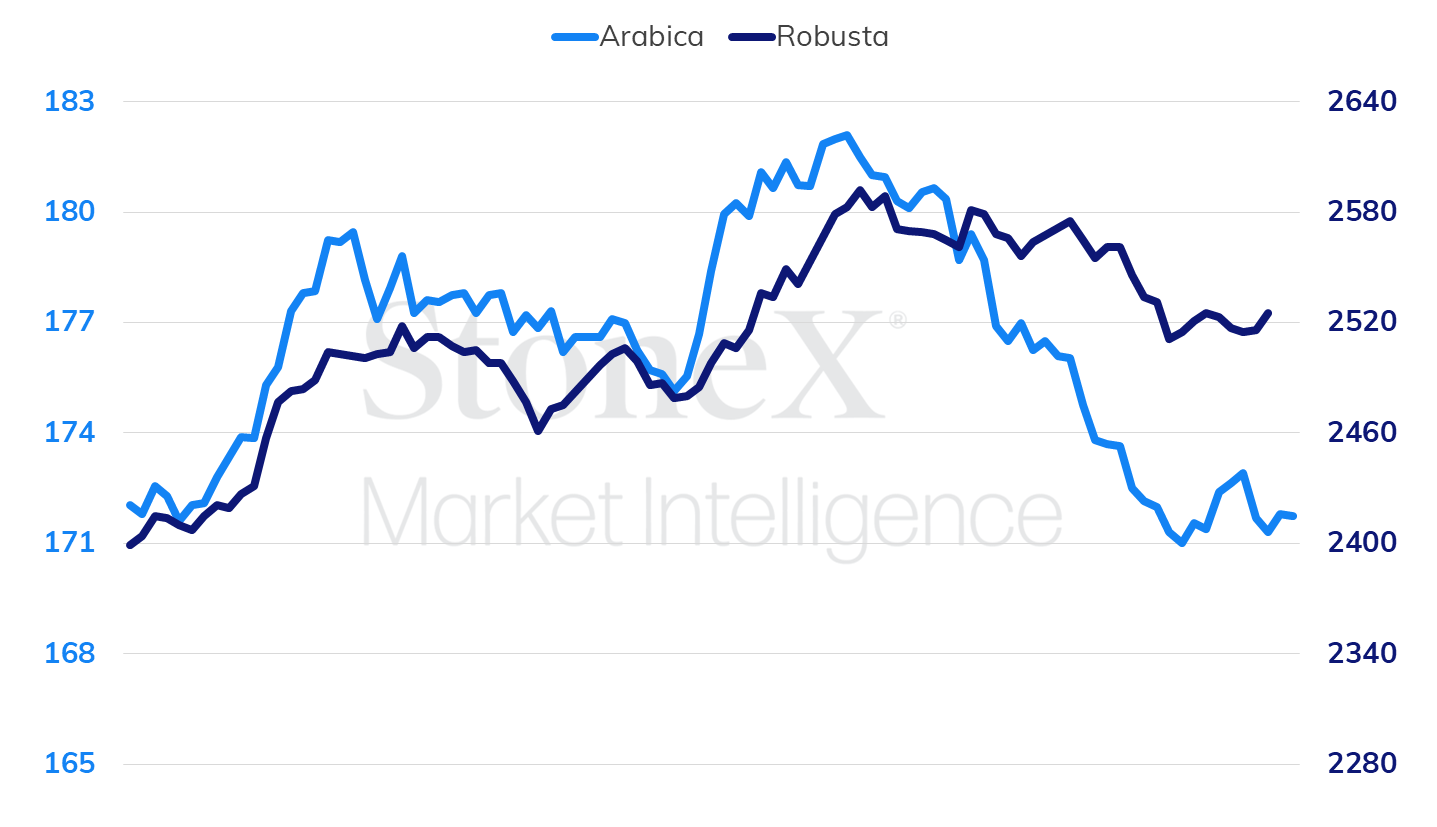
In New York, the most active contract, for March, posted losses of 390 points over the week (2.3%), closing last Friday at 166.65 c/lb. At the London terminal, Robusta futures advanced USD 100/t (4.1%) for the most liquid contract, expiring in January, which ended Friday quoted at USD 2521/t. During the period, the USDBRL pair showed some stability, closing the week with a slight rise of 0.1%, quoted at USDBRL 4.91.
Weekly intraday (most active contract) - 13/11 to 17/11
On the Brazilian domestic market, prices followed international movements and ended the period with mixed results. Considering the balance of the week, the Cepea indicator for Arabica coffee fell by 1.1%, closing Friday at BRL 879.03/bag. For Robusta coffee, the indicator rose 0.6% to BRL 655.93/bag.
From the point of view of fundamentals, the weather and certified coffee stocks continue to be the main points of attention. In the last week, certified stocks fell by more than 12,500 bags, reaching a level of just under 290,000 bags, the lowest volume since the late 90s. On the other hand, it rose to 14,600 bags pending certification. Despite the increase in the number of bags pending, the effect of the new exchange regulations from December, which ban the certification of any coffee that had previously been certified, will make it difficult to increase certified stocks in the short and medium term. Although stocks are not directly linked to supply and demand, but rather to a market context involving price differentials at origin, the fall and maintenance of certified stocks at lower levels has a bullish bias for future coffee prices.
With regard to the weather, the occurrence of El Niño brought a wave of high temperatures to Brazil, which concerned agents, given the possible impacts of adverse weather on the production potential of 2024. However, the onset of rain in some regions and the forecast for more rain in the coming weeks in Arabica-producing areas has eased agents' concerns. On the other hand, the models do not point to significant volumes of rain in the Robusta coffee producing regions of the states of Espírito Santo and Bahia, which remains a warning point. This scenario adds to agents' concerns about the supply of Robusta coffee, whose production has already been and is being damaged by the weather in Indonesia, which could complete two consecutive years with losses.
Last Friday (17), the USDA released its attaché reports for Brazil and Colombia, updating the organization's expectations and projections; the latest reports are just an update of the attachés released in June. According to the USDA, Brazilian coffee production in 2023/24 totaled 66.3 million bags, a decrease of 0.15% compared to the June estimate, but an increase of 5.9% compared to the previous crop. Arabica coffee production is projected at 44.9 million bags, an increase of 12.8% compared to 2022. On the other hand, Robusta coffee production is estimated at 21.4 million bags, down 6.1%.
According to the organization, Brazilian raw coffee exports in 2023/24 should total 39.5 million bags, up 22.7% year-on-year. Exports are expected to total 43.85 million bags, an increase of 21.3%. The USDA's projections for domestic consumption remained unchanged at 22.56 million bags, which is only 0.48% higher than last year's estimate. Finally, ending stocks are expected to fall slightly by 0.75% to 4.585 million bags.
For Colombia, the USDA projected the country's production at 11.5 million bags, showing a slight adjustment of -0.86% compared to the previous estimate of 11.6 million bags. However, year-on-year, Colombian production is expected to fall by 1.7%. Coffee exports are expected to total 12 million bags (+12.1%), with 10.8 million bags of raw coffee (+12.5%). In 2023/24, Colombian imports are expected to total 2.3 million bags, representing an increase of 9.5% compared to the previous year. Also according to the USDA, coffee consumption in the country is expected to remain almost unchanged at 2.23 million bags, but ending stocks are expected to fall by almost 27% to 620,000 bags.
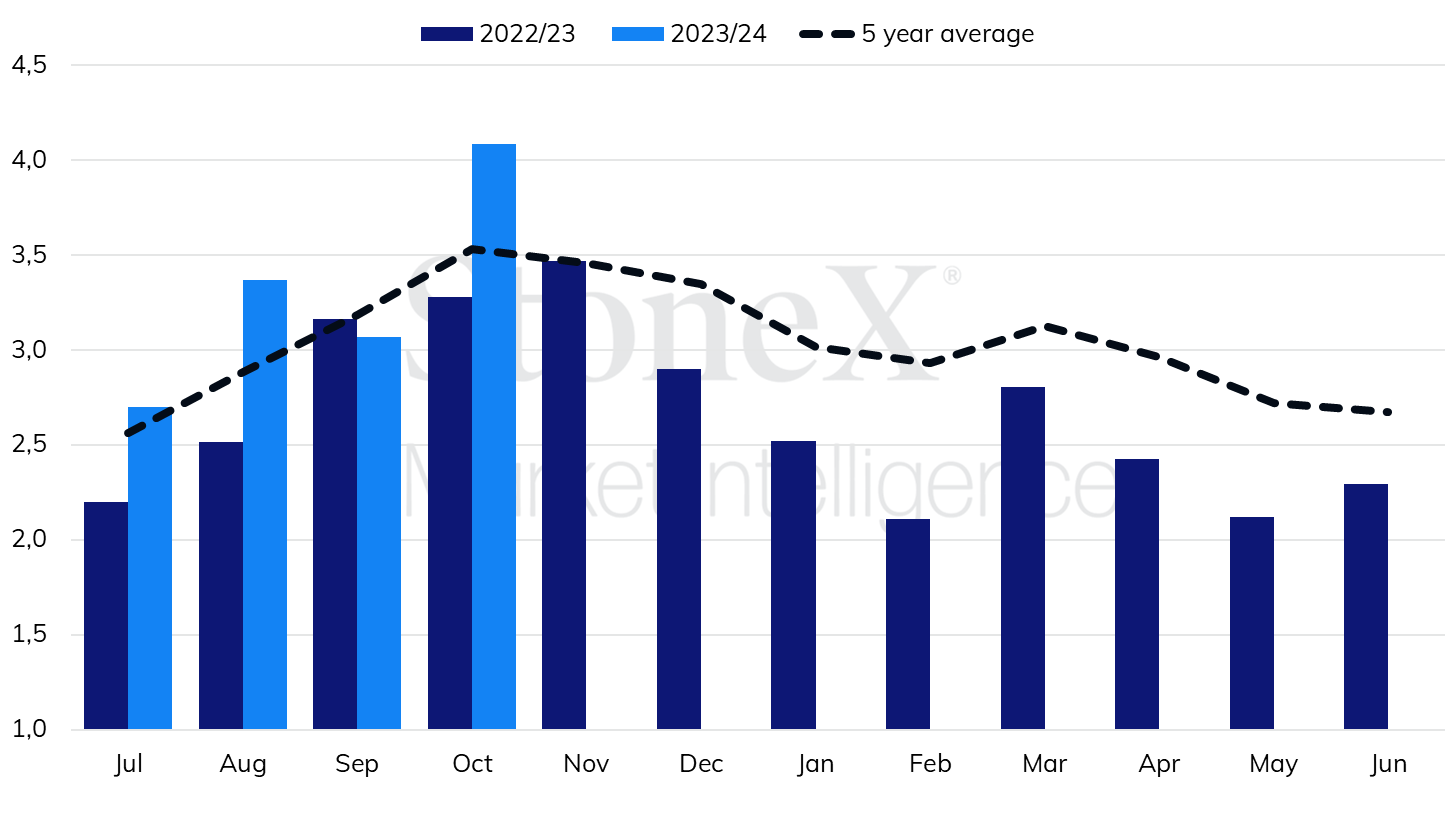
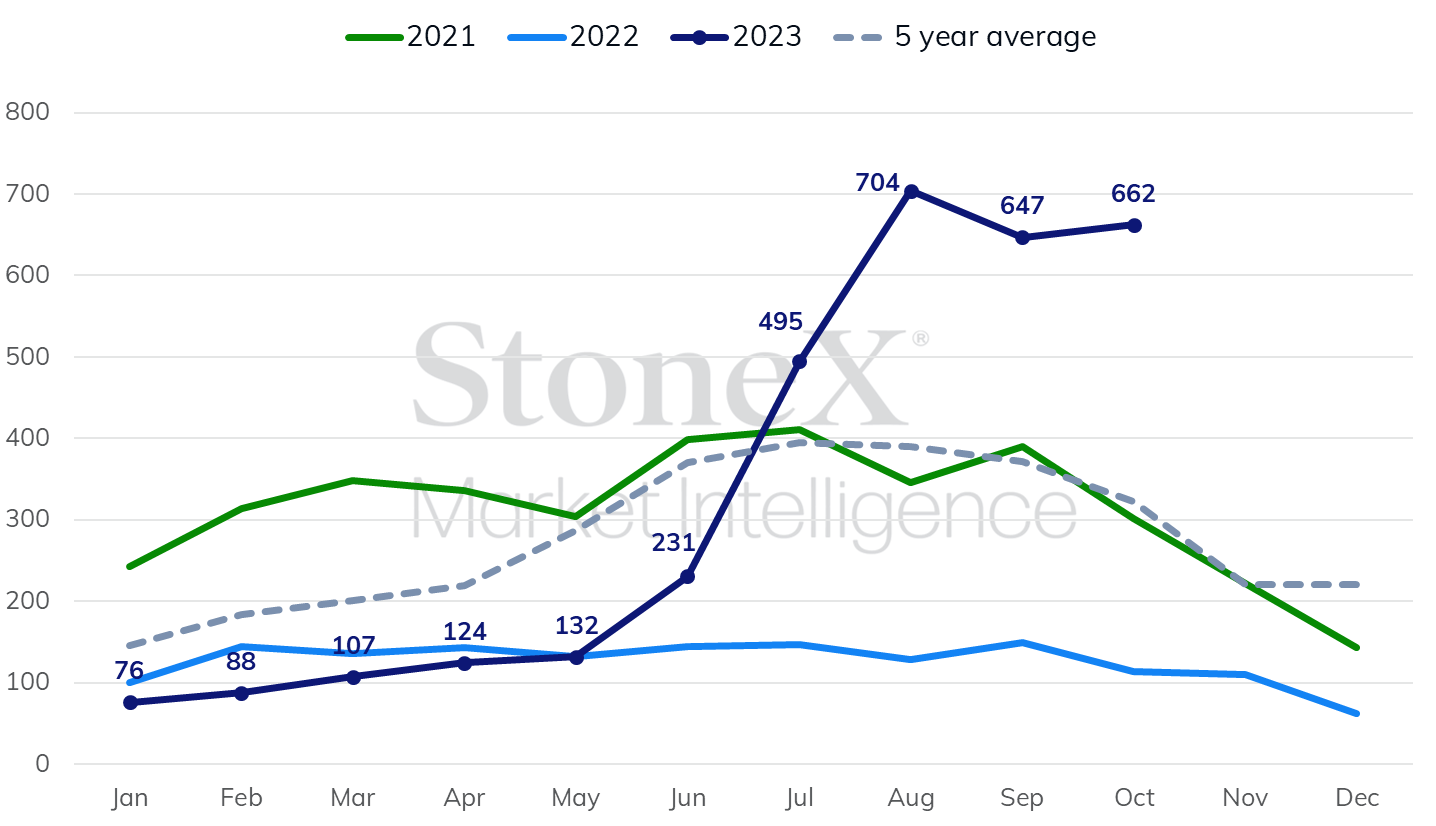
Robusta coffee achieved another month of historically high performance. Exports of the type totaled 662,000 bags, 484% more than in the same month last year and 105% above the average for the last five years, of 322,000 bags. In the first four months of the 2022/24 crop year, Robusta coffee already totals 2.507 million bags sent abroad, 366% more than at the same time in 2022, when 538,000 bags were sent.
Seasonality of Robusta coffee exports from Brazil ('000 bags)