• Arabica coffee up 0.9% on the week to 168.15 c/lb
• Robusta coffee prices rose 1.0% on the week, closing at USD 2545/t
• Cepea indicator for Arabica coffee grew by 1.2% to BRL 889.39/bag
• Cepea indicator for Robusta coffee rose 1.7%, quoted at BRL 667.00/bag
• Weather and certified stocks remain on the radar
• Return of rains should fuel optimism about the 2024/25 crop
• Espírito Santo and southern Bahia continue to be drier, with greater risks for the Robusta crop
• USDA releases appendix reports for Vietnam, Indonesia and India
• Production estimates for Vietnam sharply adjusted downwards
• Export estimates for major Robusta producers also fall
Arabica and Robusta coffee futures ended last week higher for the most active contracts. For Arabica, volumes were reduced during the week due to the Thanksgiving holiday in the US, which took place last Thursday (23). For the London terminal, prices reacted to the USDA report which reduced the projections for the Vietnamese crop in 2023/24, as will be discussed in more detail below.
From the point of view of fundamentals, there were no major changes in the general outlook, with market participants keeping an eye on the low volume of certified stocks and the weather in Brazil. For Robusta coffee, the scenario is positive for prices due to greater demand for the type amid limited supply in Asia. However, from a technical point of view, the market in London is approaching an overbought condition, which could open up space for possible corrections.
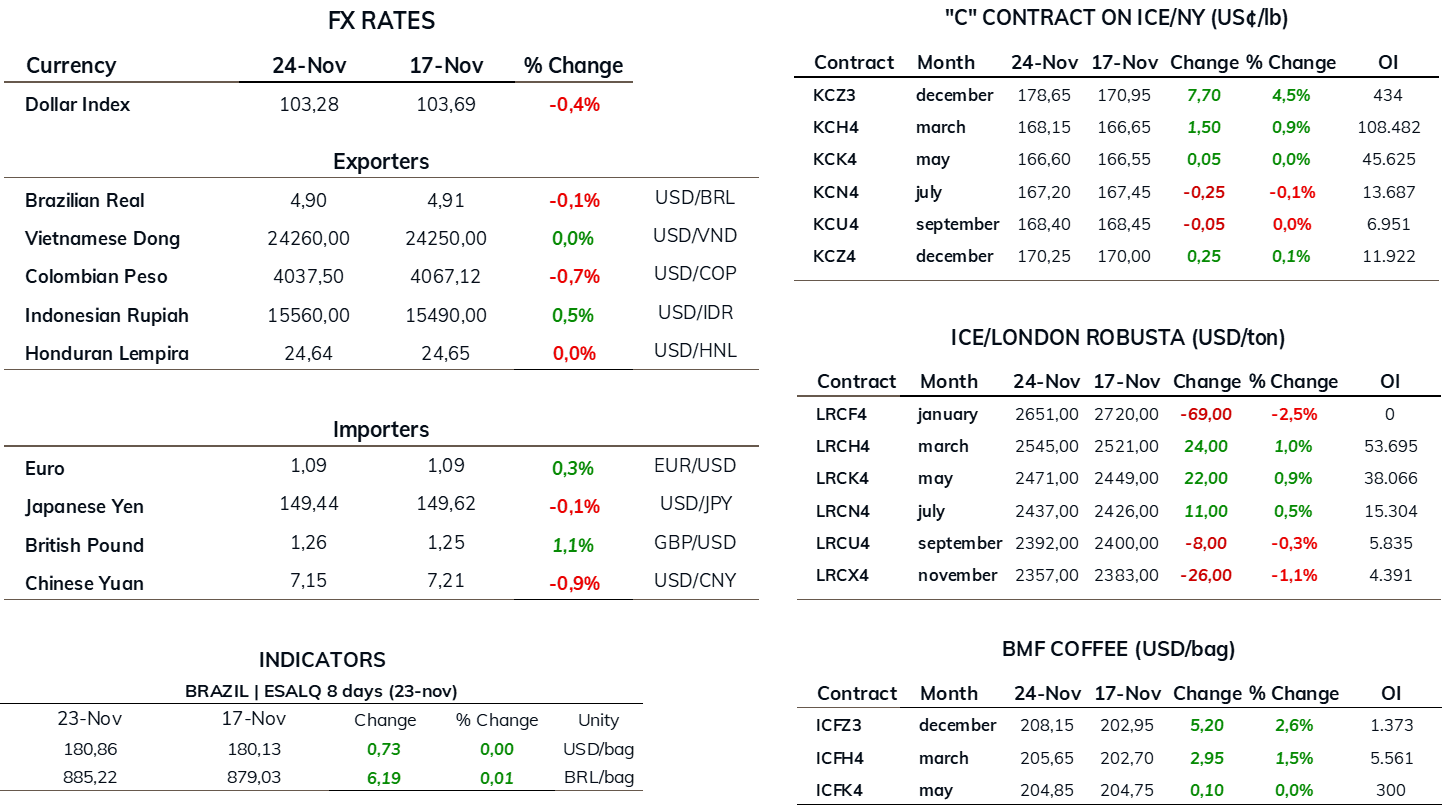
In New York, the most active contract, maturing in March, ended the week with gains of 150 points (0.9%), closing Friday (24) quoted at 168.15 c/lb. In London, the contract due in March ended the period with gains of USD 24/t (1.0%), closing at USD 2545/t. The Dollar Index ended the week with losses of 0.4% at 103.28 points and the USDBRL pair fell 0.1% to USDBRL 4.9.
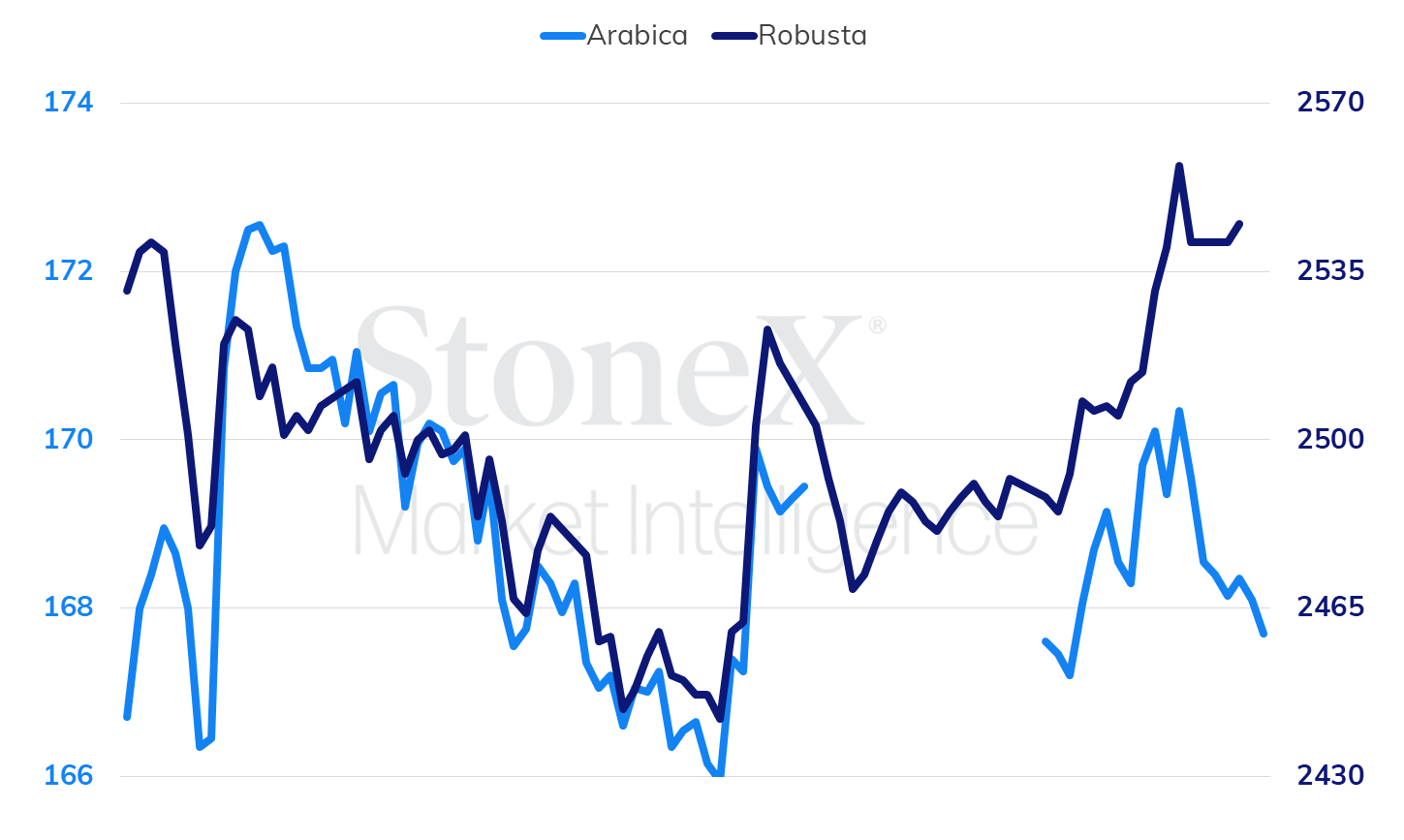
Weekly intraday (most active contract) – Nov. 20 to 24
Following the movements on the international exchanges, coffee prices on the Brazilian domestic market also ended the week higher. The Cepea indicator for Arabica coffee rose by 1.2% during the week, closing last Friday (17) at BRL 889.39/bag. For Robusta coffee, the Cepea indicator pointed to an increase of 1.7%, closing the period quoted at BRL 667.00/bag.
Among the main factors influencing prices, the weather and certified stocks continue to be the focus of attention. Currently, weather forecast models have pointed to a return of rainfall in a large part of the coffee belt, especially in the Arabica-producing regions, which is cooling agents' concerns and fueling optimism about the 2024/25 crop in Brazil. However, the models still do not indicate abundant volumes of rain in the main Robusta coffee producing regions, in the north of the state of Espírito Santo and the south of Bahia, which remains a warning point. Last week, the State Water Resources Agency (Agerh) decreed a State of Caution regarding the water situation in Espírito Santo due to the risk of an increase of water deficit in rivers and other watercourses in the state.
In the coming weeks, in addition to the weather, the focus of agents' attention will be on Brazil's export data for November, the pace of harvesting and the progress of the crop in Vietnam and the impacts of the weather in Indonesia. Without a doubt, certified stocks, which are at their lowest level in more than two decades, have been bullish for prices. Last week, the volume of coffee pending certification rose to over 22,000 bags in Friday's report (24), with the main origins being Papua New Guinea, Tanzania and Honduras.
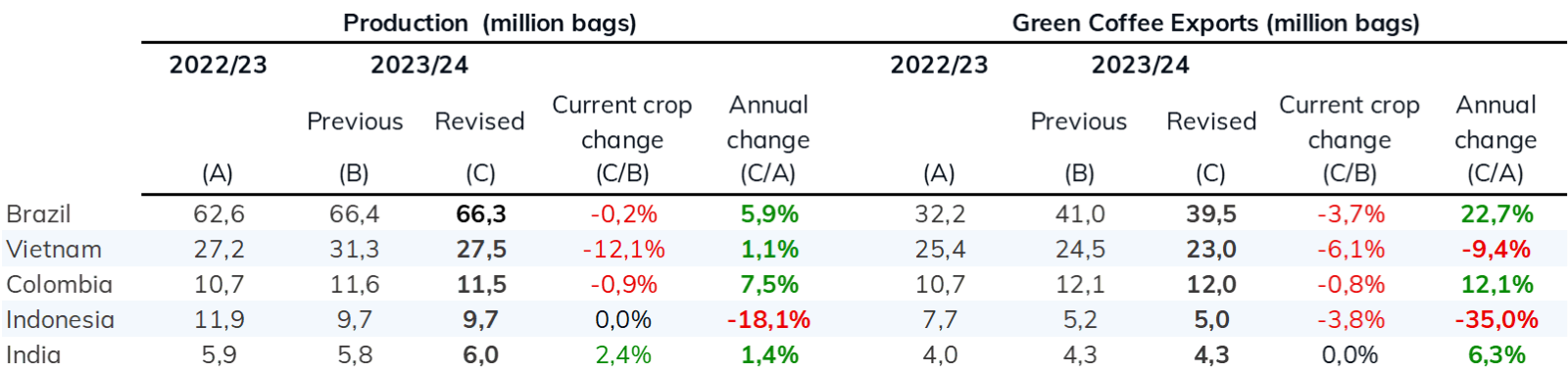
Coffee production in Vietnam for crop year 2023/24 faces significant challenges, with output projected at 27.5 million bags, a decrease of 3.8 million bags due to unfavorable weather conditions attributed to climate change and El Niño weather patterns. In addition, Robusta coffee production in 2022/23 has been adjusted to 27.2 million bags due to adverse weather conditions, resulting in lower fruit survival rates and producers directing production to other more profitable crops.
As far as domestic consumption is concerned, Vietnam saw a 15% growth in revenue from the food and beverage sector in the first eight months of 2023 compared to the same period last year. However, the continued increase in domestic prices and the Consumer Price Index (CPI) of 3% may restrict consumer demand in the coming months. The Vietnam Coffee and Cocoa Association (VICOFA) continues to promote increased domestic consumption, especially of ground and instant coffee. As for exports, the forecast is 25 million bags for 2023/24, representing a drop of 9.9%. Vietnam faces challenges in exports, with the European Union remaining the main market, despite a drop in exports to Germany, Spain and Belgium
The semi-annual report on coffee in Indonesia for 2023/24 highlights a forecast of a 35% drop in raw coffee exports, reaching 5 million bags, due to reduced production. Total coffee output is projected at 9.7 million bags, unchanged from the previous estimate and reflecting an 18% decrease compared to the previous year, mainly due to weather disturbances during fruit development. As for domestic consumption, it is estimated to reach 4.79 million bags, with the possibility of a slowdown due to price increases, encouraging consumers to look for more affordable options, such as ready-to-drink (RTD) coffee. The coffee market in Indonesia faces challenges, including growing competition between coffee chains and the expansion of non-specialized establishments.
The USDA report for the 2023/24 season in India points to coffee production of 5.9 million 60 kg bags, an increase of 2.4% on the previous estimate. Total production includes 1.4 million bags of Arabica and 4.5 million bags of Robusta. Exports are forecast at 6.3 million bags, unchanged from the previous estimate, while domestic consumption is adjusted to 1.27 million bags, down 1.2%. Coffee stocks are estimated at 73,000 bags, 65% lower than the previous estimate, due to strong exports. The report also highlights challenges, such as labor costs, weather conditions and changing consumer preferences, influencing the coffee market in India. The demand for soluble coffee and the diversification of exports are mentioned as relevant trends in the Indian coffee industry.
USDA coffee production and export estimates