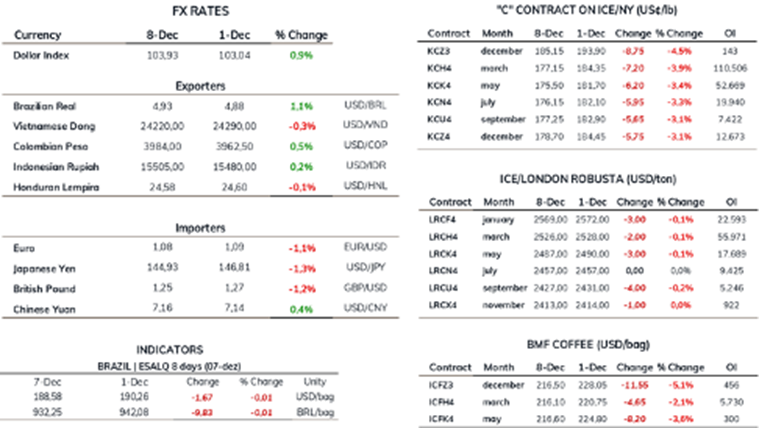
● Arabica coffee down 3.9% on the week to 177.15 c/lb
● Robusta coffee prices fell just 0.1% on the week
● The Cepea indicator for Arabica coffee fell by 1.7% to BRL 926.14/bag
● Cepea indicator for Robusta coffee rose 1.7% to BRL 709.22/bag
● Arabica prices pressured amid contract liquidation and profit-taking
● Reuters: Mercon Group files for bankruptcy
● ICO forecasts surplus of 1 million bags in 2023/24
● Brazilian weather continues to be a focus of attention
● US coffee imports remain below average levels
● US coffee imports in October were the lowest since 2014, signaling still weak consumption
As in the previous week, last week was marked by high volatility for coffee prices in New York, which were pressured by the liquidation of contracts and profit-taking after the strong rise seen in the previous week. From a fundamentals point of view, the coffee market continues to keep an eye on certified stocks and weather conditions in producing countries, especially Brazil. From a macro point of view, the Dollar Index's 0.9% rise, which closed at 103.93 points, and the USDBRL pair's 1.1% rise, which closed at USDBRL 4.93, also contributed to putting pressure on Arabica coffee prices. For Robusta coffee, prices ended the period almost unchanged due to the more positive fundamentals for the type, such as the projection of lower production in Vietnam and the weather problems in Indonesia.
For some traders, part of the volatility seen in recent weeks was related to the possible forced liquidation of the positions of Mercon, a large company linked to the sector, which filed for bankruptcy in the US last week - "as soon as Mercon filed for bankruptcy, calm returned to the market". According to news reported by Reuters last Thursday (07), the document requesting judicial recovery states that the company's debts total USD 363 million.
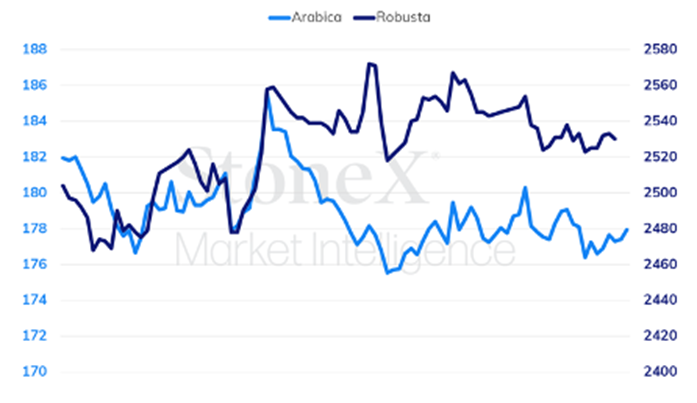
In New York, the most active contract, March/24, ended the week with losses of 720 points (3.9%), closing the period quoted at 177.15 c/lb. At the London terminal, Robusta coffee futures ended the period almost unchanged, with losses of just USD 2/t (0.1%) for the most active contract, for March, which closed at USD 2526/t.
Weekly intraday (most active contract) - 04/12 to 08/12
On the Brazilian domestic market, Arabica coffee prices followed the trends in New York and ended the period down, but Robusta coffee prices continued to rise. The Cepea indicator for Arabica coffee ended the period down 1.7% to BRL 926.14/bag. On the other hand, the indicator for Robusta coffee rose 1.7% to BRL 709.22/bag.
In its latest report, the International Coffee Organization (ICO) released its outlook for global coffee production and consumption in 2023/24. According to the institution's projections, world coffee production is expected to increase by 5.8% in 2023/24, to 178 million bags. Of these, 102.2 million bags would be Arabica coffee and 75.8 million bags Robusta coffee. To project consumption, global economic growth is assumed to continue at around 3%. As a result, the ICO expects consumption to grow by 2.2% to 177 million bags. As a result, the ICO projects a surplus of 1 million bags in the 2023/24 season.
In addition, this week the attention of global agents will be on the monetary policy decision of the Fed's Federal Open Market Committee (FOMC). The consensus is that interest rates will remain unchanged at between 5.25% and 5.50% per year for the third time in a row. Economic indicators since the Committee's last meeting have been softer than expected, so the FOMC is expected to adopt a balanced approach, reaffirming the need to wait for more indicators before considering a possible reduction in interest rates. Currently, most agents are projecting a start to the prime rate reduction cycle from May 2024. A confirmation of this scenario by the Fed could boost agents' appetite, favoring commodities and currencies of emerging countries, such as the Brazilian real.
As mentioned above, the weather has been a key factor in coffee price movements, especially in Brazil. In the world's largest coffee producer, most of the crops are going through the fruit expansion stage and at the beginning of next year they will go through the fruit filling process, both stages being critical and dependent on favorable weather conditions. The last few weeks have seen several heat waves and below-average rainfall in some regions, reflecting the impact of El Niño on the Brazilian weather.
Anomaly - % of rainfall compared to historical average (60 days)

The condition of high temperatures and low rainfall raises concerns about possible impacts on the production potential of 2024, whose production is viewed optimistically by market participants, who believe in an important advance for the coming season. However, continued adverse weather could change this scenario. For some Arabica coffee regions, the volumes of rain observed and the forecast of good volumes fuel the prospect of a good crop, but some Arabica coffee regions have faced below-average volumes of rain, such as parts of southern Minas Gerais and the Cerrado.
For Robusta coffee, part of the northern region of Espírito Santo and southern Bahia received below-average rainfall and there is no forecast of significant volumes of rain in these regions, which raises agents' concerns. Between 2014 and 2016, during El Niño, Robusta coffee production in Brazil suffered losses of 38% in two years. Of course, the conditions are not the same, so there is no expectation of such a huge loss, but this shows the potential risk to Brazilian Robusta coffee production.
There are two main points: 1) even with the use of irrigation systems, such as drip irrigation, on days with high temperatures the plant loses water at a faster rate than it is able to absorb it from the soil, so the plant wilts and the production potential is reduced. In addition, the high temperature can cause burns on the fruit and leaves, known as scalding; 2) if the water shortage scenario worsens, the government could ban the use of water for irrigation, with the aim of prioritizing human consumption of water, which could cause severe damage to crops in periods of dry weather and high temperatures.
The USDA released data on US coffee imports in October, which continue to indicate weak demand in the world's largest consumer. The country imported a total of 1.374 million bags of green coffee, just 2.6% less than in September, but a significant drop of 32% and 28% compared to October 2022 and the average of the last three years for October, respectively. This is the lowest volume of coffee imported in any month since November 2014, when the country imported 1.34 million bags.
Seasonality of US coffee imports (million bags)
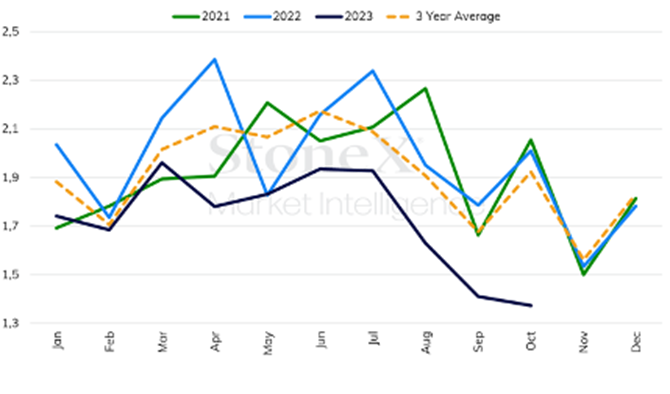
In cumulative terms, the United States imported a total of 17.3 million bags in the first 10 months of the year, down 15.2% on the same period last year, when it imported 20.4 million bags, and 11.6% below the average for the last three years. Monthly import volumes constantly below the averages for all the months of the year suggest a consumption scenario still below the pattern of previous years. As such, this scenario of stagnation or slower growth in demand remains a bearish factor for the coffee market, despite the expectation of seasonally warmer consumption during the winter in the Northern Hemisphere.
This week will also see the release of inflation data in the United States for November. The 12-month accumulated data has shown negative consumer coffee inflation in the country since August, reaching -3.6% in October. It will be crucial to see whether this remains negative, which may be a reflection of the scenario of comfortable supply and weak consumption, at least for Arabica coffee. However, the scenario of lower prices also offers more favorable conditions for a resumption of greater consumer appetite for the beverage.