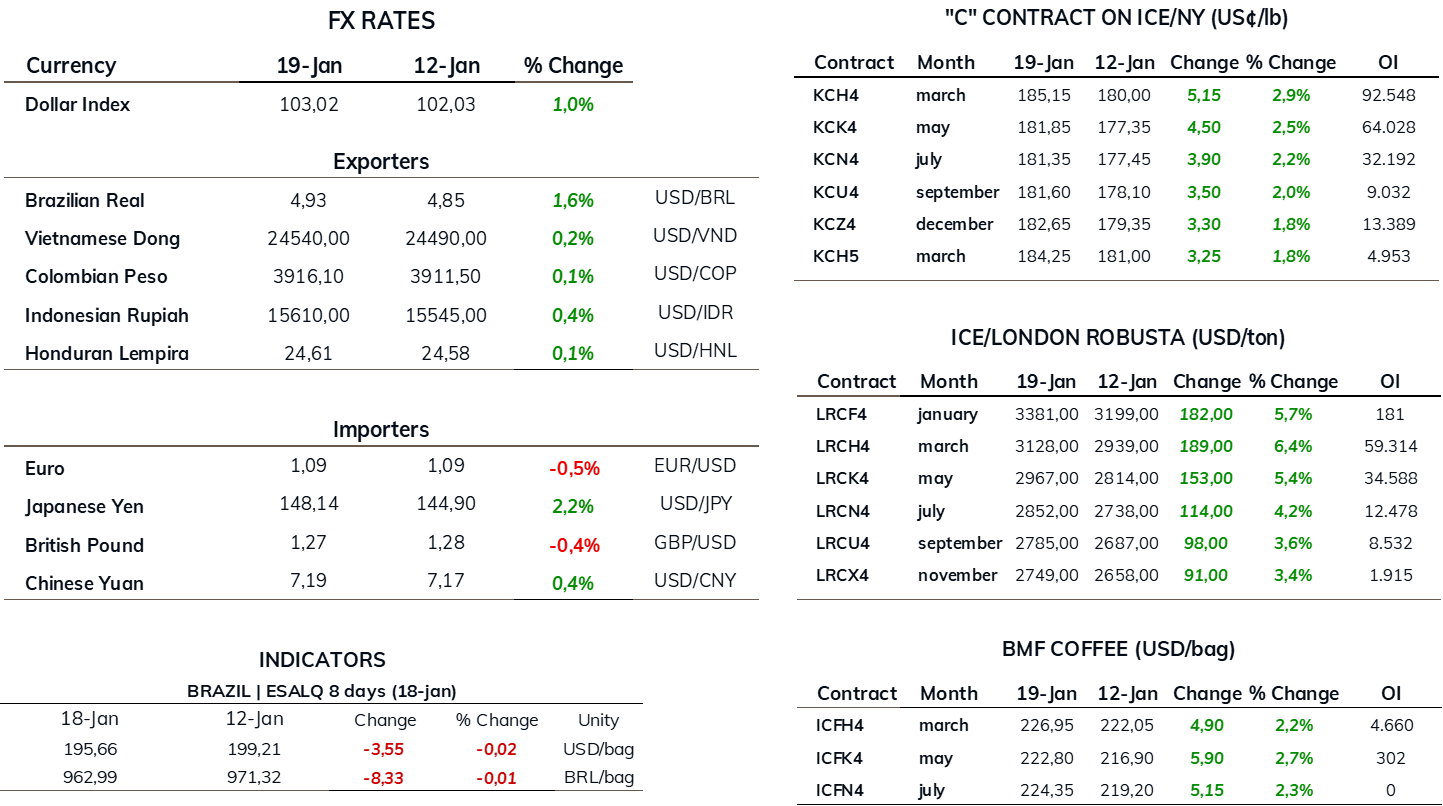
• Arabica coffee up 2.9% on the week in New York, closing at US₵ 185.15/lb
• On the London Exchange, Tobusta coffee rises 6.4% to USD 3128/t
• Cepea indicator for Arabica coffee rises 1.2% to R$983.26/bag
• Cepea indicator for Robusta coffee up 1.8% to R$ 805.98/bag
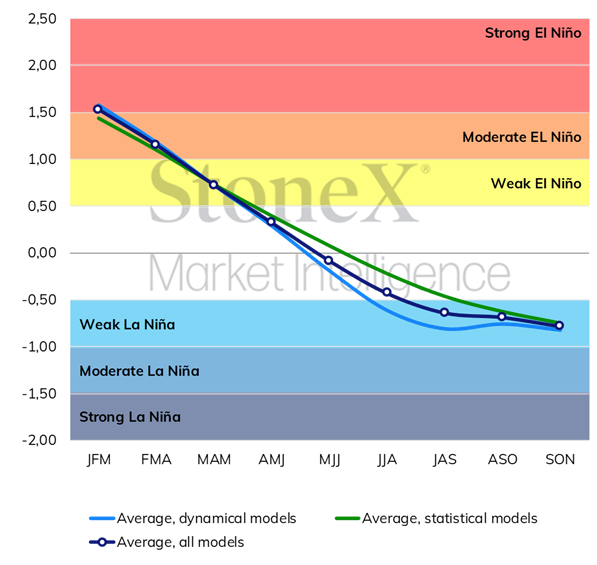
• Updated NOAA projections reinforce chances of a weak La Niña in the second half of the year
• Conab estimates 5.5% increase for Brazil's 2024/25 crop
• Brazilian coffee exports up 30.6% in December
• In 2023, Arabica exports fell 9.7%, while Robusta exports rose 212%
• ICE raises premium for certified coffees from Colombia, Kenya, Guatemala and Costa Rica
• Production drop and logistical problems boost Robusta coffee prices
• Conflict in the Red Sea continues to raise logistical costs and limit the flow of Robusta coffee
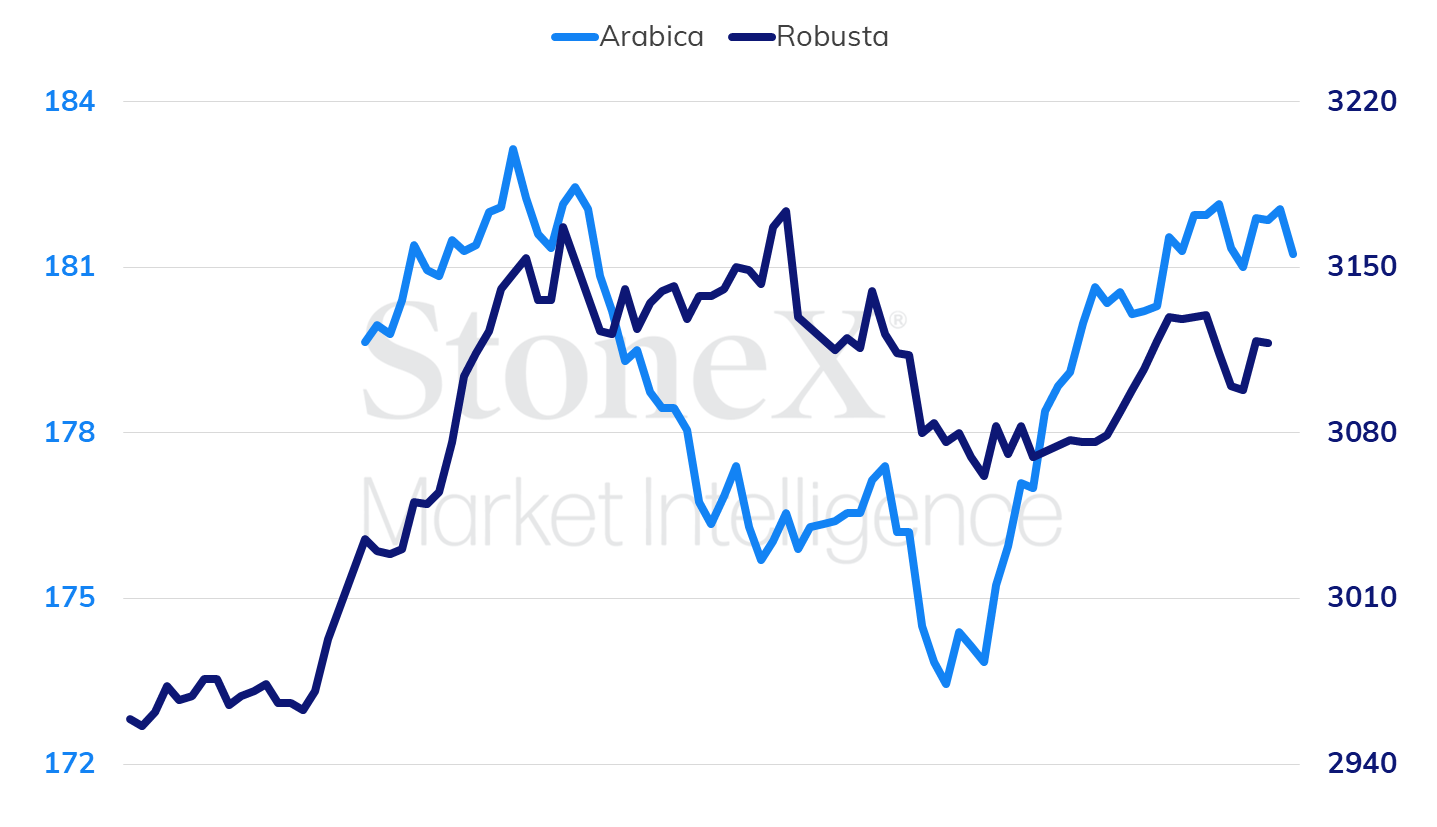
Coffee futures ended last week with a positive performance on their main trading exchanges. In New York, Arabica coffee fluctuated between gains and losses throughout the week, until consolidating its weekly gain on Friday (19), while the market awaits more information on estimates for the 2024/25 Brazilian crop and is influenced by the strong rise in Robusta coffee prices. The Mar/24 contract closed the week at US¢185.15/lb, a weekly increase of 515 points (2.9%). In London, Robusta coffee futures continued their price climb, while limited supply remains, both due to smaller crops in Indonesia and Vietnam and the logistical problems caused by the conflict in the Red Sea. Market participants have also reported that Vietnamese producers have avoided closing new deals with significant volumes, speculating that a continuation of the conflict could lead to even higher prices in the coming weeks. The equivalent contract at the London terminal closed at USD 3128/t, a weekly gain of 6.4%.
Weekly intraday (most active contract) - January 15 to January 19
On the physical market, the Cepea indicator for Arabica coffee closed at R$983.26/bag, up 1.2% for the week. The indicator for Robusta coffee ended at 805.98/bag, a gain of 1.8%.
The weather in Brazil, both in the short and long term, remains on the radar. According to StoneX's Rainfall History and Forecast report, rainfall forecasts have shown good volumes for most Arabica coffee producing areas, with accumulations over the next 14 days likely to exceed 200 mm in several producing cities in Minas Gerais. On the other hand, the latest NOAA update of the El Niño/La Niña Intensity projections has strengthened the chances of La Niña in the second half of the year, with the average of the predictive models pointing more strongly to the chance of a weak La Niña from the July-September quarter onwards. While expectations for supply in 2024 are positive, the chances of La Niña, which is associated with delayed rainfall during the flowering period, should be more and more on the radar.
Projected change in the surface temperature of the Pacific Ocean (in ºC)
The market continues to keep an eye on estimates for this year's Brazilian production. Conab has released its first estimates for the 2024/25 Brazilian crop, which point to a 5.5% increase compared to 2023/24, to 58.08 million bags, compared to 55 million the previous year. Of these, 40.7 million are Arabica coffee, an annual increase of 4.7%, while 17.3 million are Robusta coffee, an increase of 7.2% on Conab's estimate for the previous crop. Despite being relatively below the average of the main institutions, the indications of annual growth, especially for Arabica coffee, with good conditions identified in most of the producing areas, tend to contribute to the downward trend.
For Arabica, according to Conab, the increase in estimates was due to the forecast increase in the area under production, especially due to the inclusion of areas reformed in recent years, and due to the increase in productivity in almost all the important regions of São Paulo and Minas Gerais, with the exception of the Cerrado, where the high production load of the previous season may have an impact on the production potential of the current cycle. For Robusta coffee, despite the market's concern about the adverse weather caused by El Niño, Conab identified good vegetative development in Espírito Santo, with no signs of significant pests or diseases.
At the beginning of last week, Cecafé released its December exports figures, with shipments of green coffee totaling 3.8 million bags, up 30.6% over the same month in 2022. Arabica coffee accounted for 3.3 million, a monthly increase of 14.9%. Robusta shipments, meanwhile, totaled 526,000 bags, a volume that, despite being 41% lower than in November, surpasses the performance of December 2022 by 750%, when 62,000 bags were shipped.
Brazil's monthly green coffee exports (million bags)
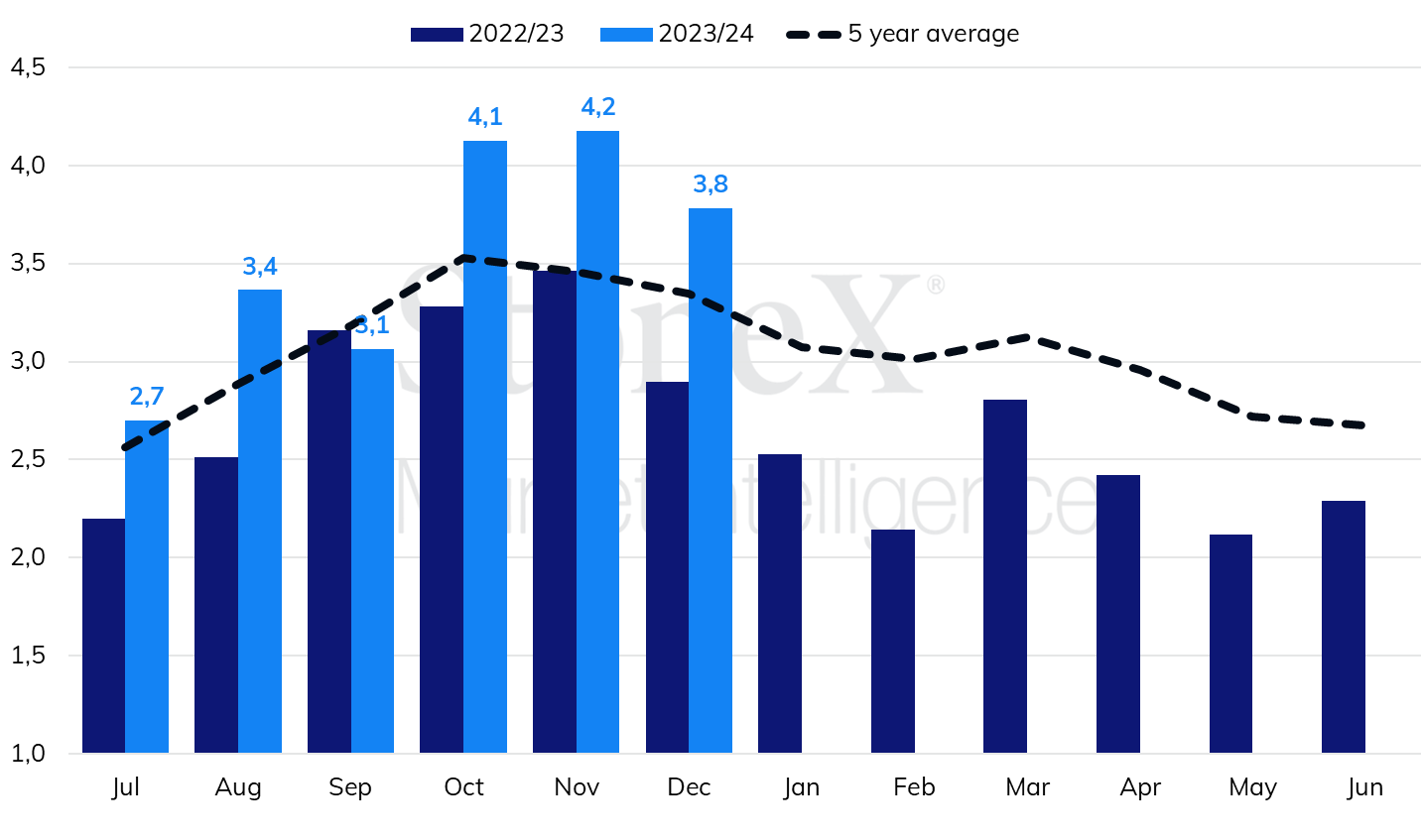
In total, Brazil shipped 35.5 million bags of green coffee in fiscal year 2023, a slight drop of 0.3% compared to the previous year. While Arabica coffee totaled 30.8 million bags shipped in 2023, down 9.7% from 2022, Robusta coffee continued to stand out, with total exports of 4.7 million bags, up 212% from last year. The greater competitiveness of Brazilian coffee to the detriment of other origins, especially Vietnam and Indonesia, which have been facing production problems due to the weather, tends to continue at the beginning of 2024, especially as long as the conflicts in the Red Sea continue, which has strongly affected logistics flows and costs between Asia and Europe.
Another highlight of last week was the news from the Intercontinental Exchange (ICE), which announced that it will increase the price premiums for physical deliveries of some types of Arabica coffee for certified stocks at the expiration of futures contracts on the exchange. Starting with the expiration of the March 2026 contract, there will be changes to the price differentials for deliveries of coffee from Colombia, Kenya, Costa Rica and Guatemala. Colombian coffee will have a premium of 10 cents per pound, up from the current 4 cents per pound. Coffees from Kenya and Guatemala will also have a premium of 10 cents over futures, while for Guatemala it will be a premium of 5 cents per pound. The measure seems to have been a move to bring the value of these coffees closer to that prevailing on the physical market, and to make the certification of these coffees more attractive, which, amid historically low stocks, could encourage deliveries from these origins to the exchange.