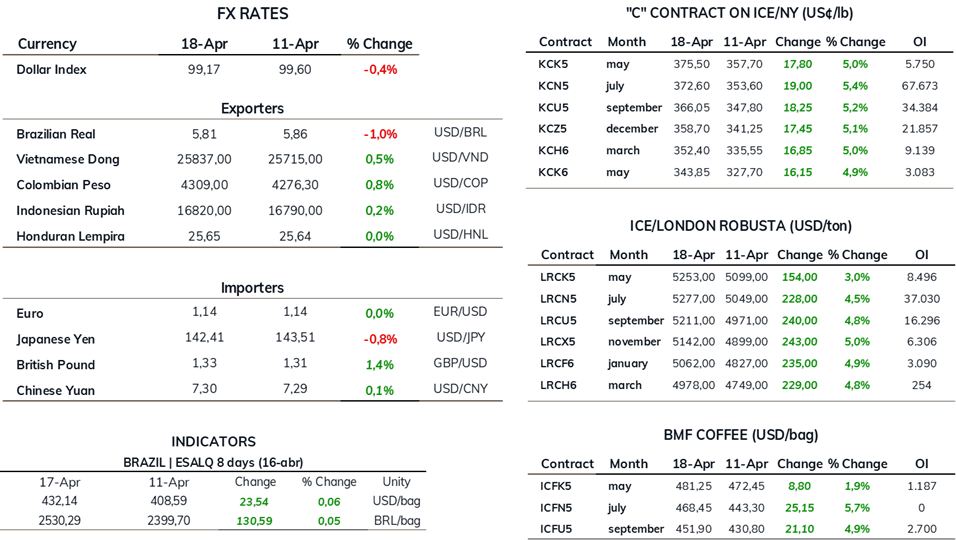
• New York posts a 5.4% weekly gain, reaching US¢ 372.60/lb
• London rises 4.5%, to USD 5,277/ton
• Dollar Index drops 0.4% for the week, and the USDBRL falls 1%
• Arabica and robusta prices climb 4.0% and 6.4%, respectively, in Brazil
• COT report shows funds liquidated contracts through April 15
• StoneX to resume weekly reports on Brazil’s harvest progress
After ending the previous week lower, coffee futures prices rebounded last week. Although there were no significant changes from a fundamental standpoint, the market was mainly driven by macroeconomic and technical factors.
Prices had come under pressure following the U.S. government's announcement of new tariffs on imports from several countries. This sparked a risk-off sentiment that weighed broadly on commodities, including coffee. However, last week saw a recovery in prices, supported by technical factors as well. The upcoming first notice day for the May contract, set for this Tuesday (22), also influenced price movements. Additionally, trading activity declined ahead of the Friday holiday, April 18.
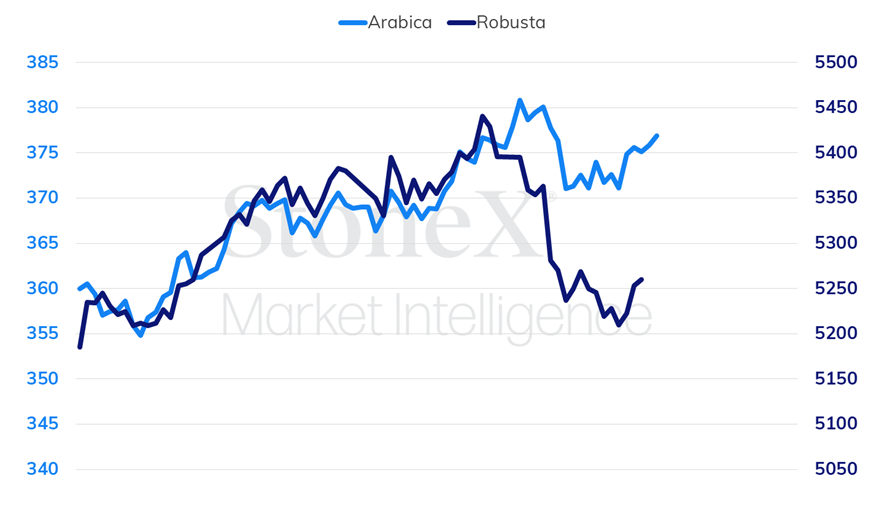
In New York, the most active contract (July) closed on Thursday (17) at US¢ 372.60/lb, a 5.4% increase compared to the previous Friday’s close. In London, the July contract rose 4.5%, ending at USD 5,277/ton. During the same period, the U.S. Dollar Index (DXY) fell 0.4%, to 99.17 points, while the Brazilian real appreciated against the dollar, with the USDBRL exchange rate declining 1.0% on the week to 5.81.
Weekly intraday (most active contract) – April 14 to 17
In the Brazilian domestic market, coffee prices also advanced. The Cepea indicator for arabica closed Thursday (17) at slightly above BRL 2,520 per 60-kg bag, up 4% for the week. The robusta indicator exceeded BRL 1,712 per bag, a 6.4% weekly increase.
From a fundamentals perspective, the scenario remains virtually unchanged. Market participants are focused on the beginning of the Brazilian harvest and the overall tight coffee supply, which continues to support prices. However, as highlighted in the StoneX Outlook report, the ongoing harvest in Brazil is expected to ease supply concerns, at least in the short and medium term. Weather conditions also remain a key market variable. Favorable weather is essential for crop growth and development, which will already influence 2026 yield potential. With the Brazilian winter approaching, any arrival of cold fronts or forecasts suggesting a risk of frost in key producing areas could also support prices.
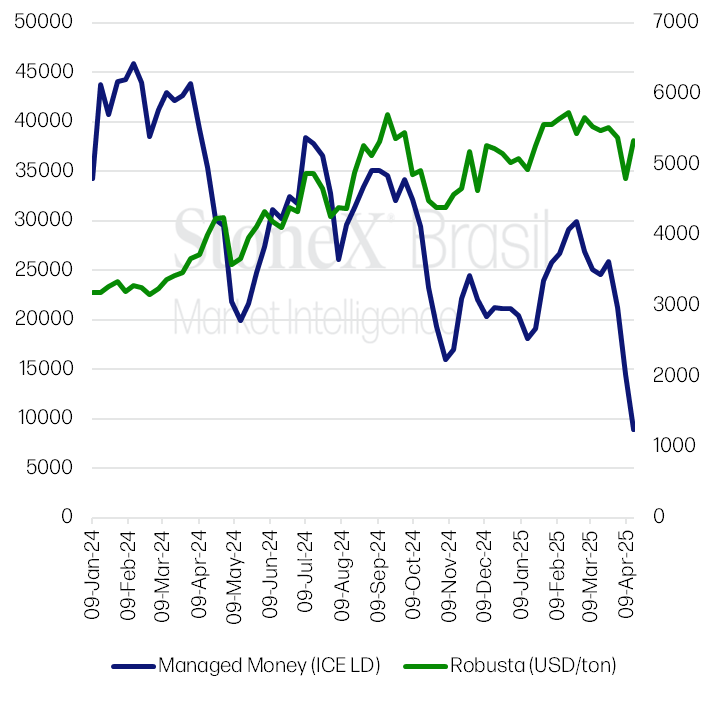
As mentioned, coffee prices have been significantly impacted by the macroeconomic environment, especially by increased risk aversion following the U.S. government’s tariff decisions, in the context of the ongoing trade war with China. According to the latest COT report published by ICE in London, between April 8 and 15, funds liquidated nearly 5,600 net long contracts on the London robusta terminal. In New York, during the same period, funds reduced just over 1,200 contracts, maintaining a net long position of 24.3 thousand contracts in the arabica market. Despite these moves, both markets registered gains over the week, reflecting tight supply conditions in the physical market.
Net fund positions in New York (left) and London (right) vs. futures prices
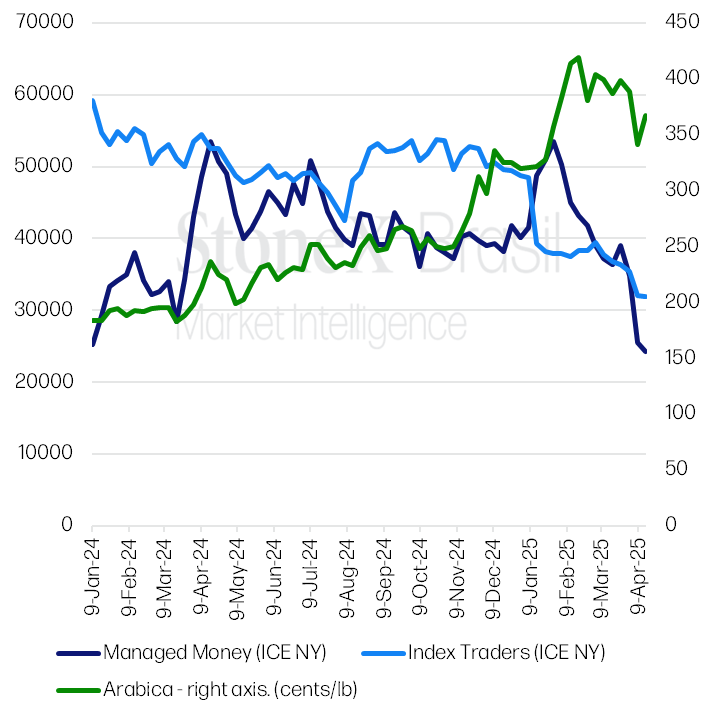
Fontes: CFTC e ICE. Elaboração: StoneX.
Looking ahead, global macroeconomic uncertainties will remain in focus and are likely to continue driving volatility in coffee prices. In addition, Brazil’s harvest progress should provide some relief to supply in the short and medium term, with participants closely monitoring its development. The harvest is underway, and in the coming weeks, StoneX will resume publication of its weekly Brazil coffee harvest progress report, with updates continuing through the end of the 2025/26 season.
INDICATORS