• Coffee prices fall; arabica falls 1.3% and robusta, 1.5% in the week
• Progress of the harvest in Brazil pressures international prices
• Funds reduce long positions on the New York and London exchanges
• Domestic market drops 2.2% for arabica and robusta, according to Cepea
• USDA projects production increase in Tanzania, Mexico, and Peru
• Partial USDA data points to higher production in 2025/26
• Polar air mass may bring frost risk to Brazil
Even with the devaluation of the dollar, coffee futures contracts ended last week lower, reflecting the progress of the harvest in Brazil, which brings some relief to the supply outlook, at least in the short to medium term — as already anticipated in previous editions of this report. In this context, speculative funds have also drastically reduced their net long positions in recent weeks.
In New York, the most active contract maturing in July fell 465 points, equivalent to 1.3%, ending Friday (May 23) quoted at US¢ 361.00/pound. In London, the July contract fell 1.5%, closing the day quoted at US$ 4,790/ton. In the same period, the dollar index (DXY) fell 1.8%, to 98.99 points, while the USD/BRL pair dropped slightly by 0.3%, trading at R$ 5.65.
Coffee futures prices – arabica (US¢/lb), robusta (USD/ton)
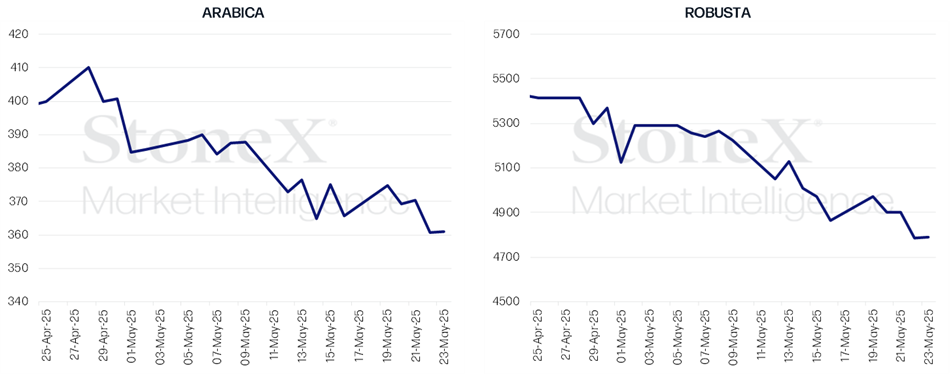
Following international trends, coffee prices also fell in the Brazilian domestic market. According to Cepea’s indicator, both arabica and robusta fell 2.2% during the week. Arabica closed at just over R$ 2,418 per bag, while robusta was around R$ 1,485 per bag.
Speculative funds have been reducing their long positions on the New York and London exchanges. In the case of arabica, actively managed funds in NY held a net long position of 29.79 thousand contracts on May 6. This position fell to 27.66 thousand on May 13 and to 25.89 thousand contracts on May 20. Index funds also slightly reduced their positions, from 34.2 thousand (May 6) to 33 thousand contracts (May 20).
Net position of funds in New York (left) and London (right) vs. futures prices
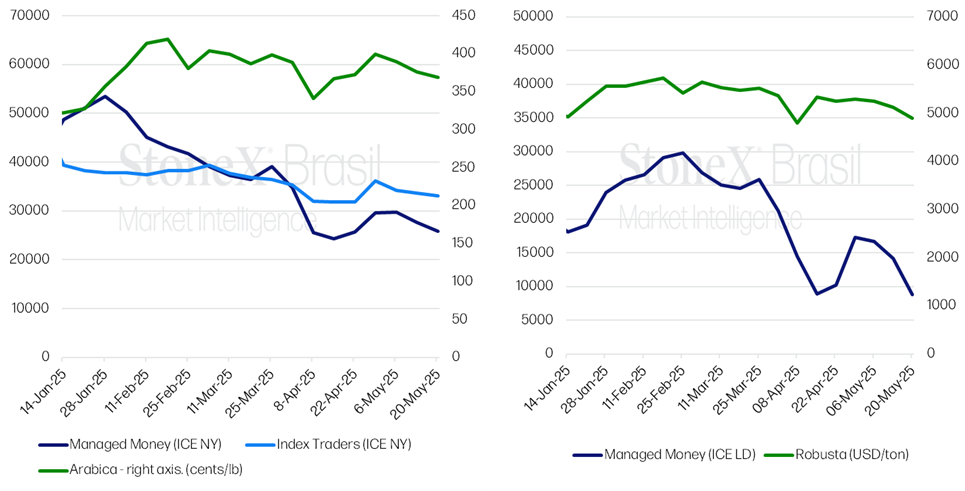
Sources: CFTC and ICE. Prepared by: StoneX.
In London, funds reduced their net long positions from 16.7 thousand contracts (May 6) to 14.2 thousand (May 13), and later to 8.84 thousand contracts on May 20 — a sharp reduction of nearly 5,400 contracts in one week.
The main factor behind this movement is the harvest progress in Brazil. As previously mentioned in earlier editions, even with the decline in production due to climatic issues — especially for arabica — the strong increase in robusta production has helped ease supply concerns.
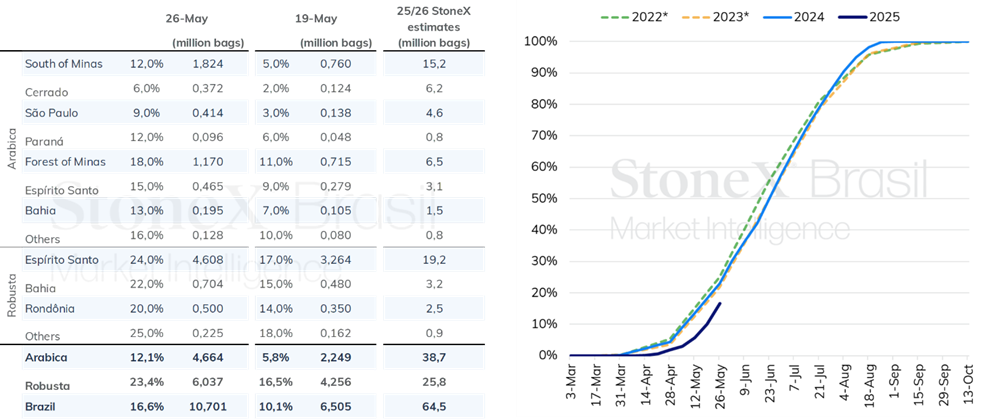
According to StoneX data, as of May 26, the harvest in Brazil had reached 16.6%. Although still below the average of previous years, the accelerated pace over the past two weeks indicates a potential normalization in the coming weeks.
Coffee harvest progress in Brazil
Source: StoneX.
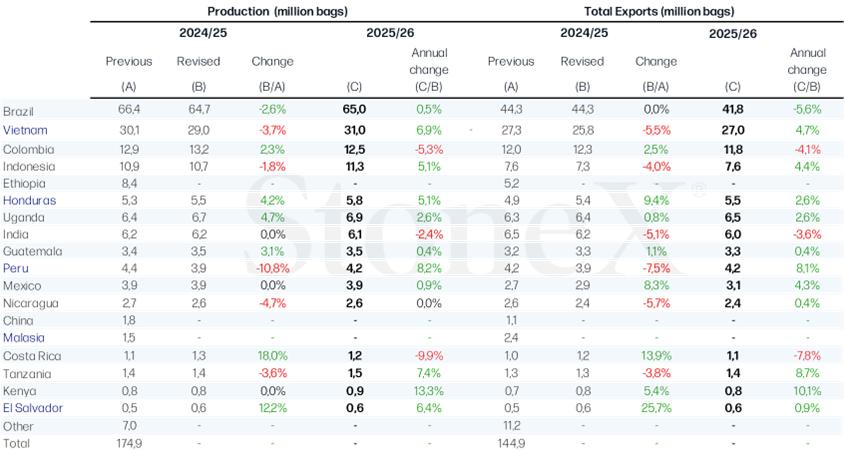
Last week, the U.S. Department of Agriculture (USDA) released its attaché reports for Tanzania, Mexico, and Peru. In Tanzania, production was estimated at 1.5 million bags in 2025/26, an increase of 7.4% over the previous season. Exports are expected to reach 1.4 million bags (+8.7%). For Mexico, USDA estimated production of 3.9 million bags (+0.9%) and exports of 3.1 million (+4.3%) in 2025/26. In Peru, production is expected to reach 4.2 million bags (+8.2%), with exports also at 4.2 million bags (+8.1%).
Based on countries for which USDA has already released data — including Brazil, Vietnam, Colombia, Indonesia, Honduras, Uganda, India, Guatemala, Mexico, Peru, Nicaragua, Costa Rica, Tanzania, Kenya, and El Salvador — combined production is estimated at 153.8 million bags in 2024/25 and 156.7 million in 2025/26, representing a 1.9% increase.
On the other hand, total exports from these countries are expected to fall from 123.7 million bags (2024/25) to 122.9 million (2025/26), a slight drop of 0.7%. It is worth noting that these figures do not include pending countries such as Ethiopia, China, and Malaysia, nor those categorized as “Others” in USDA data. The global supply and demand balance report will be released in June.
Summary of USDA attaché reports released to date
Source: USDA. Prepared by: StoneX.
Weather remains a factor to watch. Meteorological models indicate the arrival of a polar air mass in Brazilian coffee-producing regions in late May and early June, with the potential for sharp temperature drops — especially in the South and high-altitude areas.
Although some model updates have reduced the risk, the possibility of frost cannot be ruled out and should be closely monitored in the coming weeks. We recommend reading the special article published this week: “Analysis of Cold Waves in Brazil and the Relationship with ENSO and the Current Scenario”.
INDICATORS